


As Famine Looms in Gaza, the US Scrambles for Solutions

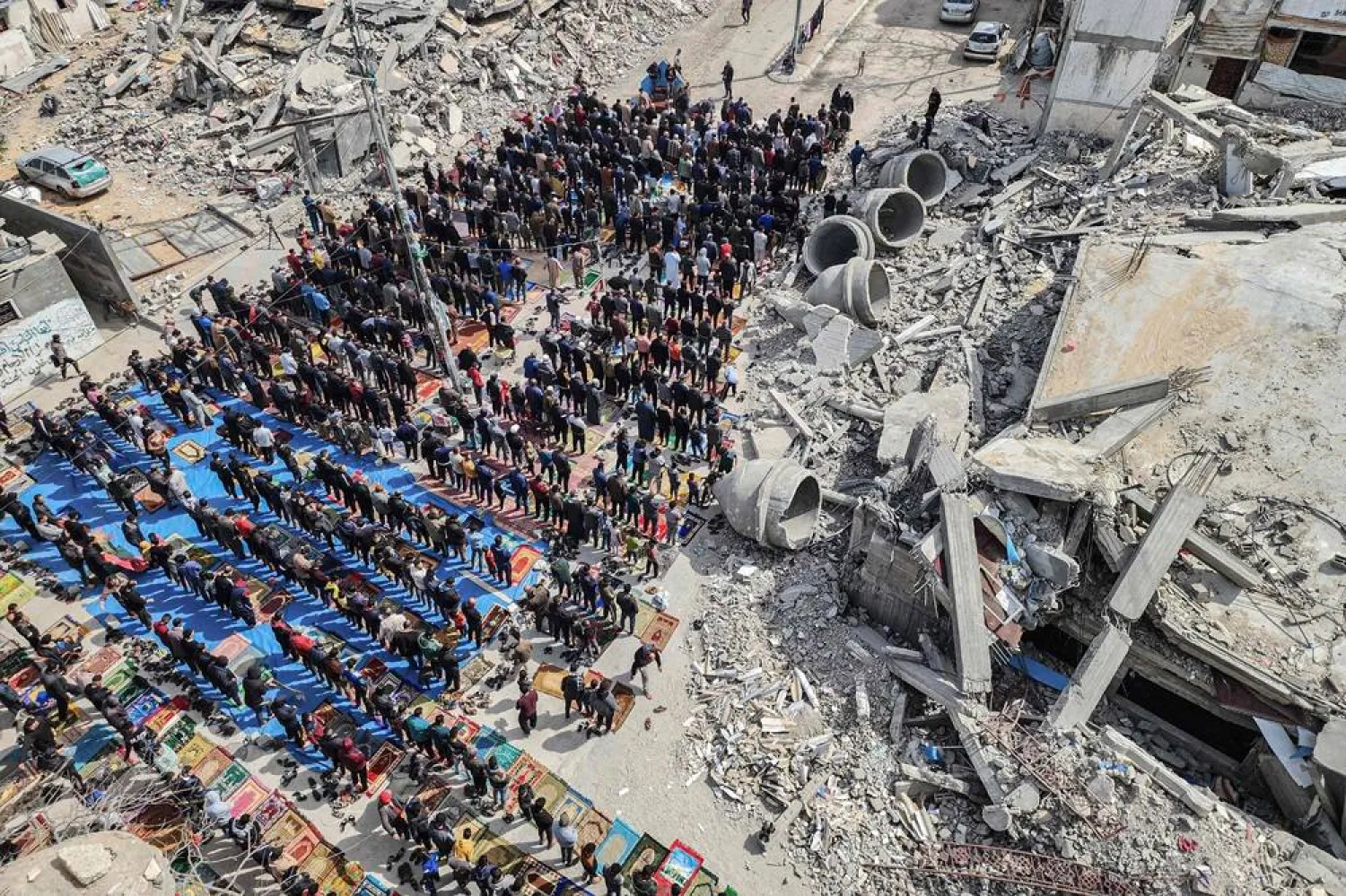
In this aerial view, Palestinians attend the Friday noon prayers in front of the ruins of the al-Faruq mosque, destroyed in Israeli strikes in Rafah in the southern Gaza Strip on March 1, 2024, amid continuing battles between Israel and the Palestinian militant group Hamas. (AFP)
TT

As Famine Looms in Gaza, the US Scrambles for Solutions

In this aerial view, Palestinians attend the Friday noon prayers in front of the ruins of the al-Faruq mosque, destroyed in Israeli strikes in Rafah in the southern Gaza Strip on March 1, 2024, amid continuing battles between Israel and the Palestinian militant group Hamas. (AFP)

From air drops of humanitarian aid to supply ships from Cyprus, the United States is urgently seeking ways to feed the people of Gaza as Israel resists Washington's push for more aid access and US efforts to broker a truce in the war test global patience.

With more than half a million people in the besieged enclave facing a looming famine amid Israel's military offensive, residents are desperate and aid deliveries have become chaotic and deadly.

On Thursday, over 100 Palestinians were killed by Israeli fire while waiting for an aid delivery, Palestinian health officials said. Israel denied it was to blame, saying many victims were run over by aid trucks.

Under pressure at home and from allies abroad to act, the Biden administration is considering expensive proposals more often associated with natural disasters and the Cold War era.

Dropping food and supplies from planes is one option, according to US officials. France has already made several such deliveries to Gaza with Jordan and others in the region.

Another is shipping assistance by sea from Cyprus, some 210 nautical miles off Gaza's Mediterranean coast, said a US official. US officials visited Cyprus this week to examine a possible maritime aid operation, the official said.

The details of such an operation, including where in Gaza supplies could be unloaded, were not clear. The official said the administration is considering using military or commercial ships, and it would be "complex in terms of securing a landing site".

No decision has been made on military involvement in such an operation, said the official, adding the Israelis were "very receptive" to the sealift option because it would avoid delays from protesters blocking land crossings to aid convoys.

The air drop idea has drawn skepticism from some in the humanitarian community.

"It's insane that the entity necessitating this expensive workaround is not ISIS ... or the Soviets ... but a US ally fighting a war with full US backing," said Jeremy Konyndyk, president of Refugees International, referring to Israel.

"Airdrops are massively expensive and low-volume ... The fact that they need be considered is a major policy failure."

Israel says it is committed to improving the humanitarian situation in Gaza, and accuses Hamas militants of endangering Palestinian civilians by using them as human shields.

Asked about the options being considered by the US, a spokesperson for the Israeli embassy in Washington referred to a statement on Thursday in which Israeli military spokesperson Daniel Hagari said Israel was coordinating aid deliveries and wants humanitarian aid to reach the enclave's people.

"We are working around the clock to make this happen," Hagari said in the video statement. "Israel puts no limits on the amount of aid that can go into Gaza."

Unsafe for aid workers

Aid deliveries to Gaza, particularly the north, have been rare and chaotic, as increased lawlessness, looting and the breakdown of the public order following Israel's military offensive that has killed more than 30,000 Palestinians has made it extremely unsafe for aid workers to operate.

The conflict began with a Hamas attack into southern Israel from Gaza on Oct. 7 in which the militants killed 1,200 people and abducted more than 250.

Thursday's incident near Gaza City was the biggest loss of civilian lives in weeks. Hamas said it could jeopardize talks in Qatar aimed at securing a ceasefire and the release of Israeli hostages. Hopes had been growing of a truce before the March 10 start of the Muslim holy fasting month of Ramadan.

The UN and relief agencies have criticized Israel for denying attempts to transfer humanitarian aid to northern parts of Gaza, restricting movement and communications.

The Biden administration says the best solution to the humanitarian crisis would be a temporary ceasefire, but as the negotiations drag on, it too is showing frustration with the government of Prime Minister Benjamin Netanyahu.

At a United Nations Security Council meeting on Tuesday on hunger in Gaza, the United States was blunt about the responsibility of its ally.

"Simply put, Israel must do more," Deputy US Ambassador to the UN Robert Wood told the Security Council.

Who provides security for aid shipments has emerged as a major problem. The UN does not have its own guards and Israeli forces have attacked Palestinian police who escorted aid trucks, accusing some of them of belonging to Hamas.

Without giving details, State Department spokesperson Matthew Miller said US officials were considering a number of aid measures. He also said Washington was talking to Israel to get a border crossing in northern Gaza opened.

Miller said there are "security and technical challenges" with opening more border crossings, but that Israel has been willing to work through them.

He said Washington had previously intervened to convince Israel to open two border crossings in the south of Gaza that it had closed. "It's not something that happened overnight," he said. "It's something we pushed for repeatedly."



Israel Military Says Soldier Killed in Gaza 

A drone view shows the destruction in a residential neighborhood, after the withdrawal of the Israeli forces from the area, amid a ceasefire between Israel and Hamas in Gaza, in Gaza City, October 21, 2025. (Reuters)
TT

Israel Military Says Soldier Killed in Gaza 

A drone view shows the destruction in a residential neighborhood, after the withdrawal of the Israeli forces from the area, amid a ceasefire between Israel and Hamas in Gaza, in Gaza City, October 21, 2025. (Reuters)

The Israeli military announced that one of its soldiers had been killed in combat in southern Gaza on Wednesday, but a security source said the death appeared to have been caused by "friendly fire".

"Staff Sergeant Ofri Yafe, aged 21, from HaYogev, a soldier in the Paratroopers Reconnaissance Unit, fell during combat in the southern Gaza Strip," the military said in a statement.

A security source, however, told AFP that the soldier appeared to have been "killed by friendly fire", without providing further details.

"The incident is still under investigation," the source added.

The death brings to five the number of Israeli soldiers killed in Gaza since a ceasefire took effect on October 10.


Syria: SDF’s Mazloum Abdi Says Implementation of Integration Deal May Take Time

People sit outdoors surrounded by nature, with the Tigris river flowing in the background, following a long atmospheric depression, near the Syrian-Turkish border in Derik, Syria, February 16, 2026 REUTERS/Orhan Qereman
TT

Syria: SDF’s Mazloum Abdi Says Implementation of Integration Deal May Take Time

People sit outdoors surrounded by nature, with the Tigris river flowing in the background, following a long atmospheric depression, near the Syrian-Turkish border in Derik, Syria, February 16, 2026 REUTERS/Orhan Qereman

Mazloum Abdi, commander of the Syrian Democratic Forces, said the process of merging the SDF with Syrian government forces “may take some time,” despite expressing confidence in the eventual success of the agreement.

His remarks came after earlier comments in which he acknowledged differences with Damascus over the concept of “decentralization.”

Speaking at a tribal conference in the northeastern city of Hasakah on Tuesday, Abdi said the issue of integration would not be resolved quickly, but stressed that the agreement remains on track.

He said the deal reached last month stipulates that three Syrian army brigades will be created out of the SDF.

Abdi added that all SDF military units have withdrawn to their barracks in an effort to preserve stability and continue implementing the announced integration agreement with the Syrian state.

He also emphasized the need for armed forces to withdraw from the vicinity of the city of Ayn al-Arab (Kobani), to be replaced by security forces tasked with maintaining order.


Israeli Far-Right Minister to Push for ‘Migration’ of West Bank, Gaza Palestinians 

A Palestinian man checks leather belts as people prepare for Ramadan, in the old city of Hebron in the Israeli-occupied West Bank, February 17,2026. (Reuters)
TT

Israeli Far-Right Minister to Push for ‘Migration’ of West Bank, Gaza Palestinians 

A Palestinian man checks leather belts as people prepare for Ramadan, in the old city of Hebron in the Israeli-occupied West Bank, February 17,2026. (Reuters)

Israel's far-right Finance Minister Bezalel Smotrich said he would pursue a policy of "encouraging the migration" of Palestinians from the occupied West Bank and Gaza Strip, Israeli media reported Wednesday.

"We will eliminate the idea of an Arab terror state," said Smotrich, speaking at an event organized by his Religious Zionism Party late on Tuesday.

"We will finally, formally, and in practical terms nullify the cursed Oslo Accords and embark on a path toward sovereignty, while encouraging emigration from both Gaza and Judea and Samaria.

"There is no other long-term solution," added Smotrich, who himself lives in a settlement in the West Bank.

Since last week, Israel has approved a series of measures backed by far-right ministers to tighten control over the West Bank, including in areas administered by the Palestinian Authority under the Oslo Accords, in place since the 1990s.

The measures include a process to register land in the West Bank as "state property" and facilitate direct purchases of land by Jewish Israelis.

The measures have triggered widespread international outrage.

On Tuesday, the UN missions of 85 countries condemned the measures, which critics say amount to de facto annexation of the Palestinian territory.

"We strongly condemn unilateral Israeli decisions and measures aimed at expanding Israel's unlawful presence in the West Bank," they said in a statement.

"Such decisions are contrary to Israel's obligations under international law and must be immediately reversed.

"We underline in this regard our strong opposition to any form of annexation."

UN Secretary-General Antonio Guterres on Monday called on Israel to reverse its land registration policy, calling it "destabilizing" and "unlawful".

The West Bank would form the largest part of any future Palestinian state. Many on Israel's religious right view it as Israeli land.

Israeli NGOs have also raised the alarm over a settlement plan signed by the government which they say would mark the first expansion of Jerusalem's borders into the occupied West Bank since 1967.

The planned development, announced by Israel's Ministry of Construction and Housing, is formally a westward expansion of the Geva Binyamin, or Adam, settlement situated northeast of Jerusalem in the West Bank.

The current Israeli government has fast-tracked settlement expansion, approving a record 52 settlements in 2025.

Excluding Israeli-annexed east Jerusalem, more than 500,000 Israelis live in West Bank settlements and outposts, which are illegal under international law.