


Gaza Ceasefire Talks Have Ended without a Breakthrough with Ramadan Days Away, Egypt Says

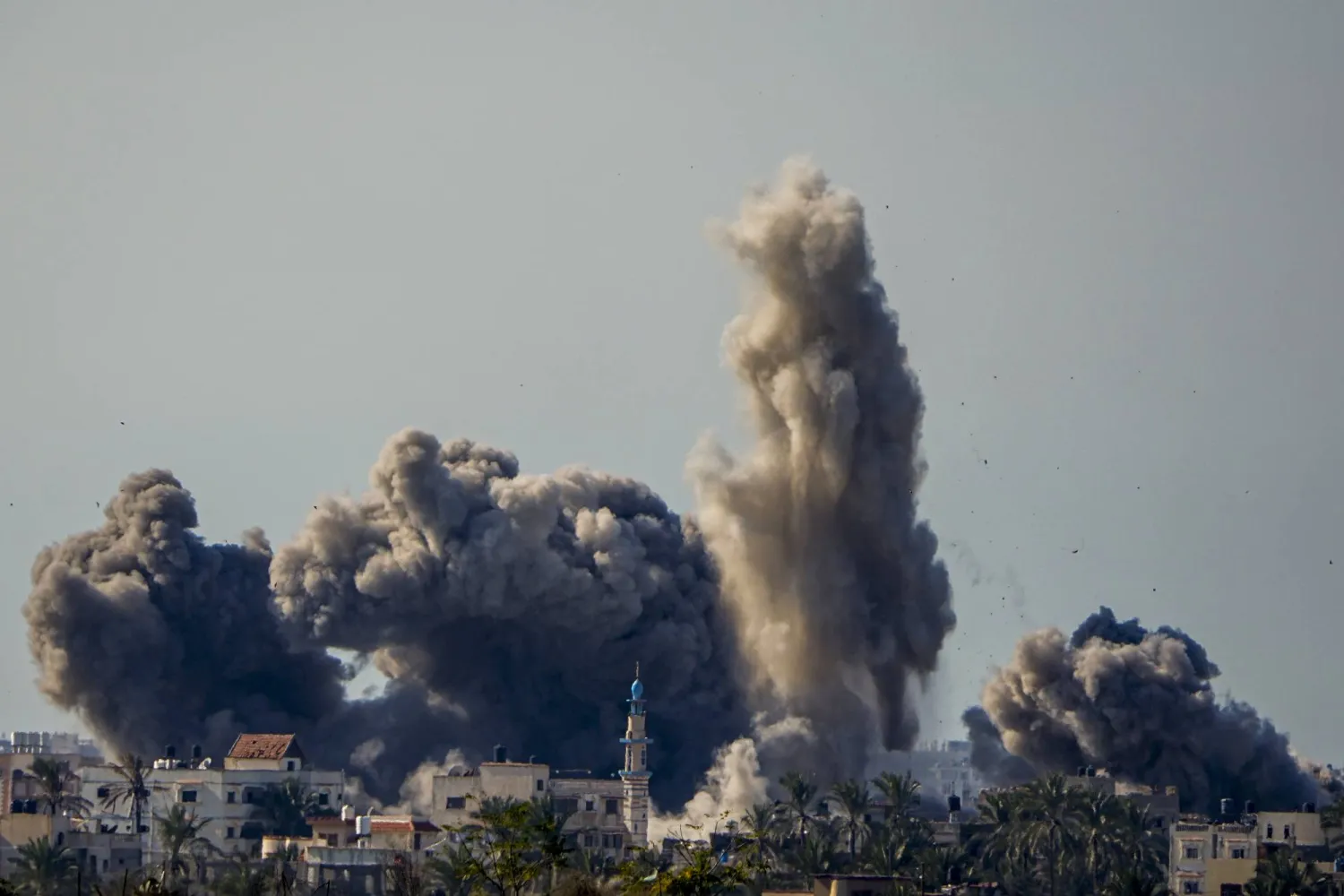
Smoke and explosion following Israeli bombardment inside the Gaza Strip, as seen from southern Israel, Sunday, Feb. 11, 2024. (AP Photo/Ariel Schalit)
TT

Gaza Ceasefire Talks Have Ended without a Breakthrough with Ramadan Days Away, Egypt Says

Smoke and explosion following Israeli bombardment inside the Gaza Strip, as seen from southern Israel, Sunday, Feb. 11, 2024. (AP Photo/Ariel Schalit)

Three days of negotiations with Hamas over a ceasefire in Gaza and the release of Israeli hostages ended Tuesday without a breakthrough, Egyptian officials said, less than a week before the start of the Muslim holy month of Ramadan, the informal deadline for a deal.

The United States, Qatar and Egypt have spent weeks trying to broker an agreement in which Hamas would release up to 40 hostages in return for a six-week ceasefire, the release of some Palestinian prisoners and an influx of aid to address the humanitarian catastrophe in the isolated territory.

Two Egyptian officials said the latest round of discussions had ended. They said Hamas presented a proposal that mediators would discuss with Israel in the coming days.

Hamas has refused to release all of the estimated 100 hostages it holds, and the remains of around 30 more, unless Israel ends its offensive, withdraws from Gaza and releases a large number of Palestinian prisoners, including senior militants serving life sentences.

US officials have said they are skeptical that Hamas actually wants a deal because the group has balked at a number of what the US and others believe are legitimate requests, including giving the names of hostages to be released.

“It is on Hamas to make decisions about whether it is prepared to engage,” US Secretary of State Antony Blinken said Tuesday.

“We have an opportunity for an immediate cease-fire that can bring hostages home, that can dramatically increase the amount of humanitarian aid getting in to Palestinians who so desperately need it, and can set the conditions for an enduring resolution,” Blinken said.

Jihad Taha, a Hamas spokesperson, said the negotiations were ongoing but “the ball is in the Israeli court.” He said Israel had thus far refused Hamas' demands for people who fled northern Gaza to be allowed to return and for guarantees of a long-term cease-fire and full Israeli withdrawal from Gaza.

“Hamas is open to proposals and initiatives that are consistent with its position calling for a ceasefire, withdrawal, the return of the displaced, the entry of relief convoys and reconstruction,” Taha said.

Israeli Prime Minister Benjamin Netanyahu has publicly rejected Hamas' demands and repeatedly vowed to continue the war until Hamas is dismantled and all the hostages are returned. Israel did not send a delegation to the latest round of talks.

An Israeli official said Israel was still waiting for Hamas to hand over a list of hostages who are alive as well the hostage-to-prisoner ratio it seeks in any release deal. It was not clear if that information was included in the latest proposal.

The Israeli and Egyptian officials spoke on condition of anonymity because they were not authorized to brief media on the negotiations.

Benny Gantz, a member of Netanyahu's War Cabinet and his main political rival, met with senior US officials in Washington on a visit that drew a rebuke from the prime minister, the latest sign of a growing rift within Israel's leadership.

Mediators had hoped to broker an agreement ahead of Ramadan, the month of dawn-to-dusk fasting that often sees heightened Israeli-Palestinian tensions linked to access to a major holy site in Jerusalem. The month is expected to begin around March 10, depending on the sighting of the moon.

“The negotiations are sensitive. I can’t say there is optimism or pessimism, but we haven’t yet reached a point at which we can achieve a ceasefire,” Egyptian Foreign Minister Sameh Shoukry said Monday.

The war began with a Hamas attack into southern Israel on Oct. 7 in which Palestinian militants killed some 1,200 people and took around 250 hostages. More than 100 of them were released during a weeklong cease-fire in November.

The attack sparked an Israeli invasion of the enclave of 2.3 million people that Gaza's Health Ministry says has killed more than 30,000 Palestinians. Aid groups say the fighting has displaced most of the territory’s population and pushed a quarter of the population to the brink of famine.

The UN children’s agency said Monday that at least 10 children have reportedly died in isolated northern Gaza because of dehydration and malnutrition.

“There are likely more children fighting for their lives somewhere in one of Gaza’s few remaining hospitals, and likely even more children in the north unable to obtain care at all,” Adele Khodr, the UNICEF regional director for the Middle East and North Africa, said in a statement.

“These tragic and horrific deaths are man-made, predictable and entirely preventable," she added.

The Gaza Health Ministry said Sunday that 15 children have starved to death at the Kamal Adwan Hospital in northern Gaza and another six were at risk of dying from malnutrition and dehydration. It was not clear if the children had underlying medical conditions that increased their vulnerability.

Northern Gaza, the first target of Israel’s offensive, has suffered mass devastation. The World Food Program recently suspended aid shipments to the north, citing the breakdown of security. An attempt by the Israeli military to bring in aid ended in tragedy last week when over 100 Palestinians were fatally shot by Israeli forces or trampled to death in a melee.

Up to 300,000 Palestinians are believed to remain in northern Gaza after Israel ordered the evacuation of the entire region, including Gaza City, in October. Many have been reduced to eating animal fodder to survive. The UN says one in six children under 2 in the north suffer from acute malnutrition.

The United States and other countries have carried out air drops in recent days, but aid groups say the expensive, last-ditch measure is not enough to address the soaring needs.

Israel is still carrying out strikes in all parts of Gaza and has threatened to expand its ground offensive to the southernmost city of Rafah, where around half of Gaza's population has sought refuge. Gantz has said the Rafah operation could begin as soon as Ramadan if there is no deal on the hostages.

Gaza’s Health Ministry said 97 people had been killed over the last 24 hours. bringing the overall Palestinian death toll to 30,631. The ministry does not differentiate between civilians and combatants in its figures, but says women and children make up around two-thirds of the total casualties.

Israel says it tries to avoid harming civilians and blames the high toll on Hamas because the militants operate in dense, residential areas. But the army rarely accounts for individual strikes, which often kill women and children.



Israel Military Says Soldier Killed in Gaza 

A drone view shows the destruction in a residential neighborhood, after the withdrawal of the Israeli forces from the area, amid a ceasefire between Israel and Hamas in Gaza, in Gaza City, October 21, 2025. (Reuters)
TT

Israel Military Says Soldier Killed in Gaza 

A drone view shows the destruction in a residential neighborhood, after the withdrawal of the Israeli forces from the area, amid a ceasefire between Israel and Hamas in Gaza, in Gaza City, October 21, 2025. (Reuters)

The Israeli military announced that one of its soldiers had been killed in combat in southern Gaza on Wednesday, but a security source said the death appeared to have been caused by "friendly fire".

"Staff Sergeant Ofri Yafe, aged 21, from HaYogev, a soldier in the Paratroopers Reconnaissance Unit, fell during combat in the southern Gaza Strip," the military said in a statement.

A security source, however, told AFP that the soldier appeared to have been "killed by friendly fire", without providing further details.

"The incident is still under investigation," the source added.

The death brings to five the number of Israeli soldiers killed in Gaza since a ceasefire took effect on October 10.


Syria: SDF’s Mazloum Abdi Says Implementation of Integration Deal May Take Time

People sit outdoors surrounded by nature, with the Tigris river flowing in the background, following a long atmospheric depression, near the Syrian-Turkish border in Derik, Syria, February 16, 2026 REUTERS/Orhan Qereman
TT

Syria: SDF’s Mazloum Abdi Says Implementation of Integration Deal May Take Time

People sit outdoors surrounded by nature, with the Tigris river flowing in the background, following a long atmospheric depression, near the Syrian-Turkish border in Derik, Syria, February 16, 2026 REUTERS/Orhan Qereman

Mazloum Abdi, commander of the Syrian Democratic Forces, said the process of merging the SDF with Syrian government forces “may take some time,” despite expressing confidence in the eventual success of the agreement.

His remarks came after earlier comments in which he acknowledged differences with Damascus over the concept of “decentralization.”

Speaking at a tribal conference in the northeastern city of Hasakah on Tuesday, Abdi said the issue of integration would not be resolved quickly, but stressed that the agreement remains on track.

He said the deal reached last month stipulates that three Syrian army brigades will be created out of the SDF.

Abdi added that all SDF military units have withdrawn to their barracks in an effort to preserve stability and continue implementing the announced integration agreement with the Syrian state.

He also emphasized the need for armed forces to withdraw from the vicinity of the city of Ayn al-Arab (Kobani), to be replaced by security forces tasked with maintaining order.


Israeli Far-Right Minister to Push for ‘Migration’ of West Bank, Gaza Palestinians 

A Palestinian man checks leather belts as people prepare for Ramadan, in the old city of Hebron in the Israeli-occupied West Bank, February 17,2026. (Reuters)
TT

Israeli Far-Right Minister to Push for ‘Migration’ of West Bank, Gaza Palestinians 

A Palestinian man checks leather belts as people prepare for Ramadan, in the old city of Hebron in the Israeli-occupied West Bank, February 17,2026. (Reuters)

Israel's far-right Finance Minister Bezalel Smotrich said he would pursue a policy of "encouraging the migration" of Palestinians from the occupied West Bank and Gaza Strip, Israeli media reported Wednesday.

"We will eliminate the idea of an Arab terror state," said Smotrich, speaking at an event organized by his Religious Zionism Party late on Tuesday.

"We will finally, formally, and in practical terms nullify the cursed Oslo Accords and embark on a path toward sovereignty, while encouraging emigration from both Gaza and Judea and Samaria.

"There is no other long-term solution," added Smotrich, who himself lives in a settlement in the West Bank.

Since last week, Israel has approved a series of measures backed by far-right ministers to tighten control over the West Bank, including in areas administered by the Palestinian Authority under the Oslo Accords, in place since the 1990s.

The measures include a process to register land in the West Bank as "state property" and facilitate direct purchases of land by Jewish Israelis.

The measures have triggered widespread international outrage.

On Tuesday, the UN missions of 85 countries condemned the measures, which critics say amount to de facto annexation of the Palestinian territory.

"We strongly condemn unilateral Israeli decisions and measures aimed at expanding Israel's unlawful presence in the West Bank," they said in a statement.

"Such decisions are contrary to Israel's obligations under international law and must be immediately reversed.

"We underline in this regard our strong opposition to any form of annexation."

UN Secretary-General Antonio Guterres on Monday called on Israel to reverse its land registration policy, calling it "destabilizing" and "unlawful".

The West Bank would form the largest part of any future Palestinian state. Many on Israel's religious right view it as Israeli land.

Israeli NGOs have also raised the alarm over a settlement plan signed by the government which they say would mark the first expansion of Jerusalem's borders into the occupied West Bank since 1967.

The planned development, announced by Israel's Ministry of Construction and Housing, is formally a westward expansion of the Geva Binyamin, or Adam, settlement situated northeast of Jerusalem in the West Bank.

The current Israeli government has fast-tracked settlement expansion, approving a record 52 settlements in 2025.

Excluding Israeli-annexed east Jerusalem, more than 500,000 Israelis live in West Bank settlements and outposts, which are illegal under international law.