


Deadly Strikes Hit Gaza as Israel Mulls Truce Talks Position

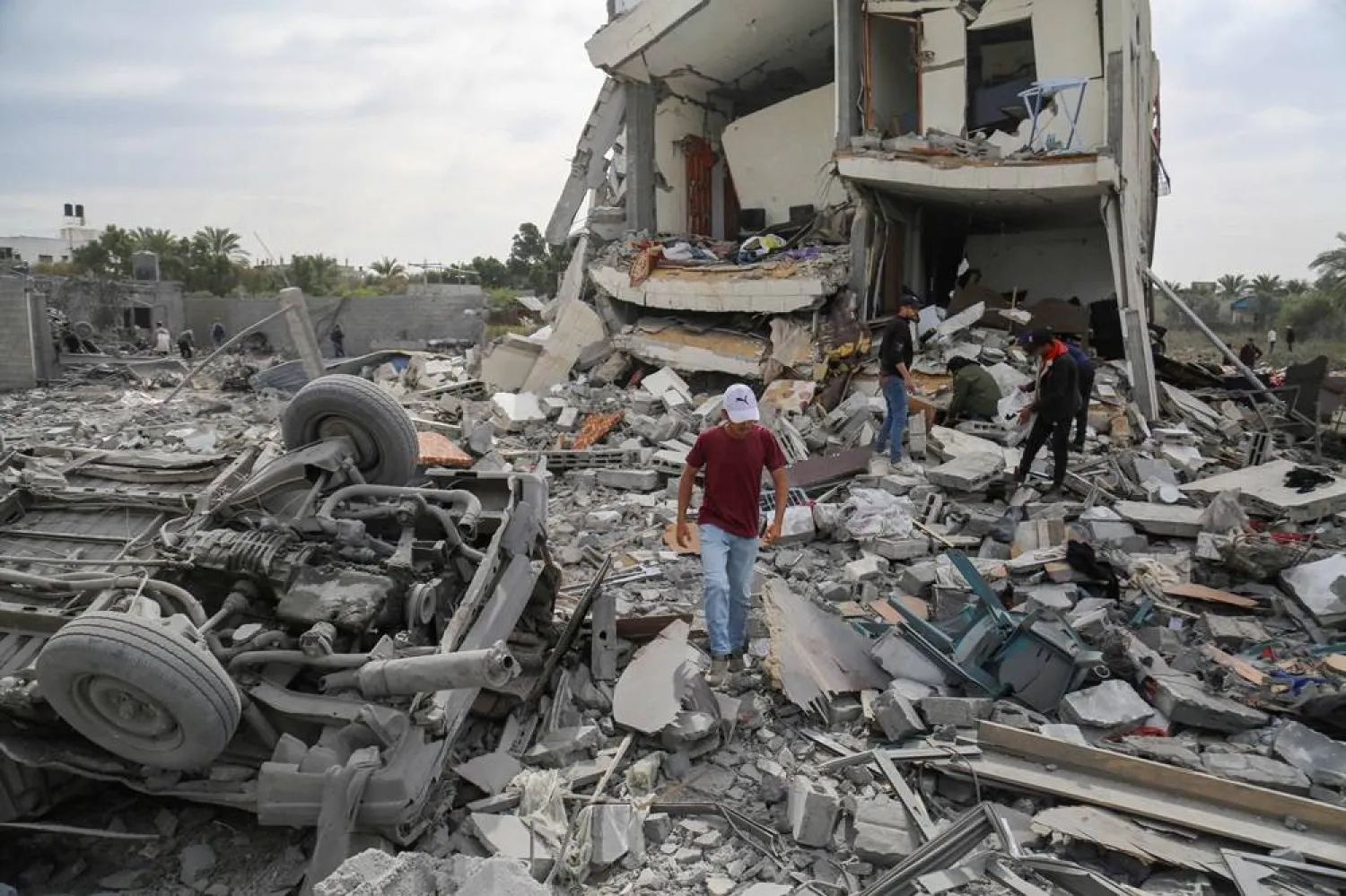
Palestinians search the rubble of the Tabatibi family home following overnight Israeli bombardment west of the Nuseirat refugee camp in the central Gaza Strip on March 16, 2024, amid ongoing battles between Israel and Hamas. (AFP)
TT

Deadly Strikes Hit Gaza as Israel Mulls Truce Talks Position

Palestinians search the rubble of the Tabatibi family home following overnight Israeli bombardment west of the Nuseirat refugee camp in the central Gaza Strip on March 16, 2024, amid ongoing battles between Israel and Hamas. (AFP)

At least 61 Palestinians were killed in overnight Israeli bombardment, the health ministry in Hamas-run Gaza said Sunday, as Israel was preparing to send negotiators to new truce talks in Qatar.

Israel's security cabinet and the smaller war cabinet were to meet to "decide on the mandate of the delegation in charge of the negotiations before its departure for Doha," the prime minister's office said.

Its statement did not specify when the delegation would leave for the latest round of talks which comes after Hamas submitted a new proposal for a pause in fighting and hostage release.

More than five months of war and an Israeli siege have led to dire humanitarian conditions in the Gaza Strip, where the United Nations has repeatedly warned of looming famine for the coastal territory's 2.4 million people.

As the flow of aid trucks into Gaza has slowed, a second ship was due to depart from Cyprus along a new maritime corridor to bring food and relief goods, Cypriot officials said.

On Saturday the US charity World Central Kitchen said its team had finished unloading supplies from a barge towed by Spanish aid vessel Open Arms which had pioneered the sea route.

The United Nations has reported particular difficulty in accessing north Gaza, where residents say they have resorted to eating animal fodder, and where some have stormed the few aid trucks that have made it through.

Shelling and clashes were reported in south Gaza's main city of Khan Younis and elsewhere.

The territory's health ministry said 12 members of the same family, whose house in Deir al-Balah was hit, were among those killed overnight.

Most Gazans displaced by the fighting have sought refuge in Rafah on the Egyptian border, where Israel has threatened to launch a ground offensive, without giving a timeline.

The head of the UN's World Health Organization, Tedros Adhanom Ghebreyesus, appealed to Israel "in the name of humanity" not to launch an assault on Rafah.

'Humanitarian catastrophe'

An evacuation planned by the Israeli army ahead of launching its assault was not a practical solution, Tedros argued, noting that Palestinians there do not "have anywhere safe to move to".

"This humanitarian catastrophe must not be allowed to worsen," he said on social media platform X.

The war was triggered by Hamas's October 7 attack on southern Israel that resulted in about 1,160 deaths, mostly civilians, according to an AFP tally of official figures.

Israel's retaliatory campaign against Hamas has killed at least 31,645 people in Gaza, most of them women and children, according to the health ministry.

Palestinian fighters also seized about 250 Israeli and foreign hostages in the attack. Dozens were released during a week-long truce in November, and Israel believes about 130 remain in Gaza including 32 presumed dead.

Israeli Prime Minister Benjamin Netanyahu has faced domestic pressure to secure the release of the captives, with protesters in Tel Aviv on Saturday carrying banners urging a "hostage deal now".

"The civilians... need to demand from their leaders to do the right thing," said demonstrator Omer Keidar, 27.

The Hamas proposal calls for an Israeli withdrawal from "all cities and populated areas" in Gaza during a six-week truce and more humanitarian aid, according to an official from the Palestinian group.

With the situation on the ground increasingly dire, aid donors have turned to deliveries by air or sea.

Multiple governments have begun daily airdrops of food over Gaza, while the new maritime corridor is to be complemented by a US-military-built temporary pier.

Malnutrition and disease

But air and sea missions are no alternative to land deliveries, UN agencies say. Humanitarian groups have cited Israeli restrictions as among the obstacles they face.

The United States, which provides Israel with billions of dollars in military assistance, has also grown increasingly critical of Netanyahu over his handling of the war.

Washington has said it cannot support Israel's long-threatened operation against Hamas in Rafah without a "credible, achievable, executable plan" to protect Palestinian civilians.

The crisis has only grown worse in Rafah, said medical staff at a clinic run by Palestinian volunteers that offers treatment for displaced Gazans.

"We're facing shortages of medications, especially pediatric medicines," said Dr. Samar Gregea, herself displaced from Gaza City in the north.

"There are a lot of patients in the camp, with all children suffering from malnutrition," she told AFP, also reporting the "widespread presence of hepatitis A".

"Children require foods high in sugars, like dates, which are currently unavailable."


UN Chief Calls for Israel to Re-Open Gaza Crossings amid Fuel Shortage

Palestinians displaced during the two-year Israeli offensive, shelter at a tent camp in Gaza City, March 1, 2026. (Reuters)
TT

UN Chief Calls for Israel to Re-Open Gaza Crossings amid Fuel Shortage

Palestinians displaced during the two-year Israeli offensive, shelter at a tent camp in Gaza City, March 1, 2026. (Reuters)

UN Secretary-General Antonio Guterres called Monday for Israel to re-open border crossings into Gaza to allow aid to flow into the war-ravaged territory, his spokesman said.

"Israeli authorities have closed all crossings, including Rafah, and have suspended humanitarian movements in and near areas where Israeli troops remain deployed in Gaza," said spokesman Stephane Dujarric.

"It is imperative that all crossings be reopened... as soon as possible."

Gaza is rapidly running out of its limited fuel supply and stocks of food staples may become tight, officials say, after Israel blocked the entry of fuel and goods into the war-shattered territory, citing fighting with Iran. 

Israel's military closed all Gaza border crossings on Saturday after announcing air strikes on Iran carried out jointly with the United States. Israeli authorities say the crossings cannot be operated safely during war and have not said how long they would be shut. 

FEW DAYS' ‌WORTH OF SUPPLIES 

Gaza ‌is wholly dependent on fuel brought in ‌by ⁠trucks from Israel and ⁠Egypt and a lack of fresh supplies would put hospital operations at risk and threaten water and sanitation services, local officials say. Most Palestinians in Gaza are internally displaced after Israel's two-year war with Hamas. 

"I expect we have maybe a couple of days' running time," said Karuna Herrmann, the Jerusalem director of United Nations Office ⁠for Project Services (UNOPS), which manages fuel distribution in ‌Gaza. 

Amjad Al-Shawa, a Palestinian aid leader ‌in Gaza, who works with the UN and NGOs, estimated fuel supplies ‌could last three or four days, while stocks of vegetables, flour, ‌and other essentials could also soon run out if the crossings remain shut. 

Reuters was unable to independently verify those estimates. 

Israel's COGAT military agency, which controls access to Gaza, said that enough food had been delivered ‌to the territory since the start of an October truce to provide for the population. 

"(The) existing stock ⁠is expected ⁠to suffice for an extended period," COGAT said, without elaborating. It declined to comment on potential fuel shortages. 

The truce was part of broader US-backed plan to end the war that involves reopening the Rafah border crossing with Egypt, increasing the flow of aid into the enclave, and rebuilding it. 

Hamada Abu Laila, a displaced Palestinian in Gaza, said the closures were stoking fear of a return of famine, which gripped parts of the enclave last year after Israel blocked aid deliveries for 11 weeks. 

"Why is it our fault, in Gaza, with regional wars between Israel, Iran, and America? It is not our fault," Abu Laila said. 


Strikes Hit Beirut's Southern Suburbs after Israeli Warning

Smoke and dust rise amid explosions in Lebanon, as seen from Israel, after Lebanon's Iran-backed Hezbollah and Israel exchanged fire amid the US-Israel conflict with Iran. REUTERS/Shir Torem
TT

Strikes Hit Beirut's Southern Suburbs after Israeli Warning

Smoke and dust rise amid explosions in Lebanon, as seen from Israel, after Lebanon's Iran-backed Hezbollah and Israel exchanged fire amid the US-Israel conflict with Iran. REUTERS/Shir Torem

Several strikes hit Beirut's southern suburbs on Monday after Israeli evacuation warnings, as seen on AFPTV's live broadcast, as Israel attacked the country following Hezbollah's dawn missile launches.

Plumes of smoke were rising from the targeted area as state media reported four Israeli strikes on the suburbs.

Meanwhile, the US Embassy in Lebanon renewed its call for citizens to leave Lebanon immediately.

"We urge US citizens not to travel to Lebanon. If you are in the country, depart Lebanon NOW," the US embassy said on Monday, as Israeli strikes pounded Beirut's southern suburbs, and dozens of villages mainly in south Lebanon.

"The US Embassy strongly encourages US citizens in Southern Lebanon, near the borders with Syria, in refugee settlements, and in the Dahiyeh neighborhood of Beirut to depart those areas immediately," the embassy said.


Families Take Shelter in Schools as Lebanon’s Government Calls Hezbollah’s Strike on Israel Illegal

A displaced family who fled Israeli airstrikes in southern Lebanon sits at a school turned into a shelter, in Beirut, Lebanon, Monday, March 2, 2026. (AP Photo/Bilal Hussein)
TT

Families Take Shelter in Schools as Lebanon’s Government Calls Hezbollah’s Strike on Israel Illegal

A displaced family who fled Israeli airstrikes in southern Lebanon sits at a school turned into a shelter, in Beirut, Lebanon, Monday, March 2, 2026. (AP Photo/Bilal Hussein)

Lebanese civilians fled from the country's south and Beirut’s southern suburbs on Monday, seeking refuge in schools in Lebanon's capital following a new and deadly escalation between Israel and the Iran-allied Lebanese militant group Hezbollah.

Lebanon’s Health Ministry reported at least 31 people were killed and 149 wounded in overnight strikes in the Beirut suburbs and southern Lebanon.

The Lebanese government later Monday slammed Hezbollah's decision to enter Iran's war with Israel and the United States, calling the militant group's actions illegal and demanding it hand over its weapons.

Highways were jammed overnight and into Monday with people fleeing after what was Israel's deadliest barrage on Lebanon in more than a year, striking hours after Hezbollah fired missiles across the border for the first time in more than a year.

Ali Hamdan was stuck in gridlock on the road between his village in southern Lebanon, Deir al-Zahrani, and the port city of Sidon. What should have been a half-hour’s drive had taken seven hours, he said.

“I don’t know how long it will take us to reach Beirut," he said. "I’m headed toward Beirut, but I don’t know where yet. We don’t have a place to stay.”

At a public school in Beirut, hastily converted into a temporary shelter, families arrived carrying mattresses, plastic bags, and bundles of clothing. Other families sat on sidewalks beside their belongings, some men smoking as they waited for space to open inside.

Volunteers moved through the crowd, registering names as families filled classrooms and gathered in the school courtyard.

Hussein Abu Ali, who fled a southern Beirut suburb with his wife and children, described the moment the strikes hit.

“My son began shaking and crying," he said. "Where are you supposed to go? I stepped outside, then back in because I was afraid of shooting in the air. I gathered my children and went down to the street.”

Nadia Al‑Salman, displaced from the southern town of Majdal Zoun, said they left their homes "not out of fear or terror of the United States, but to fulfill our religious and legal duty to protect ourselves.”

During the latest Israel-Hezbollah war in 2024, at one point, more than a million people were displaced in Lebanon. Many have been unable to return to their homes in the south, where villages along the border remain in ruins.

Hezbollah launched rockets into Israel a day after the militant Palestinian group Hamas attacked southern Israel on Oct. 7, 2023, triggering the war in Gaza. After months of low-level fighting, the conflict escalated into a full-scale war in September 2024 before a US brokered ceasefire nominally halted the fighting two months later.

Since that ceasefire, Israel has continued to launch near-daily strikes in Lebanon, saying it aims to stop Hezbollah from rebuilding.

Monday’s escalation also marked the first time in more than a year that Hezbollah has claimed responsibility for firing into Israel. Hezbollah said in a statement that the strikes were carried out in retaliation for the killing of Iran’s Supreme Leader Ali Khamenei, and for “repeated Israeli aggressions,” describing it as “a legitimate defensive response."

But Lebanon’s government said it considers Hezbollah’s military activities illegal and that the group should hand over its weapons. Prime Minister Nawaf Salam said after an emergency Cabinet meeting Monday that only the state should decide on matters of war and peace.

He added that Hezbollah’s military activities were banned going forward and called on security agencies to prevent the firing of missiles or drones from Lebanon and detain those behind the launch. It was the harshest stance the Lebanese government has taken yet toward Hezbollah, which also has a political party with a parliamentary bloc in addition to its armed militants.

Salam also called on the international community to work on getting a “clear and final commitment” from Israel to stop its strikes on Lebanon.

The Israeli military overnight issued a warning for residents of around 50 communities across southern and eastern Lebanon to evacuate. Military spokesman Brig. Gen. Effie Defrin said Israel is keeping “all options on the table,” including a potential ground invasion of Lebanon and threatened that “Hezbollah will pay a very heavy price."

He said Israel has called up more than 100,000 reservists since the war with Iran began on Saturday.

Hezbollah later condemned the government's decision to ban its military activities, while Israel carried out retaliatory strikes in response to rockets fired by the Iran-backed group.

In a statement, Mohammed Raad, the head of the group's parliamentary bloc, condemned Beirut's "swaggering decisions", saying that "the Lebanese were expecting a decision rejecting the (Israeli) aggression".
