


Blinken Urges Israel and Hamas to Move Ahead with a Ceasefire Deal, Says ‘Time Is Now’

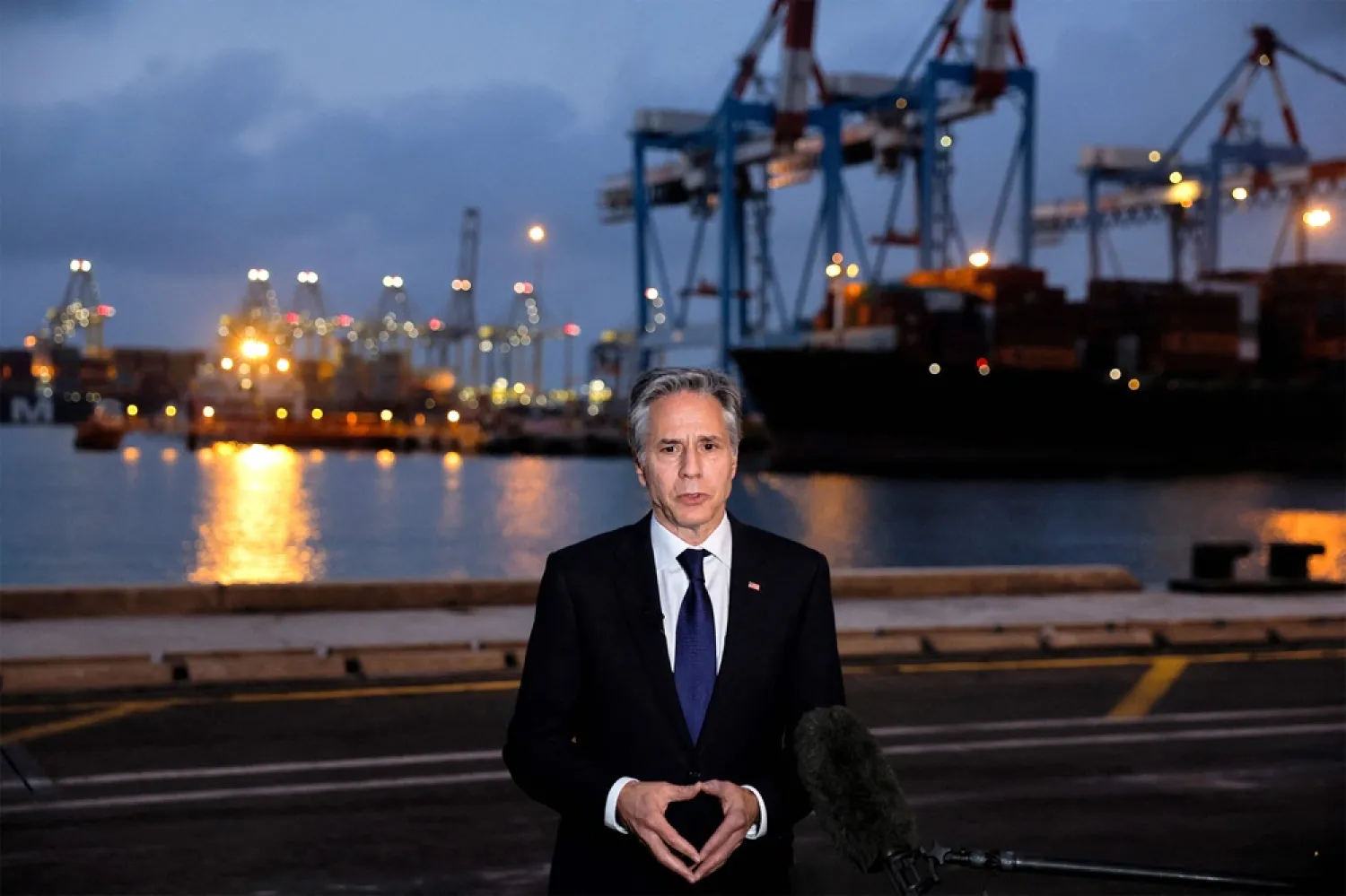
US Secretary of State Antony Blinken speaks to the press at the port of Ashdod in southern Israel on May 1, 2024. (AFP)
TT

Blinken Urges Israel and Hamas to Move Ahead with a Ceasefire Deal, Says ‘Time Is Now’

US Secretary of State Antony Blinken speaks to the press at the port of Ashdod in southern Israel on May 1, 2024. (AFP)

US Secretary of State Antony Blinken met with Israeli leaders Wednesday in his push for a ceasefire deal between Israel and Hamas, saying "the time is now" for an agreement that would free hostages and bring a pause in the nearly seven months of war in Gaza.

Blinken is on his seventh visit to the region since the war erupted in October, aiming to secure what’s been an elusive deal between Israel and Hamas that could avert an Israeli incursion into the southern Gaza town of Rafah, where some 1.4 million Palestinians are sheltering.

The current round of talks appears to be serious, but the sides remain far apart on one key issue — whether the war should end as part of an emerging deal.

Before agreeing to an initial, short-term ceasefire and partial hostage release, Hamas wants assurances that the eventual freeing of all the hostages will bring the end of Israel’s offensive and its full withdrawal from Gaza.  

Israel has offered only a pause after which it would resume its offensives until Hamas is destroyed. Israeli Prime Minister Benjamin Netanyahu repeated his determination to attack Rafah in talks with Blinken on Wednesday.

Blinken put pressure on Hamas, saying it would bear the blame for any failure to get a deal. Hamas said in a statement it would likely reply to the latest proposal on Thursday.

"We are determined to get a ceasefire that brings the hostages home and to get it now, and the only reason that that wouldn’t be achieved is because of Hamas," Blinken told Israel’s ceremonial President Isaac Herzog at a meeting in Tel Aviv.

"There is a proposal on the table, and as we’ve said, no delays, no excuses. The time is now," he said.

Blinken said the deal would also allow much needed food, medicine and water to get into Gaza, where the war has sparked a humanitarian crisis and displaced much of the territory’s population.

Still, Netanyahu's vow to carry out a military operation in Rafah, which Israel says is the last major Hamas stronghold showed the remaining challenges in the talks.

"The operation in Rafah doesn’t depend on anything. The prime minister made this clear to Secretary Blinken," Netanyahu’s office said after the two met Wednesday. A day earlier, Netanyahu pledged to move on Rafah "with or without" a ceasefire deal.

The United States has staunchly supported Israel’s campaign of bombardment and ground offensives in Gaza since Hamas’ unprecedented attack on Oct. 7 into southern Israel. But it has grown increasingly critical of the staggering toll borne by Palestinian civilians and has been outspoken against an assault on Rafah, where more than half of Gaza's population of 2.3 million has packed in and around the town after fleeing fighting elsewhere in the territory.

Washington says it opposes a major offensive but that if Israel conducts one it must first evacuate civilians.

In Rafah, Palestinians terrified of a potential Israeli invasion clung to hope that, after months of reported near-deals, this time a ceasefire would be sealed. Hundreds of thousands are living in vast tent camps filling the once empty areas around Rafah

Salwa Abu Hatab, a woman who fled Khan Younis, said she wants to go home. "Do you think we like life in tents? We are tired and suffering," she said. "Every day they say there is a truce and negotiations, and in the end it fails. We hope they will succeed this time."

"If the invasion happens, we do not know where to go," said Enas Syam, a woman from Gaza City carrying her child in the camp. "There is no safe place left."

In his talks with Netanyahu, Blinken urged him to build on what he said has been the "improvement" in the delivery of aid to Gaza over the past month. Bowing to US pressure to increase aid deliveries, Israel re-opened its Erez crossing into the northern Gaza Strip on Wednesday for the first time since it was damaged in Hamas’ Oct. 7 attack.

Throughout his regional visit, with previous stops in Saudi Arabia and Jordan, Blinken urged Hamas to accept the latest ceasefire proposal, calling it "extraordinarily generous" on Israel’s part.

The proposal — brokered by the US, Egypt and Qatar — would put a full Israeli withdrawal from Gaza up for discussion, according to leaked details confirmed by an Egyptian official and a Hamas official.

The proposal lays out three stages of six to seven weeks each with a detailed timetable of steps. The first phase would bring a pause during which Hamas would release some hostages, particularly civilian women, in exchange for the release of Palestinian prisoners in Israeli jails.

Israeli troops would withdraw from a coastal road in Gaza to facilitate passage of aid and the return of displaced people to the north, then the troops would withdraw from central Gaza. In the meantime, talks would start on restoring "a permanent calm," the Egyptian official said, speaking on condition of anonymity to discuss the internal negotiations.

The next stage would bring implementation of the calm, including Hamas’ release of all remaining hostages – soldiers and civilians – and a withdrawal of Israeli forces out of Gaza.

The last stage would see the release of bodies of dead hostages and the start of a five-year reconstruction plan. The plan says that Hamas would agree not to rebuild its military arsenal. The details were first reported in the Lebanese newspaper Al-Akhbar, which is close to Hamas and the Lebanese Hezbollah armed group.

The Egyptian official said Hamas wanted the language of the second phase to be strengthened to specify a "complete Israeli withdrawal from the entire Gaza Strip" to avoid different interpretations. It also wants clearer terms for the unconditional return of displaced people to the north of Gaza, since the current outline didn’t fully explain who would be allowed back, the official said.

Meanwhile, Israeli airstrikes in Gaza continued. Late Tuesday, a strike hit a house in Rafah — where strikes have been continual despite the masses of Palestinians taking refuge there — killing at least two children, according to hospital authorities. An Associated Press journalist saw the children’s bodies at Abu Yousef al-Najjar hospital as their relatives mourned the deaths.

On Wednesday, Israel’s military said it was operating in central Gaza, where it said jets struck militants, including one said to be setting up explosives.

The Israel-Hamas war was sparked by the unprecedented Oct. 7 raid into southern Israel in which gunmen killed around 1,200 people, mostly civilians, and abducted around 250 hostages. Israel says the fighters are still holding around 100 hostages and the remains of more than 30 others.

The war in Gaza has killed more than 34,000 Palestinians, according to local health officials. The war has driven around 80% of Gaza’s population of 2.3 million from their homes, caused vast destruction in several towns and cities and pushed northern Gaza to the brink of famine.



Israel Says US Gaza Executive Board Composition Against its Policy

FILE - A displacement camp sheltering Palestinians on a beach amid stormy weather is seen in Gaza City, Jan. 13, 2026. (AP Photo/Jehad Alshrafi, File)
TT

Israel Says US Gaza Executive Board Composition Against its Policy

FILE - A displacement camp sheltering Palestinians on a beach amid stormy weather is seen in Gaza City, Jan. 13, 2026. (AP Photo/Jehad Alshrafi, File)

Prime Minister Benjamin Netanyahu's office said on Saturday that this week's Trump administration announcement on the composition of a Gaza executive board was not coordinated with Israel and ran counter to government policy.

It said Foreign Minister Gideon Saar would raise the issue with US Secretary of State Marco Rubio.

The ⁠statement did not specify what part of the board's composition contradicted Israeli policy. An Israeli government spokesperson declined to comment.

The board, unveiled by the White House on Friday, includes Turkish Foreign Minister Hakan Fidan. Israel ⁠has repeatedly opposed any Turkish role in Gaza.

Other members of the executive board include Sigrid Kaag, the UN special coordinator for the Middle East peace process; an Israeli-Cypriot billionaire; and a minister from the United Arab Emirates.

Washington this week also announced the start of the second phase of President ⁠Donald Trump's plan, announced in September, to end the war in Gaza. This includes creating a transitional technocratic Palestinian administration in the enclave.

The first members of the so-called Board of Peace - to be chaired by Trump and tasked with supervising Gaza's temporary governance - were also named. Members include Rubio, billionaire developer Steve Witkoff and Trump's son-in-law Jared Kushner.


Sisi Says he Values Trump Offer to Mediate Egypt-Ethiopia Dispute on GERD

FILE PHOTO: US President Donald Trump points as he attends a meeting with oil industry executives, at the White House in Washington, D.C., US, January 9, 2026. REUTERS/Evelyn Hockstein/File Photo
TT

Sisi Says he Values Trump Offer to Mediate Egypt-Ethiopia Dispute on GERD

FILE PHOTO: US President Donald Trump points as he attends a meeting with oil industry executives, at the White House in Washington, D.C., US, January 9, 2026. REUTERS/Evelyn Hockstein/File Photo

Egyptian President Abdel Fattah al-Sisi said he valued an offer by US President Donald Trump to mediate ⁠a dispute over Nile River waters between Egypt and Ethiopia.

In a post on ⁠X, Sisi said on Saturday that he addressed Trump's letter by affirming Egypt's position and concerns about the country's water ⁠security in regards to Ethiopia's Grand Ethiopian Renaissance Dam (GERD).

"I am ready to restart US mediation between Egypt and Ethiopia to responsibly resolve the question of 'The Nile Water Sharing' once and for all," Trump wrote to Sisi in the letter that was also posted on Trump’s Truth Social account.

Addis Ababa's September 9 inauguration of GERD has been a source of anger ⁠in Cairo, which is downstream on the Nile.

Ethiopia sees the $5 billion dam on a tributary of the Nile as central to its economic ambitions.

Egypt says the dam violates international treaties and could cause both droughts ⁠and flooding.

Sudan, another ​downstream country, has expressed concern about the regulation and safety of ⁠its own water supplies and dams.

Sudan's army leader Abdel Fattah al-Burhan also welcomed Trump's mediation offer on Saturday.


Kurds Say Sharaa's Decree Falls Short, Syrian Government Forces Enter Deir Hafer

Syrian army convoys enter the Deir Hafer area in the eastern Aleppo countryside, Syria, after the Kurdish-led Syrian Democratic Forces (SDF) announced the handover of the area west of the Euphrates to the Syrian government, 17 January 2026. EPA/AHMAD FALLAHA
TT

Kurds Say Sharaa's Decree Falls Short, Syrian Government Forces Enter Deir Hafer

Syrian army convoys enter the Deir Hafer area in the eastern Aleppo countryside, Syria, after the Kurdish-led Syrian Democratic Forces (SDF) announced the handover of the area west of the Euphrates to the Syrian government, 17 January 2026. EPA/AHMAD FALLAHA

Syria's Kurds on Saturday said a presidential decree recognizing the minority's rights and making Kurdish an official language fell short of their expectations as Syrian government forces entered the outskirts of a northern town.

In a statement, the Kurdish administration in Syria's north and northeast said the decree issued by President Ahmed al-Sharaa on Friday was "a first step, however it does not satisfy the aspirations and hopes of the Syrian people".

It added that "rights are not protected by temporary decrees, but... through permanent constitutions that express the will of the people and all components" of society.

Al-Sharaa’s decree affirmed that Syrian citizens of Kurdish origin are an integral and original part of the Syrian people, and that their cultural and linguistic identity is an inseparable component of Syria’s inclusive national identity.

The decree commits the state to protecting cultural and linguistic diversity and guarantees Kurdish citizens the right to preserve their heritage, arts, and mother tongue within the framework of national sovereignty.

It recognizes Kurdish as a national language and allows it to be taught in public and private schools in areas where Kurds make up a significant proportion of the population.

It also grants Syrian nationality to all residents of Kurdish origin living on Syrian territory, including those previously unregistered, while ensuring full equality in rights and duties.

The decree further designates Nowruz, celebrated annually on March 21, as an official public holiday.

Syrian government forces entered the outskirts of the northern town of Deir Hafer Saturday morning after the command of Kurdish-led fighters said it would evacuate the area in an apparent move to avoid conflict.

This came after deadly clashes erupted earlier this month between government troops and the US-backed and Kurdish-led Syrian Democratic Forces in the city of Aleppo, Syria’s largest.

It ended with the evacuation of Kurdish fighters from three neighborhoods taken over by government forces.

An Associated Press reporter saw on Saturday government tanks, armored personnel carriers and other vehicles, including pickup trucks with heavy machine-guns mounted on top of them, rolling toward the town of Deir Hafer from nearby Hamima after bulldozers removed barriers. There was no SDF presence on the edge of the town.

Meanwhile, the Syrian military said Saturday morning its forces were in full control of Deir Hafer, captured the Jarrah airbase east of the town, and were working on removing all mines and explosives. It added that troops would also move toward the nearby town of Maskana.

On Friday night, after government forces started pounding SDF positions in Deir Hafer, the Kurdish-led fighters’ top commander Mazloum Abdi posted on X that his group would withdraw from contested areas in northern Syria. Abdi said SDF fighters would relocate east of the Euphrates River starting 7 a.m. (0400 gmt) Saturday.

The easing of tension came after US military officials visited Deir Hafer on Friday and held talks with SDF officials in the area.

The United States has good relations with both sides and has urged calm.