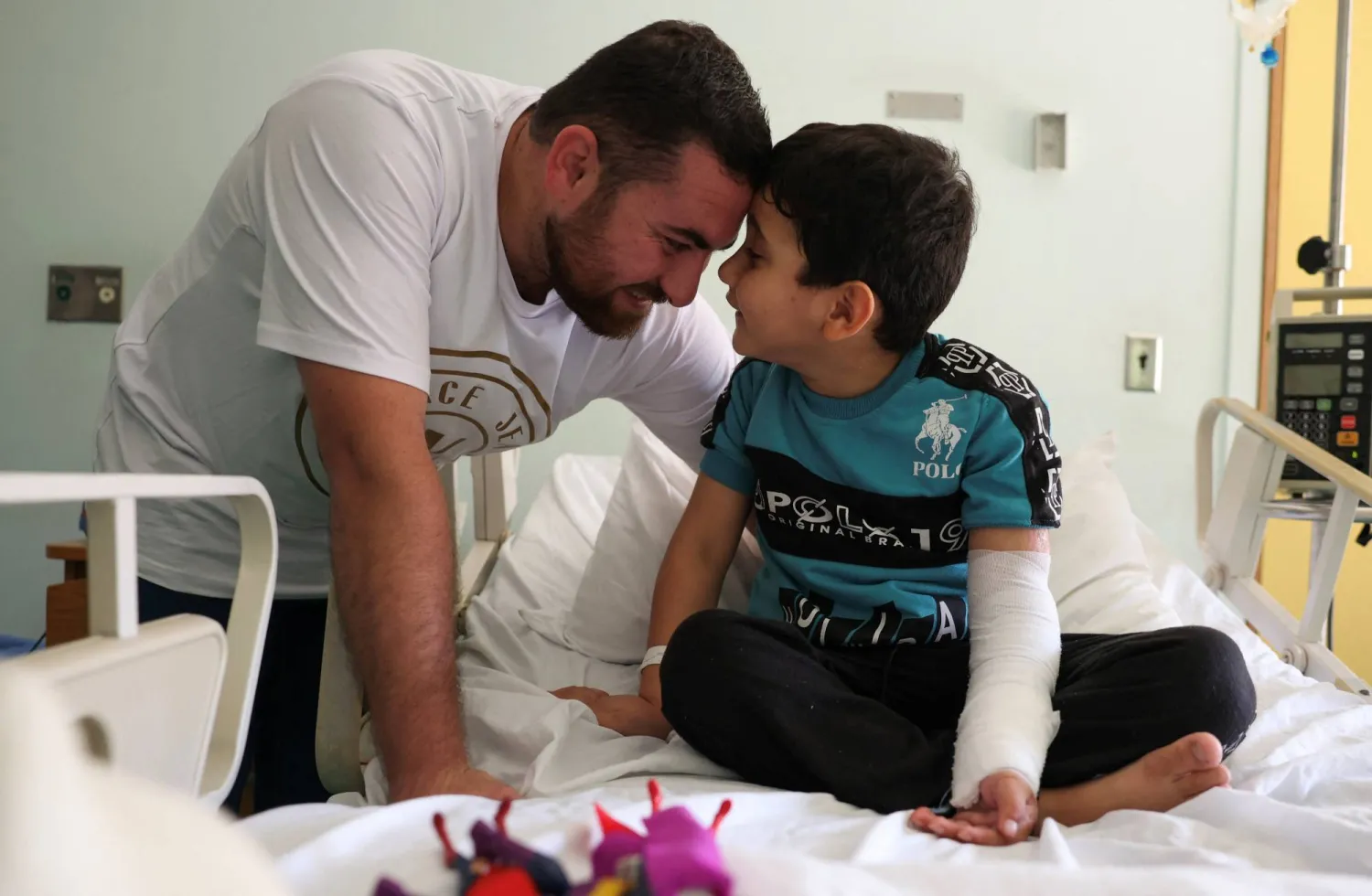
Adam, First Wounded Gazan to Arrive in Lebanon for Treatment

5-year-old Adam Afana, the first Palestinian child wounded in Israel's war on Gaza to land in Lebanon, plays with his uncle Eid Afana, as he sits on a hospital bed at the American University of Beirut's Medical Center in Beirut, Lebanon May 31, 2024. Reuters
TT

Adam, First Wounded Gazan to Arrive in Lebanon for Treatment

5-year-old Adam Afana, the first Palestinian child wounded in Israel's war on Gaza to land in Lebanon, plays with his uncle Eid Afana, as he sits on a hospital bed at the American University of Beirut's Medical Center in Beirut, Lebanon May 31, 2024. Reuters

Five-year-old Adam Afana dreamt of being a police officer "to keep people safe," his uncle said, before losing his father, his siblings and cousins, and nearly all of his left arm in an Israeli strike seven months ago on Gaza.
Now, Adam is the first Palestinian child wounded in Israel's war in Gaza to land in Lebanon, where he has been receiving care since Monday at the American University of Beirut's Medical Center with help from the Ghassan Abu Sittah Children's Fund, Reuters said.
In a sunlit room in the hospital, Adam plays with superhero action figures and watches videos on an iPad. He laughs, pokes fun at his uncle and the nurses, but only has stilted answers when asked about his journey to safety in Beirut.
Getting him to Lebanon was no easy task: Adam spent more than six weeks in Gaza after he was wounded, sheltering from bombing and undergoing one emergency surgery on his arm without anesthesia.
In early December, his uncle managed to enter Gaza City for just two days from Egypt to bring Adam and his mother out via the Rafah crossing, according to Reuters.
They were lucky: Israel's attack this month on Rafah has cut off the main crossing into Egypt, constricting aid and stopping what had been a trickle of people leaving for medical help.
The family spent nearly six months in Egypt, but Adam's arm needed specialized care. Thus began the campaign to get him to Lebanon, a country with a precarious sectarian balance and complex history with Palestinian refugees, with severe restrictions on which can enter.
AUB President Fadlo Khoury told reporters earlier this week the university had “extensive discussions” with Lebanese authorities to allow Adam entry - and that they hoped he would be the first of more Palestinian children to benefit from the hospital's expertise in treating war trauma.
Dania Dandashli from the Ghassan Abu Sittah Children's Fund told Reuters the organization hoped to treat a total of 50 war-wounded Palestinian children in Lebanon over the next year.
Israel's ground and air campaign in Gaza has killed more than 36,000 people, including thousands of children, and wounded more than 81,000, health authorities in Gaza.
The war was triggered by an attack by the Hamas Movement on Israelis that killed 1200, with more than 250 hostages taken, by Israeli tallies.



Syria to Start Currency Swap on January 1st, Central Bank Governor Says

Syrian pounds are pictured inside an exchange currency shop in Azaz, Syria February 3, 2020. Picture taken February 3, 2020. REUTERS/Khalil Ashawi/File Photo
TT

Syria to Start Currency Swap on January 1st, Central Bank Governor Says

Syrian pounds are pictured inside an exchange currency shop in Azaz, Syria February 3, 2020. Picture taken February 3, 2020. REUTERS/Khalil Ashawi/File Photo

Syria will start swapping old banknotes for new ones under a ​plan to replace Assad-era notes starting from January 1, 2026, Central Bank Governor Abdelkader Husrieh said on Thursday.

Husrieh announced the introduction of the new Syrian currency, saying the decree "sets January ‌1, 2026, ‌as the start date ‌for ⁠the ​exchange ‌process". Sources familiar with the matter told Reuters in August that the country will issue new banknotes, removing two zeros from its currency in an attempt to restore ⁠public confidence in the severely devalued pound.

The ‌step is intended ‍to strengthen ‍the Syrian pound after its purchasing ‍power collapsed to record lows following a 14-year conflict that ended with President Bashar al-Assad's ouster in December.

Husrieh ​said the operation will take place through a smooth and orderly ⁠swap - a move bankers hope will ease fears that the new currency could fuel inflation and further erode the purchasing power of Syrians already reeling from high prices.

He added that a press conference will soon outline the exact regulations and mechanisms.


Türkiye Begins Black Box Analysis of Jet Crash That Killed Libyan Military Chief and 7 Others

Libyan national flags fly at half-mast in Tripoli on December 24, 2025, after the head of Libya's armed forces and his four aides died in a plane crash in Türkiye. (AFP)
TT

Türkiye Begins Black Box Analysis of Jet Crash That Killed Libyan Military Chief and 7 Others

Libyan national flags fly at half-mast in Tripoli on December 24, 2025, after the head of Libya's armed forces and his four aides died in a plane crash in Türkiye. (AFP)

The technical analysis of the recovered black boxes from a jet crash that killed eight people, including western Libya’s military chief, began as the investigation proceeded in cooperation with Libyan authorities, the Turkish Ministry of Defense said Thursday.

The private jet with Gen. Muhammad Ali Ahmad al-Haddad, four other military officials and three crew members crashed on Tuesday after taking off from Türkiye’s capital, Ankara, killing everyone on board. Libyan officials said the cause of the crash was a technical malfunction on the plane.

The high-level Libyan delegation was on its way back to Tripoli after holding defense talks in Ankara aimed at boosting military cooperation between the two countries.

The wreckage was scattered across an area covering 3 square kilometers (more than a square mile), complicating recovery efforts, according to the Turkish Interior Minister Ali Yerlikaya.

A 22-person delegation, including five family members, arrived from Libya early on Wednesday to assist in the investigation.


Lebanese President: We are Determined to Hold Parliamentary Elections on Time

President Joseph Aoun between Prime Minister Nawaf Salam and Speaker Nabih Berri (Lebanese Presidency file photo)
TT

Lebanese President: We are Determined to Hold Parliamentary Elections on Time

President Joseph Aoun between Prime Minister Nawaf Salam and Speaker Nabih Berri (Lebanese Presidency file photo)

Lebanese President Joseph Aoun reiterated on Thursday that the country’s parliamentary elections are a constitutional obligation that must be carried out on time.

Lebanon’s state-run National News Agency quoted Aoun as saying that he, alongside Prime Minister Nawaf Salam and Parliament Speaker Nabih Berri, is determined to hold the elections on schedule.

Aoun also emphasized that diplomatic efforts have continued unabated to keep the specter of war at bay, noting that "things are heading in a positive direction".

The agency also cited Berri reaffirming that the elections will take place as planned, with "no delays, no extensions".

The Lebanese parliamentary elections are scheduled for May next year.