


Israel Keeps Pounding Central Gaza as Palestinian Death Toll in Hostage Rescue Raid Rises to 274

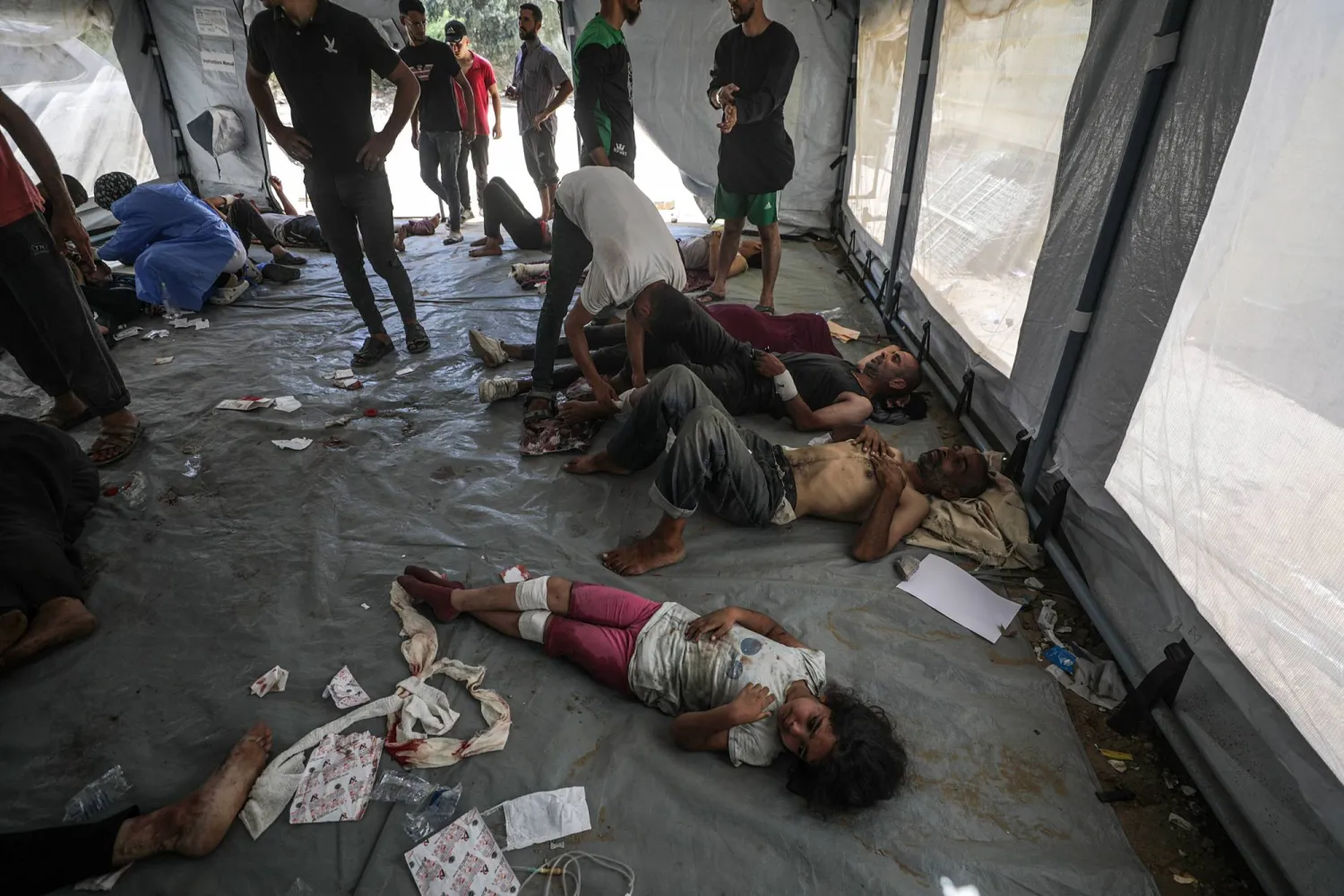
Injured Palestinians at Al Awda hospital during an Israeli military operation in Al Nusairat refugee camp in the central Gaza Strip 08 June 2024. EPA/MOHAMMED SABER
TT

Israel Keeps Pounding Central Gaza as Palestinian Death Toll in Hostage Rescue Raid Rises to 274

Injured Palestinians at Al Awda hospital during an Israeli military operation in Al Nusairat refugee camp in the central Gaza Strip 08 June 2024. EPA/MOHAMMED SABER

Israeli forces pounded central Gaza anew on Sunday, a day after killing 274 Palestinians during a hostage rescue raid, and tanks advanced further into Rafah in an apparent bid to seal off part of the southern city, residents and Hamas media said.

Palestinians remained in shock over Saturday's death toll, the worst over a 24-hour period of the Gaza war for months and including many women and children, Palestinian medics said.

In an update on Sunday, Gaza's health ministry said 274 Palestinians were killed - up from 210 it reported on Saturday - and 698 were injured when Israeli special force commandos stormed into the densely populated Al-Nuseirat camp to rescue four hostages held since October by Hamas militants.

Sixty-four of the dead were children and 57 were women, the Hamas-run Gaza government media office said on Sunday.

Israel's military said a special forces officer was killed in exchanges of fire with militants emerging from cover in residential blocks, and that it knew of "under 100" Palestinians killed, though not how many of them were fighters or civilians.

Hamas' armed wing said on Sunday three Israeli hostages, including one with US citizenship, were killed during the raid, but provided no names. It released a video of what appeared to be corpses with censor bars obscuring their faces.

A Hamas assertion on Saturday that some hostages had died was rejected as "a blatant lie" by the Israeli military.

Gaza's health ministry said another 798 Palestinians were injured in the Israeli raid, and one of them, 4-year-old Tawfiq Abu Youssef, was in critical condition when visited in hospital on Sunday by his father Raed.

The boy was first thought to have died before he moved his hand slightly while in the arms of a relative rushing him to hospital - captured in a video that went viral on social media.

"I had already dug his grave," his father told Reuters, adding that most members of his extended family were among those killed in the raid.

MORE AIRSTRIKES IN CENTRAL GAZA

In central Gaza on Sunday, Israeli airstrikes on houses in the city of Deir Al-Balah and in the nearby Al-Bureij refugee camp killed three Palestinians in each location, while tanks shelled parts of Al-Nuseirat and Al-Maghazi camps, medics said.

The Israeli military said in a statement its forces were continuing operations east of Al-Bureij and Deir al-Balah, killing a number of Palestinian gunmen and destroying militant infrastructure.

Israel sent forces into Rafah in May in what it called a mission to wipe out Hamas' last intact combat units after eight months of war, in which Israeli forces have bombed much of the rest of Gaza to rubble while advancing against fierce resistance from militants embedded in crowded cities and built-up camps.

Israeli tank forces have since seized Gaza's entire border strip with Egypt running through Rafah to the Mediterranean coast and invaded many districts of the city of 280,000 residents, prompting around one million displaced people who had been sheltering in Rafah to flee elsewhere.

ISRAELI TANKS ADVANCE FURTHER IN RAFAH

On Sunday, tanks advanced into two new districts in an apparent effort to complete the encirclement of the entire eastern side of Rafah, touching off clashes with dug-in Hamas-led armed groups, according to residents trapped in their homes.

Palestinian medics said an Israeli airstrike on a house in Tel Al-Sultan in western Rafah killed two people.

The Israeli military said troops of its 162nd division were raiding some districts of Rafah where they had located "numerous additional terror tunnel shafts, mortars, and (other) weapons" belonging to Palestinian Islamist militants.

Hamas precipitated the war with a lightning cross-border attack into Israel last Oct. 7, killing around 1,200 people and seizing over 250 hostages, according to Israeli tallies. About half the hostages were freed during a brief November truce.

Israel's ensuing air and ground war in Gaza has killed at least 37,084 Palestinians, the health ministry in the Hamas-run territory said in its Sunday update. The ministry says thousands more dead are feared buried under the rubble.

Attempts by the United States and regional countries to broker a deal that would release all remaining hostages in return for a ceasefire have repeatedly stumbled on Israeli and Hamas intransigence over terms for an end to the war.

A humanitarian catastrophe has unfolded as the war has dragged on, with over three-quarters of Gaza's 2.3 million population displaced, malnutrition widespread and basic infrastructure in ruins.

Gaza's conflict has destabilized the wider Middle East, drawing in Hamas' main supporter Iran and its Lebanese ally Hezbollah, which has been clashing with Israel along its northern border for months, raising fears of all-out war.

Concern about an escalation in Israeli-Hezbollah hostilities and a sharp decline in expectations of a Gaza ceasefire have weakened Israel's shekel currency by 3% to 3.75 to the dollar since June 4. 


Israeli Strikes in South Lebanon Kill Two

Smoke rises from the site of an Israeli airstrike that targeted the village of Sohmor, in southern Lebanon on January 15, 2026. (Photo by Rabih DAHER / AFP)
TT

Israeli Strikes in South Lebanon Kill Two

Smoke rises from the site of an Israeli airstrike that targeted the village of Sohmor, in southern Lebanon on January 15, 2026. (Photo by Rabih DAHER / AFP)

An Israeli strike on south Lebanon killed one person on Friday, the health ministry in Beirut said a day after raids that Israel said had targeted Hezbollah.

Israel has kept up regular strikes in Lebanon despite a November 2024 ceasefire that sought to end more than a year of hostilities with Hezbollah, usually saying it is targeting members of the group or its infrastructure.

In a statement, the health ministry said an "Israeli enemy strike" on a vehicle in Mansuri in south Lebanon killed one person.

According to AFP, it also said that a strike on Mayfadun in south Lebanon the previous night killed one person.

Israel said Thursday's attack killed a Hezbollah member it alleged "took part in attempts to reestablish Hezbollah's infrastructure in the Zawtar al-Sharqiyah area.”

The attacks come a week after Lebanon's military said it had completed disarming Hezbollah south of the Litani River, the first phase of a nationwide plan, although Israel has called those efforts insufficient.

On Thursday, Israel carried out several strikes against eastern Lebanon's Bekaa region, north of the Litani, after issuing warnings to evacuate.

United Nations peacekeepers, deployed in the south to separate Lebanon from Israel, said on Friday that an Israeli drone "dropped a grenade" on its troops.

On Monday, the peacekeeping force said an Israeli tank fired near its troops, and warned that such incidents were becoming "disturbingly common".


Syria's Leader Sharaa in Berlin on Tuesday, Says German Presidency

Syria's President Ahmed al-Sharaa.
TT

Syria's Leader Sharaa in Berlin on Tuesday, Says German Presidency

Syria's President Ahmed al-Sharaa.

Syria's President Ahmed al-Sharaa will be visiting Berlin next Tuesday and meet his German counterpart Frank-Walter Steinmeier, the German presidency said.

The office of Chancellor Friedrich Merz has yet to announce whether they would also hold talks during the visit, which comes at a time when the German government is seeking to step up repatriations of Syrians to their homeland.


US Envoy Opens File on Funds Smuggled from Iraq

Iraqis burn pictures of US President Donald Trump and Israeli Prime Minister Benjamin Netanyahu outside the Iranian consulate in Basra, January 13, 2026 (Reuters). 
TT

US Envoy Opens File on Funds Smuggled from Iraq

Iraqis burn pictures of US President Donald Trump and Israeli Prime Minister Benjamin Netanyahu outside the Iranian consulate in Basra, January 13, 2026 (Reuters). 

Iraqi politicians and observers warn of the potential fallout from a comprehensive review of suspicious financial transactions in Iraq as promised by US envoy Mark Savaya.

Meanwhile, a surprise decision by Iraqi Prime Minister Mohammed Shia al-Sudani, the leading vote-getter in the elections, to relinquish his right to form a government in favor of runner-up Nouri al-Maliki continues to cast a shadow over the leadership of the Coordination Framework, the umbrella alliance of Shiite political forces.

Savaya, who was praised on Wednesday by US President Donald Trump for having done “a great job in Iraq,” announced on Thursday the launch of a comprehensive review of suspicious payments and financial transactions in Iraq.

The review will be conducted in cooperation with the US Treasury Department and the Office of Foreign Assets Control, alongside discussions on potential sanctions targeting networks that undermine financial integrity and finance terrorist activities.

Savaya has not yet made an official visit to Baghdad since assuming his role as presidential envoy to Iraq, although he previously visited the country in a personal capacity. He is of Christian Iraqi origin, and his family left Iraq in the 1990s.

In a statement, Savaya said he was meeting with the US Treasury Department and OFAC to discuss key challenges and reform opportunities in Iraq’s state-owned and private banks, with a particular focus on strengthening financial governance, compliance, and institutional accountability.

According to the statement, both sides agreed to conduct a comprehensive review of records related to suspicious payments and financial transactions involving Iraqi institutions, companies, and individuals linked to smuggling operations, money laundering, and fraudulent contracts and financial projects that fund and enable terrorist activities.

Discussions also included next steps regarding potential sanctions against entities and networks that undermine financial integrity and state authority.

Savaya said relations between Iraq and the United States have never been stronger than they are today under Trump’s leadership.

Iraqi politician and former electricity minister Luay al-Khatteeb told Asharq Al-Awsat that Savaya’s message aligns with statements made by the US chargé d’affaires during his shuttle meetings with political bloc leaders regarding Washington’s official stance should a parliamentary majority vote in favor of undesirable figures.

Al-Khatteeb said the Coordination Framework must act with intelligence, seriousness, and realism by selecting credible figures who exceed US administration expectations and command international respect.

He warned that Iraq’s political scene is deeply unsettled and that the economy is in its worst condition, heading toward collapse if Shiite leaders continue clinging to failed policies and appointing ineffective and internationally unacceptable figures.

“The choices of the Coordination Framework,” he said, “will be the official response and message to the international community - and especially to the US administration - either yielding rewards or exacting a heavy price.”
