Israel's Pledge to Guard an Aid Route into Gaza Falls Flat as Lawlessness Blocks Distribution

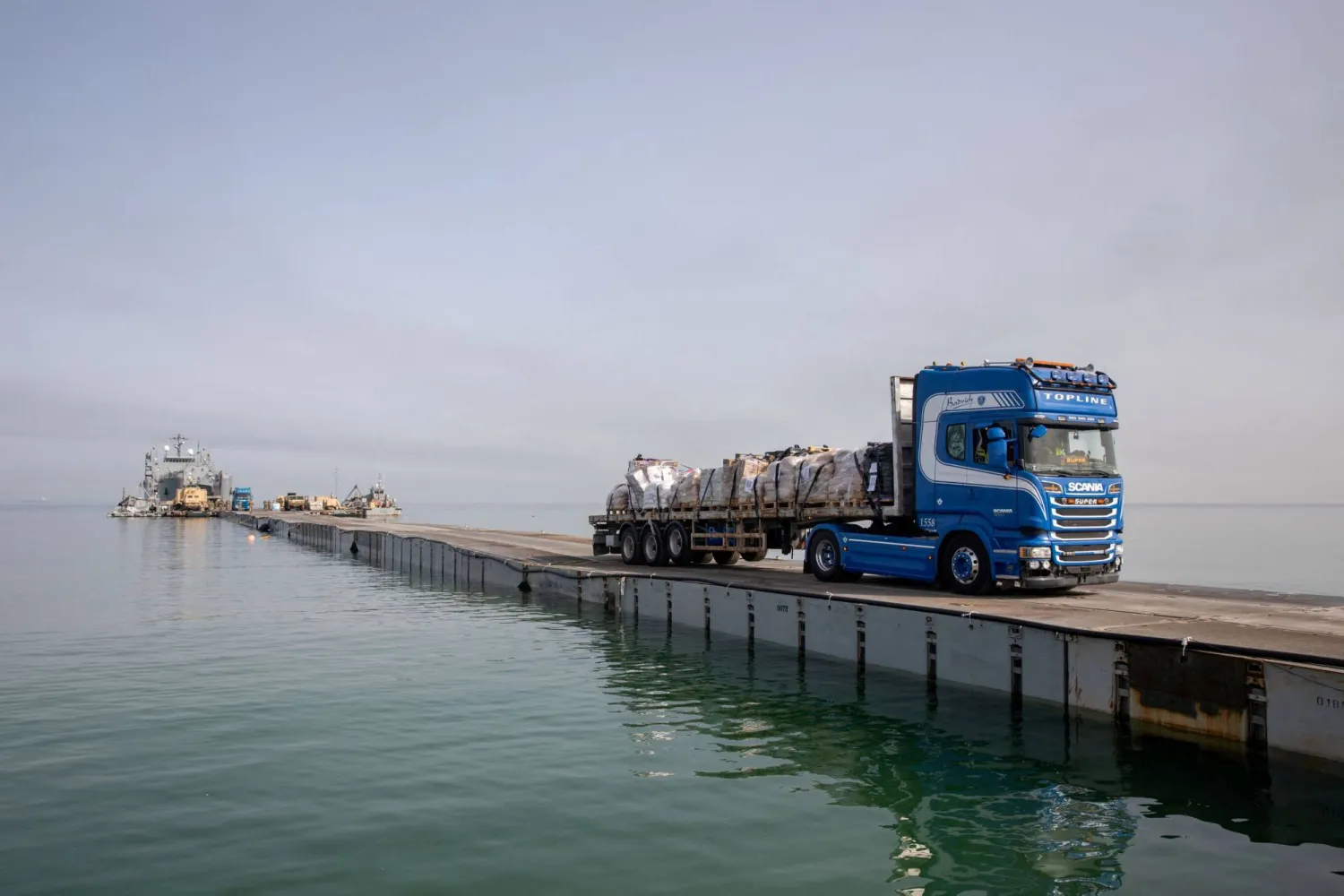
A truck carries humanitarian aid across Trident Pier, a temporary pier to deliver aid, off the Gaza Strip, amid the ongoing conflict between Israel and the Palestinian group Hamas, near the Gaza coast, May 19, 2024. US Army Central/Handout via REUTERS
TT

Israel's Pledge to Guard an Aid Route into Gaza Falls Flat as Lawlessness Blocks Distribution

A truck carries humanitarian aid across Trident Pier, a temporary pier to deliver aid, off the Gaza Strip, amid the ongoing conflict between Israel and the Palestinian group Hamas, near the Gaza coast, May 19, 2024. US Army Central/Handout via REUTERS

The Israeli military said Sunday that it was establishing a new safe corridor to deliver aid into southern Gaza. But days later, this self-declared “tactical pause” has brought little relief to desperate Palestinians.
The United Nations and international aid organizations say a breakdown in law and order has made the aid route unusable, The Associated Press reported.
With thousands of truckloads of aid piled up, groups of armed men are regularly blocking convoys, holding drivers at gunpoint and rifling through their cargo, according to a UN official who spoke on condition of anonymity because he was not authorized to brief the media on the issue.
The lawlessness is a major obstacle to aid distribution to southern and central Gaza — where an estimated 1.3 million Palestinians displaced from Rafah, or more than half of Gaza’s entire population, are now sheltering in tent camps and cramped apartments without adequate food, water, or medical supplies.
Here is a closer look at the security challenges facing the UN and aid organizations.
Israel's ‘tactical pause’ stymied Israel said Sunday it would observe daily pauses in combat along a route stretching from Kerem Shalom — the strip’s only operational aid crossing in the south — to the nearby city of Khan Younis. Before the pause, aid organizations had reported that the need to coordinate trucks’ movement with the Israelis in an active combat zone was slowing aid distribution.
The head of the UN’s World Food Program said Thursday that the pause has made “no difference at all” in aid distribution efforts. “We haven’t been able to get in,” said Cindy McCain in an interview with Al-Monitor. “We’ve had to reroute some of our trucks. They’ve been looted. As you know, we’ve been shot at and we’ve been rocketed.”
The UN official familiar with the aid effort said that there has been no sign of Israeli activity along the route. The UN tried to send a convoy of 60 trucks down the road Tuesday to pick up aid at Kerem Shalom. But 35 of the trucks were intercepted by armed men, the official said.
In recent days, the groups have moved closer to the crossing and set up roadblocks to halt trucks loaded with supplies, the UN official said. They have searched the pallets for smuggled cigarettes, a rare luxury in a territory where a single smoke can go for $25.
The surge in lawlessness is a result of growing desperation in Gaza and the power vacuum left by Hamas’s waning power over the territory, said Mkhaimar Abusada, an associate professor of political science at Al-Azhar University in Gaza who is now in Cairo.
With the enclave's police force targeted by Israel, he said, crime has reemerged as an untreated issue in Gaza.
“After Hamas came to power, one of the things that they brought under their control was the lawlessness of the so-called big clans,” said Abusada. “Now, that’s left for the Palestinians on their own to deal with it. So once again, we are seeing shootings between families, there are thefts, all the bad things are happening.”
UNRWA, the UN agency for Palestinian refugees, used to deploy local Palestinian police to escort aid convoys, but many refused to continue serving after airstrikes killed at least eight police officers in Rafah, the agency said.
Israel says the police are legitimate targets because they are controlled by Hamas.
Is any aid still getting into Gaza? The situation has largely paralyzed aid distribution to the south — particularly since Gaza’s nearby Rafah crossing was closed when Israel invaded the city early last month.
The UN official said that 25 trucks of flour used the route Tuesday. Some private commercial trucks also got through — many of which used armed security to deter groups seeking to seize their cargo. An AP reporter stationed along the road Monday saw at least eight trucks pass by, armed security guards riding on top.
Before Israel’s offensive into the city of Rafah, hundreds of fuel trucks routinely entered the area.
The UN has now begun rerouting some fuel trucks through northern Gaza. Farhan Haq, a UN spokesman, said five fuel trucks entered Gaza Wednesday. The UN humanitarian office reported that these were the first fuel deliveries since early June and supplies remain scarce.
Aid groups say only a ceasefire and a reopening of the Rafah crossing could significantly increase aid flow to the area.
The military body in charge of coordinating humanitarian aid efforts, COGAT, did not respond to multiple requests for comment.
Security concerns also afflict aid from the US pier project. The US installed a pier off Gaza’s coast last month, aiming to provide an additional route for aid to enter Gaza. But the ambitious project has suffered repeated logistical and security setbacks.
Cyprus and US officials said the pier was up and running again Thursday after being detached for a second time last week because of rough seas. COGAT said Thursday there were “hundreds of aid pallets awaiting collection and distribution by the UN aid agencies.”
But there, too, security concerns are hindering distribution of aid.
The UN suspended its cooperation with the pier on June 9 – a day after rumors swirled that the Israeli military had used the area in a hostage rescue operation that left over 270 Palestinians dead. Photos of the operation showed an Israeli military helicopter in what appeared to be the vicinity of the pier.
Both Israel and the US deny the pier was used in the operation. But the perception that the pier was used for military purposes could endanger humanitarian workers, and threaten humanitarian groups’ principles of neutrality, the UN says.
Aid workers said they are working with the Israelis to find a solution, but that the security burden falls squarely on Israel’s shoulders.
Officials from the UN and other humanitarian organizations, including Samantha Power, head of the US Agency for International Development, met with Israel’s military chief and COGAT officials this week to seek solutions.
USAID said afterward that the meeting ended with promises of specific actions, but gave no details.



Germany Moves Troops Out of Iraq, Citing Mideast 'Tensions'

FILE PHOTO: German Defense Minister Ursula von der Leyen visits the Transport Helicopter Regiment 30 (Transporthubschrauberregiment 30) at the Hermann-Koehl-Kaserne in Niederstetten, Germany, August 20, 2018. REUTERS/Ralph Orlowski
TT

Germany Moves Troops Out of Iraq, Citing Mideast 'Tensions'

FILE PHOTO: German Defense Minister Ursula von der Leyen visits the Transport Helicopter Regiment 30 (Transporthubschrauberregiment 30) at the Hermann-Koehl-Kaserne in Niederstetten, Germany, August 20, 2018. REUTERS/Ralph Orlowski

Germany's military has "temporarily" moved some troops out of Erbil in northern Iraq because of "escalating tensions in the Middle East," a German defense ministry spokesman told AFP on Thursday.

Dozens of German soldiers had been relocated away from the base in Erbil, capital of Iraq's autonomous Kurdistan region.

"Only the personnel necessary to maintain the operational capability of the camp in Erbil remain on site," the spokesman said.

The spokesman did not specify the source of the tensions, but US President Donald Trump has ordered a major build-up of US warships, aircraft and other weaponry in the region and threatened action against Iran.

German troops are deployed to Erbil as part of an international mission to train local Iraqi forces.

The spokesman said the German redeployment away from Erbil was "closely coordinated with our multinational partners".


UN: At Least 15 Children Killed in Sudan Drone Strike

The war in Sudan, ongoing since mid-April 2023, has caused extensive destruction across the country (AFP)
TT

UN: At Least 15 Children Killed in Sudan Drone Strike

The war in Sudan, ongoing since mid-April 2023, has caused extensive destruction across the country (AFP)

A drone strike on a displacement camp in Sudan killed at least 15 children earlier this week, the United Nations reported late on Wednesday.

"On Monday 16 February, at least 15 children were reportedly killed and 10 wounded after a drone strike on a displacement camp in Al Sunut, West Kordofan," the UN children's agency said in a statement.

Across the Kordofan region, currently the Sudan war's fiercest battlefield, "we are seeing the same disturbing patterns from Darfur -- children killed, injured, displaced and cut off from the services they need to survive," UNICEF's Executive Director Catherine Russell said.


MSF Will Keep Operating in Gaza 'as Long as We Can'

(FILES) A Palestinian man walks on his crutches to the Doctors Without Borders or Medecins Sans Frontieres (MSF) clinic, in the al-Rimal neighborhood of Gaza City on new year's Eve, December 31, 2025. (Photo by Omar AL-QATTAA / AFP)
TT

MSF Will Keep Operating in Gaza 'as Long as We Can'

(FILES) A Palestinian man walks on his crutches to the Doctors Without Borders or Medecins Sans Frontieres (MSF) clinic, in the al-Rimal neighborhood of Gaza City on new year's Eve, December 31, 2025. (Photo by Omar AL-QATTAA / AFP)

The head of Doctors Without Borders in the Palestinian territories told AFP the charity would continue working in Gaza for as long as possible, following an Israeli decision to end its activities there.

In early February, Israel announced it was terminating all the activities in Gaza by the medical charity, known by its French acronym MSF, after it failed to provide a list of its Palestinian staff.

MSF has slammed the move, which takes effect on March 1, as a "pretext" to obstruct aid.

"For the time being, we are still working in Gaza, and we plan to keep running our operations as long as we can," Filipe Ribeiro told AFP in Amman, but said operations were already facing challenges.

"Since the beginning of January, we are not anymore in the capacity to get international staff inside Gaza. The Israeli authorities actually denied any entry to Gaza, but also to the West Bank," he said.

Ribeiro added that MSF's ability to bring medical supplies into Gaza had also been impacted.

"They're not allowed for now, but we have some stocks in our pharmacies that will allow us to keep running operations for the time being," he said.

"We do have teams in Gaza that are still working, both national and international, and we have stocks."

In December, Israel announced it would prevent 37 aid organizations, including MSF, from working in Gaza from March 1 for failing to submit detailed information about their Palestinian employees, drawing widespread condemnation from NGOs and the United Nations.

It had alleged that two MSF employees had links with Palestinian militant groups Hamas and Islamic Jihad, which the medical charity has repeatedly and vehemently denied.

MSF says it did not provide the names of its Palestinian staff because Israeli authorities offered no assurances regarding their safety.

Ribeiro warned of the massive impact the termination of MSF's operations would have for healthcare in war-shattered Gaza.

"MSF is one of the biggest actors when it comes to the health provision in Gaza and the West Bank, and if we are obliged to leave, then we will create a huge void in Gaza," he said.

The charity says it currently provides at least 20 percent of hospital beds in the territory and operates around 20 health centers.

In 2025 alone, it carried out more than 800,000 medical consultations, treated more than 100,000 trauma cases and assisted more than 10,000 infant deliveries.