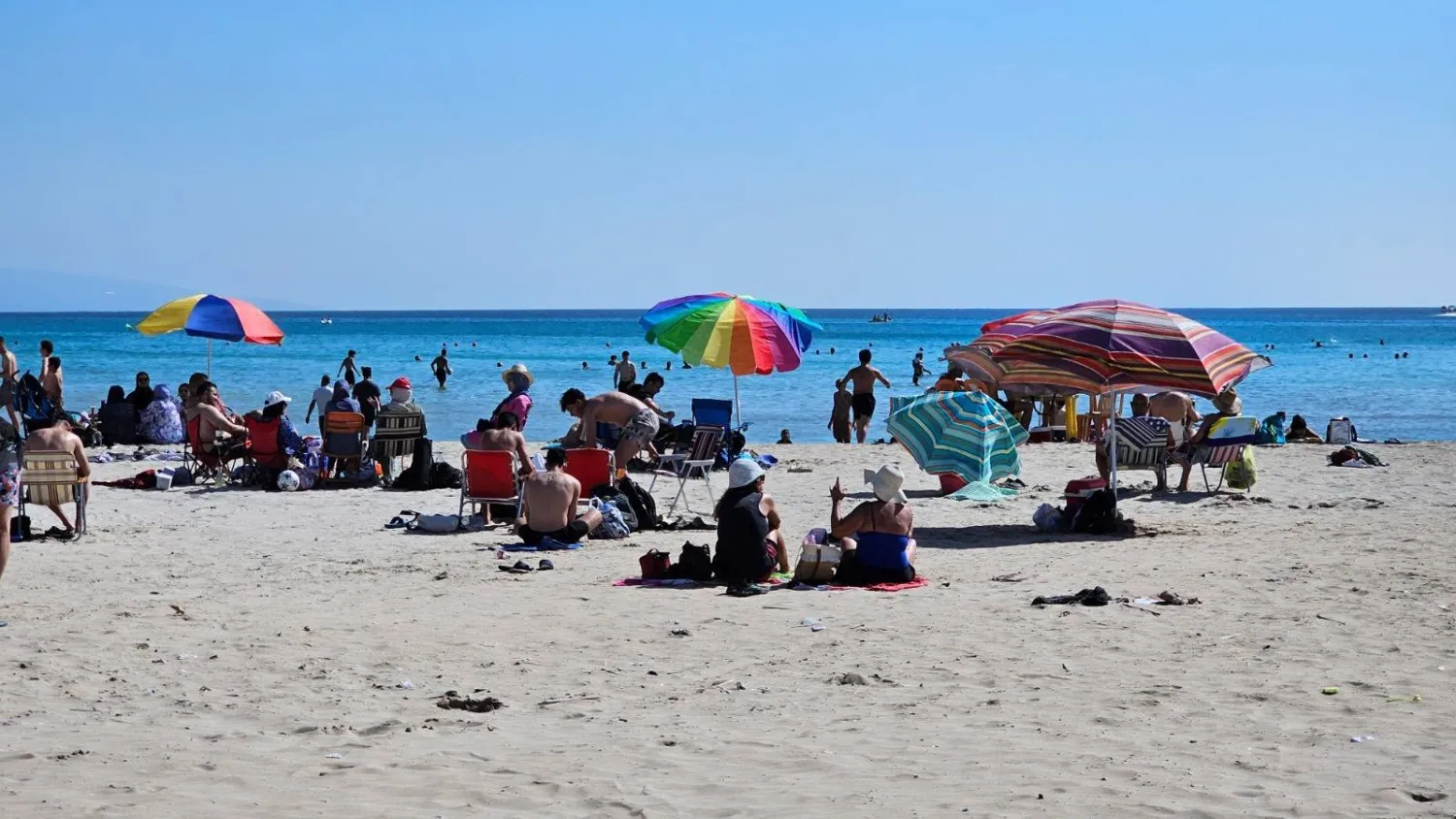
War Undermines Tourism in South Lebanon, Tyre Stands Out

Tyre's beach on the opening day of the summer tourist season (Asharq Al-Awsat)
TT

War Undermines Tourism in South Lebanon, Tyre Stands Out

Tyre's beach on the opening day of the summer tourist season (Asharq Al-Awsat)

Beachgoers in Lebanon’s southern city of Tyre look up as Israeli fighter jets break the sound barrier and release flares while leaving Lebanese airspace. They start dancing to a Julia Boutros song, undeterred by the ongoing war since October 8.
Despite shelling just 10 kilometers away, they enjoy the sea and sun.
Meanwhile, resorts south of Tyre are empty, reflecting the decline in tourism in southern Lebanon due to the conflict.
Tyre’s municipality has set up beach tents to welcome visitors to its southern shore for the start of the summer tourist season.
Ali Badr al-Din, head of the Tyre Beach Reserve, told Asharq Al-Awsat that the season “started early this year as a clear message that Tyre will not bow to security threats.”
“We are continuing our summer tourism activities by opening the beach tent season and inviting people to enjoy one of the Mediterranean’s finest sandy beaches,” said Badr al-Din.
Thousands visited Tyre’s beach in the first week of the beach tents’ opening.
Amal Wazni, a tent owner, chose to keep her business running despite the risks of war in the south.
She told Asharq Al-Awsat she is optimistic about the tourist season, despite the dangers and sounds of shelling.
“Tyre is relatively safe and has not been directly targeted by Israeli strikes. Attacking the city would be costly for the enemy,” she said.
Tourists understand this. In nine months of conflict, Tyre hasn’t been hit, though its outskirts have been shelled four times.
However, the scene at Tyre’s beach does not represent the overall tourism situation in the south; rather, it starkly contrasts with it.
Despite the lively beach, tourist facilities like hotels, guesthouses, chalets, and resorts across the region are facing severe challenges. Owners are calling it a “disaster.”
Just 5 kilometers south of Tyre, a major tourist resort employs around 130 workers, supporting 70 families at least.
Despite its proximity, many usual guests have avoided visiting due to the ongoing war.
Bilal Jazini, the resort manager, told Asharq Al-Awsat that occupancy has dropped over 90%.
He pointed out that the war has had a significant impact on resorts from Tyre to Naqoura, leading many to decide against opening this season to avoid financial losses, given the high operational costs and minimal returns.



Canada Eases Sanctions on Syria

13 February 2026, Bavaria, Munich: Anita Anand, Minister of Foreign Affairs of Canada, arrives at the Bavarian Hof for the 62nd Munich Security Conference. Photo: Felix Hörhager/dpa
TT

Canada Eases Sanctions on Syria

13 February 2026, Bavaria, Munich: Anita Anand, Minister of Foreign Affairs of Canada, arrives at the Bavarian Hof for the 62nd Munich Security Conference. Photo: Felix Hörhager/dpa

Canadian Minister of Foreign Affairs Anita Anand said on Wednesday that Canada had amended its economic sanctions on Syria ‌to ease ‌restrictions related ‌to the ⁠import and export ⁠of goods, investment activities and the provision of financial and other ⁠services, according to Reuters.

"The amendments also ‌remove ‌24 entities and ‌one individual from ‌the Syria Regulations to reduce barriers to economic activity and ‌to enable transactions with state-affiliated entities ⁠in ⁠key sectors critical to Syria’s recovery," Anand said in a statement.


Tetteh: Despite UN Engagement, No Progress in Libya Roadmap

Head of the United Nations Support Mission in Libya Hanna Tetteh Getty)
TT

Tetteh: Despite UN Engagement, No Progress in Libya Roadmap

Head of the United Nations Support Mission in Libya Hanna Tetteh Getty)

The UN’s top envoy for Libya, Hanna Tetteh, has informed the Security Council that despite active United Nations engagement, the Libyan House of Representatives and the High Council of State have failed to make progress on the first steps of the agreed political roadmap, including establishing a mechanism to select the board of the High National Elections Commission (HNEC) and advancing electoral legislation.

Briefing the Council in New York on Wednesday, the Special Representative of the Secretary-General said: “Their inability to use their agreed mechanism and follow-on unilateral actions has further eroded their credibility."

Tetteh added that Libyan public perceptions reflect a growing belief that the bodies are “unable or unwilling” to deliver.

She told Council members that she has begun consultations with key actors on an alternative two-step approach aimed at restoring momentum. Should a smaller group of Libyan representatives fail to agree on the roadmap’s milestones, she warned, a broader convening would be required. “We cannot wait indefinitely,” she emphasized.

The UN envoy also issued a stark warning about escalating tensions within Libya’s judicial system.

She said “contradictory, parallel judicial decisions put into jeopardy the unity of the legal and judicial systems,” cautioning that the situation “is a red line that if crossed can undermine the unity of the state.”

She urged Libyan leaders to refrain from further escalatory steps and called on the Council to hold accountable those taking actions that threaten to fracture the judiciary.

Tetteh also warned that transnational criminal networks continue to expand, turning Libya into a major transit hub for drug trafficking and sustaining illicit economies linked to corruption and armed groups.


Damascus, in Cooperation with Baghdad, Foils Plot to Smuggle Drugs Abroad

Quantities of Captagon prepared for smuggling abroad- SANA
TT

Damascus, in Cooperation with Baghdad, Foils Plot to Smuggle Drugs Abroad

Quantities of Captagon prepared for smuggling abroad- SANA

Syrian authorities said they have thwarted an attempt to smuggle a large shipment of drugs out of the country.

The Syrian Narcotics Directorate said on Wednesday it seized approximately 400,000 captagon pills, weighing about 65 kilograms, during an operation in Homs province in central Syria.

The drugs would have been smuggled to other countries, the Syrian Arab News Agency (SANA) reported. Two suspects were arrested on suspicion of managing a drug-trafficking network operating across borders.

The operation was carried out in coordination with Iraq’s General Directorate for Narcotics and Psychotropic Substances Control, SANA quoted a Syrian Interior Ministry statement as saying.

Earlier this month, the Syrian Narcotics Directorate conducted a joint security operation with the Iraqi authorities targeting an international drug-trafficking network, and seizing about 300,000 Captagon pills. Two people were also arrested.