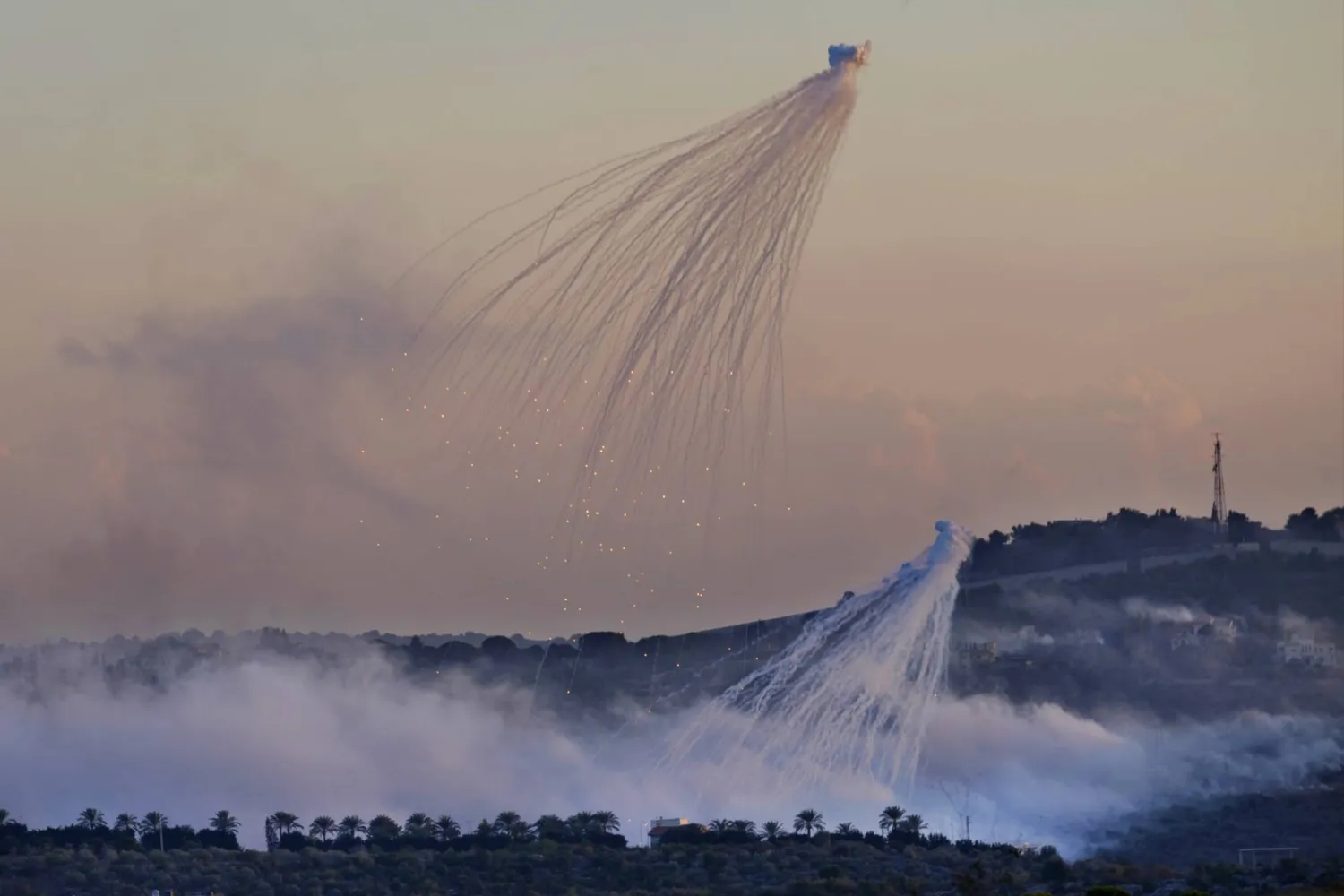
Fires Have Become the Most Visible Sign of the Conflict Heating Up on the Lebanon-Israel Border

FILE - Shells that appear to be white phosphorus from Israeli artillery explode over Dahaira, a Lebanese border village with Israel, south Lebanon, on Oct. 16, 2023. (AP Photo/Hussein Malla, File)
TT

Fires Have Become the Most Visible Sign of the Conflict Heating Up on the Lebanon-Israel Border

FILE - Shells that appear to be white phosphorus from Israeli artillery explode over Dahaira, a Lebanese border village with Israel, south Lebanon, on Oct. 16, 2023. (AP Photo/Hussein Malla, File)

With cease-fire talks faltering in Gaza and no clear offramp for the conflict on the Lebanon-Israel border, the daily exchanges of strikes between Hezbollah and Israeli forces have sparked fires that are tearing through forests and farmland on both sides of the frontline.
The blazes — exacerbated by supply shortages and security concerns — have consumed thousands of hectares of land in southern Lebanon and northern Israel, becoming one of the most visible signs of the escalating conflict, The Associated Press said.
There is an increasingly real possibility of a full-scale war — one that would have catastrophic consequences for people on both sides of the border. Some fear the fires sparked by a larger conflict would also cause irreversible damage to the land.
Charred remains in Lebanon and in Israel. Images of fires sparked by Hezbollah's rockets have driven public outrage and spurred Israel’s far-right national security minister, Itamar Ben-Gvir, to declare last month that it is “time for all of Lebanon to burn.”
Much of it was already burning.
Fires in Lebanon began in late April — earlier than the usual fire season — and have torn through the largely rural areas along the border.
The town of Shebaa, tucked in the mountains on Lebanon’s southeastern edge, has little Hezbollah presence, and the town hasn't been targeted as frequently as other border villages. But the sounds of shelling still boom regularly, and in the mountains above it, formerly oak-lined ridges are charred and bare.
In a cherry orchard on the outskirts of town, clumps of fruit hang among browned leaves after a fire sparked by an Israeli strike tore through. Firefighters and local men — some using their shirts to beat out flames — stopped the blaze from reaching houses and UN peacekeeper center nearby.
“Grass will come back next year, but the trees are gone,” said Moussa Saab, whose family owns the orchard. “We’ll have to get saplings and plant them, and you need five or seven years before you can start harvesting.”
Saab refuses to leave with his wife and 8-year-old daughter. They can't afford to live elsewhere, and they fear not being able to return, as happened to his parents when they left the disputed Shebaa Farms area.
In Israel, the slopes of Mount Meron, Israel’s second-highest mountain and home to an air base, were long covered in native oak trees, a dense grove providing shelter to wild pigs, gazelles, and rare species of flowers and fauna.
Now the green slopes are interrupted by three new burn scars — the largest a few hundred square meters — remnants of a Hezbollah explosive drone shot down a few weeks ago. Park rangers worry that devastation has just begun.
“The damage this year is worse a dozen times over this year,” said Shai Koren, of the northern district for Israel’s Nature and Parks Authority.
Looking over the slopes of Meron, Koren said he doesn’t expect this forest to survive the summer: “You can take a before and after picture.”
Numbers and weapons
Since the war began, the Israeli military has tracked 5,450 launches toward northern Israel. According to Israeli think tank the Alma Research and Education Center, most early launches were short-range anti-tank missiles, but Hezbollah's drone usage has increased.
In Lebanon, officials and human rights groups accuse Israel of firing white phosphorus incendiary shells at residential areas, in addition to regular artillery shelling and airstrikes.
The Israeli military says it uses white phosphorus only as a smokescreen, not to target populated areas. But even in open areas, the shells can spark fast-spreading fires.
The border clashes began Oct. 8, a day after the Hamas-led incursion into southern Israel that killed around 1,200 people and sparked the war in Gaza. There, more than 37,000 have been killed, according to Gaza's Health Ministry.
Hezbollah began launching rockets into northern Israel to open what it calls a “support front” for Hamas, to pull Israeli forces away from Gaza.
Israel responded, and attacks spread across the border region. In northern Israel, 16 soldiers and 11 civilians have been killed. In Lebanon, more than 450 people — mostly fighters, but also 80-plus civilians and noncombatants — have been killed.
Exchanges have intensified since early May, when Israel launched its incursion into the southern Gaza city of Rafah. That coincided with the beginning of the hot, dry wildfire season.
Since May, Hezbollah strikes have resulted in 8,700 hectares (about 21,500 acres) burned in northern Israel, according to Israel's Nature and Parks Authority.
Eli Mor, of Israel’s Fire and Rescue, said drones, which are much more accurate than rockets, often “come one after another, the first one with a camera and the second one will shoot.”
“Every launch is a real threat,” Mor added.
In southern Lebanon, about 4,000 hectares (10,000 acres) have burned due to Israeli strikes, said George Mitri, of the Land and Natural Resources program at the University of Balamand. In the two years before, he said, Lebanon's total area burned annually was 500 to 600 hectares (1,200 to 1,500 acres).
Fire response Security concerns hamper the response to a fire's first crucial hours. Firefighting planes are largely grounded over fears they'll be shot down. On the ground, firefighters often can't move without army escorts.
“If we lose half an hour or an hour, it might take us an extra day or two days to get the fire under control,” said Mohammad Saadeh, head of the Shebaa civil defense station. The station responded to 27 fires in three weeks last month — nearly as many as a normal year.
On the border's other side, Moran Arinovsky used to be a chef and is now deputy commander of the emergency squad at Kibbutz Manara. With about 10 others, he's fought more than 20 fires in the past two months.
Mor, of Israel’s Fire and Rescue, said firefighters often must triage.
“Sometimes we have to give up on open areas that are not endangering people or towns,” Mor said.
The border areas are largely depopulated. Israel's government evacuated a 4-kilometer strip early in the war, leaving only soldiers and emergency personnel. In Lebanon, there's no formal evacuation order, but large swathes have become virtually uninhabitable.
Some 95,000 people in Lebanon and 60,000 people in Israel have been displaced for nine months.
Kibbutz Sde Nehemia didn't evacuate, and Efrat Eldan Schechter said some days she watches helplessly as plumes of smoke grow closer to home.
“There's a psychological impact, the knowledge and feeling that we’re alone,” she said, because firefighters can't access certain areas.
Israeli Prime Minister Benjamin Netanyahu has said that as fighting in Gaza winds down, Israel will send more troops to its northern border. That could open a new front and raise the risk of more destructive fires.



Lebanon Says One Killed in Israeli Strike on Palestinian Refugee Camp

22 January 2026, Lebanon, Qnarit: People inspect the damage of a building that was destroyed by an Israeli air raid on the southern Lebanese village of Qnarit. (dpa)
TT

Lebanon Says One Killed in Israeli Strike on Palestinian Refugee Camp

22 January 2026, Lebanon, Qnarit: People inspect the damage of a building that was destroyed by an Israeli air raid on the southern Lebanese village of Qnarit. (dpa)

An Israeli strike on Lebanon's largest Palestinian refugee camp killed one person on Friday, state media reported, with the Israeli army saying it had targeted the Palestinian group Hamas.

The official National News Agency said "an Israeli drone" targeted a neighborhood of the Ain al-Hilweh camp, which is located on the outskirts of the southern city of Sidon.

It reported that one person was killed and an unspecified number wounded.

An AFP correspondent saw smoke rising from a building in the densely populated camp as ambulances headed to the scene.

The Israeli army said in a statement that its forces "struck a Hamas command center from which terrorists operated".

Israel has kept up regular strikes on Lebanon despite a November 2024 ceasefire that sought to halt more than a year of hostilities with Hezbollah.

Israel has also struck targets belonging to Hezbollah's Palestinian ally Hamas, including in a raid on Ain al-Hilweh last November that killed 13 people.

The UN rights office had said 11 children were killed in that strike, which Israel said targeted a Hamas training compound, though the group denied it had military installations in Palestinian camps in Lebanon.

In October 2023, Hezbollah began launching rockets at Israel in support of Hamas at the outset of the Gaza war, triggering months of exchanges that culminated in two months of all-out war in Lebanon.

On Sunday, Lebanon said an Israeli strike near the Syrian border in the country's east killed four people, as Israel said it targeted operatives from Palestinian group Islamic Jihad.


UN Says It Risks Halting Somalia Aid Due to Funding Cuts 

A Somali trader marks watermelons for sale at an open-air grocery market as Muslims start the fasting month of Ramadan, the holiest month in the Islamic calendar, within Bakara market in Mogadishu, Somalia, February 18, 2026. (Reuters)
TT

UN Says It Risks Halting Somalia Aid Due to Funding Cuts 

A Somali trader marks watermelons for sale at an open-air grocery market as Muslims start the fasting month of Ramadan, the holiest month in the Islamic calendar, within Bakara market in Mogadishu, Somalia, February 18, 2026. (Reuters)

The UN's World Food Program (WFP) warned Friday it would have to stop humanitarian assistance in Somalia by April if it did not receive new funding.

The Rome-based agency said it had already been forced to reduce the number of people receiving emergency food assistance from 2.2 million in early 2025 to just over 600,000 today.

"Without immediate funding, WFP will be forced to halt humanitarian assistance by April," it said in a statement.

In early January, the United States suspended aid to Somalia over reports of theft and government interference, following the destruction of a US-funded WFP warehouse in the capital Mogadishu's port.

The US announced a resumption of WFP food distribution on January 29.

However, all UN agencies have warned of serious funding shortfalls since Washington began slashing aid across the world following President Donald Trump's return to the White House last year.

"The situation is deteriorating at an alarming rate," said Ross Smith, WFP Director of Emergency Preparedness and Response, in Friday's statement.

"Families have lost everything, and many are already being pushed to the brink. Without immediate emergency food support, conditions will worsen quickly.

"We are at the cusp of a decisive moment; without urgent action, we may be unable to reach the most vulnerable in time, most of them women and children."

Some 4.4 million people in Somalia are facing crisis-levels of food insecurity, according to the WFP, the largest humanitarian agency in the country.

The Horn of Africa country has been plagued by conflict and also suffered two consecutive failed rainy seasons.


Hamas Says Path for Gaza Must Begin with End to ‘Aggression’ 

Makeshift tents of displaced Palestinian families among the ruins of their homes at sunset during the holy month of Ramadan in Jabaliya northern Gaza Strip on, 19 February 2026. (EPA)
TT

Hamas Says Path for Gaza Must Begin with End to ‘Aggression’ 

Makeshift tents of displaced Palestinian families among the ruins of their homes at sunset during the holy month of Ramadan in Jabaliya northern Gaza Strip on, 19 February 2026. (EPA)

Discussions on Gaza's future must begin with a total halt to Israeli "aggression", the Palestinian movement Hamas said after US President Donald Trump's Board of Peace met for the first time.

"Any political process or any arrangement under discussion concerning the Gaza Strip and the future of our Palestinian people must start with the total halt of aggression, the lifting of the blockade, and the guarantee of our people's legitimate national rights, first and foremost their right to freedom and self-determination," Hamas said in a statement Thursday.

Trump's board met for its inaugural session in Washington on Thursday, with a number of countries pledging money and personnel to rebuild the Palestinian territory, more than four months into a fragile ceasefire between Israel and Hamas.

Israeli Prime Minister Benjamin Netanyahu has insisted however that Hamas must disarm before any reconstruction begins.

"We agreed with our ally the US that there will be no reconstruction of Gaza before the demilitarization of Gaza," Netanyahu said.

The Israeli leader did not attend the Washington meeting but was represented by his foreign minister Gideon Saar.

Trump said several countries had pledged more than seven billion dollars to rebuild the territory.

Muslim-majority Indonesia will take a deputy commander role in a nascent International Stabilization Force, the unit's American chief Major General Jasper Jeffers said.

Trump, whose plan for Gaza was endorsed by the UN Security Council in November, also said five countries had committed to providing troops, including Morocco, Kazakhstan, Kosovo and Albania.