


Israeli Army’s Plan to Flood Hamas Tunnels Fails

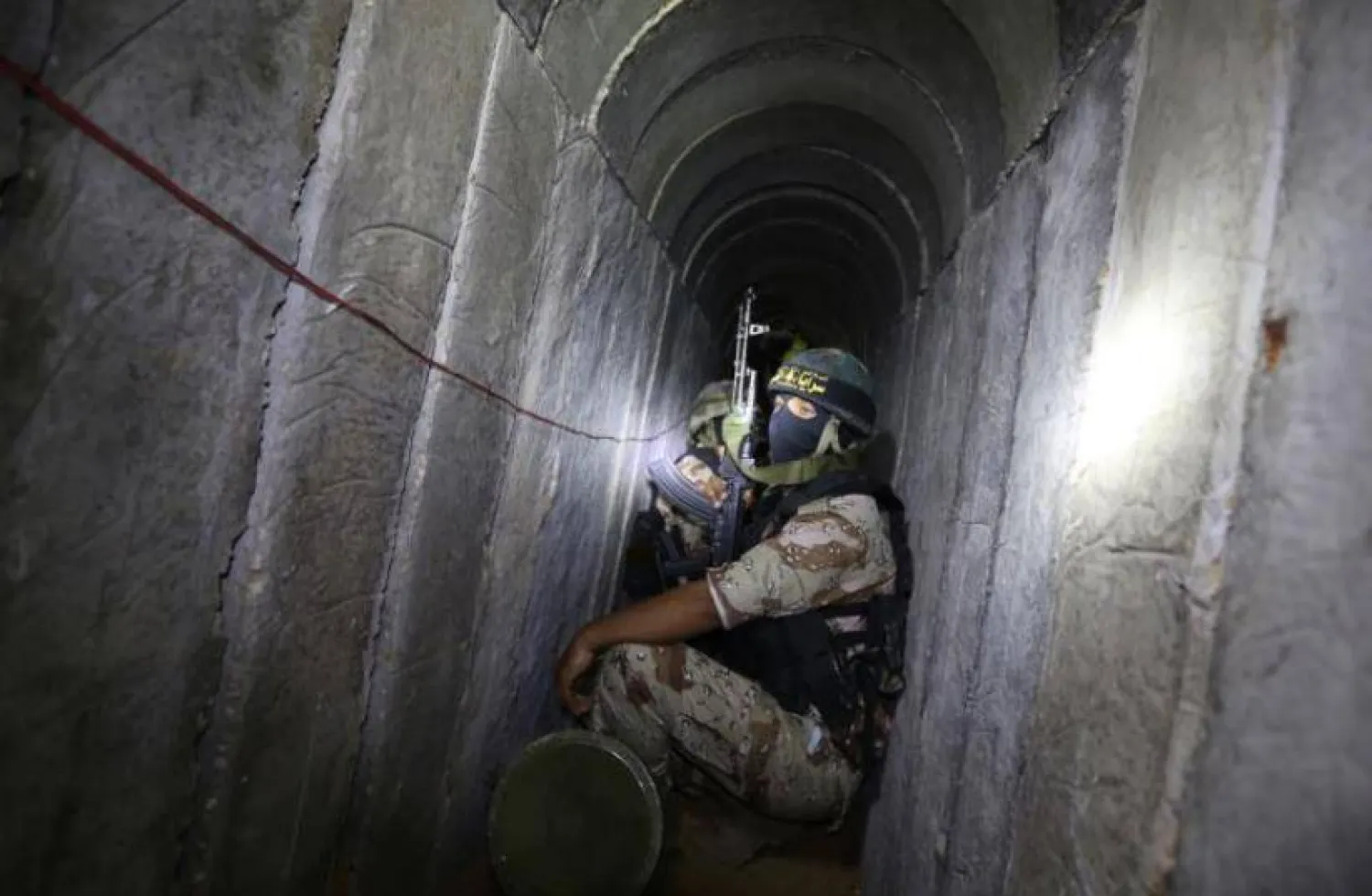
A Palestinian fighter from the Islamic Jihad's armed wing, the Al-Quds Brigades, is seen in a tunnel in the south of the Gaza Strip (AFP)
TT

Israeli Army’s Plan to Flood Hamas Tunnels Fails

A Palestinian fighter from the Islamic Jihad's armed wing, the Al-Quds Brigades, is seen in a tunnel in the south of the Gaza Strip (AFP)

The Israeli media on Saturday renewed talk about the Atlantis system, a significant engineering and technological breakthrough that was supposed to take out the Hamas tunnels and to kill senior Hamas officials, by pumping in seawater at high intensity.

The system was supposed to be the game changer, a new, relatively quick and lethal solution to one of the more complex fronts in the Gaza Strip.

But Israel started by adopting an old and unsuitable plan, continued by ignoring professional advice and the possible danger to the abductees – and ended quietly a few months later, anyone saying whether it achieved anything at all.

Haaretz surveys profiled the Atlantis project – a predictable military failure which no one stopped until it was too late.

“But about half a year after this system was revealed to the public, it turns out that Atlantis is lost; it's no longer in use, and nobody in the army can say what benefit, if any, was gained from this expensive project,” the newspaper wrote.

A Haaretz investigation – based on discussions with a series of different sources, who are closely involved in the development and operation of the system, as well as documents and minutes from closed discussions, in which senior officers and professionals participated– reveals a large number of screw-ups in the way it was handled by the army, and provides a profile of a failure foretold.

For example, it turns out that the system started to operate even before the necessary opinions requested by the army were given; that behind the accelerated activity there was a great deal of pressure imposed from above by the head of Southern Command, Maj. Gen. Yaron Finkelman; and that it was activated while possibly endangering Israelis who were alive when abducted to the Strip.
“The system was activated in at least one central Hamas tunnel that was clearly used by the organization during various stages of the war,” said a defense source who was deeply involved in project Atlantis. “And it's very likely that there were hostages there who served as a human shield.”

The question of how it happened that a project described by the Israeli Army as a “tie breaker” turned into a steadily growing failure has a complex answer.

One of the main causes is the backdrop, Haaretz said. During the first days of the war, says a defense source, “The achievements on the ground against Hamas officials were insignificant. Most of the Hamas forces, mainly the military arm, entered the tunnels and that created pressure on the senior Israeli Army command.”

That's why, says another source who spoke to Haaretz, Finkelman demanded solutions; ways of striking at Hamas activists in the tunnels. “There was frustration because during those stages the forces didn't really think that we'd start to enter all the tunnels,” recalls the source.

“They also began to realize the dimensions of the tunnels that Military Intelligence didn't know about.”

At that time, the Israeli Army was still learning about the tunnels they encountered in the Strip and their scope hundreds of kilometers.

“The army,” he adds, “found itself on the ground realizing that Hamas was below the ground and it had no solution for removing them from there.”

It was actually the renewal of a contingency plan that was proposed in the ground forces years before Finkelman assumed his position.

At the time the purpose was to deal with a different type of tunnel. Its chances of success in dealing with the tunnels that the army found in the Strip beginning on October 7 were low.

But according to defense sources who spoke to Haaretz, Finkelman gave a green light to taking the old plan and adapting it to the new situation.
After the plan received the necessary permits, the Army turned to the Israel Water Authority for assistance.

The authority hastened to mobilize for the mission and formed two groups of civilian experts in several fields. One group was placed in charge of pumping the water into the tunnels, the second was asked to study the subject of water loss through the walls of a tunnel. Both groups got started.
But the Israeli Army didn't wait for the conclusions, and already at this point they embarked on the next stage.

The Southern Command's 162nd division was chosen as the contractor of the operation, and infrastructure work was assigned to the fighters of the Shayetet 13 naval commandos, which for several weeks became a pipeline unit.

The main goal: joining pipes and deploying them in the combat area.

“For a month and a half the Israeli army neutralized an entire division,” says one of the commanders who took part in the project. “It assigned combat soldiers to plumbing jobs and guarding pipes, throughout the Strip, when it had no idea whether the project had any operational feasibility.”

He said, “The Army had no way of knowing whether the system was working, what had happened in the tunnels, what the situation was of the terrorists inside and whether there were hostages who were harmed as a result of the water. To this moment it isn't clear what damage was caused in the tunnels, if any. They simply don't know anything.”

According to a document issued by the experts on the subject, about three weeks after Atlantis began to operate, “The activation wasn't carried out according to the recommendations of the professionals. The pumping wasn't done according to the combat theory that was developed, no findings were gathered and they didn't take the measurements that were described.”

The experts were angry throughout the period. “There was a disconnect between the sources in the field and the accompanying unit on the one hand and the experts who planned the method of operation on the other,” they said.

And in fact, at that time, say professionals, the military lacked the requisite information and data about the tunnels, certainly not how to flood them in a way that would harm those inside or cause them to flee to the surface.

In the course of the project, the Water Authority investigators had a chance to be exposed to the study prepared by a Hamas activist who served in the tunnel system in the past 10 years. Along with his statement that the tunnels became the main system prepared by the organization for a military confrontation with Israel, he described how they were constructed and the logic behind them.



Germany Moves Troops Out of Iraq, Citing Mideast 'Tensions'

FILE PHOTO: German Defense Minister Ursula von der Leyen visits the Transport Helicopter Regiment 30 (Transporthubschrauberregiment 30) at the Hermann-Koehl-Kaserne in Niederstetten, Germany, August 20, 2018. REUTERS/Ralph Orlowski
TT

Germany Moves Troops Out of Iraq, Citing Mideast 'Tensions'

FILE PHOTO: German Defense Minister Ursula von der Leyen visits the Transport Helicopter Regiment 30 (Transporthubschrauberregiment 30) at the Hermann-Koehl-Kaserne in Niederstetten, Germany, August 20, 2018. REUTERS/Ralph Orlowski

Germany's military has "temporarily" moved some troops out of Erbil in northern Iraq because of "escalating tensions in the Middle East," a German defense ministry spokesman told AFP on Thursday.

Dozens of German soldiers had been relocated away from the base in Erbil, capital of Iraq's autonomous Kurdistan region.

"Only the personnel necessary to maintain the operational capability of the camp in Erbil remain on site," the spokesman said.

The spokesman did not specify the source of the tensions, but US President Donald Trump has ordered a major build-up of US warships, aircraft and other weaponry in the region and threatened action against Iran.

German troops are deployed to Erbil as part of an international mission to train local Iraqi forces.

The spokesman said the German redeployment away from Erbil was "closely coordinated with our multinational partners".


UN: At Least 15 Children Killed in Sudan Drone Strike

The war in Sudan, ongoing since mid-April 2023, has caused extensive destruction across the country (AFP)
TT

UN: At Least 15 Children Killed in Sudan Drone Strike

The war in Sudan, ongoing since mid-April 2023, has caused extensive destruction across the country (AFP)

A drone strike on a displacement camp in Sudan killed at least 15 children earlier this week, the United Nations reported late on Wednesday.

"On Monday 16 February, at least 15 children were reportedly killed and 10 wounded after a drone strike on a displacement camp in Al Sunut, West Kordofan," the UN children's agency said in a statement.

Across the Kordofan region, currently the Sudan war's fiercest battlefield, "we are seeing the same disturbing patterns from Darfur -- children killed, injured, displaced and cut off from the services they need to survive," UNICEF's Executive Director Catherine Russell said.


MSF Will Keep Operating in Gaza 'as Long as We Can'

(FILES) A Palestinian man walks on his crutches to the Doctors Without Borders or Medecins Sans Frontieres (MSF) clinic, in the al-Rimal neighborhood of Gaza City on new year's Eve, December 31, 2025. (Photo by Omar AL-QATTAA / AFP)
TT

MSF Will Keep Operating in Gaza 'as Long as We Can'

(FILES) A Palestinian man walks on his crutches to the Doctors Without Borders or Medecins Sans Frontieres (MSF) clinic, in the al-Rimal neighborhood of Gaza City on new year's Eve, December 31, 2025. (Photo by Omar AL-QATTAA / AFP)

The head of Doctors Without Borders in the Palestinian territories told AFP the charity would continue working in Gaza for as long as possible, following an Israeli decision to end its activities there.

In early February, Israel announced it was terminating all the activities in Gaza by the medical charity, known by its French acronym MSF, after it failed to provide a list of its Palestinian staff.

MSF has slammed the move, which takes effect on March 1, as a "pretext" to obstruct aid.

"For the time being, we are still working in Gaza, and we plan to keep running our operations as long as we can," Filipe Ribeiro told AFP in Amman, but said operations were already facing challenges.

"Since the beginning of January, we are not anymore in the capacity to get international staff inside Gaza. The Israeli authorities actually denied any entry to Gaza, but also to the West Bank," he said.

Ribeiro added that MSF's ability to bring medical supplies into Gaza had also been impacted.

"They're not allowed for now, but we have some stocks in our pharmacies that will allow us to keep running operations for the time being," he said.

"We do have teams in Gaza that are still working, both national and international, and we have stocks."

In December, Israel announced it would prevent 37 aid organizations, including MSF, from working in Gaza from March 1 for failing to submit detailed information about their Palestinian employees, drawing widespread condemnation from NGOs and the United Nations.

It had alleged that two MSF employees had links with Palestinian militant groups Hamas and Islamic Jihad, which the medical charity has repeatedly and vehemently denied.

MSF says it did not provide the names of its Palestinian staff because Israeli authorities offered no assurances regarding their safety.

Ribeiro warned of the massive impact the termination of MSF's operations would have for healthcare in war-shattered Gaza.

"MSF is one of the biggest actors when it comes to the health provision in Gaza and the West Bank, and if we are obliged to leave, then we will create a huge void in Gaza," he said.

The charity says it currently provides at least 20 percent of hospital beds in the territory and operates around 20 health centers.

In 2025 alone, it carried out more than 800,000 medical consultations, treated more than 100,000 trauma cases and assisted more than 10,000 infant deliveries.