


Destruction of Gaza Water Wells Deepens Palestinian Misery

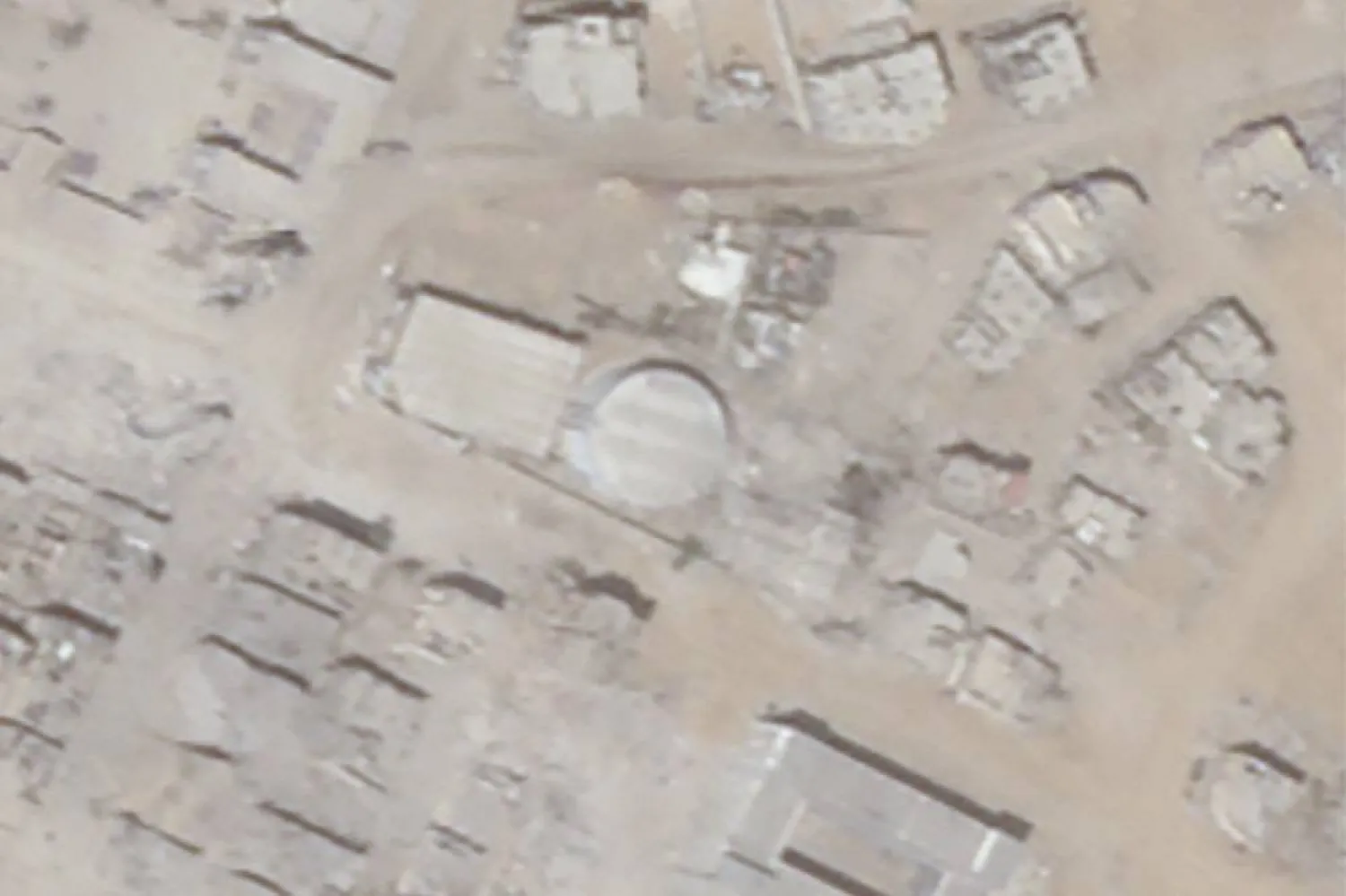
A satellite image shows the Canada Well water facility in Tel al-Sultan, Rafah, after the site was damaged in an Israeli Army explosion, in this handout image obtained by Reuters on July 30, 2024. 2024 (Planet Labs Inc/Handout via Reuters)
TT

Destruction of Gaza Water Wells Deepens Palestinian Misery

A satellite image shows the Canada Well water facility in Tel al-Sultan, Rafah, after the site was damaged in an Israeli Army explosion, in this handout image obtained by Reuters on July 30, 2024. 2024 (Planet Labs Inc/Handout via Reuters)

Israel's military blew up more than 30 water wells in Gaza this month, a municipality official and residents said, adding to the trauma of air strikes that have turned much of the Palestinian enclave into a wasteland ravaged by a humanitarian crisis.

Salama Shurab, head of the water networks at Khan Younis municipality, said the wells were destroyed by Israeli forces between July 18-27 in the southern towns of Rafah and Khan Younis.

The Israeli military did not respond to the allegations that its soldiers had torched the wells.

It is not only ever-present danger from Israeli bombardment or ground fighting that makes life a trial for Gaza's Palestinian civilians. It is also the daily slog to find bare necessities such as water, to drink or cook or wash with.

People have dug wells in bleak areas near the sea where the bombing has pushed them, or rely on salty tap water from Gaza's only aquifer, now contaminated with seawater and sewage.

Children walk long distances to line up at makeshift water collection points. Often not strong enough to carry the filled containers, they drag them home on wooden boards.

Gaza City has lost nearly all its water production capacity, with 88% of its water wells and 100% of its desalination plants damaged or destroyed, Oxfam said in a recent report.

Palestinians were already facing a severe water crisis as well as shortages of food, fuel and medicine before the destruction of the wells, which has deepened the anguish brought on by the Gaza war, now in its tenth month.

All Gazans can do is wait in long lines to collect water since US, Qatari and Egyptian mediators have failed to secure a ceasefire from Israel and its arch-foe Hamas. Not only is there a shortage of water, much of it is also contaminated.

"We stand in the sun, my eye hurts because of the sun, because we stand for long (hours) to (secure) water," said Youssef El-Shenawy, a Gaza resident.

"This is our struggle with non-potable water, and then there is our struggle with drinking water, which we take another queue for, that’s if it is available."

The war started on Oct. 7 when Hamas, the Palestinian armed group ruling Gaza, killed 1,200 people in Israel, according to Israeli tallies, and took another 250 or so to hold as hostages in Gaza, one of the most crowded places on earth.

Israel's retaliatory offensive has killed more than 39,000 people and bombed much of Gaza, where functioning hospitals are scarce, into rubble, Gaza health authorities say.

Fayez Abu Toh observed fellow Gazans standing in line in the heat eager to get their hands on water. Like many Palestinians he wonders why Israel strikes targets that pose no threat to its military.

“Whoever has a bit of a sense of humanity has to look at these people, care for them and try to (impose) a ceasefire and end this war. We are fed up; we are all dead and tired. The people have nothing left," he said.

“Does this well affect the strength of the (Israeli) Defense Force? This is a destruction of the infrastructure of the Palestinian people to further worsen the situation, and to pressure these people that have no one, but God."



Israel Military Says Soldier Killed in Gaza 

A drone view shows the destruction in a residential neighborhood, after the withdrawal of the Israeli forces from the area, amid a ceasefire between Israel and Hamas in Gaza, in Gaza City, October 21, 2025. (Reuters)
TT

Israel Military Says Soldier Killed in Gaza 

A drone view shows the destruction in a residential neighborhood, after the withdrawal of the Israeli forces from the area, amid a ceasefire between Israel and Hamas in Gaza, in Gaza City, October 21, 2025. (Reuters)

The Israeli military announced that one of its soldiers had been killed in combat in southern Gaza on Wednesday, but a security source said the death appeared to have been caused by "friendly fire".

"Staff Sergeant Ofri Yafe, aged 21, from HaYogev, a soldier in the Paratroopers Reconnaissance Unit, fell during combat in the southern Gaza Strip," the military said in a statement.

A security source, however, told AFP that the soldier appeared to have been "killed by friendly fire", without providing further details.

"The incident is still under investigation," the source added.

The death brings to five the number of Israeli soldiers killed in Gaza since a ceasefire took effect on October 10.


Syria: SDF’s Mazloum Abdi Says Implementation of Integration Deal May Take Time

People sit outdoors surrounded by nature, with the Tigris river flowing in the background, following a long atmospheric depression, near the Syrian-Turkish border in Derik, Syria, February 16, 2026 REUTERS/Orhan Qereman
TT

Syria: SDF’s Mazloum Abdi Says Implementation of Integration Deal May Take Time

People sit outdoors surrounded by nature, with the Tigris river flowing in the background, following a long atmospheric depression, near the Syrian-Turkish border in Derik, Syria, February 16, 2026 REUTERS/Orhan Qereman

Mazloum Abdi, commander of the Syrian Democratic Forces, said the process of merging the SDF with Syrian government forces “may take some time,” despite expressing confidence in the eventual success of the agreement.

His remarks came after earlier comments in which he acknowledged differences with Damascus over the concept of “decentralization.”

Speaking at a tribal conference in the northeastern city of Hasakah on Tuesday, Abdi said the issue of integration would not be resolved quickly, but stressed that the agreement remains on track.

He said the deal reached last month stipulates that three Syrian army brigades will be created out of the SDF.

Abdi added that all SDF military units have withdrawn to their barracks in an effort to preserve stability and continue implementing the announced integration agreement with the Syrian state.

He also emphasized the need for armed forces to withdraw from the vicinity of the city of Ayn al-Arab (Kobani), to be replaced by security forces tasked with maintaining order.


Israeli Far-Right Minister to Push for ‘Migration’ of West Bank, Gaza Palestinians 

A Palestinian man checks leather belts as people prepare for Ramadan, in the old city of Hebron in the Israeli-occupied West Bank, February 17,2026. (Reuters)
TT

Israeli Far-Right Minister to Push for ‘Migration’ of West Bank, Gaza Palestinians 

A Palestinian man checks leather belts as people prepare for Ramadan, in the old city of Hebron in the Israeli-occupied West Bank, February 17,2026. (Reuters)

Israel's far-right Finance Minister Bezalel Smotrich said he would pursue a policy of "encouraging the migration" of Palestinians from the occupied West Bank and Gaza Strip, Israeli media reported Wednesday.

"We will eliminate the idea of an Arab terror state," said Smotrich, speaking at an event organized by his Religious Zionism Party late on Tuesday.

"We will finally, formally, and in practical terms nullify the cursed Oslo Accords and embark on a path toward sovereignty, while encouraging emigration from both Gaza and Judea and Samaria.

"There is no other long-term solution," added Smotrich, who himself lives in a settlement in the West Bank.

Since last week, Israel has approved a series of measures backed by far-right ministers to tighten control over the West Bank, including in areas administered by the Palestinian Authority under the Oslo Accords, in place since the 1990s.

The measures include a process to register land in the West Bank as "state property" and facilitate direct purchases of land by Jewish Israelis.

The measures have triggered widespread international outrage.

On Tuesday, the UN missions of 85 countries condemned the measures, which critics say amount to de facto annexation of the Palestinian territory.

"We strongly condemn unilateral Israeli decisions and measures aimed at expanding Israel's unlawful presence in the West Bank," they said in a statement.

"Such decisions are contrary to Israel's obligations under international law and must be immediately reversed.

"We underline in this regard our strong opposition to any form of annexation."

UN Secretary-General Antonio Guterres on Monday called on Israel to reverse its land registration policy, calling it "destabilizing" and "unlawful".

The West Bank would form the largest part of any future Palestinian state. Many on Israel's religious right view it as Israeli land.

Israeli NGOs have also raised the alarm over a settlement plan signed by the government which they say would mark the first expansion of Jerusalem's borders into the occupied West Bank since 1967.

The planned development, announced by Israel's Ministry of Construction and Housing, is formally a westward expansion of the Geva Binyamin, or Adam, settlement situated northeast of Jerusalem in the West Bank.

The current Israeli government has fast-tracked settlement expansion, approving a record 52 settlements in 2025.

Excluding Israeli-annexed east Jerusalem, more than 500,000 Israelis live in West Bank settlements and outposts, which are illegal under international law.