West Bank Palestinians Say Haniyeh Killing Will Not Affect Fight with Israel

(FILES) Hamas leader Ismail Haniyeh talks to reporters after his meeting with Egyptian officials in Gaza City, 12 February 2006. (Photo by Mohammed ABED / AFP)
TT

West Bank Palestinians Say Haniyeh Killing Will Not Affect Fight with Israel

(FILES) Hamas leader Ismail Haniyeh talks to reporters after his meeting with Egyptian officials in Gaza City, 12 February 2006. (Photo by Mohammed ABED / AFP)

Palestinians in the occupied West Bank condemned the assassination of Ismail Haniyeh, the political leader of Hamas who was killed in Iran on Wednesday, but said it would have little effect on the movement.
Israeli officials have not so far claimed responsibility for the killing of Haniyeh, who had been in Tehran for the inauguration of the new Iranian President Masoud Pezeshkian, and there has been no official comment from the government, said Reuters.
But few doubted that Haniyeh, the public face of Hamas who took the top job in 2017, was the latest in a string of Hamas leaders to have been killed by Israel.
"We woke up this morning to a tragedy for the Palestinian people," said Fawzi Nassar, a resident of the southern city of Hebron.
"He is not the first one they assassinated - there were many leaders in the past like Sheikh Ahmed Yassin and others, but that will not affect our steadfastness," he said, referring to the founder of Hamas who was killed by an Israeli helicopter gunship in 2004.
Palestinian factions called for a day of protest and a general strike in the West Bank and Palestinian President Mahmoud Abbas, whose Fatah faction is a political rival to Hamas, condemned the killing, which Fatah called a "heinous and cowardly act".
Although the West Bank is under the nominal leadership of the Palestinian Authority, run by Fatah, opinion polls show support for Hamas is strong.
"His assassination will not affect the party because the party is not a new one," said Suheil Nasrelddin, a resident of Hebron. "They have a lot of leaders, even the youngest child is a leader."
The West Bank has been in turmoil since the Oct. 7 attack on Israel which sparked Israel's invasion of Gaza, with regular raids by Israeli forces in cities across the area.
Hundreds of Palestinians have been killed, many of them armed militants but also many stone-throwing youths or unarmed protesters and uninvolved civilians.
"The Israeli crime of assassinating Ismael Haniyeh, the leader of Hamas, will not break the Palestinian resistance or the Palestinian people's determination to achieve our freedom," said Mustafa Barghouti, a Palestinian politician who heads the Union Of Palestinian Medical Relief Committees.
"Of course it will escalate the situation," he said. "And this is what Netanyahu wants, he knows that the end of this war is the end of his political career."


Humanitarian, Security Conditions Deteriorate in Gaza as Armed Group Attacks Continue

 A young Palestinian boy drags scrap metal against the backdrop of destroyed buildings in Nuseirat on November 2, 2026. (AFP)
A young Palestinian boy drags scrap metal against the backdrop of destroyed buildings in Nuseirat on November 2, 2026. (AFP)
TT

Humanitarian, Security Conditions Deteriorate in Gaza as Armed Group Attacks Continue

 A young Palestinian boy drags scrap metal against the backdrop of destroyed buildings in Nuseirat on November 2, 2026. (AFP)
A young Palestinian boy drags scrap metal against the backdrop of destroyed buildings in Nuseirat on November 2, 2026. (AFP)

Humanitarian and security conditions are worsening in Gaza as Israel tightens restrictions on border crossings and the movement of people and goods, while armed groups backed by the Israeli military press ahead with attacks on the ground.

In a surprise move on Tuesday morning, Israel informed Egyptian and Palestinian coordination officials that it planned to block goods and humanitarian aid arriving through the Rafah crossing between Egypt and Gaza, citing alleged smuggling of banned items, mainly cigarettes, tobacco products and other goods Israel prohibits from entering the enclave.

Israel also abruptly turned back more than 20 patients and 35 accompanying relatives who had left for medical treatment through Rafah, citing security concerns. Hours later, the patients were told they could travel after all.

Israel also maintains tight control over shipments entering through the Kerem Shalom crossing. Supplies remain below levels seen before the latest crisis, which halted the flow of goods into Gaza for a full week before limited deliveries resumed about 10 days ago.

The restrictions have triggered "severe shortages of essential goods, record price increases and a near-total collapse in purchasing power," the Gaza Chamber of Commerce said.

Maher al-Tabbaa, the chamber's director, said Israel was allowing only about 200 types of goods into Gaza under stringent restrictions.

Prices have surged by 500% to 600%, while those of goods barred by Israel have soared by between 2,000% and 3,000%, he told a press briefing.

Armed groups raid displacement camp

Gaza's worsening humanitarian crisis has been matched by deteriorating security, with Israeli airstrikes continuing alongside operations by armed groups based in areas occupied by Israeli forces.

Under a ceasefire agreement based on a plan proposed by US President Donald Trump, a conceptual boundary known as the "yellow line" separates Israeli-occupied territory in eastern Gaza, covering more than 60% of the enclave, from areas to the west controlled by Hamas and other Palestinian factions.

In an operation described as mirroring Israeli military tactics, armed men infiltrated a displacement camp near Abu Hamid roundabout in central-eastern Khan Younis shortly after midnight between Sunday and Monday, under the cover of Israeli drones flying overhead.

The gunmen entered on foot before reinforcements arrived in four-wheel-drive vehicles, allowing them to seize control of the camp and surround it.

They then ordered several people to surrender over loudspeakers, only to discover that none of those sought were there, a source on the ground told Asharq Al-Awsat.

Three sources and eyewitnesses living near the camp said the gunmen searched tents and opened fire, terrifying residents, particularly women and children.

They abducted more than 35 members of the Barbakh family, including teenage boys, and took them to areas under their control in eastern Khan Younis, the sources said.

More than 10 hours later, the armed groups released all but four of those abducted, keeping the four young men for questioning.

A source on the ground quoted some of those released as saying they had been interrogated by Israeli officers, not the armed men who had handed them over to Israeli forces stationed nearby.

A source from a Palestinian faction in Khan Younis said the raid was intended to "spread chaos and flex the muscles" of armed groups backed by the Israeli military.

Another source said the operation could be a prelude to an Israeli advance aimed at expanding the territory under its control and pushing the yellow line farther west.

The boundary lies just a few hundred meters from the camp, the source said, pointing to similar Israeli advances in other parts of Gaza.


Fears of Armed Factions Spiraling Out of Control in Renewed War Spur Iraqi Contacts

Members of Iraq's pro-Iran paramilitary group Kataib Hezbollah gather in a mourning procession for one of their comrades who was killed the previous day in a strike in Basra, during the funeral in Baghdad on April 8, 2026. (AFP)
TT

Fears of Armed Factions Spiraling Out of Control in Renewed War Spur Iraqi Contacts

Members of Iraq's pro-Iran paramilitary group Kataib Hezbollah gather in a mourning procession for one of their comrades who was killed the previous day in a strike in Basra, during the funeral in Baghdad on April 8, 2026. (AFP)

Iraqi officials fear Iran-backed armed factions could spiral out of control if fighting with the United States resumes, as conflicting reports of an airstrike on a security facility in eastern Iraq, denied by Baghdad, add to tensions.

A senior source in the ruling Coordination Framework alliance said the government was working to keep Iraq out of a new conflict by negotiating directly with armed factions to persuade them to remain neutral.

The talks are being conducted through influential intermediaries, the source said.

Baghdad is also deploying security forces to poorly controlled areas and remote locations outside major cities, as it recently did in Basra province, to prevent armed groups from attacking neighboring countries if war breaks out.

But the source, who is familiar with internal discussions on the regional escalation, cast doubt on the government's ability to contain the fallout from a war.

He said Baghdad could struggle to rein in Iran-backed factions or safeguard Iraqi oil exports, which have recently recovered to more than 3 million barrels per day.

Even before regional tensions intensified, the government was struggling to resolve the issue of weapons held by armed factions. Doubts over its disarmament strategy have deepened since a deadline to bring those weapons under state control was pushed back from Sept. 30 to June 30, 2027.

The Coordination Framework had been negotiating with the factions through a political committee of senior political figures.

But amid mounting fears of renewed war, reports have circulated widely that Prime Minister Ali al-Zaidi opened a separate channel of communication with the armed groups, bypassing the committee.

A political source told Asharq Al-Awsat that Iran-backed factions may have updated their lists of targets inside Iraq and across the region as the prospect of war grows.

Saud al-Saedi, a lawmaker from the Hoquq Movement, the political wing of the Kataib Hezbollah faction, denied that al-Zaidi had personally intervened in the negotiations.

Saedi told reporters that the Coordination Framework had reached understandings with the factions on reorganizing their weapons.

The plan called for a joint committee bringing together representatives of the factions, the government, the Popular Mobilization Forces (PMF) and the Coordination Framework, he said.

But al-Zaidi has yet to sign the agreement, Saedi added, suggesting that the prime minister was under US pressure.

US warning

Meanwhile, Washington has stepped up pressure on Baghdad over weapons outside state control, according to political sources cited by local news agency Shafaq News.

The sources said Steven Fagin, the US charge d'affaires in Iraq, had delivered direct warnings to government and political figures in recent days, stressing that Washington was closely monitoring efforts to bring weapons under state control.

Failure to honor commitments or produce a concrete plan to end the presence of weapons beyond state control by June 30 could prompt Washington to designate Iraq a "state sponsor of terrorism" and impose sanctions and other measures, the sources quoted Fagin as warning.

As Baghdad remains silent on the possibility of renewed war, armed factions have largely adopted the same approach.

But the Ansar Allah al-Awfiya movement, an ally of former Prime Minister Mohammed Shia al-Sudani, broke that silence last Friday, warning Washington against using Iraqi territory or airspace to attack Iran while pledging neutrality if war erupts.

The movement's spokesperson, Ali al-Fatlawi, said it would remain neutral as long as Iraq was not used as a launchpad for attacks on neighboring countries.

He also urged Washington not to violate Iraqi airspace.

"Any violation of Iraqi sovereignty will prompt a response from the movement," Fatlawi said, adding that its leadership would decide the nature of that response according to the circumstances.

In recent days, armed factions and affiliated media outlets reported dozens of incursions into Iraqi airspace by US warplanes and reconnaissance aircraft.

The claims coincided with western media reports that US and Israeli fighter jets had conducted exercises over Iraq and several other countries in the region, simulating strikes on Iran.

On Tuesday, media reports said a Popular Mobilization Forces facility in the eastern province of Diyala had come under air attack.

But Lieutenant General Saad Maan, an official with Iraq's Security Media Cell, dismissed the reports.

"There is no truth to reports of any attack or airstrike in the province," he said in a brief statement.


Israeli Detonations Reshape South Lebanon Villages, Deepen Their Isolation

Israeli tanks and military vehicles on a road between destroyed houses in southern Lebanon near the border with northern Israel, April 29, 2026. (AFP)
TT

Israeli Detonations Reshape South Lebanon Villages, Deepen Their Isolation

Israeli tanks and military vehicles on a road between destroyed houses in southern Lebanon near the border with northern Israel, April 29, 2026. (AFP)

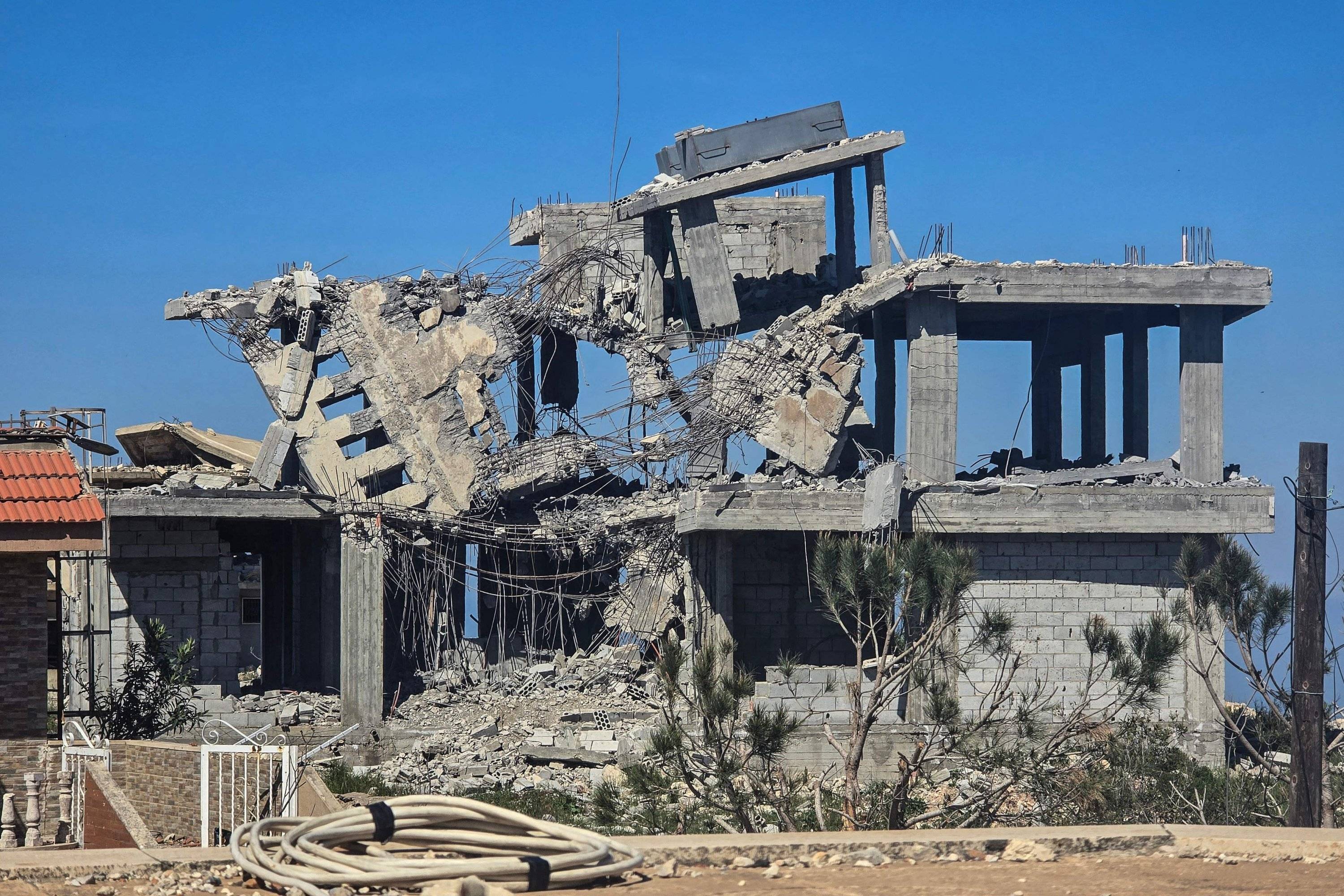
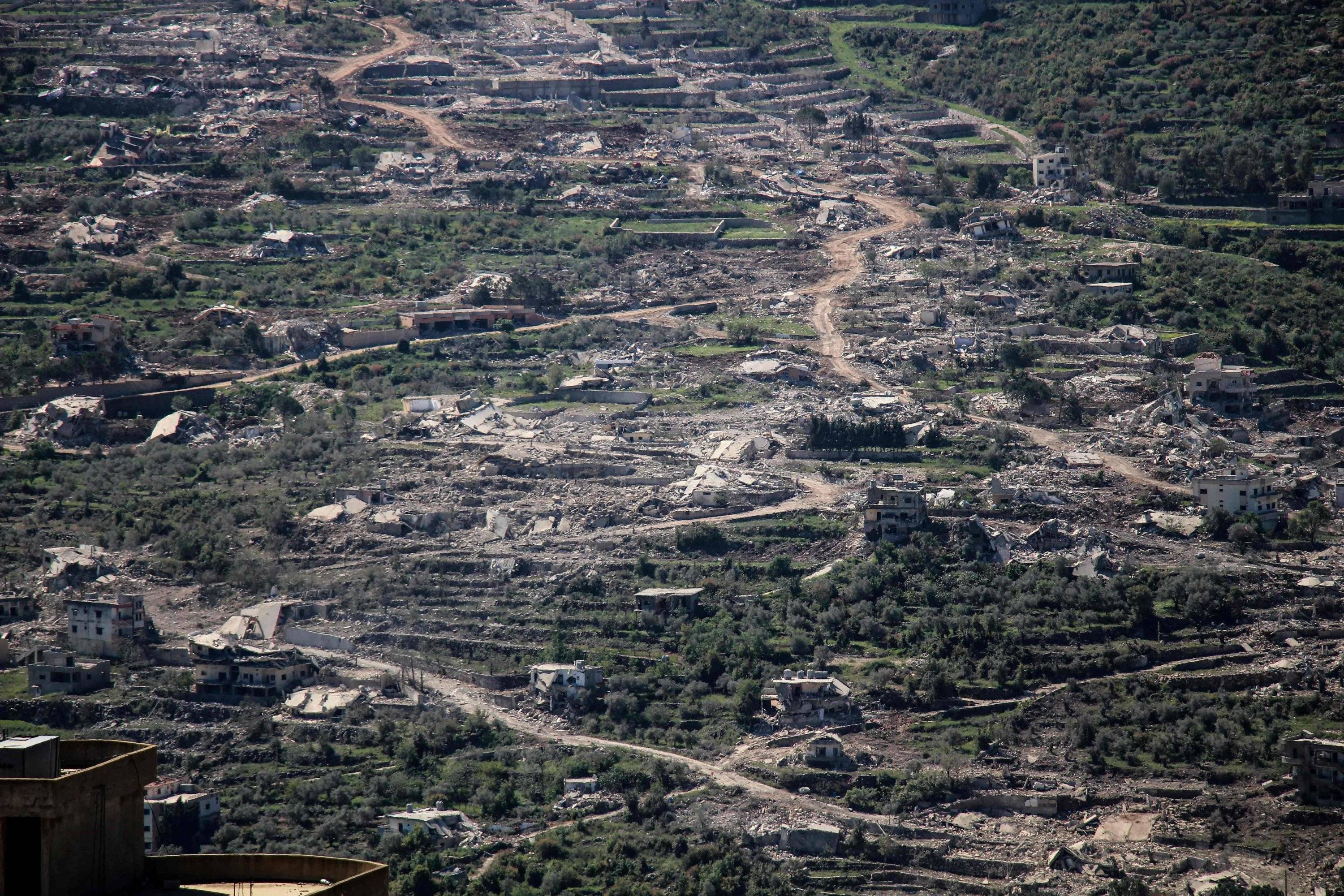
Israeli forces are blasting homes, farmland, roads and bridges across southern Lebanon, leaving villages stripped of familiar landmarks and raising fears that residents may never be able to return.

The destruction extends far beyond military positions and hilltops, according to scientific data and a study of war damage. A military expert says the pattern points to an Israeli effort to reshape the region's population and landscape.

Officials at Lebanon's National Council for Scientific Research told Asharq Al-Awsat that 2,057 Israeli explosions were recorded between April 17 and Oct. 29, reflecting the scale of Israeli military operations. No published breakdown of their geographic distribution or counting methodology was available.

An earlier scientific report published by the council documented 1,731 mining and demolition operations in southern Lebanon between March 2 and September 10, including 1,128 after the June 26 “framework agreement”.

The daily average surged from 5.15 operations before the agreement to about 15 afterward.

Homes and bridges in ruins

More than 90,000 homes across Lebanon had been damaged or destroyed by mid-June, according to preliminary estimates cited in a study by Information International. The figure was not limited to southern Lebanon.

The study documented seven bridges completely destroyed and partial damage to the Qasmieh Bridge, among eight bridges targeted along routes linking the area south of the Litani River to surrounding areas.

Citing the International Organization for Migration, the study said 499,784 people remained internally displaced as of July 1, highlighting the struggle to restore stability even as returns began.

The National Council for Scientific Research also documented a massive blast in Majdal Zoun on June 28 and ground waves triggered by an explosion in Shaqif overnight on July 30-31, equivalent to a magnitude 3.8 earthquake, according to the National Center for Geophysics.

A separate explosion in Ali al-Taher on September 10 coincided with a magnitude 4.1 seismic event recorded by the US Geological Survey.

The Shaqif blast raised concerns over the historic Beaufort castle, which has temporary enhanced protection and is listed among the "Castles of Jabal Amel" on the World Heritage List.

The remains of a home destroyed by the Israeli army in the village of Beit Lif, southern Lebanon, April 22, 2026. (AFP)

'Eliminating the foundations of life'

Retired Staff Brigadier General Khalil al-Gemayel described the destruction as a systematic scorched-earth policy designed to wipe out residential communities, deprive them of the basic necessities of life and prevent residents from returning.

He said the operations were paving the way for a prolonged Israeli presence in areas under its control.

The council's tally of 2,057 explosions since April was consistent with the scale of Israeli operations on the ground, Gemayel said, pointing to almost daily blasts targeting not only military positions and hilltops but also homes, neighborhoods, buildings and infrastructure.

The destruction was particularly concentrated around major population centers such as Bint Jbeil, Khiam and Aita al-Shaab, as well as villages including Zawtar al-Sharqiyeh, he said.

Gemayel said the pattern closely followed Israeli troop deployments, with built-up areas and population centers facing Israeli positions bearing the brunt of the demolitions.

The operations went beyond immediate military objectives and were intended to bring about sweeping demographic and environmental changes, he added.

"Destroying homes, infrastructure, vegetation and farmland effectively eliminates the foundations of life, rather than merely preventing military use of these areas," he said.

Gemayel compared the operations to Israel's actions in Syria's Golan Heights after its occupation in 1967, when villages were demolished and cleared.

He said the same approach was now being repeated in southern Lebanon, with the landscape altered and the traces of residential communities erased.

Even a political settlement and Israeli withdrawal would not guarantee a swift return of the displaced, he warned.

Rebuilding communities could take years, perhaps decades, with some residents potentially unable even to locate their former homes after entire streets, buildings and village landmarks disappeared.

A general view shows homes and structures demolished by the Israeli army in the village of Beit Lif, southern Lebanon, April 22, 2026. (AFP)

Imposing a new reality

Gemayel said the demolitions were concentrated in several areas along built-up stretches extending roughly 1,000 meters in front of Israeli positions, targeting buildings and residential communities facing deployed troops.

He identified Majdal Zoun and Mansouri, along with areas around Srebbine, Yater, Beit Yahoun, Hadatha, Baraachit and Aita al-Jabal, as examples.

He said Israeli aerial surveillance and other technological capabilities often allowed its forces to distinguish civilian from military movements, but that had not stopped the destruction from spreading.

Gemayel said the ultimate aim was to prevent residents from returning to areas occupied by Israeli forces or facing their positions by destroying villages and residential communities capable of sustaining everyday life.

The scale and pattern of destruction suggested Israel intended to maintain a long-term presence while imposing a new geographic and demographic reality that could prove difficult to reverse even after military operations ended, he said.