


Frustration with Netanyahu Mounts as Gaza Talks Falter

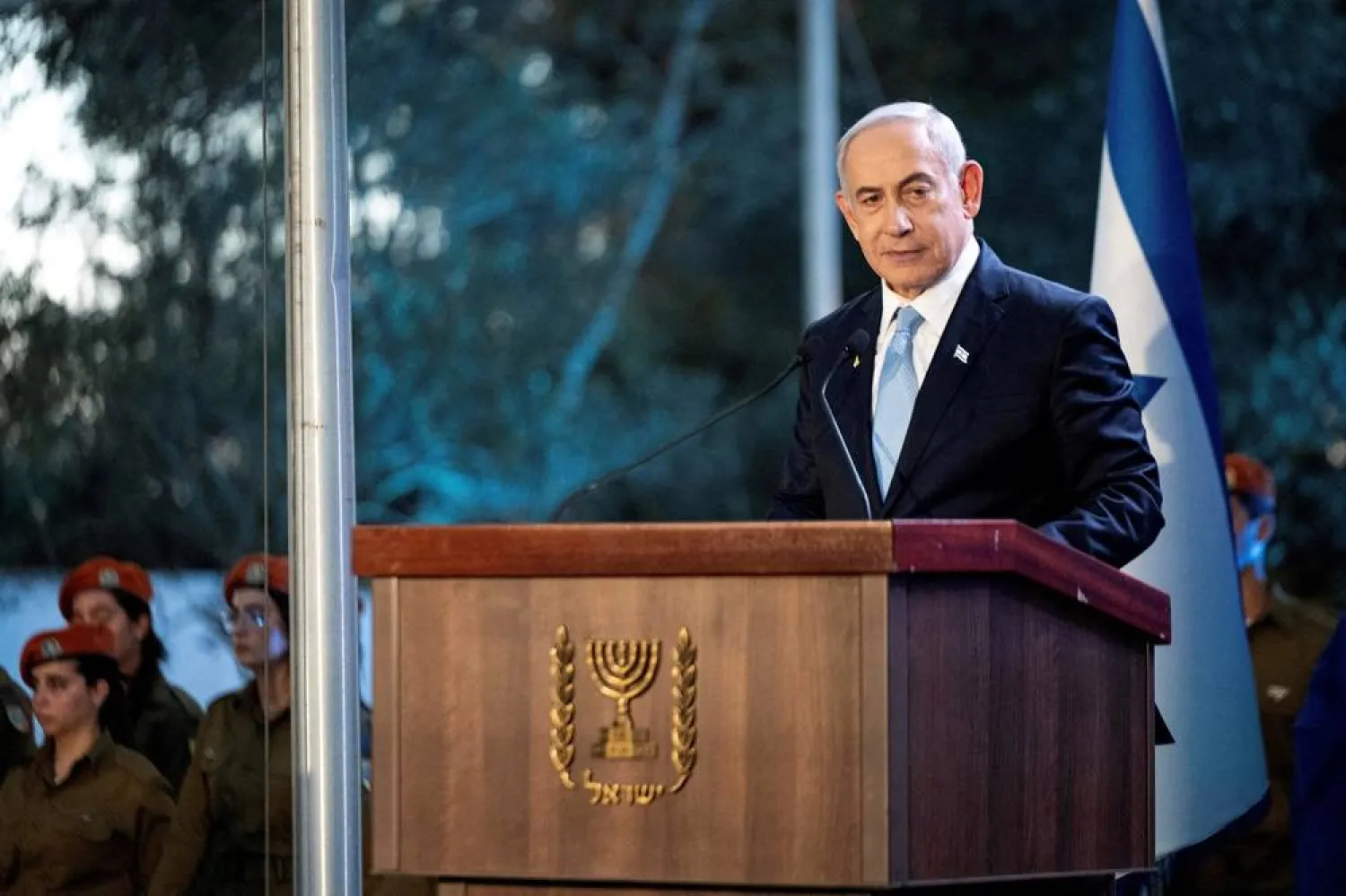
Israeli Prime Minister Benjamin Netanyahu speaks at a state memorial ceremony for Zeev Jabotinsky, founder of the Revisionist Zionist movement, amid the ongoing Israel-Hamas conflict at Mount Herzl military cemetery in Jerusalem, August 4, 2024. (Reuters)
TT

Frustration with Netanyahu Mounts as Gaza Talks Falter

Israeli Prime Minister Benjamin Netanyahu speaks at a state memorial ceremony for Zeev Jabotinsky, founder of the Revisionist Zionist movement, amid the ongoing Israel-Hamas conflict at Mount Herzl military cemetery in Jerusalem, August 4, 2024. (Reuters)

Israeli Prime Minister Benjamin Netanyahu is facing mounting frustration within Israel and abroad over his handling of faltering talks aimed at securing a Gaza hostage release and ceasefire deal, according to three Israeli officials.

Divisions between Netanyahu and the defense establishment over the deal have also surfaced in public remarks and behind closed doors, in angry exchanges leaked on Saturday to the Israeli press.

Over the past four weeks three Israeli officials, one in the negotiating team and two with close knowledge of the talks, have voiced concern that politics was undermining the chances of a deal.

"The feeling is that the prime minister is avoiding making a decision about the deal and is not pushing for it full force," one of the officials told Reuters on Sunday.

Some of Netanyahu's far-right coalition partners have threatened government stability should the war end before Hamas is defeated.

Netanyahu has repeatedly said the release of the remaining 115 hostages held in Gaza since the Hamas-led Oct. 7 assault on Israel that triggered the war was a top priority.

The Oct. 7 attackers killed 1,200 people and took more than 250 captive, according to Israeli tallies. Gaza's Hamas-run health authorities say more than 39,000 Palestinians have since been killed in fighting in the densely populated coastal enclave.

TENSIONS LAID BARE

Tensions between Netanyahu - who insists he is safeguarding Israel's security - and some in his negotiating team, were laid bare in his public remarks on Sunday.

"I am prepared to go very far to release all of our hostages, while maintaining the security of Israel," Netanyahu said in televised remarks at his cabinet meeting.

"Our commitment stands in complete contrast to the leaks and mendacious briefings on the issue of our hostages."

Efforts by the United States, Egypt and Qatar to secure a deal between Israel and Hamas had gained momentum over July but have since ground to a near halt after new terms were introduced to an agreed framework presented by Washington in May.

The framework involves three phases, with the first seeing a six-week ceasefire and the release of women, elderly and wounded hostages in exchange for hundreds of Palestinian prisoners held by Israel.

But sources have told Reuters a new Israeli condition that displaced Palestinians should be screened as they return to the enclave's north when the ceasefire begins was among the sticking points.

The killing on Wednesday of Hamas leader Ismail Haniyeh in Tehran has further complicated matters, though the armed group has not shut the door entirely on negotiators.

"We will continue to apply military pressure on Hamas and its senior figures, until the return of all of our hostages and achieving all of the war goals," Netanyahu said.

"Anyone who wants the release of our hostages must pressure Hamas, not the government of Israel."

Netanyahu's remarks came in response to a flurry of reports over the weekend. One, by N12 News, quoted US President Joe Biden telling Netanyahu in their Thursday phone call to "stop bullshitting me" about advancing the talks.

Netanyahu's office said he does not comment on his conversations with the US president. The White House did not immediately respond to a request for comment on the remarks, which were also reported by Haaretz newspaper, citing a senior Biden administration official.

"The people who are leaking these things out of meetings want to pressure the prime minister to make a bad deal. But what these leaks are doing is encouraging Hamas to add more and more demands," a fourth Israeli official told Reuters on Monday.

RED LINES

A second N12 report cited Israeli security chiefs, including Defense Minister Yoav Gallant and the head of the Shin Bet domestic security service Ronen Bar, casting doubt during a Wednesday meeting on Netanyahu's commitment to a hostage deal.

Gallant, according to the report, told Netanyahu that the new terms he introduced have made a deal impossible. The Shin Bet declined to comment on closed door discussions. Gallant's office did not immediately respond to a request for comment.

But in public remarks, Gallant and Israel's military chief Herzi Halevi have made a point of noting that after months of battering Hamas in Gaza forces can handle any challenges posed by a ceasefire, at the same time stressing the importance of sealing a deal that would see hostages freed.

Their messaging over the past few weeks has been in stark contrast to Netanyahu frequently citing his "red lines" on Israel's security in any deal. He has denied introducing new terms and has traded blame with Hamas over the stalemate.

"We have insisted on our red lines, and we will continue to insist on them – both in the face of our enemies and our friends," Netanyahu said on Sunday.



Israel Military Says Soldier Killed in Gaza 

A drone view shows the destruction in a residential neighborhood, after the withdrawal of the Israeli forces from the area, amid a ceasefire between Israel and Hamas in Gaza, in Gaza City, October 21, 2025. (Reuters)
TT

Israel Military Says Soldier Killed in Gaza 

A drone view shows the destruction in a residential neighborhood, after the withdrawal of the Israeli forces from the area, amid a ceasefire between Israel and Hamas in Gaza, in Gaza City, October 21, 2025. (Reuters)

The Israeli military announced that one of its soldiers had been killed in combat in southern Gaza on Wednesday, but a security source said the death appeared to have been caused by "friendly fire".

"Staff Sergeant Ofri Yafe, aged 21, from HaYogev, a soldier in the Paratroopers Reconnaissance Unit, fell during combat in the southern Gaza Strip," the military said in a statement.

A security source, however, told AFP that the soldier appeared to have been "killed by friendly fire", without providing further details.

"The incident is still under investigation," the source added.

The death brings to five the number of Israeli soldiers killed in Gaza since a ceasefire took effect on October 10.


Syria: SDF’s Mazloum Abdi Says Implementation of Integration Deal May Take Time

People sit outdoors surrounded by nature, with the Tigris river flowing in the background, following a long atmospheric depression, near the Syrian-Turkish border in Derik, Syria, February 16, 2026 REUTERS/Orhan Qereman
TT

Syria: SDF’s Mazloum Abdi Says Implementation of Integration Deal May Take Time

People sit outdoors surrounded by nature, with the Tigris river flowing in the background, following a long atmospheric depression, near the Syrian-Turkish border in Derik, Syria, February 16, 2026 REUTERS/Orhan Qereman

Mazloum Abdi, commander of the Syrian Democratic Forces, said the process of merging the SDF with Syrian government forces “may take some time,” despite expressing confidence in the eventual success of the agreement.

His remarks came after earlier comments in which he acknowledged differences with Damascus over the concept of “decentralization.”

Speaking at a tribal conference in the northeastern city of Hasakah on Tuesday, Abdi said the issue of integration would not be resolved quickly, but stressed that the agreement remains on track.

He said the deal reached last month stipulates that three Syrian army brigades will be created out of the SDF.

Abdi added that all SDF military units have withdrawn to their barracks in an effort to preserve stability and continue implementing the announced integration agreement with the Syrian state.

He also emphasized the need for armed forces to withdraw from the vicinity of the city of Ayn al-Arab (Kobani), to be replaced by security forces tasked with maintaining order.


Israeli Far-Right Minister to Push for ‘Migration’ of West Bank, Gaza Palestinians 

A Palestinian man checks leather belts as people prepare for Ramadan, in the old city of Hebron in the Israeli-occupied West Bank, February 17,2026. (Reuters)
TT

Israeli Far-Right Minister to Push for ‘Migration’ of West Bank, Gaza Palestinians 

A Palestinian man checks leather belts as people prepare for Ramadan, in the old city of Hebron in the Israeli-occupied West Bank, February 17,2026. (Reuters)

Israel's far-right Finance Minister Bezalel Smotrich said he would pursue a policy of "encouraging the migration" of Palestinians from the occupied West Bank and Gaza Strip, Israeli media reported Wednesday.

"We will eliminate the idea of an Arab terror state," said Smotrich, speaking at an event organized by his Religious Zionism Party late on Tuesday.

"We will finally, formally, and in practical terms nullify the cursed Oslo Accords and embark on a path toward sovereignty, while encouraging emigration from both Gaza and Judea and Samaria.

"There is no other long-term solution," added Smotrich, who himself lives in a settlement in the West Bank.

Since last week, Israel has approved a series of measures backed by far-right ministers to tighten control over the West Bank, including in areas administered by the Palestinian Authority under the Oslo Accords, in place since the 1990s.

The measures include a process to register land in the West Bank as "state property" and facilitate direct purchases of land by Jewish Israelis.

The measures have triggered widespread international outrage.

On Tuesday, the UN missions of 85 countries condemned the measures, which critics say amount to de facto annexation of the Palestinian territory.

"We strongly condemn unilateral Israeli decisions and measures aimed at expanding Israel's unlawful presence in the West Bank," they said in a statement.

"Such decisions are contrary to Israel's obligations under international law and must be immediately reversed.

"We underline in this regard our strong opposition to any form of annexation."

UN Secretary-General Antonio Guterres on Monday called on Israel to reverse its land registration policy, calling it "destabilizing" and "unlawful".

The West Bank would form the largest part of any future Palestinian state. Many on Israel's religious right view it as Israeli land.

Israeli NGOs have also raised the alarm over a settlement plan signed by the government which they say would mark the first expansion of Jerusalem's borders into the occupied West Bank since 1967.

The planned development, announced by Israel's Ministry of Construction and Housing, is formally a westward expansion of the Geva Binyamin, or Adam, settlement situated northeast of Jerusalem in the West Bank.

The current Israeli government has fast-tracked settlement expansion, approving a record 52 settlements in 2025.

Excluding Israeli-annexed east Jerusalem, more than 500,000 Israelis live in West Bank settlements and outposts, which are illegal under international law.