UN Envoy: South Sudan is Not Ready to Hold its First Post-Independence Elections in December

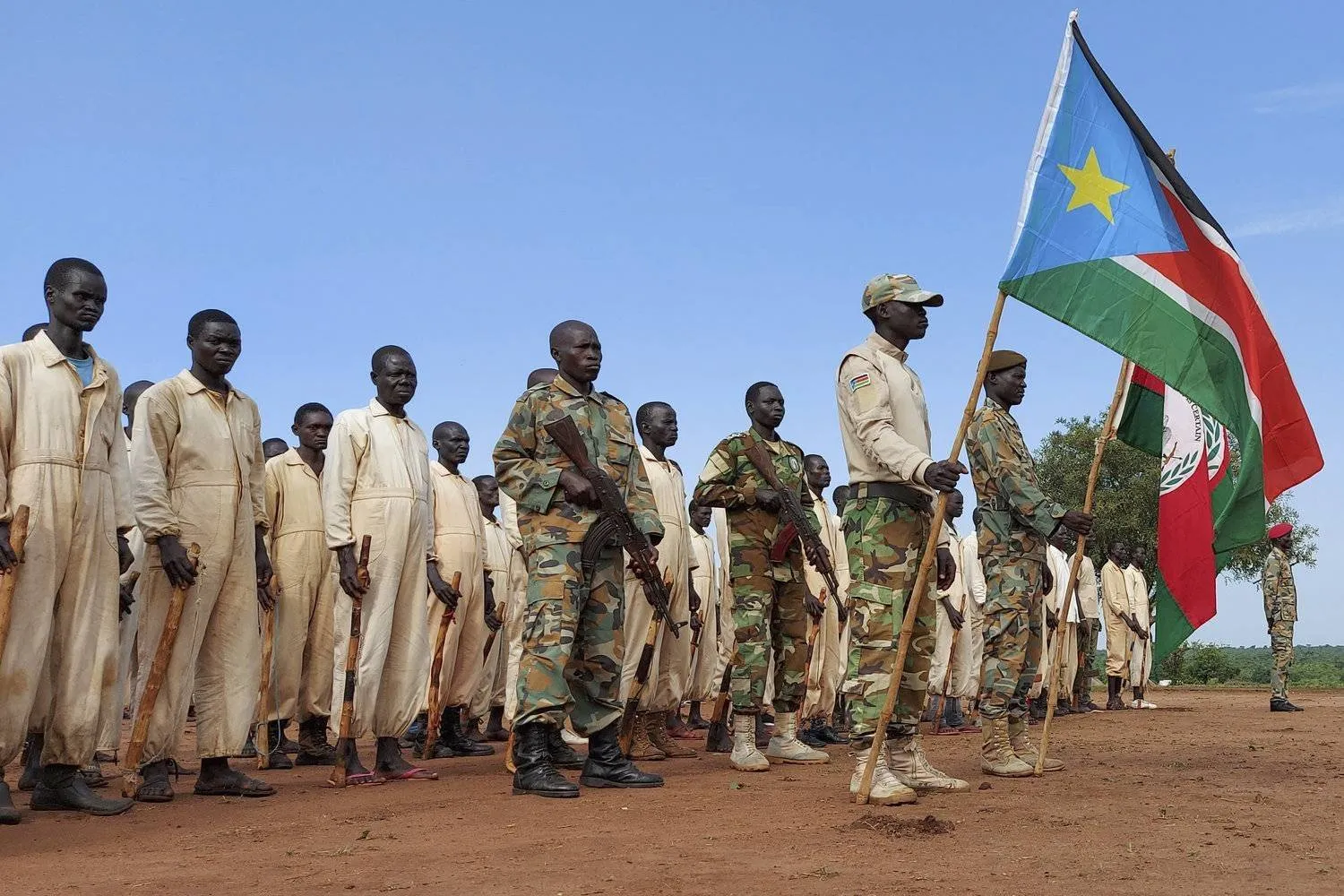
File photo: Military trainees parade during the visit of the defense minister to a military training center in Owiny Ki-Bul, Eastern Equatoria, South Sudan on June 27, 2020. (AP Photo/Maura Ajak, File) (ASSOCIATED PRESS)
TT

UN Envoy: South Sudan is Not Ready to Hold its First Post-Independence Elections in December

File photo: Military trainees parade during the visit of the defense minister to a military training center in Owiny Ki-Bul, Eastern Equatoria, South Sudan on June 27, 2020. (AP Photo/Maura Ajak, File) (ASSOCIATED PRESS)

South Sudan is not ready to hold its first post-independence elections in December and political players are discussing whether voting should be held this year, the UN’s top envoy in the troubled African country said Wednesday.
Nicholas Haysom told the UN Security Council that the consultations make it difficult to treat the election date of Dec. 22 announced last month by the National Elections Commission “as a definitive trigger in isolation from other critical factors.”
The vote, which would be the first since South Sudan gained independence from Sudan in 2011 after a long conflict, is meant to be the culmination of a peace agreement signed five years ago to pull the world’s newest nation out of a civil war largely based on ethnic divisions. Fighting between forces loyal to the current president, Salva Kiir, battled those loyal to the current vice president, Riek Machar, killing some 400,000 people.
Last December, Haysom outlined a series of conditions needed to hold credible and peaceful elections. In April, he told the Security Council the parties hadn’t implemented a “critical mass” of the key steps for free and fair elections — and he told the UN’s most powerful body Wednesday that his assessment is the same today.
On a positive note, he said the Elections Commission has started assessing “the ground-level infrastructure and facilities required for a conducive environment for conducting elections,” and 29 political parties have been registered.
The UN peacekeeping mission continues “to support the creation of an enabling environment for elections in South Sudan whenever they are held,” focusing on its mandate to help protect civilians, Haysom said..
He said there are concerns among large segments of civil society, political parties, the Commission on Human Rights and the international community about a bill recently passed by South Sudan's parliament that grants the National Security Service the power to make arrests without a warrant.
Critics of the security bill say it contradicts “their aspirations for open civic and political space” to build a democratic society and is incompatible with the spirit of South Sudan's transitional constitution and its human rights obligations, he said.
“It has been noted that the president has the power to refer the law back to Parliament to remedy the criticisms that have been raised,” Haysom said. “This would be a significant opportunity to demonstrate a commitment to achieving the open political space in which to conduct South Sudan’s first democratic elections.”
US Ambassador Linda Thomas-Greenfield told the council that the United States and many diplomatic missions are deeply concerned that the security law could “further erode the country’s political and civic environment.”
Turning to the country’s humanitarian and economic outlook, Haysom warned that “a perfect storm is gathering.”
He pointed to chronic food insecurity, the spillover of the conflict in neighboring Sudan, a rapidly deteriorating economy exacerbated by a ruptured oil pipeline and a cut in revenue, “and the potential for once-in-a-lifetime flooding in September.”
“Any one of these elements on its own presents a significant challenge,” Haysom said. “When taken together, it could push the country to a tipping point — and all during a time where the people of South Sudan are embarking on a delicate phase of nation-building.”
Edem Wosornu, the UN humanitarian office’s operations director, gave the council some stark figures — more than 9 million people, 76% of South Sudan’s population, require humanitarian assistance and 7.1 million are “acutely food insecure, an increase of about 1.5 million people since last year.”
Wosornu said mid-year projections by UN food security experts suggested that conflict and flooding “could result in pockets of famine between June 2024 and January 2025.”
South Sudan’s humanitarian plight is worsened by a deepening economic crisis, she said. Most oil exports have halted since February because of the ruptured pipeline. A more than 70% depreciation of the South Sudanese pound in the first six months of 2024 has made basic commodities unaffordable for many people, with the annual inflation rate reaching 97% in June, according to the National Bureau of Statistics.



Israel Military Says Soldier Killed in Gaza 

A drone view shows the destruction in a residential neighborhood, after the withdrawal of the Israeli forces from the area, amid a ceasefire between Israel and Hamas in Gaza, in Gaza City, October 21, 2025. (Reuters)
TT

Israel Military Says Soldier Killed in Gaza 

A drone view shows the destruction in a residential neighborhood, after the withdrawal of the Israeli forces from the area, amid a ceasefire between Israel and Hamas in Gaza, in Gaza City, October 21, 2025. (Reuters)

The Israeli military announced that one of its soldiers had been killed in combat in southern Gaza on Wednesday, but a security source said the death appeared to have been caused by "friendly fire".

"Staff Sergeant Ofri Yafe, aged 21, from HaYogev, a soldier in the Paratroopers Reconnaissance Unit, fell during combat in the southern Gaza Strip," the military said in a statement.

A security source, however, told AFP that the soldier appeared to have been "killed by friendly fire", without providing further details.

"The incident is still under investigation," the source added.

The death brings to five the number of Israeli soldiers killed in Gaza since a ceasefire took effect on October 10.


Syria: SDF’s Mazloum Abdi Says Implementation of Integration Deal May Take Time

People sit outdoors surrounded by nature, with the Tigris river flowing in the background, following a long atmospheric depression, near the Syrian-Turkish border in Derik, Syria, February 16, 2026 REUTERS/Orhan Qereman
TT

Syria: SDF’s Mazloum Abdi Says Implementation of Integration Deal May Take Time

People sit outdoors surrounded by nature, with the Tigris river flowing in the background, following a long atmospheric depression, near the Syrian-Turkish border in Derik, Syria, February 16, 2026 REUTERS/Orhan Qereman

Mazloum Abdi, commander of the Syrian Democratic Forces, said the process of merging the SDF with Syrian government forces “may take some time,” despite expressing confidence in the eventual success of the agreement.

His remarks came after earlier comments in which he acknowledged differences with Damascus over the concept of “decentralization.”

Speaking at a tribal conference in the northeastern city of Hasakah on Tuesday, Abdi said the issue of integration would not be resolved quickly, but stressed that the agreement remains on track.

He said the deal reached last month stipulates that three Syrian army brigades will be created out of the SDF.

Abdi added that all SDF military units have withdrawn to their barracks in an effort to preserve stability and continue implementing the announced integration agreement with the Syrian state.

He also emphasized the need for armed forces to withdraw from the vicinity of the city of Ayn al-Arab (Kobani), to be replaced by security forces tasked with maintaining order.


Israeli Far-Right Minister to Push for ‘Migration’ of West Bank, Gaza Palestinians 

A Palestinian man checks leather belts as people prepare for Ramadan, in the old city of Hebron in the Israeli-occupied West Bank, February 17,2026. (Reuters)
TT

Israeli Far-Right Minister to Push for ‘Migration’ of West Bank, Gaza Palestinians 

A Palestinian man checks leather belts as people prepare for Ramadan, in the old city of Hebron in the Israeli-occupied West Bank, February 17,2026. (Reuters)

Israel's far-right Finance Minister Bezalel Smotrich said he would pursue a policy of "encouraging the migration" of Palestinians from the occupied West Bank and Gaza Strip, Israeli media reported Wednesday.

"We will eliminate the idea of an Arab terror state," said Smotrich, speaking at an event organized by his Religious Zionism Party late on Tuesday.

"We will finally, formally, and in practical terms nullify the cursed Oslo Accords and embark on a path toward sovereignty, while encouraging emigration from both Gaza and Judea and Samaria.

"There is no other long-term solution," added Smotrich, who himself lives in a settlement in the West Bank.

Since last week, Israel has approved a series of measures backed by far-right ministers to tighten control over the West Bank, including in areas administered by the Palestinian Authority under the Oslo Accords, in place since the 1990s.

The measures include a process to register land in the West Bank as "state property" and facilitate direct purchases of land by Jewish Israelis.

The measures have triggered widespread international outrage.

On Tuesday, the UN missions of 85 countries condemned the measures, which critics say amount to de facto annexation of the Palestinian territory.

"We strongly condemn unilateral Israeli decisions and measures aimed at expanding Israel's unlawful presence in the West Bank," they said in a statement.

"Such decisions are contrary to Israel's obligations under international law and must be immediately reversed.

"We underline in this regard our strong opposition to any form of annexation."

UN Secretary-General Antonio Guterres on Monday called on Israel to reverse its land registration policy, calling it "destabilizing" and "unlawful".

The West Bank would form the largest part of any future Palestinian state. Many on Israel's religious right view it as Israeli land.

Israeli NGOs have also raised the alarm over a settlement plan signed by the government which they say would mark the first expansion of Jerusalem's borders into the occupied West Bank since 1967.

The planned development, announced by Israel's Ministry of Construction and Housing, is formally a westward expansion of the Geva Binyamin, or Adam, settlement situated northeast of Jerusalem in the West Bank.

The current Israeli government has fast-tracked settlement expansion, approving a record 52 settlements in 2025.

Excluding Israeli-annexed east Jerusalem, more than 500,000 Israelis live in West Bank settlements and outposts, which are illegal under international law.