


More than 40,000 Palestinians Have Been Killed in Gaza, Territory’s Health Ministry Says

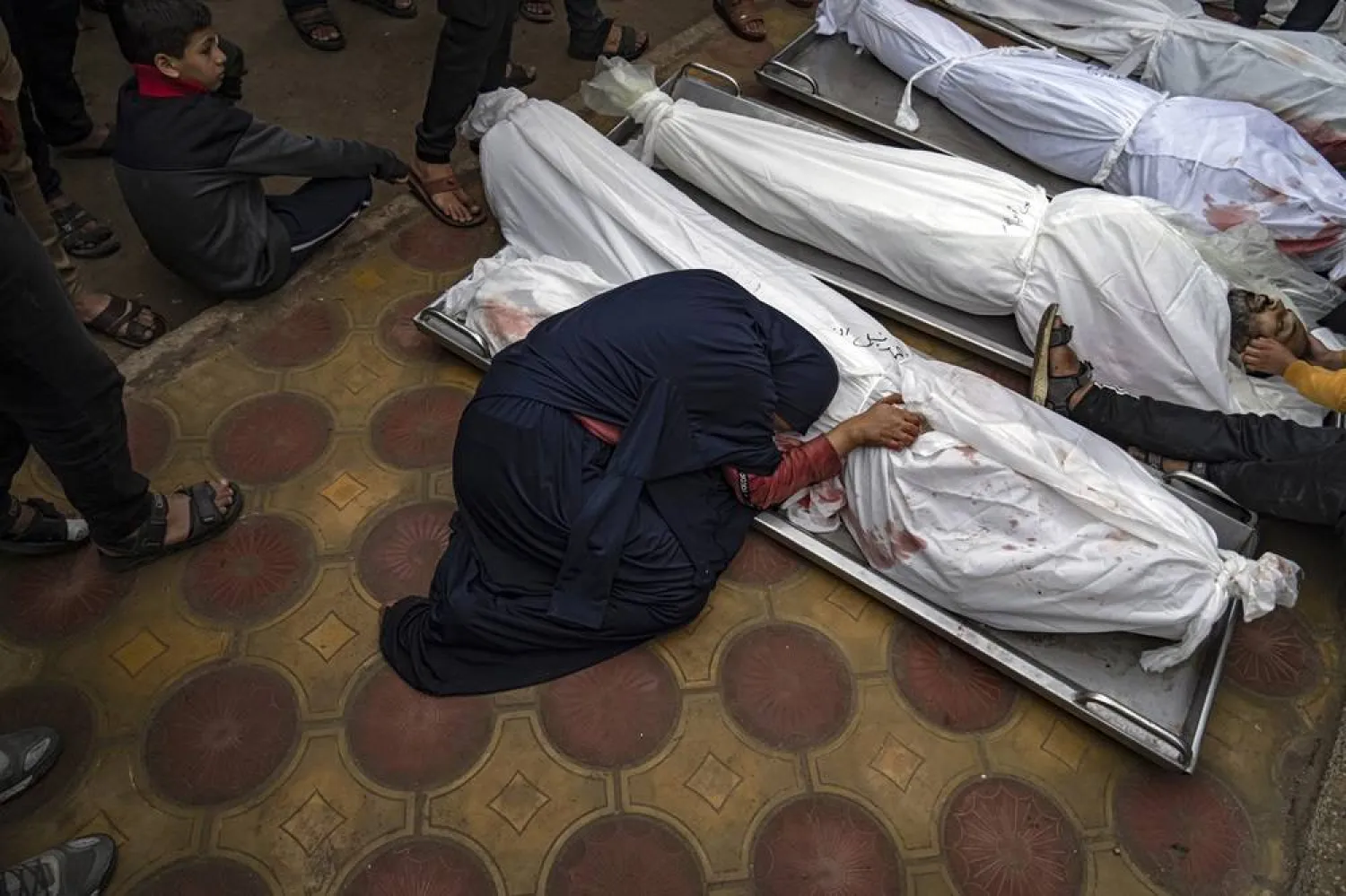
A woman mourns the covered bodies of her child and her husband killed in an Israeli army bombardment of the Gaza Strip, in the hospital in Khan Younis, Tuesday Dec. 5, 2023. (AP)
TT

More than 40,000 Palestinians Have Been Killed in Gaza, Territory’s Health Ministry Says

A woman mourns the covered bodies of her child and her husband killed in an Israeli army bombardment of the Gaza Strip, in the hospital in Khan Younis, Tuesday Dec. 5, 2023. (AP)

More than 40,000 Palestinians have been killed in the Israel-Hamas war in Gaza, the territory’s Health Ministry said Thursday.

Israel’s offensive has also wounded 92,401 people and displaced over 85% of the population from their homes, the ministry in Hamas-run Gaza said. It does not distinguish between civilians and militants in its toll.

The announcement came during yet another push from international mediators to broker a ceasefire in the war, now in its 11th month.

The conflict began Oct. 7 after Hamas-led fighters attacked southern Israel, killing some 1,200 people — most of them civilians — and dragging roughly 250 hostages to Gaza.

Israel says 111 of the captives have not been released, including the bodies of 39. The hostages include 15 women and two children under the age of 5.

In Gaza, health officials have struggled to fully identify the dead as bodies stream into overwhelmed hospitals and morgues where they say the count is compiled amid the chaos of war and displacement.

In its most recent detailed report on the dead, issued Thursday, the ministry said 40,005 people have been killed. Health officials and civil defense workers say the true toll is likely thousands higher, since many bodies remain buried under the rubble of buildings destroyed in airstrikes.

Israel’s air and ground offensive in Gaza has been one of the most devastating military campaigns in recent history.

The bombardment and shelling have killed entire Palestinian families. With cemeteries often unreachable, families fleeing Israeli airstrikes bury their dead wherever possible — in backyards, along roadsides and under the staircases of their homes.

Israel says it aims to eliminate Hamas. It blames Hamas for civilian deaths because fighters operate in civilian areas and have built extensive tunnel networks underneath them. Israeli forces have regularly targeted mosques, schools, hospitals and cemeteries where it claims fighters or tunnels are located, often causing civilian casualties.

The fighting has also killed 329 Israeli soldiers. The Israeli military claims around 15,000 Hamas fighters are among those killed in Gaza but has not provided evidence.

Nearly 85% of Gaza’s 2.3 million people have been driven from their homes, fleeing multiple times across the territory to escape ground offensives. During the war, thousands within Israel and in southern Lebanon have also been displaced.

The assault has created a massive humanitarian crisis in Gaza. The entire territory is at high risk of famine and over 495,000 people — more than a fifth of the population — are expected to experience the most severe level of hunger in the next months, according to the latest report by the leading authority on measuring hunger.

Sanitation systems have been destroyed, leaving pools of sewage and towers of garbage in tent camps packed with displaced families.

The offensive likely either damaged or destroyed 59% of all structures in Gaza by July 3, including 70% of buildings in north Gaza, according to an analysis of satellite data by Corey Scher and Jamon Van Den Hoek, experts in mapping damage during war.

The conflict has sparked fears of a wider regional war, with Lebanon’s Hezbollah and the Israeli military trading fire almost daily over their countries’ border.

More than 500 people have been killed on the Lebanese side, including some 350 Hezbollah members and 50 fighters from other armed groups, with the rest civilians. In Israel, 22 soldiers and 24 civilians have been killed.



Report: Iran’s Ambassador Won’t Leave Lebanon Despite Expulsion

Iranian Ambassador to Syria Mohammad Reza Sheibani, shows his ink-stained finger as he votes in the first round of the Iranian presidential election on June 14, 2013 at the Iranian embassy in the Syrian capital, Damascus. (AFP)
TT

Report: Iran’s Ambassador Won’t Leave Lebanon Despite Expulsion

Iranian Ambassador to Syria Mohammad Reza Sheibani, shows his ink-stained finger as he votes in the first round of the Iranian presidential election on June 14, 2013 at the Iranian embassy in the Syrian capital, Damascus. (AFP)

Iran's ambassador will not leave Lebanon despite being declared persona non grata and ordered to leave the country by Sunday, an Iranian diplomatic source told AFP.

"The ambassador will not leave Lebanon, in accordance with the wishes of the speaker of parliament Nabih Berri and of Hezbollah," the source said, speaking on condition of anonymity.

Hezbollah has denounced the decision while Berri's Amal party joined Hezbollah ministers in boycotting a cabinet session this week in protest at the order to expel Mohammad Reza Sheibani.

The foreign ministry this week gave Tehran's envoy until Sunday to leave in the latest unprecedented step by Lebanese authorities since a new war erupted on March 2 between Israel and Hezbollah.

The ministry accused him of making statements "interfering in Lebanon's internal politics".

French Foreign Minister Jean-Noel Barrot called the expulsion "a courageous decision".

The Lebanese authorities have banned Hezbollah's military and security activities. It is the only armed non-state group in the country and a close ally of Iran.

It has also banned the presence and operations of Iran's Revolutionary Guards whom Prime Minister Nawaf Salam accused of directing Hezbollah operations against Israel.


Netanyahu Says Israel Will Widen Its Invasion of Southern Lebanon

Israeli army soldiers walk next to a self-propelled Howitzer artillery gun positioned in the upper Galilee in northern Israel near the border with southern Lebanon on March 29, 2026. (AFP)
TT

Netanyahu Says Israel Will Widen Its Invasion of Southern Lebanon

Israeli army soldiers walk next to a self-propelled Howitzer artillery gun positioned in the upper Galilee in northern Israel near the border with southern Lebanon on March 29, 2026. (AFP)

Prime Minister Benjamin Netanyahu announced Sunday that Israel will widen its invasion of southern Lebanon.

Netanyahu said Israel would expand what he called the “existing security strip” in Lebanon as Israeli forces continue to target the Iranian-backed Hezbollah militant group.

“We are determined to fundamentally change the situation in the north,” he said on a visit to northern Israel.

Netanyahu said Hezbollah still retained "residual capabilities" to fire rockets at Israel, but the group had been severely hit by Israeli forces.

"Iran is no longer the same Iran, Hezbollah is no longer the same Hezbollah, and Hamas is no longer the same Hamas," he added.

"These are no longer terrorist armies threatening our existence -- they are defeated enemies, fighting for their own survival."

"We are determined, we are fighting, and with God's help -- we are winning," Netanyahu said.

There were no immediate details.

In Lebanon, officials say more than 1,100 people have been killed and more than one million displaced since the Iran war began.


France Condemns Houthis for Entering Middle East War

A satellite image shows Bab el-Mandab Strait off the coast of Yemen, February 27, 2026. (2026 Planet Labs PBC/Handout via Reuters)
TT

France Condemns Houthis for Entering Middle East War

A satellite image shows Bab el-Mandab Strait off the coast of Yemen, February 27, 2026. (2026 Planet Labs PBC/Handout via Reuters)

France condemned on Sunday two attacks by Yemen's Houthi militants on Israeli targets, accusing them of escalating tension in the Middle East by entering the regional war.

A Houthi spokesman said on Saturday the Iranian-backed group had fired missiles and drones towards "several vital and military sites" in Israel, the same day that Israel said it had intensified attacks on Iran's military industry.

The escalation came after more than a month of Israeli and US bombardment of Iran, to which Iran has responded by attacking US-linked interests in wealthy Gulf states.

"The Houthis should abstain from all attacks," French foreign ministry spokesman Pascal Confavreux said. He accused them of being "irresponsible".

He said everything should be done "to avoid an even greater escalation of the conflict", which has killed thousands across the region and sent energy markets into a tailspin.

The war has disrupted global maritime traffic through the Strait of Hormuz, a key waterway in the Gulf through which a fifth of the world's crude supplies pass, along with substantial shipments of gas and fertilizers.

The only alternative routes are to sail through the Red Sea on the other side of the Arabian peninsula or make the much lengthier journey around the tip of southern Africa.

From Yemen, the Houthis could potentially disrupt shipping through the Red Sea, as they did at the height of Israel's war on Gaza.

The European Union said on March 16 it would not extend the bloc's existing naval mission in the Red Sea to help re-open the Strait of Hormuz.

US President Donald Trump had lashed out at EU and NATO countries for not agreeing to escort ships through the strait.