


Quintuplets among Gaza’s Dead as Blinken Travels to the Region to Seek a Ceasefire Deal

A Palestinian man searches for bodies and survivors among the rubble of a destroyed building following an overnight Israeli airstrike on Al-Zawayda neighborhood, central Gaza Strip, 17 August 2024. EPA/MOHAMMED SABER
TT

Quintuplets among Gaza’s Dead as Blinken Travels to the Region to Seek a Ceasefire Deal

A Palestinian man searches for bodies and survivors among the rubble of a destroyed building following an overnight Israeli airstrike on Al-Zawayda neighborhood, central Gaza Strip, 17 August 2024. EPA/MOHAMMED SABER

Israeli strikes across Gaza killed 28 people overnight and into Sunday, including young quintuplets, local health officials said, as US Secretary of State Antony Blinken headed to the region to try to seal a ceasefire deal after months of negotiations.

The US and fellow mediators Egypt and Qatar said they were closing in on a deal after two days of talks in Doha, with American and Israeli officials expressing cautious optimism. But Hamas has signaled resistance to what it called new demands by Israel.

The evolving proposal calls for a three-phase process in which Hamas would release all hostages abducted during its Oct. 7 attack, which triggered the deadliest war fought between Israelis and Palestinians. In exchange, Israel would withdraw its forces from Gaza and release Palestinian prisoners.

The war has killed over 40,000 Palestinians, according to local health authorities, displaced the vast majority of the territory's 2.3 million residents and led experts to warn of famine and the outbreak of diseases like polio.

"It is as if we live a primitive life,” said Sanaa Akela, a displaced Palestinian now in the central town of Deir al-Balah, where sewage flooded some streets.

Hamas-led fighters killed some 1,200 people, mostly civilians, in the Oct. 7 attack and abducted around 250. Of those, some 110 are still believed to be in Gaza, though Israeli authorities say around a third are dead. More than 100 hostages were released in November during a weeklong ceasefire.

Several children placed in a single body bag  

The latest Israeli bombardment included a strike on a home in Deir al-Balah that killed a woman and her six children, according to Al-Aqsa Martyrs Hospital. An Associated Press reporter there counted the bodies.

Mohammed Awad Khatab, the children's grandfather, said his daughter was a teacher, and the youngest child was 18 months. The others were 10-year-old quintuplets, the hospital said.

“The six children have become body parts. They were placed in a single bag,” he told reporters. “What did they do? Did they kill any of the Jews? ... Will this provide security to Israel?”

Another strike east of Deir al-Balah killed at least four people, according to an AP journalist at the hospital. A strike in the northern town of Jabaliya hit two apartments, killing two men, a woman and her daughter, according to Gaza's Health Ministry.  

Another two strikes in central Gaza killed nine people, according to Al-Awda Hospital.  

Late Saturday, a strike near the southern city of Khan Younis killed four people from the same family, including two women, according to Nasser Hospital.

Israel says it only targets fighters and blames civilian deaths on Hamas because the group conceals gunmen, weapons, tunnels and rockets in residential areas. But the Israeli bombardment has wiped out entire extended families and orphaned thousands of children.

Israel says ‘cautious optimism’ about ceasefire talks  

Mediation efforts gained new urgency after the targeted killing of two top militants last month, both attributed to Israel, brought vows of revenge from Iran and the Lebanese Hezbollah, raising fears of an all-out war across the Middle East.

An American official said Friday that mediators were beginning preparations for implementing the latest ceasefire proposal, and Israeli Prime Minister Benjamin Netanyahu's office expressed “cautious optimism” that a deal could be reached.

An Israeli delegation was traveling to Cairo on Sunday for further talks, and Blinken will meet with Netanyahu on Monday morning.

Netanyahu told a Cabinet meeting there are areas where Israel can be flexible and unspecified areas where it won’t be. “We are conducting negotiations and not a scenario in which we just give and give,” he said.

Hamas has cast doubt on whether an agreement is near, saying the latest proposal diverged significantly from a previous iteration it had accepted in principle.  

Hamas has rejected Israel’s demands for a lasting military presence along the Gaza-Egypt border and a line bisecting Gaza where Israeli forces would search Palestinians returning to their homes. Israel says both are needed to prevent militants from rearming and returning to the north.

Israel showed flexibility on retreating from the border corridor, and a meeting between Egyptian and Israeli military officials was scheduled for the week ahead to agree on a withdrawal mechanism, according to two Egyptian officials, who spoke on condition of anonymity because they were not authorized to discuss the private negotiations.



US Slaps Sanctions on Sudan’s RSF Commanders over El-Fasher Killings

FILE - A Sudanese child, who fled el-Fasher city with family after Sudan's RSF attacked the western Darfur region, receives treatment at a camp in Tawila, Sudan, Nov. 2, 2025. (AP Photo/Mohammed Abaker, File)
TT

US Slaps Sanctions on Sudan’s RSF Commanders over El-Fasher Killings

FILE - A Sudanese child, who fled el-Fasher city with family after Sudan's RSF attacked the western Darfur region, receives treatment at a camp in Tawila, Sudan, Nov. 2, 2025. (AP Photo/Mohammed Abaker, File)

The United States announced sanctions on Thursday on three Sudanese Rapid Support Forces (RSF) commanders over their roles in the "horrific campaign" of the siege and capture of El-Fasher.

The US Treasury said the RSF carried out "ethnic killings, torture, starvation, and sexual violence" in the operation.

Earlier Thursday, the UN's independent fact-finding mission on Sudan said the siege and seizure of the city in Darfur bore "the hallmarks of genocide."

Its investigation concluded that the seizure last October had inflicted "three days of absolute horror," and called for those responsible to be brought to justice.

"The United States calls on the Rapid Support Forces to commit to a humanitarian ceasefire immediately," US Treasury Secretary Scott Bessent said in a statement.

"We will not tolerate this ongoing campaign of terror and senseless killing in Sudan."

The Treasury noted that the three sanctioned individuals were part of the RSF's 18-month siege of and eventual capture of El-Fasher.

They are RSF Brigadier General Elfateh Abdullah Idris Adam, Major General Gedo Hamdan Ahmed Mohamed and field commander Tijani Ibrahim Moussa Mohamed.

Bessent warned that Sudan's civil war risks further destabilizing the region, "creating conditions for terrorist groups to grow and threaten the safety and interests of the United States."

The UN probe into the takeover of El-Fasher -- after the 18-month siege -- concluded that thousands of people, particularly from the Zaghawa ethnic group, "were killed, raped or disappeared."


Israel's Netanyahu Says No Reconstruction of Gaza before Demilitarization

Israel’s Prime Minister Benjamin Netanyahu - File Photo/AFP
TT

Israel's Netanyahu Says No Reconstruction of Gaza before Demilitarization

Israel’s Prime Minister Benjamin Netanyahu - File Photo/AFP

Israeli Prime Minister Benjamin Netanyahu said on Thursday there would be no reconstruction of war-shattered Gaza before the disarmament of Hamas, as the "Board of Peace" convened for its inaugural meeting in Washington.

Around two dozen world leaders and senior officials met for the first meeting of the board, which was set up after the United States, Qatar and Egypt negotiated a ceasefire in October to halt two years of war in the Gaza Strip.

"We agreed with our ally the US there will be no reconstruction of Gaza before the demilitarization of Gaza," Netanyahu said during a televised speech at a military ceremony on Thursday, AFP reported.

The meeting in Washington will also look at how to launch the International Stabilization Force (ISF) that will ensure security in Gaza.

One of the most sensitive issues before the board is the future of the Islamist movement Hamas, which fought the war with Israel and still exerts influence in the territory.

Disarmament of the group is a central Israeli demand and a key point in negotiations over the ceasefire's next stage.

US officials including Steve Witkoff, Trump's friend and roving negotiator, have insisted that solid progress is being made and that Hamas is feeling pressure to give up weapons.

Israel has suggested sweeping restrictions including seizing small personal rifles from Hamas.

It remains unclear whether, or how, the Palestinian technocratic committee formed to handle day-to-day governance of Gaza will address the issue of demilitarization.

The 15-member National Committee for the Administration of Gaza (NCAG) will operate under the supervision of the "Board of Peace", and its head, Ali Shaath, is attending the meeting in Washington on Thursday.


Trump Tells First Meeting of Board of Peace that $7 billion Raised for Gaza

US President Donald Trump speaking in Washington - AFP
TT

Trump Tells First Meeting of Board of Peace that $7 billion Raised for Gaza

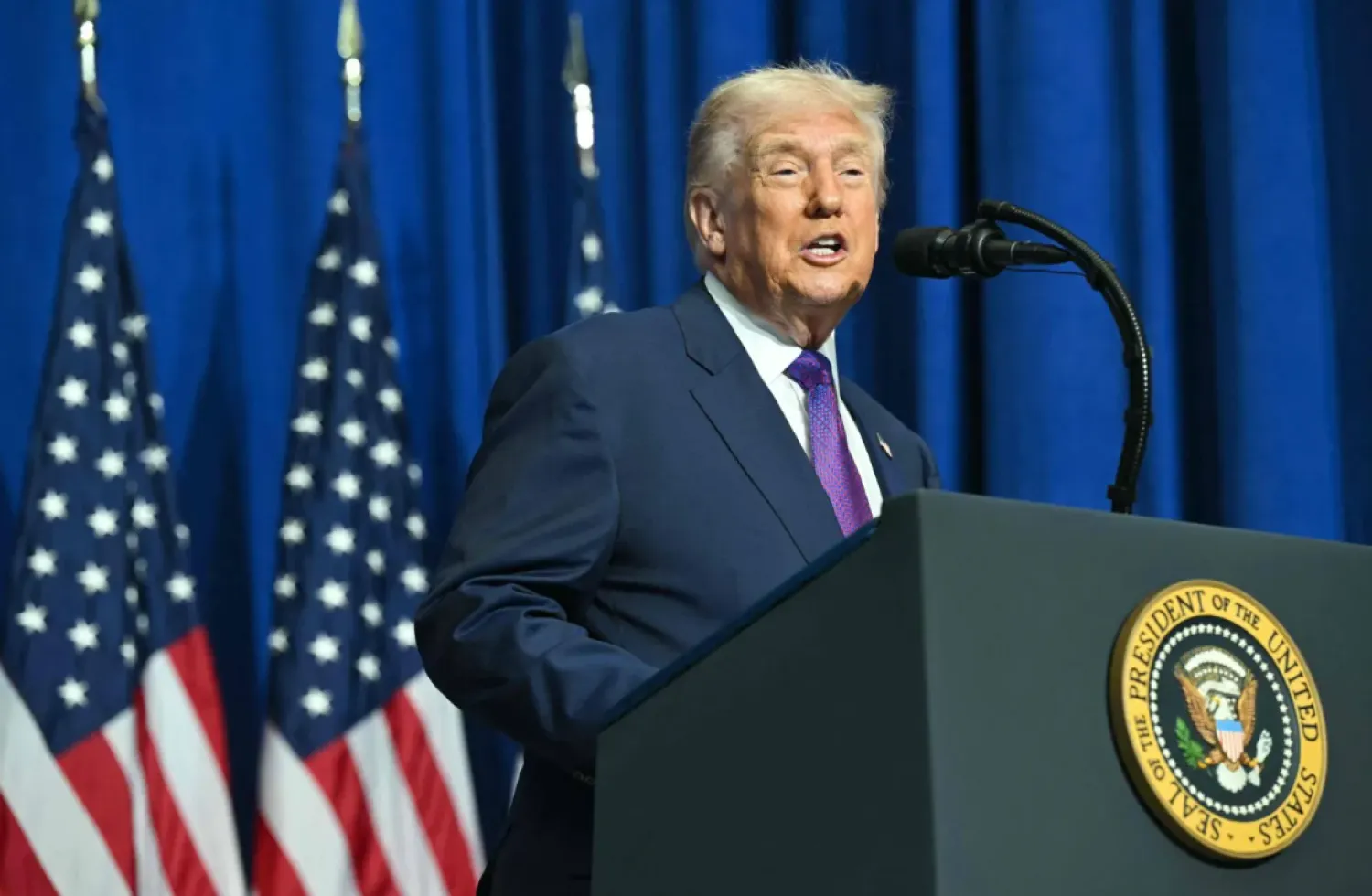
US President Donald Trump speaking in Washington - AFP

US President Donald Trump told the first meeting of his Board of Peace on Thursday that $7 billion has been contributed to a Gaza reconstruction fund that aims to rebuild the enclave once Hamas disarms, an objective that is far from becoming a reality.

The disarmament of Hamas militants and accompanying withdrawal of Israeli troops, the size of the reconstruction fund and the flow of humanitarian aid to the war-battered populace of Gaza are among the major questions likely to test the effectiveness of the board in the weeks and months ahead.

In a flurry of announcements at the end of a long, winding speech, Trump said the United States will make a contribution of $10 billion to the Board of Peace. He said contributing nations had raised $7 billion as an initial down payment for Gaza reconstruction.

Trump first proposed the board last September when he announced his plan to end Israel's war in Gaza. He later made clear the board's remit would be expanded beyond Gaza to tackle other conflicts worldwide.

Trump also said FIFA will raise $75 million for soccer-related projects in Gaza and that the United Nations will chip in $2 billion for humanitarian assistance.

TRUMP SAYS ANY IRAN DEAL MUST BE MEANINGFUL, PROSPECTS SHOULD BE CLEAR IN 10 DAYS

The Board of Peace includes Israel but not Palestinian representatives and Trump's suggestion that the Board could eventually address challenges beyond Gaza has stirred anxiety that it could undermine the UN's role as the main platform for global diplomacy and conflict resolution.

"We're going to strengthen the United Nations," Trump said, trying to assuage his critics. "It's really very important."

The meeting came as Trump threatens war against Iran and has embarked on a massive military buildup in the region in case Tehran refuses to give up its nuclear program.

Trump said he should know in 10 days whether a deal is possible. "We have to have a meaningful deal," he said.

The event had the feel of a Trump campaign rally, with music blaring from his eclectic playlist from Elvis Presley to the Beach Boys. Red Trump hats were given to participants.

Senior US officials said Trump will also announce that several nations are planning to send thousands of troops to participate in an International Stabilization Force that will help keep the peace in Gaza when it eventually deploys.

Hamas, fearful of Israeli reprisals, has been reluctant to hand over weaponry as part of Trump's 20-point Gaza plan that brought about a fragile ceasefire last October in the two-year Gaza war.

Trump said he hoped use of force to disarm Hamas would not be necessary. He said Hamas had promised to disarm and it "looks like they're going to be doing that, but we'll have to find out."