


Blinken Visits Gaza Mediators in Pursuit of Ceasefire Deal as Hamas, Israel Signal Challenges

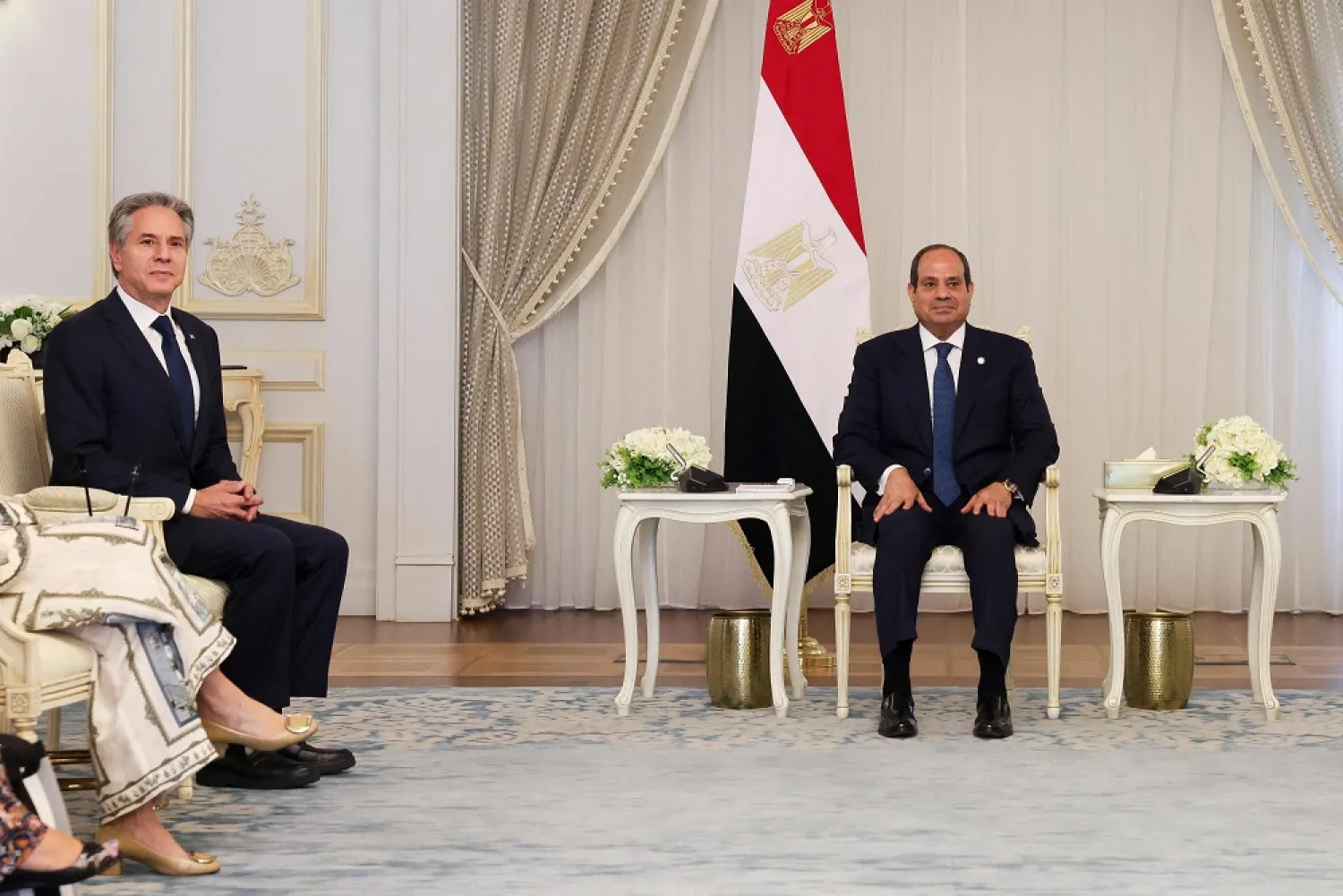
US Secretary of State Antony Blinken (L) meets with Egyptian President Abdel Fattah al-Sisi in El-Alamein on August 20, 2024. (AFP)
TT

Blinken Visits Gaza Mediators in Pursuit of Ceasefire Deal as Hamas, Israel Signal Challenges

US Secretary of State Antony Blinken (L) meets with Egyptian President Abdel Fattah al-Sisi in El-Alamein on August 20, 2024. (AFP)

US Secretary of State Antony Blinken was visiting fellow mediators Egypt and Qatar as he pressed ahead Tuesday with the latest diplomatic mission to secure a ceasefire in the war in Gaza, even as Hamas and Israel signaled that challenges remain.

Egyptian President Abdel Fattah al-Sisi warned on Tuesday of the risk of the Gaza war expanding regionally in a way "difficult to imagine" during a meeting with Blinken, the Egyptian presidency said.

Hamas in a new statement called the latest ceasefire proposal presented to it a "reversal" of what it agreed to previously and accused the US of acquiescing to what it called "new conditions" from Israel. There was no immediate US response.

Israeli Prime Minister Benjamin Netanyahu, meanwhile, told relatives of hostages in Gaza that a key goal is to "preserve our strategic security assets in the face of great pressures from home and abroad." He noted the "capture" of a narrow buffer zone along the Gaza-Egypt border that Israel calls the Philadelphi corridor. Neither Hamas nor Egypt wants an Israeli presence there.

The meeting came as Israel's military said it recovered the bodies of six hostages taken in Hamas’ Oct. 7 attack that started the war, bringing fresh grief for many Israelis who have long pressed Netanyahu to agree to a ceasefire that would bring remaining hostages home.

Blinken's meetings in Egypt and upcoming ones in Qatar come a day after he met in Israel with Netanyahu and said the prime minister had accepted a US proposal to bridge gaps separating Israel and Hamas. Blinken called on the armed group to do the same.

But there still appear to be wide gaps between the two sides, including Israel’s demand for lasting control over strategic corridors in Gaza, which Hamas has rejected.

Pressure to seal a ceasefire deal has been especially urgent after the recent targeted killings of militant leaders of Hamas and Hezbollah in Iran and Lebanon, both blamed on Israel, and vows of retaliation that have sparked fears of a wider regional war.

Israel's military said its forces recovered the bodies in an overnight operation in southern Gaza, without saying when or how the six died. A forum for hostage families said they were kidnapped alive. Hamas says some captives have been killed and wounded in Israeli airstrikes.

The recovery of the remains is a blow to Hamas, which hopes to exchange hostages for Palestinian prisoners, an Israeli withdrawal and a lasting ceasefire. But it was also likely to increase pressure on Israel's government to reach a deal to free dozens of hostages who are still believed to be alive.

The military said it had identified the remains of Chaim Perry, 80; Yoram Metzger, 80; Avraham Munder, 79; Alexander Dancyg, 76; Nadav Popplewell, 51; and Yagev Buchshtav, 35. Metzger, Munder, Popplewell and Buchshtav had family members who were also abducted but freed during a November ceasefire.

Munder's death was confirmed by Kibbutz Nir Oz, the farming community where he was among around 80 residents who were taken captive. It said he died "after enduring months of physical and mental torture." Israeli authorities had previously determined that the other five were deceased.

Netanyahu praised the recovery effort and said "our hearts ache for the terrible loss," and vowed that Israel would make every effort to bring all hostages home, dead or alive.

There were no immediate reports of any casualties among Israelis or Palestinians in the recovery operation.

Hamas is still believed to be holding around 110 hostages captured in the Oct. 7 attack. Israeli authorities estimate around a third of them are dead.

Hamas-led fighters burst through Israel's defenses on Oct. 7 and rampaged across the south, killing some 1,200 people, mostly civilians, and taking around 250 people hostage. Over 100 hostages were released in exchange for Palestinians imprisoned in Israel during a weeklong ceasefire last year.

Israel's retaliatory offensive has killed over 40,000 Palestinians, according to Gaza's Health Ministry, which does not say how many were militants. Air and ground operations have caused widespread destruction and forced the vast majority of Gaza's 2.3 million residents to flee their homes, often multiple times. Aid groups fear the outbreak of diseases like polio.

An Israeli airstrike on Tuesday killed at least 10 people at a school-turned-shelter in Gaza City, in what the military said was a precise strike on a Hamas command center. Another strike killed a mother and her five children in central Gaza.

The Palestinian Civil Defense, first responders operating under the Hamas-run government, said they were still searching for survivors after the strike on the Mustafa Hafez school in Gaza City. It said around 700 people were sheltering at the school when it was hit.

The Israeli military said the strike targeted Hamas militants who had set up a command center inside the school and were planning and launching attacks.

An Israeli airstrike in central Gaza killed five children and their mother, according to the nearby Al-Aqsa Martyrs Hospital, where an Associated Press reporter counted the bodies. The hospital said the father, Alaa Abu Zeid, a schoolteacher, has been in Israeli detention for the last nine months.



Syria Closes ISIS-linked al-Hol Camp after Emptying it

18 February 2026, Syria, Al-Hol: A view of al-Hol camp. Photo: Moawia Atrash/dpa
TT

Syria Closes ISIS-linked al-Hol Camp after Emptying it

18 February 2026, Syria, Al-Hol: A view of al-Hol camp. Photo: Moawia Atrash/dpa

Syrian authorities have closed al-Hol camp, which long housed relatives of suspected ISIS militants, after emptying the formerly Kurdish-controlled facility, a camp official told AFP on Sunday.

"All Syrian and non-Syrian families were relocated," Fadi al-Qassem, the official appointed by the government to manage al-Hol's affairs told AFP.

Al-Hol, located in a desert region of Hasakeh province, had been Syria's largest camp housing relatives of suspected ISIS fighters.

Last month, the government took over the camp from its Kurdish administrators, who had long run it, as Kurdish forces ceded territory and Damascus extended its control across swathes of Syria's northeast.

Since then, thousands of family members of foreign militants have left for unknown destinations.

The facility had housed some 24,000 people, mostly Syrians but also Iraqis and more than 6,000 other foreigners of around 40 nationalities.

Qassem said security forces were searching the tents for any remaining families.

Earlier this week, authorities had started evacuating the remaining residents, taking them to a camp in Akhtarin, in the north of Aleppo province.

Some of the families were taken elsewhere, Qassem said, without specifying the location.

"The camp's residents are children and women who need support for their reintegration," he added.

A source in a humanitarian organization that was active in the camp told AFP: "We evacuated all our teams working inside the camp, dismantled all our equipment and prefabricated rooms and moved them out of the camp".

Last week, the US military said it had completed the transfer of thousands of ISIS suspects, including many Syrians but also Westerners, to Iraq, after they were held in Kurdish-run prisons in northeast Syria for years.


Palestinian Foreign Ministry Condemns US Ambassador to Israel’s Statements

The Israeli settlement of Har Homa, seen from the West Bank city of Bethlehem, Tuesday, Dec. 17, 2024. (AP)
TT

Palestinian Foreign Ministry Condemns US Ambassador to Israel’s Statements

The Israeli settlement of Har Homa, seen from the West Bank city of Bethlehem, Tuesday, Dec. 17, 2024. (AP)

The Palestinian Ministry of Foreign Affairs and Expatriates condemned statements by the US ambassador to Israel, in which he claimed that Israel has the right to exercise control over the entire Middle East.

The ministry emphasized that these provocative statements constitute a blatant call for aggression against the sovereignty of states.

It added that they support the continuation of the occupation’s war of genocide and displacement, as well as the implementation of its annexation and expansionist plans against the Palestinian people, SPA reported.

The Palestinian foreign ministry pointed out that the statements contradict religious and historical facts and international law, SPA reported.

It called on the US administration to take a clear stance regarding its ambassador to Israel’s remarks, which are completely at odds with the US president’s position rejecting the annexation of the West Bank.


Israel Carries Out More Strikes in Lebanon amid Lack of Int’l Assurances on Wider Regional Escalation

People gather near a building damaged in an Israeli strike in the village of Bednayel in eastern Lebanon, 21 February 2026. EPA/WAEL HAMZEH
TT

Israel Carries Out More Strikes in Lebanon amid Lack of Int’l Assurances on Wider Regional Escalation

People gather near a building damaged in an Israeli strike in the village of Bednayel in eastern Lebanon, 21 February 2026. EPA/WAEL HAMZEH

Lebanese officials say the country has yet to obtain firm or decisive Western guarantees that it will be spared from a larger confrontation in the region as speculation grows over a potential US strike on Iran.

Chief concerns center on whether Hezbollah would be targeted as part of any large-scale strike, or whether the group might intervene militarily alongside Tehran.

Ministerial sources said Israeli airstrikes on Hamas in the Ain al-Hilweh Palestinian refugee camp in southern Lebanon, as well as overnight raids targeting Hezbollah in the eastern Bekaa Valley fall within the pattern of ongoing military operations Lebanon, particularly targeted assassinations against figures linked to both groups.

The sources told Asharq Al-Awsat Lebanon has not received explicit Western assurances that it would not be drawn into a wider confrontation if the conflict expands.

On Hezbollah’s position, the sources noted that the group has not offered a clear position on how it would respond to potential developments.

They pointed to behind-the-scenes efforts led primarily by Parliament Speaker Nabih Berri who believes “Hezbollah will not take any step if Iran is struck.”

Although Hezbollah has previously declared it “would stand idle” in case of escalation, the sources said the party has not announced any specific military plans.

Statements made by its officials have been vague, they added, citing remarks by head of Hezbollah’s parliamentary bloc Mohammad Raad, who stressed on Friday the party’s commitment to “the security and stability of the country and the continuation of normal life.”

In Lebanon’s official response, President Joseph Aoun strongly condemned the Israeli raids carried out overnight by land and sea, which targeted the Sidon area and towns in the Bekaa.

He described the continued attacks as “blatant aggression” aimed at sabotaging Lebanon’s diplomatic efforts with brotherly and friendly nations - foremost among them the United States - to consolidate stability and halt Israeli hostilities.

Aoun said the strikes were a renewed violation of Lebanon’s sovereignty and a clear breach of international obligations, particularly United Nations Security Council Resolution 1701, which calls for a cessation of hostilities and full implementation of its provisions.

The president renewed his appeal to countries supporting regional stability to assume their responsibilities by pressing for an immediate halt to the attacks and ensuring respect for international resolutions in a way that preserves Lebanon’s sovereignty, security, and territorial integrity, and prevents further escalation.