World Food Program Launches Probe Into its Sudan Operations

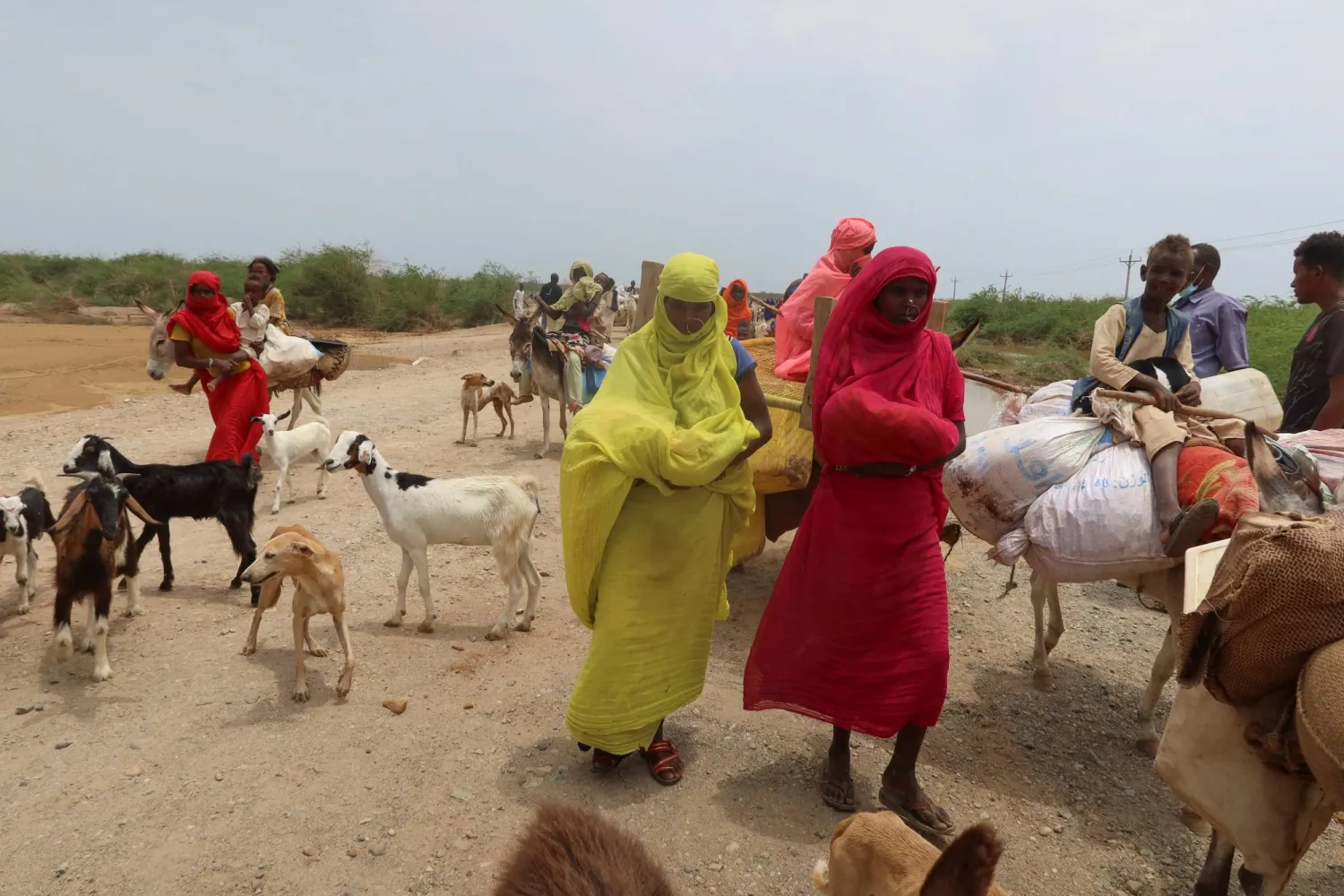
Evacuees move their belongings on donkeys, following devastating floods, in Tokar, Red Sea State, Sudan, August 28, 2024. REUTERS/El Tayeb Siddig
TT

World Food Program Launches Probe Into its Sudan Operations

Evacuees move their belongings on donkeys, following devastating floods, in Tokar, Red Sea State, Sudan, August 28, 2024. REUTERS/El Tayeb Siddig

The UN World Food Program is investigating two of its top officials in Sudan over allegations including fraud and concealing information from donors about its ability to deliver food aid to civilians amid the nation’s dire hunger crisis, according to 11 people with knowledge of the probe.
The investigation by the WFP’s Office of the Inspector General (OIG) comes as the UN’s food-aid arm is struggling to feed millions of people in war-plagued Sudan, now suffering one of the world’s most severe food shortages in years.
As part of the probe, investigators are looking at whether WFP staff sought to hide the alleged role of Sudan’s army in obstructing aid amid a brutal 16-month war with a rival paramilitary for control of the country, according to five of the sources who spoke to Reuters.
One of those being examined in the inquiry is the WFP’s deputy country director in Sudan, Khalid Osman, who has been given a “temporary duty assignment” outside Sudan, a de facto suspension, according to six sources.
A second senior official, WFP area manager Mohammed Ali, is being investigated in connection with the alleged disappearance of more than 200,000 liters of the UN organization’s fuel in the Sudanese city of Kosti, according to four sources. Reuters could not confirm whether Ali remains in his role.
Osman and Ali declined to comment when contacted by Reuters, referring the news agency to the WFP’s media office.
Asked about the probe by Reuters, the WFP said that “allegations of individual misconduct related to irregularities in pockets of our operation in Sudan” are under urgent review by its inspector general’s office. It declined to comment on the nature of alleged wrongdoing or the status of specific employees.
The US government’s aid agency, USAID, told Reuters in a statement that it was notified by the WFP on Aug. 20 of “potential incidents of fraud affecting WFP operations in Sudan.” USAID says it is the single largest donor to the WFP, providing nearly half of all contributions in a typical year.
“These allegations are deeply concerning and must be thoroughly investigated,” the USAID statement said. “USAID immediately referred these allegations to the USAID Office of the Inspector General."



Israeli-Backed Group Kills a Senior Hamas Police Officer in Gaza, Threatens More Attacks

Palestinians walk along a road amid destroyed buildings in Jabalia, in the northern Gaza Strip, on January 10, 2026. (AFP)
TT

Israeli-Backed Group Kills a Senior Hamas Police Officer in Gaza, Threatens More Attacks

Palestinians walk along a road amid destroyed buildings in Jabalia, in the northern Gaza Strip, on January 10, 2026. (AFP)

An Israeli-backed Palestinian group said on Monday it had killed a senior Hamas police officer in the southern Gaza Strip, an incident which Hamas blamed on "Israeli collaborators".

A statement from the Hamas-run interior ministry said gunmen opened fire from a passing car, ​killing Mahmoud Al-Astal, head of the criminal police unit in Khan Younis, in the south of the enclave. It described the attackers as "collaborators with the occupation".

Hussam Al-Astal, leader of an anti-Hamas group based in an area under Israeli control east of Khan Younis, claimed responsibility for the killing in a video he posted on his Facebook page. The surname he shares with the dead man, Al-Astal, is common in that part of Gaza.

"To those who work with Hamas, your destiny is to be killed. Death is coming to you," he ‌said, dressed in ‌a black military-style uniform and clutching an assault rifle.

Reuters could ‌not ⁠independently ​verify ‌the circumstances of the attack. An Israeli military official said the army was not aware of any operations in the area.

The emergence of armed anti-Hamas groups, though still small and localized, has added pressure on the movement and could complicate efforts to stabilize and unify a divided Gaza, shattered by two years of war.

These groups remain unpopular among the local population as they operate in areas under Israeli control, although they publicly deny they take Israeli orders. Hamas has held public executions ⁠of people it accuses of collaboration.

Under a ceasefire in place since October, Israel has withdrawn from nearly half of ‌the Gaza Strip, but its troops remain in control of ‍the other half, largely a wasteland ‍where virtually all buildings have been levelled.

Nearly all of the territory's two million people ‍now live in Hamas-held areas, mostly in makeshift tents or damaged buildings, where the group has been reasserting its grip. Four Hamas sources said it continues to command thousands of fighters despite suffering heavy losses during the war.

Israel has been allowing rivals of Hamas to operate in areas it controls. In ​later phases, US President Donald Trump's plan for Gaza calls for Israel to withdraw further and for Hamas to yield power to an internationally backed administration, ⁠but there has so far been no progress towards those steps.

Prime Minister Benjamin Netanyahu acknowledged Israeli backing for anti-Hamas groups in June, saying Israel had "activated" clans, but has given few details since then.

The ceasefire has ended major combat in Gaza over the past three months, but both sides have accused the other of regular violations. More than 440 Palestinians and three Israeli soldiers have been killed since the truce took effect.

Gaza health authorities said on Monday Israeli drone fire killed at least three people near the center of Khan Younis.

The Israeli military did not have an immediate comment on the drone incident.

The war erupted on October 7, 2023 when Gazan fighters invaded Israel, killing about 1,200 people and taking some 250 hostages, according to ‌Israeli tallies.

Israel’s subsequent military assault on Gaza has killed more than 71,000 Palestinians, according to the enclave’s health ministry, and led to accusations of genocide and war crimes, which Israel denies.


Hamas Postpones Election of Political Bureau Chief Indefinitely

(From left) Nizar Awadallah, Khalil al-Hayya and Mohammad Ismail Darwish during a meeting with Iran’s Supreme Leader Ali Khamenei last February 2025. (Khamenei's website/AFP)
TT

Hamas Postpones Election of Political Bureau Chief Indefinitely

(From left) Nizar Awadallah, Khalil al-Hayya and Mohammad Ismail Darwish during a meeting with Iran’s Supreme Leader Ali Khamenei last February 2025. (Khamenei's website/AFP)

Senior sources within Hamas said the movement has decided to postpone the election of the head of its political bureau, which had been scheduled to take place within the first ten days of January.

The sources told Asharq Al-Awsat that the decision to delay the vote was taken “until further notice,” noting that no new date has been set, although elections “could be held at any moment.”

One source attributed the postponement to “security and political conditions,” as well as Hamas’ current preoccupation with negotiations aimed at moving to the second phase of the ceasefire, amid intensified mediation efforts involving regional brokers and the United States.

Other sources pointed to additional factors, including internal disagreements over organizational arrangements within the Gaza Strip, which have deepened in recent days and are now the subject of efforts to resolve them.

Hamas is facing what sources described as its most severe crisis since its founding in 1987. Israeli strikes launched after the Oct. 7, 2023 attack have targeted various levels and wings of the movement, triggering significant organizational and financial challenges.

Sources said the accelerating momentum surrounding a possible transition to the second phase of the ceasefire has become the main concern for Hamas’s leadership. While electing a new head of the political bureau is seen as a key step in reorganizing the movement’s internal affairs, the process may take longer than initially expected, they added.

Only days ago, sources had told Asharq Al-Awsat that the elections were expected to be held within the first ten days of the new year, with the aim of reinforcing internal stability and reassuring the outside world that the movement remains cohesive.

Those sources said at the time that electing a political bureau chief would not end the role of the current leadership council formed after the assassinations of Ismail Haniyeh and Yahya al-Sinwar. The council would instead continue as an advisory body overseeing Hamas’ internal and external affairs.

Asked whether internal divisions exist over who should lead Hamas, one source said only that “the electoral process is conducted according to established rules and regulations, and there are no disputes over the individual who will lead the movement.”

However, there have been suggestions that Khaled Meshaal, head of Hamas’s political bureau abroad, and Khalil al-Hayya, head of the political bureau in Gaza, are the top contenders for the post.

Some sources said there is strong support within Hamas’ external leadership and in the West Bank for Meshaal to assume the role, while a majority in Gaza favors al-Hayya.

The sources did not rule out the emergence of a third, currently unidentified figure. “Nothing can be predicted at this stage,” one source said. “What is happening should not be seen as rivalry driven by internal disputes over leadership, but rather as a healthy competitive process.”


Syrian Army on Alert after SDF Armed Groups Detected East of Aleppo

People walk down a street as a car drives by following a ceasefire which ended days of fighting between Syrian security forces and Kurdish fighters in the Kurdish-majority Sheikh Maqsoud neighborhood, of the northern city of Aleppo on January 11, 2026. (AFP)
TT

Syrian Army on Alert after SDF Armed Groups Detected East of Aleppo

People walk down a street as a car drives by following a ceasefire which ended days of fighting between Syrian security forces and Kurdish fighters in the Kurdish-majority Sheikh Maqsoud neighborhood, of the northern city of Aleppo on January 11, 2026. (AFP)

The Syrian army went on alert on Sunday after detecting armed groups aligned with the Syrian Democratic Forces (SDF) east of Aleppo city.

In statements to the SANA state news agency, the Operations Command said that the nature and objectives of these military reinforcements and troop concentrations brought by the SDF to eastern Aleppo have not yet been identified.

The Command added that Syrian army forces have been placed on full alert, deployment lines east of Aleppo have been reinforced, and all necessary measures have been taken to be ready for all possible scenarios.

First responders on Sunday entered a contested neighborhood in the northern city of Aleppo after days of deadly clashes between government forces and Kurdish-led forces. Syrian state media said the military was deployed in large numbers.

The clashes broke out Tuesday in the predominantly Kurdish neighborhoods of Sheikh Maqsoud, Achrafieh and Bani Zaid after the government and the SDF, the main Kurdish-led force in the country, failed to make progress on how to merge the SDF into the national army. Security forces captured Achrafieh and Bani Zaid.

The fighting between the two sides was the most intense since the fall of then-President Bashar Assad to opposition groups in December 2024. At least 23 people were killed in five days of clashes and more than 140,000 were displaced amid shelling and drone strikes.

The Kurdish fighters have now evacuated from the Sheikh Maqsoud neighborhood to northeastern Syria, which is under the control of the SDF.

However, they said in a statement they will continue to fight now that the wounded and civilians have been evacuated, in what they called a “partial ceasefire.”