
Israel Recovers the Bodies of 6 Hostages in Gaza, Including Israeli-American Hersh Goldberg-Polin

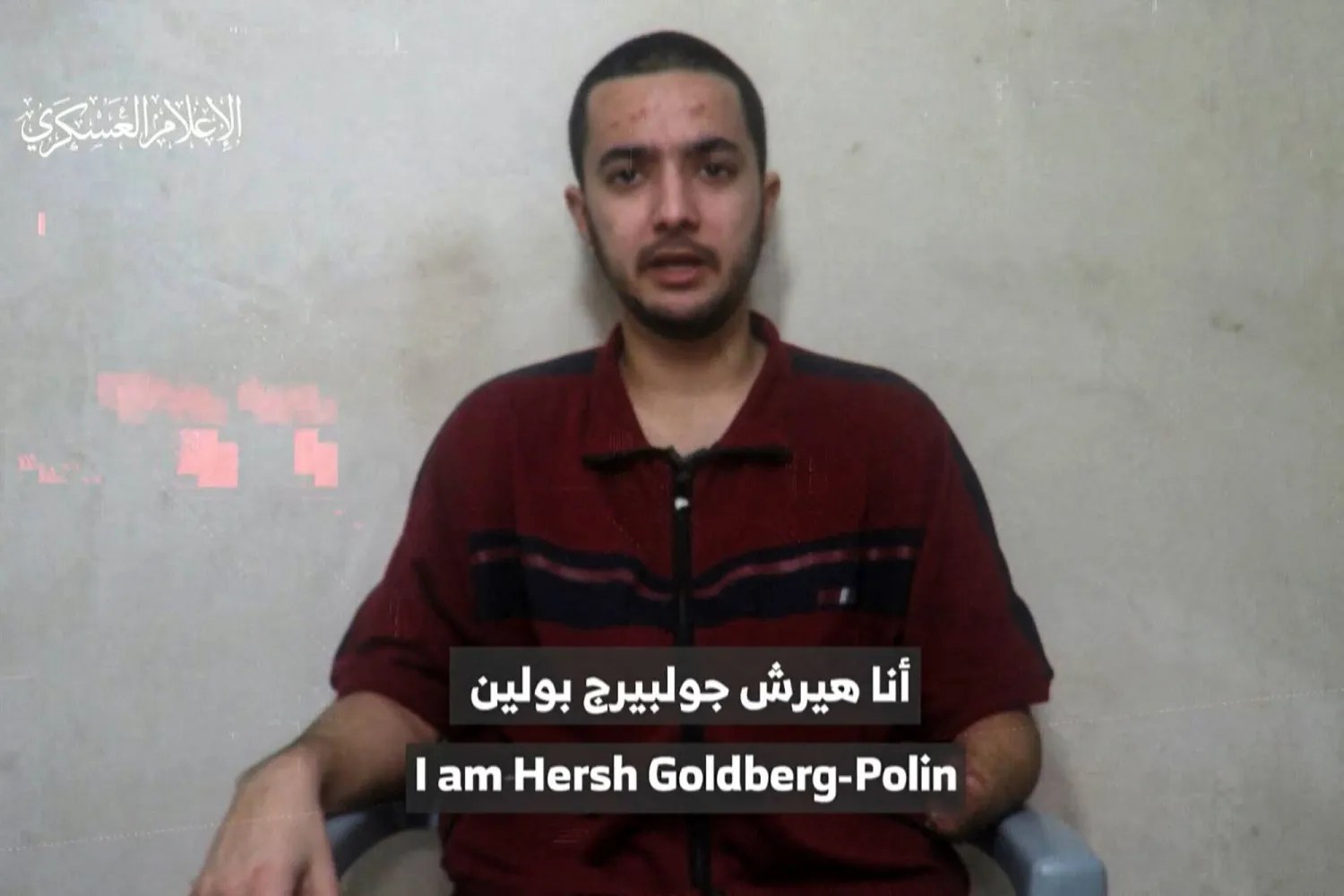
(FILES) An image grab from a video released by the media office of the Palestinian group Hamas on April 24, 2024, shows an Israeli-American man who identified himself as Hersh Goldberg-Polin, 23, one of the hostages abducted from the Nova music festival in southern Israel during the Hamas attack on October 7, 2023, speaking to a camera. (Photo by Hamas Media Office / various sources / AFP)
TT

Israel Recovers the Bodies of 6 Hostages in Gaza, Including Israeli-American Hersh Goldberg-Polin

(FILES) An image grab from a video released by the media office of the Palestinian group Hamas on April 24, 2024, shows an Israeli-American man who identified himself as Hersh Goldberg-Polin, 23, one of the hostages abducted from the Nova music festival in southern Israel during the Hamas attack on October 7, 2023, speaking to a camera. (Photo by Hamas Media Office / various sources / AFP)

Israel on Sunday said it had recovered the bodies of six hostages in Gaza, including a young Israeli-American man who became one of the most well-known captives held by Hamas as his parents met with world leaders and pressed for his release.

The military said all six had been killed shortly before the arrival of Israeli forces. Their recovery sparked calls for mass protests against Prime Minister Benjamin Netanyahu, whom many Israelis blame for failing to bring them back alive in a deal with Hamas to end the 10-month-old war. Negotiations over such a deal have dragged on for months.

Netanyahu said Israel would hold Hamas accountable for killing the hostages in "cold blood," and blamed the group for the stalled negotiations, saying "whoever murders hostages doesn’t want a deal."

Fighters seized Hersh Goldberg-Polin, 23, and four of the other hostages at a music festival in southern Israel during Hamas' Oct. 7 attack, which triggered the war.

The native of Berkeley, California, lost part of his left arm to a grenade in the attack. In April, a Hamas-issued video showed him alive but with his left hand missing, sparking new protests in Israel urging the government to do more to secure the hostages' release.

The army identified the other dead hostages as Ori Danino, 25; Eden Yerushalmi, 24; Almog Sarusi, 27; and Alexander Lobanov, 33; who were also taken from the music festival. The sixth, Carmel Gat, 40, was abducted from the nearby farming community of Be'eri.

It said the bodies were recovered from a tunnel in the southern Gaza city of Rafah, around a kilometer (half a mile) from where another hostage, Qaid Farhan Alkadi, 52, was rescued alive last week.

Lt. Col. Nadav Shoshani, a military spokesperson, said the army believed there were hostages in the area but had no specific intelligence. He said Israeli forces found the bodies several dozen meters (yards) underground as "ongoing combat" was underway, but that there was no firefight in the tunnel itself.

He said there was no doubt that Hamas had killed them.

Hamas has offered to release the hostages in return for an end to the war, the withdrawal of Israeli forces and the release of a large number of Palestinian prisoners, including high-profile militants.

Izzat al-Rishq, a senior Hamas official, said the hostages would still be alive if Israel had accepted a US- backed ceasefire proposal that Hamas said it had agreed to back in July.

Families of hostages call for a "complete halt of the country" Netanyahu has vowed to continue the war until Hamas is destroyed and says military pressure is needed to bring home the hostages.

Israel's Channel 12 reported that he got into a shouting match at a security Cabinet meeting late Thursday with his defense minister, Yoav Gallant, who accused him of prioritizing control of a strategic corridor along the Gaza-Egypt border — a major sticking point in the talks — over the lives of the hostages.  

The Cabinet reportedly voted in favor of remaining in the corridor over the objections of Gallant, who said it would prevent a hostage deal.

An Israeli official confirmed the report and said three of the hostages — Goldberg-Polin, Yerushalmi and Gat — had been slated to be released in the first phase of a ceasefire proposal discussed back in July. The official was not authorized to brief media about the negotiations and spoke on condition of anonymity.

"In the name of the state of Israel, I hold their families close to my heart and ask forgiveness," Gallant said Sunday after the remains were recovered. He later called for the Cabinet to reverse its decision.

A forum of hostage families called for a massive protest on Sunday, demanding a "complete halt of the country" to push for the implementation of a ceasefire and hostage release.

"A deal for the return of the hostages has been on the table for over two months. Were it not for the delays, sabotage, and excuses those whose deaths we learned about this morning would likely still be alive," it said in a statement.

US President Joe Biden, who has met with Goldberg-Polin's parents, said he was "devastated and outraged."

"It is as tragic as it is reprehensible," he said. "Make no mistake, Hamas leaders will pay for these crimes. And we will keep working around the clock for a deal to secure the release of the remaining hostages."

Vice President Kamala Harris said her prayers were with the Goldberg-Polin family and condemned Hamas.

A high-profile campaign Goldberg-Polin’s parents, US-born immigrants to Israel, became perhaps the most high-profile relatives of hostages on the international stage. They met with Biden, Pope Francis and others and addressed the United Nations, urging the release of all hostages.

On Aug. 21, his parents addressed a hushed hall at the Democratic National Convention — after sustained applause and chants of "bring him home."

"This is a political convention. But needing our only son — and all of the cherished hostages — home is not a political issue. It is a humanitarian issue," said his father, Jon Polin. His mother, Rachel, who bowed her head during the ovation and touched her chest, said "Hersh, if you can hear us, we love you, stay strong, survive."

She and her husband sought to keep their son and the others held from being reduced to numbers, describing Hersh as a music and soccer lover and traveler with plans to attend university since his military service had ended.

Some 250 hostages were taken on Oct. 7. Israel now believes that 101 remain in captivity, including 35 who are believed to be dead. More than 100 were freed during a weeklong ceasefire in November in exchange for the release of Palestinians imprisoned by Israel. Eight have been rescued by Israeli forces.

Two previous Israeli operations to free hostages killed scores of Palestinians. Hamas says several hostages have been killed in Israeli airstrikes and failed rescue attempts. Israeli troops mistakenly killed three Israelis who escaped captivity in December.

Hamas-led fighters killed some 1,200 people, mostly civilians, when they stormed into southern Israel on Oct. 7, attacking army bases and several farming communities.

Israel's retaliatory offensive in Gaza has killed over 40,000 Palestinians, according to local health officials, who do not say how many were fighters. It has displaced the vast majority of Gaza's 2.3 million people, often multiple times, and plunged the besieged territory into a humanitarian catastrophe.

In a separate development Sunday, Palestinian militants killed three Israeli police officers when they opened fire on their vehicle in the West Bank, according to Israeli officials. Israel has been carrying out large-scale military raids across the occupied territory in recent days.


Sudan Clinics Could Run Out of Supplies in Weeks Due to Middle East War, Warns NGO

Sudanese women lie in beds as they receive treatment for dengue fever at Omdurman Hospital, as Sudan grapples with outbreaks of dengue and cholera amid the annual rainy season and a collapsed healthcare and infrastructure system, in Khartoum, Sudan, September 23, 2025. (Reuters)
TT

Sudan Clinics Could Run Out of Supplies in Weeks Due to Middle East War, Warns NGO

Sudanese women lie in beds as they receive treatment for dengue fever at Omdurman Hospital, as Sudan grapples with outbreaks of dengue and cholera amid the annual rainy season and a collapsed healthcare and infrastructure system, in Khartoum, Sudan, September 23, 2025. (Reuters)

Medical supplies to clinics dealing with the humanitarian crisis in Sudan could run out within two weeks unless shipments are rapidly rerouted after disruptions due to the conflict in the Middle East, the charity Save the Children said.

The expanding US-Israeli war on Iran has shaken global supply chains, with airspace closures and the halt of shipping through the Strait of Hormuz.

Some $600,000 worth of essential medicines are stuck in ports in Dubai, the charity said. About ‌90 Sudanese government-run ‌clinics serving roughly 400,000 patients rely on the ‌charity's ⁠supply of medicines, ⁠vaccines and nutritional treatment, with no in-country alternative, Save the Children's global director of supply chain, Willem Zuidema, told Reuters.

Sudan's three-year conflict has displaced millions of people and triggered one of the world's largest humanitarian crises.

"We have a couple of weeks to do this rerouting before the country's stocks run out. The clock is ticking," Zuidema said, adding that once buffer stocks are ⁠exhausted patients would not be able to access basic ‌healthcare support.

The medicines, which include antibiotics, ‌antimalarials, pain and fever medication, and pediatric injectable drugs, normally enter via Port Sudan ‌and travel by road to areas including Darfur.

UN aid chief Tom Fletcher ‌said last week the Middle East conflict is straining humanitarian supply chains, with sub-Saharan Africa and Gaza under particular pressure.

RISING COSTS, DONOR CUTS COMPOUND CRISIS

The World Health Organization also warned of growing medical supply shortages in Sudan.

"There's a huge ‌crunch in Sudan, of course, and there's also a bigger crunch in medical commodities going into certain provinces," WHO ⁠regional director ⁠Hanan Balkhy said.

Rising transport costs are impacting aid budgets heavily constrained by major donor cuts, Save the Children said, with container freight rates rising about 25–30% as some shipping firms reroute vessels around the Cape of Good Hope, adding weeks to delivery times.

The level of disruption to freight and subsequent cost impact may be worse than in the initial stages of the Ukraine war and COVID pandemic, because there is little buffer in the system after the aid cuts, Zuidema said.

"Demand will go up, but the means for us to respond - especially with the increasing fuel prices driving up cost - will go down. That's extremely worrying."

Save the Children's country budget for Sudan this year has been slashed by $4 million to $98 million.


Lebanon Transfers More Than 130 Syrian Prisoners Under Bilateral Agreement

 The Masnaa border crossing between Lebanon and Syria. (AFP file)
The Masnaa border crossing between Lebanon and Syria. (AFP file)
TT

Lebanon Transfers More Than 130 Syrian Prisoners Under Bilateral Agreement

 The Masnaa border crossing between Lebanon and Syria. (AFP file)
The Masnaa border crossing between Lebanon and Syria. (AFP file)

Lebanon transferred more than 130 Syrian detainees to their home country on Tuesday, a Lebanese judicial official and Syrian state media said, as part of an agreement the two sides signed last month.

Overcrowded Lebanese prisons host more than 2,200 Syrians held on various charges.

Many are still awaiting trial, while hundreds have been brought before military courts on charges of "terrorism" or related offences, including attacks on Lebanese forces.

Others are in custody for alleged membership in extremist or armed groups that were opposed to now ousted Syrian president Bashar al-Assad, who was supported by Lebanon's Hezbollah group during the Syrian civil war.

The judicial official told AFP that "106 convicted inmates were released from Roumieh Prison (north of Beirut), in addition to 31 others from Qobbeh Prison in Tripoli" in the country's north.

"The convoy headed to the Masnaa crossing to hand them over to the Syrian side," the official added.

Syrian state news agency SANA later reported that the detainees had reached the Syrian side of the border crossing.

It is the first batch of prisoners to be transferred under an agreement signed between the two countries in February, which will cover almost 300 convicts who have served 10 years or more in Lebanese prisons.

Under the agreement, they will be required to complete the remainder of their sentences in Syria.

"Today, the implementation of the agreement on the Syrian detainees in Lebanon and the mechanism to transport them to Syrian territory has begun," SANA quoted the charge d'affaires at Syria's embassy in Beirut, Iyad al-Hazzaa, as saying.

He said 136 detainees were among the first group, with those remaining to follow "upon completion of the necessary procedures for their release".

It was not immediately clear why there was a discrepancy in the reported number of detainees.

The issue of the detainees had been a sticking point in Beirut-Damascus relations following Assad's overthrow in December 2024.

Over the past year, both sides have repeatedly expressed their determination to open a new chapter in bilateral ties.


Civilians Pay a Heavy Price as War in Lebanon Drives Death, Displacement, UN Says

Smoke rises from the site of an Israeli airstrike that targeted an area in Beirut's southern suburbs on March 17, 2026. (AFP)
TT

Civilians Pay a Heavy Price as War in Lebanon Drives Death, Displacement, UN Says

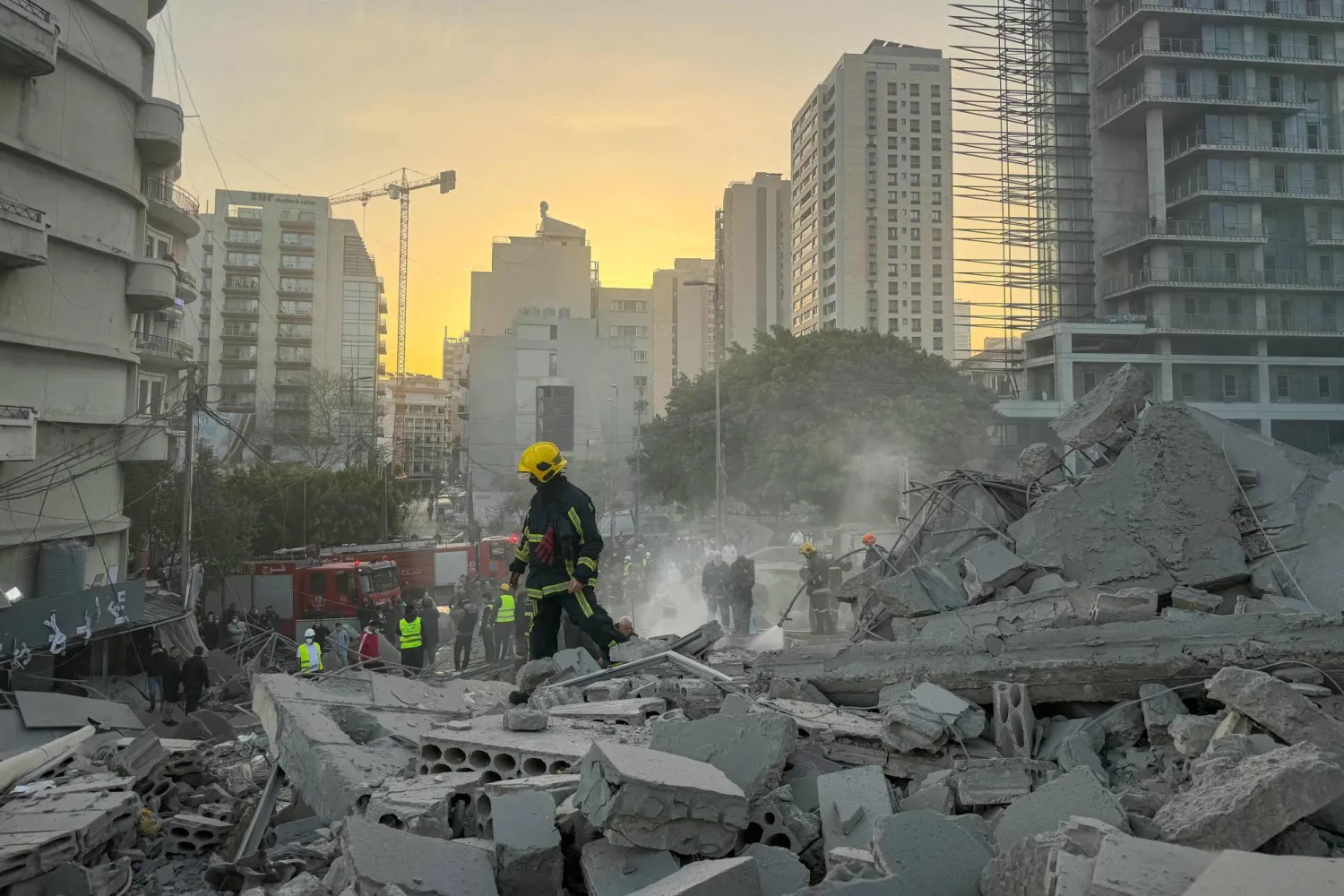
Smoke rises from the site of an Israeli airstrike that targeted an area in Beirut's southern suburbs on March 17, 2026. (AFP)

Civilians are paying a heavy price as the war in Lebanon continues to expand, driving death, injuries and displacement the United Nations said on Tuesday.

"Displacement is increasing incredibly quickly. Right ‌now, hundreds of ‌thousands of people ‌left ⁠their homes. Many ⁠leaving with very little, just the clothes they were wearing," said the UN Humanitarian Coordinator Imran Riza.

Lebanon was sucked ⁠into the war in ‌the ‌Middle East on March 2 when ‌Hezbollah opened fire at ‌Israel, saying it aimed to avenge the killing of Iran's supreme leader. Israel has responded ‌with an offensive that has killed more ⁠than ⁠800 people in Lebanon and forced more than 800,000 from their homes.

Almost a fifth of people living in Lebanon are now registered as displaced, according to Lebanese government figures, with displacement set to increase, the UN said.

Israeli air strikes on residential buildings in Lebanon raise concerns under international law, the human ‌rights ‌office said ‌on ⁠Tuesday said.

"Israeli air ⁠strikes have destroyed entire residential buildings in dense ⁠urban environments with ‌multiple ‌members of the ‌same family, ‌including women and children often killed together," ‌UN human rights office spokesperson ⁠Thameen Al-Kheetan ⁠told reporters in Geneva.

"Such attacks raise concerns under international humanitarian law," he added.