


UN Peacekeepers in Lebanon Urge Immediate De-Escalation 

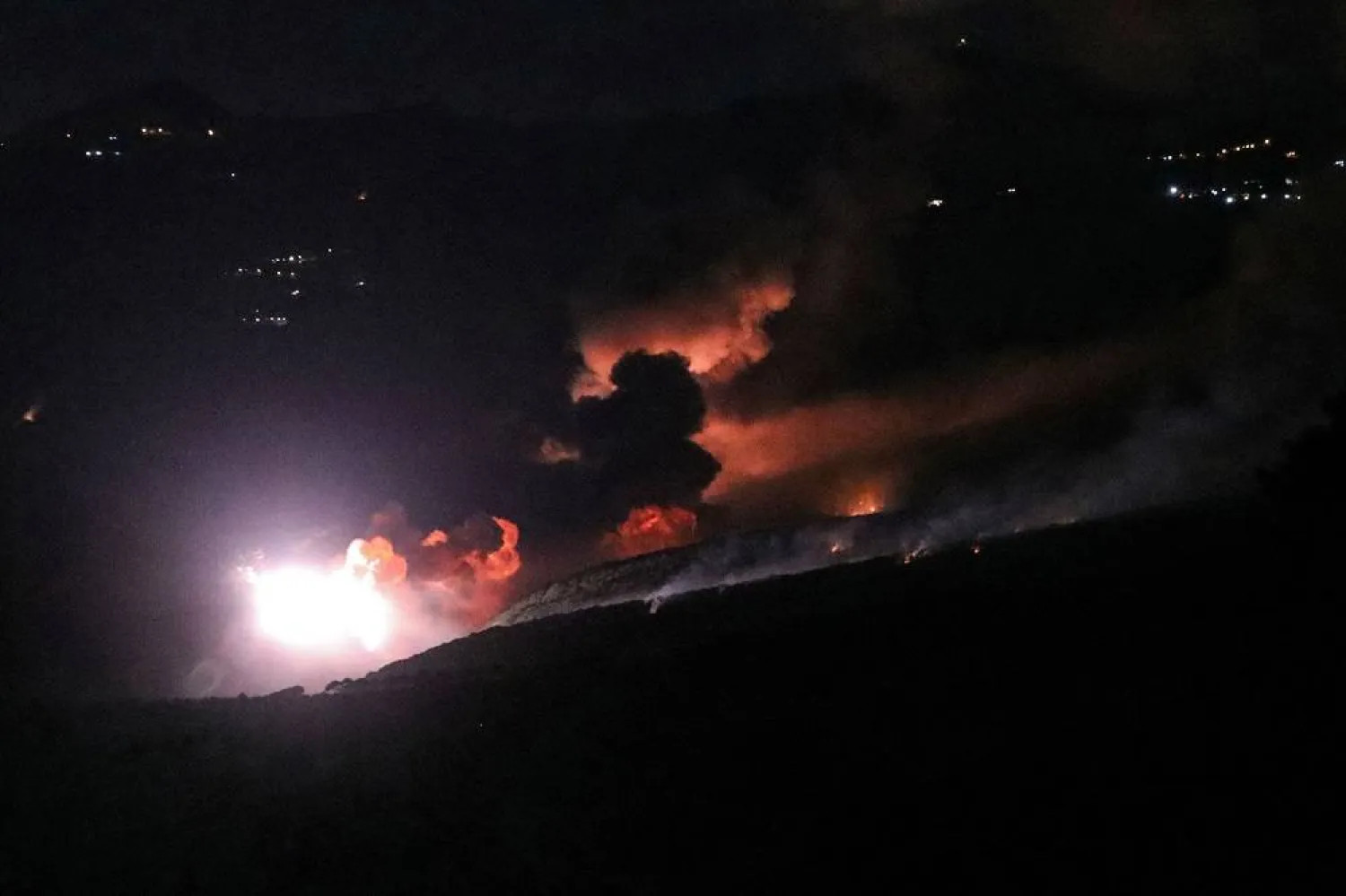
Smoke and fire rise from the site of an Israeli strike on the southern Lebanese border village of Mahmoudiyeh on September 19, 2024. (AFP)
TT

UN Peacekeepers in Lebanon Urge Immediate De-Escalation 

Smoke and fire rise from the site of an Israeli strike on the southern Lebanese border village of Mahmoudiyeh on September 19, 2024. (AFP)

UN peacekeepers in Lebanon urged immediate de-escalation as hostilities rumbled on at the Lebanese-Israeli border on Friday, following Israel's most intense airstrikes in nearly a year of conflict with the Iran-backed Hezbollah. 

Israel's military said on Thursday it had struck hundreds of Hezbollah rocket launchers that had been set to fire towards Israel, in what security sources in Lebanon said was the heaviest such attack since hostilities began last October. 

Ignited by the Gaza war, the conflict has intensified significantly this week, with Hezbollah suffering an unprecedented attack in which pagers and walkie talkies used by its members exploded, killing 37 people and wounding thousands. 

The UNIFIL peacekeeping force in south Lebanon said on Friday morning that the previous 12 hours had seen "a heavy intensification of the hostilities" across the Lebanese-Israeli border and in its area of operations. 

"We are concerned at the increased escalation across the Blue Line and urge all actors to immediately de-escalate", UNIFIL spokesperson Andrea Tenenti told Reuters, referring to the line that delineates the border between Lebanon and Israel. 

Israeli airstrikes on Friday hit at least three villages in south Lebanon, according to security sources in Lebanon and Hezbollah's al-Manar television, which broadcast footage of a cloud of smoke rising from one of the attacks. 

There was no immediate comment from the Israeli military. 

Hezbollah said its fighters had fired a guided missile at an Israeli troop position in Metula, an Israeli town on the border targeted frequently by the Lebanese group over the last year. 

The Israeli military on Friday lifted orders restricting movement and large gatherings that it had issued on Thursday night for a number of communities in northern Israel and the Golan Heights. The restrictions were ordered following the start of the Israeli strikes. 

Security sources in Lebanon said four people were wounded in Israel's intensive bombardment on Thursday. It was not immediately clear if they were Hezbollah members. 

The year-long conflict between Israel and Hezbollah is the worst since they fought a war in 2006. Tens of thousands have had to leave homes on both sides of the border. 

While the conflict has largely played out in areas at or near the frontier, this week's escalation has heightened concerns that it could widen and further intensify. 

The United States on Thursday warned all parties in the Middle East against escalation, saying Washington's priority is to find a diplomatic solution. 

"We will continue to stand by Israel's right to defend itself, but we don't want to see any party escalate this conflict, period," State Department spokesperson Matthew Miller told a news briefing. 

'RED LINES' 

In a TV address on Thursday, Hezbollah leader Hassan Nasrallah said the device explosions on Tuesday and Wednesday "crossed all red lines" and vowed to punish Israel. 

Israel has not directly commented on the pager and radio detonations, which security sources say were probably carried out by its Mossad spy agency, which has a long history of carrying out sophisticated attacks on foreign soil. 

The 15-member Security Council is due to meet on Friday over the blasts. 

Israeli Defense Minister Yoav Gallant said late on Thursday that Israel will keep up military action against Hezbollah. 

Israel has said its goal is to ensure the safe return of Israelis to northern Israel. 

Hezbollah, an ally of the Palestinian armed group Hamas, says its attacks on northern Israel aim to support Palestinians under Israeli fire in the Gaza Strip. 

Nasrallah said on Thursday that the Lebanese front would not stop "before the halt of the aggression on Gaza". 


Israel Military Says Soldier Killed in Gaza 

A drone view shows the destruction in a residential neighborhood, after the withdrawal of the Israeli forces from the area, amid a ceasefire between Israel and Hamas in Gaza, in Gaza City, October 21, 2025. (Reuters)
TT

Israel Military Says Soldier Killed in Gaza 

A drone view shows the destruction in a residential neighborhood, after the withdrawal of the Israeli forces from the area, amid a ceasefire between Israel and Hamas in Gaza, in Gaza City, October 21, 2025. (Reuters)

The Israeli military announced that one of its soldiers had been killed in combat in southern Gaza on Wednesday, but a security source said the death appeared to have been caused by "friendly fire".

"Staff Sergeant Ofri Yafe, aged 21, from HaYogev, a soldier in the Paratroopers Reconnaissance Unit, fell during combat in the southern Gaza Strip," the military said in a statement.

A security source, however, told AFP that the soldier appeared to have been "killed by friendly fire", without providing further details.

"The incident is still under investigation," the source added.

The death brings to five the number of Israeli soldiers killed in Gaza since a ceasefire took effect on October 10.


Syria: SDF’s Mazloum Abdi Says Implementation of Integration Deal May Take Time

People sit outdoors surrounded by nature, with the Tigris river flowing in the background, following a long atmospheric depression, near the Syrian-Turkish border in Derik, Syria, February 16, 2026 REUTERS/Orhan Qereman
TT

Syria: SDF’s Mazloum Abdi Says Implementation of Integration Deal May Take Time

People sit outdoors surrounded by nature, with the Tigris river flowing in the background, following a long atmospheric depression, near the Syrian-Turkish border in Derik, Syria, February 16, 2026 REUTERS/Orhan Qereman

Mazloum Abdi, commander of the Syrian Democratic Forces, said the process of merging the SDF with Syrian government forces “may take some time,” despite expressing confidence in the eventual success of the agreement.

His remarks came after earlier comments in which he acknowledged differences with Damascus over the concept of “decentralization.”

Speaking at a tribal conference in the northeastern city of Hasakah on Tuesday, Abdi said the issue of integration would not be resolved quickly, but stressed that the agreement remains on track.

He said the deal reached last month stipulates that three Syrian army brigades will be created out of the SDF.

Abdi added that all SDF military units have withdrawn to their barracks in an effort to preserve stability and continue implementing the announced integration agreement with the Syrian state.

He also emphasized the need for armed forces to withdraw from the vicinity of the city of Ayn al-Arab (Kobani), to be replaced by security forces tasked with maintaining order.


Israeli Far-Right Minister to Push for ‘Migration’ of West Bank, Gaza Palestinians 

A Palestinian man checks leather belts as people prepare for Ramadan, in the old city of Hebron in the Israeli-occupied West Bank, February 17,2026. (Reuters)
TT

Israeli Far-Right Minister to Push for ‘Migration’ of West Bank, Gaza Palestinians 

A Palestinian man checks leather belts as people prepare for Ramadan, in the old city of Hebron in the Israeli-occupied West Bank, February 17,2026. (Reuters)

Israel's far-right Finance Minister Bezalel Smotrich said he would pursue a policy of "encouraging the migration" of Palestinians from the occupied West Bank and Gaza Strip, Israeli media reported Wednesday.

"We will eliminate the idea of an Arab terror state," said Smotrich, speaking at an event organized by his Religious Zionism Party late on Tuesday.

"We will finally, formally, and in practical terms nullify the cursed Oslo Accords and embark on a path toward sovereignty, while encouraging emigration from both Gaza and Judea and Samaria.

"There is no other long-term solution," added Smotrich, who himself lives in a settlement in the West Bank.

Since last week, Israel has approved a series of measures backed by far-right ministers to tighten control over the West Bank, including in areas administered by the Palestinian Authority under the Oslo Accords, in place since the 1990s.

The measures include a process to register land in the West Bank as "state property" and facilitate direct purchases of land by Jewish Israelis.

The measures have triggered widespread international outrage.

On Tuesday, the UN missions of 85 countries condemned the measures, which critics say amount to de facto annexation of the Palestinian territory.

"We strongly condemn unilateral Israeli decisions and measures aimed at expanding Israel's unlawful presence in the West Bank," they said in a statement.

"Such decisions are contrary to Israel's obligations under international law and must be immediately reversed.

"We underline in this regard our strong opposition to any form of annexation."

UN Secretary-General Antonio Guterres on Monday called on Israel to reverse its land registration policy, calling it "destabilizing" and "unlawful".

The West Bank would form the largest part of any future Palestinian state. Many on Israel's religious right view it as Israeli land.

Israeli NGOs have also raised the alarm over a settlement plan signed by the government which they say would mark the first expansion of Jerusalem's borders into the occupied West Bank since 1967.

The planned development, announced by Israel's Ministry of Construction and Housing, is formally a westward expansion of the Geva Binyamin, or Adam, settlement situated northeast of Jerusalem in the West Bank.

The current Israeli government has fast-tracked settlement expansion, approving a record 52 settlements in 2025.

Excluding Israeli-annexed east Jerusalem, more than 500,000 Israelis live in West Bank settlements and outposts, which are illegal under international law.
