


Weaponizing Ordinary Devices Violates International Law, United Nations Rights Chief Says

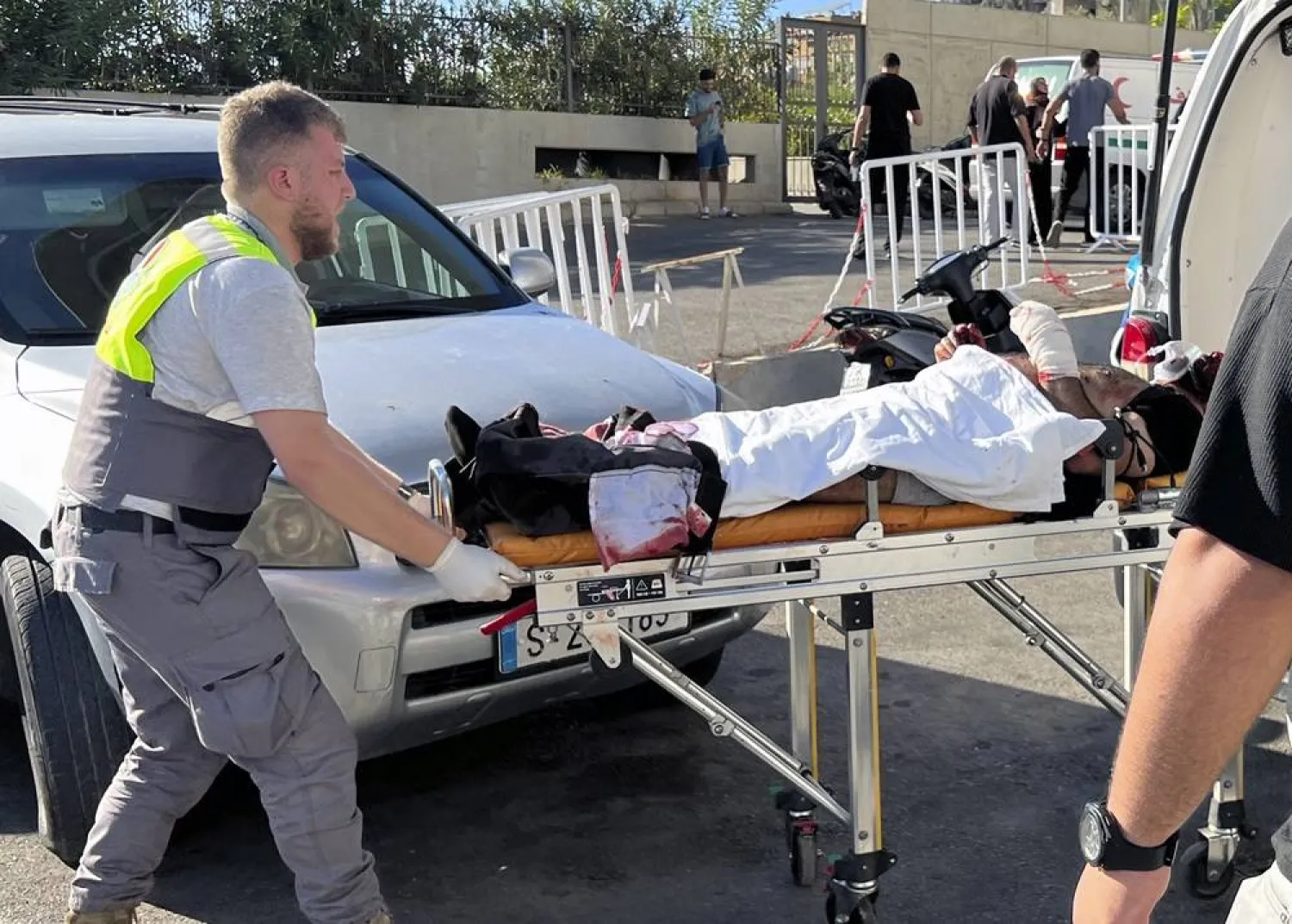
A Civil Defense first-responder carries a wounded man whose handheld pager exploded at al-Zahraa hospital in Beirut, on Sept. 17, 2024. (AP)
TT

Weaponizing Ordinary Devices Violates International Law, United Nations Rights Chief Says

A Civil Defense first-responder carries a wounded man whose handheld pager exploded at al-Zahraa hospital in Beirut, on Sept. 17, 2024. (AP)

Weaponizing ordinary communication devices represents a new development in warfare, and targeting thousands of Lebanese people using pagers, two-way radios and electronic equipment without their knowledge is a violation of international human rights law, the United Nations human rights chief said Friday.

Volker Türk told an emergency meeting of the UN Security Council there must be an independent and transparent investigation of the two attacks in Lebanon on Tuesday and Wednesday where these devices exploded, reportedly killing 37 people and injuring more than 3,400 others.

“Those who ordered and carried out these attacks must be held to account,” he said.

Lebanon has blamed Israel for the attacks, which appeared to target Hezbollah members but also saw many civilian casualties, including children. Hezbollah has fought many conflicts with Israel, including a war in 2006, and it has conducted near-daily strikes against Israel to support Hamas fighters who attacked Israel on Oct. 7.

Before the council meeting, Israel’s UN Ambassador Danny Danon was asked by reporters about speculation Israel was behind the two explosions.

“We are not commenting on the specific attacks you mentioned, but I can tell you that we will do everything we can to target those terrorists to minimize casualties for civilians,” he replied.

Lebanon’s caretaker Foreign Minister Abdallah Bou Habib accused Israel of terrorizing the entire Lebanese population on streets, in markets, shops and their homes where their communications devices exploded.

He held up a photo of a mangled and bloodied hand, telling ambassadors from the 15 council nations: “Look at the ugliness of what has happened in this picture.”

Bou Habib insisted that Israel not only launched the attacks but told the council there were “official declarations” and a tweet by an adviser to Prime Minister Benjamin Netanyahu “that was lately deleted, emphasizing the responsibility of Israel and praising the positive results of this assault.”

He appeared to be referring to a deleted tweet by Netanyahu adviser Topaz Luke, who reportedly retweeted a post that included a reply indicating that Israel was behind the attacks in Lebanon and neighboring Syria.

Israel’s Danon criticized the Lebanese minister for never mentioning Hezbollah and said the Lebanese people are “trapped in the grip of this terrorist organization.”

Bou Habib warned the council that if it doesn’t condemn the week’s deadly explosions and name Israel as the perpetrator, a “Pandora’s Box” will be opened, and governments and extremists will target, terrorize and kill civilians with similar communications devices on trains, planes and elsewhere.

Türk, the UN high commissioner for human rights, said the explosions not only violated international human rights law but also appear to violate international humanitarian law’s key principles in carrying out attacks: distinction between civilians and combatants, proportionality, and precautions.

International law also prohibits the use of booby-trap devices that look harmless, he said, and “it is a war crime to commit violence intended to spread terror among civilians.”

“Let me be clear — this method of warfare may be new and unfamiliar,” Türk said, “but international humanitarian and human rights law apply regardless and must be upheld.”

Israel’s Danon blamed Iran and its “puppet” Hezbollah for the military action across the Lebanon-Israel border.

“While Israel is not seeking a wider conflict, let me be clear: We will not allow Hezbollah to continue its provocations,” he said. Israel will do “whatever it takes” to return its 60,000 citizens who fled their homes in the north because of attacks, “and we will not allow Hezbollah’s terror to dictate the future of our nation.”

Iran’s UN Ambassador Amir Saeid Iravani countered that “Israel bears full responsibility for the perpetration of such horrific crimes,” and said his government will pursue accountability for the attack on the country’s ambassador to Lebanon, whose eyes were injured in the explosions Tuesday.

He said the gravity of the attacks against the Lebanese people must also be seen as “a threat to peace and security across the region.” He added that “the international community must not ignore the role the Western countries, in particular the United States and UK, play in enabling Israel’s aggressions.”

UN political chief Rosemary DiCarlo warned the council that the explosions along with more than 11 months of bloodshed in Gaza, and near-daily exchanges of fire across the Israel-Lebanon border, pose a grave risk to security and stability in the region.

She urged all actors to exercise maximum restraint, and she strongly urged countries with influence on the parties “to leverage it now.”

Earlier, UN spokesperson Stephane Dujarric urged Israel and Hezbollah to immediately return to the cessation of hostilities that existed before Hamas’ Oct. 7 attacks in southern Israel and Israel's responding military campaign in Gaza, warning that “the region is on the brink of a catastrophe” and a diplomatic solution should be pursued urgently.



UN: At Least 15 Children Killed in Sudan Drone Strike

The war in Sudan, ongoing since mid-April 2023, has caused extensive destruction across the country (AFP)
TT

UN: At Least 15 Children Killed in Sudan Drone Strike

The war in Sudan, ongoing since mid-April 2023, has caused extensive destruction across the country (AFP)

A drone strike on a displacement camp in Sudan killed at least 15 children earlier this week, the United Nations reported late on Wednesday.

"On Monday 16 February, at least 15 children were reportedly killed and 10 wounded after a drone strike on a displacement camp in Al Sunut, West Kordofan," the UN children's agency said in a statement.

Across the Kordofan region, currently the Sudan war's fiercest battlefield, "we are seeing the same disturbing patterns from Darfur -- children killed, injured, displaced and cut off from the services they need to survive," UNICEF's Executive Director Catherine Russell said.


MSF Will Keep Operating in Gaza 'as Long as We Can'

(FILES) A Palestinian man walks on his crutches to the Doctors Without Borders or Medecins Sans Frontieres (MSF) clinic, in the al-Rimal neighborhood of Gaza City on new year's Eve, December 31, 2025. (Photo by Omar AL-QATTAA / AFP)
TT

MSF Will Keep Operating in Gaza 'as Long as We Can'

(FILES) A Palestinian man walks on his crutches to the Doctors Without Borders or Medecins Sans Frontieres (MSF) clinic, in the al-Rimal neighborhood of Gaza City on new year's Eve, December 31, 2025. (Photo by Omar AL-QATTAA / AFP)

The head of Doctors Without Borders in the Palestinian territories told AFP the charity would continue working in Gaza for as long as possible, following an Israeli decision to end its activities there.

In early February, Israel announced it was terminating all the activities in Gaza by the medical charity, known by its French acronym MSF, after it failed to provide a list of its Palestinian staff.

MSF has slammed the move, which takes effect on March 1, as a "pretext" to obstruct aid.

"For the time being, we are still working in Gaza, and we plan to keep running our operations as long as we can," Filipe Ribeiro told AFP in Amman, but said operations were already facing challenges.

"Since the beginning of January, we are not anymore in the capacity to get international staff inside Gaza. The Israeli authorities actually denied any entry to Gaza, but also to the West Bank," he said.

Ribeiro added that MSF's ability to bring medical supplies into Gaza had also been impacted.

"They're not allowed for now, but we have some stocks in our pharmacies that will allow us to keep running operations for the time being," he said.

"We do have teams in Gaza that are still working, both national and international, and we have stocks."

In December, Israel announced it would prevent 37 aid organizations, including MSF, from working in Gaza from March 1 for failing to submit detailed information about their Palestinian employees, drawing widespread condemnation from NGOs and the United Nations.

It had alleged that two MSF employees had links with Palestinian militant groups Hamas and Islamic Jihad, which the medical charity has repeatedly and vehemently denied.

MSF says it did not provide the names of its Palestinian staff because Israeli authorities offered no assurances regarding their safety.

Ribeiro warned of the massive impact the termination of MSF's operations would have for healthcare in war-shattered Gaza.

"MSF is one of the biggest actors when it comes to the health provision in Gaza and the West Bank, and if we are obliged to leave, then we will create a huge void in Gaza," he said.

The charity says it currently provides at least 20 percent of hospital beds in the territory and operates around 20 health centers.

In 2025 alone, it carried out more than 800,000 medical consultations, treated more than 100,000 trauma cases and assisted more than 10,000 infant deliveries.


Egyptian-Turkish Military Talks Focus on Strengthening Partnership

The Commander of the Egyptian Air Force during his meeting with the Turkish Air Force chief in Cairo on Wednesday (Egyptian military spokesperson)
TT

Egyptian-Turkish Military Talks Focus on Strengthening Partnership

The Commander of the Egyptian Air Force during his meeting with the Turkish Air Force chief in Cairo on Wednesday (Egyptian military spokesperson)

Senior Egyptian and Turkish air force commanders met in Cairo on Wednesday for talks focused on strengthening military partnership and expanding bilateral cooperation, in the latest sign of warming defense ties between the two countries.

The meeting brought together the Commander of the Egyptian Air Force, Lt. Gen. Amr Saqr, and his Turkish counterpart, Gen. Ziya Cemal Kadioglu, to review a range of issues of mutual interest amid growing cooperation between the two air forces.

Egypt’s military spokesperson said the talks reflect the Armed Forces’ commitment to deepening military collaboration with friendly and partner nations.

Earlier this month, Egypt and Türkiye signed a military cooperation agreement during talks in Cairo between Egyptian President Abdel Fattah el-Sisi and his Turkish counterpart, President Recep Tayyip Erdogan.

Sisi highlighted similar viewpoints on regional and international issues, while Erdogan noted that enhanced cooperation and forthcoming joint steps would help support regional peace.

Cairo and Ankara also signed an agreement last August on the joint production of vertical take-off and landing (VTOL) drones. Production of unmanned ground vehicles has also begun under a partnership between the Turkish firm HAVELSAN and Egypt’s Kader Factory.

During the talks, Saqr underscored the importance of coordinating efforts to advance shared interests and expressed hope for closer ties that would benefit both air forces.

Kadioglu, for his part, stressed the depth of bilateral partnership and the strong foundations of cooperation between the two countries’ air forces.

According to the military spokesperson, Kadioglu also toured several Egyptian Air Force units to review the latest training and armament systems introduced in recent years.

Military cooperation between Egypt and Türkiye has gained momentum since 2023, following the restoration of full diplomatic relations and reciprocal presidential visits that reflected positively on the defense sector.

In September last year, the joint naval exercise “Sea of Friendship 2025” was held in Turkish territorial waters, aimed at enhancing joint capabilities and exchanging expertise against a range of threats.