


Hezbollah Leaders among 37 Killed in Israeli Strike in Lebanon

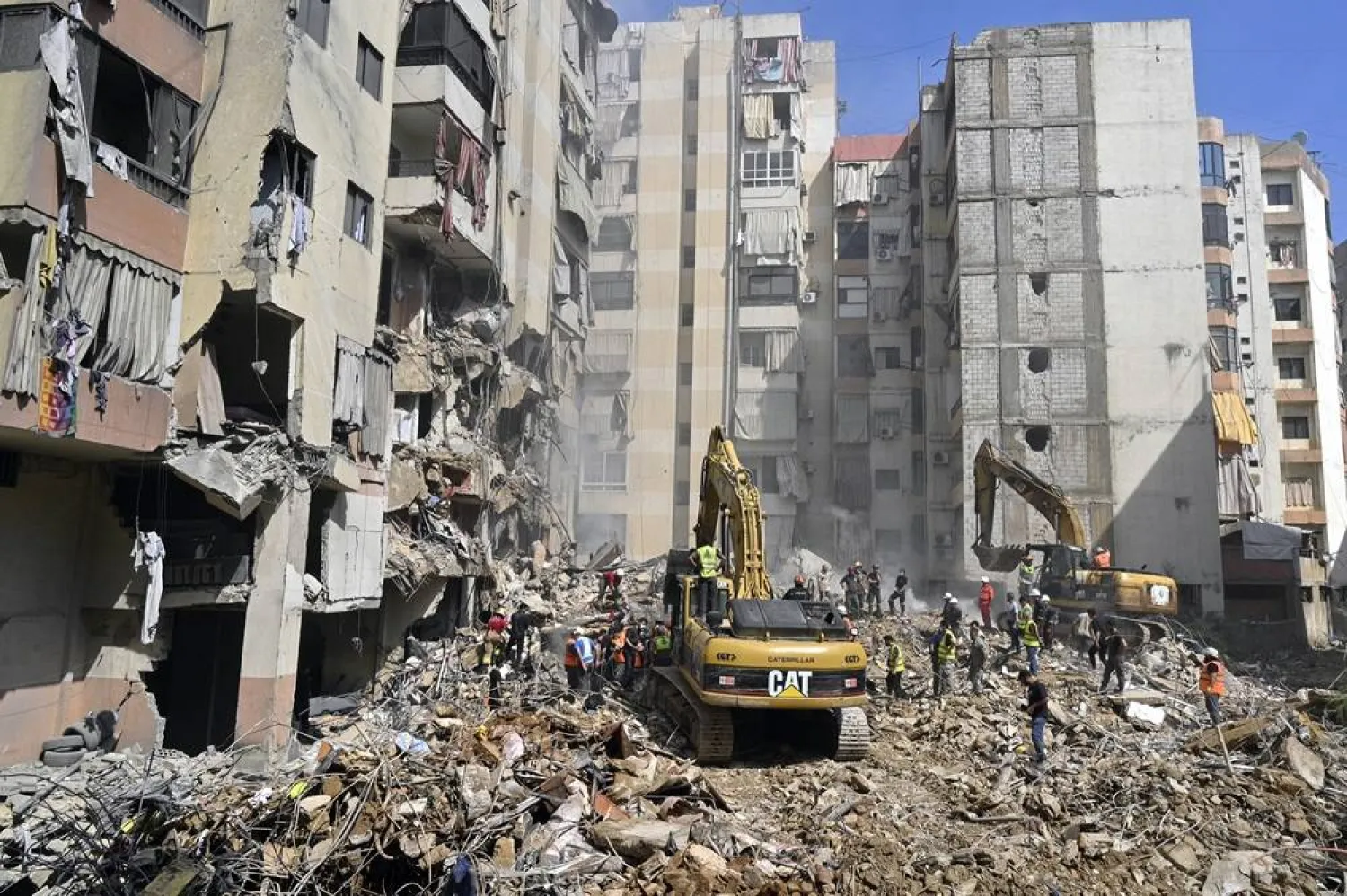
Emergency workers use excavators to clear the rubble at the site which was targeted by an Israeli strike the previous day, in the southern suburb of Beirut, Lebanon, 21 September 2024. (EPA)
TT

Hezbollah Leaders among 37 Killed in Israeli Strike in Lebanon

Emergency workers use excavators to clear the rubble at the site which was targeted by an Israeli strike the previous day, in the southern suburb of Beirut, Lebanon, 21 September 2024. (EPA)

Two Hezbollah leaders were among those killed in an Israeli airstrike on a Beirut suburb on Friday, Israel’s military said Saturday, as Lebanon raised the death toll from the attack to 37, including women and children.

Israel and Hezbollah continued to trade fire Saturday, a day after the airstrike claimed the lives of Ibrahim Akil, who was in charge of Hezbollah’s elite Radwan Force, and Ahmed Wahbi, another senior commander in the group’s military wing.

Firas Abiad told reporters that the dead included seven women and three children. He said another 68 people were wounded of whom 15 remained in hospital, adding that search and rescue operations were still ongoing, with the number of casualties likely to rise.

The rare strike hit an apartment block in a densely populated south Beirut neighborhood on Friday afternoon during rush hour. It was the deadliest strike targeting the Lebanese capital since the 2006 Israel-Hezbollah war.

Hezbollah confirms more than a dozen operatives were killed Akil, the main target, had been wanted by the US for years for his alleged role in the 1983 bombing of the US Embassy in Beirut and in taking American and German hostages in Lebanon in the 1980s.  

He was under US sanctions and the US State Department last year announced a reward of up to $7 million for information leading to his “identification, location, arrest, and/or conviction.”

Wahbi was described as a commander who played major roles within Hezbollah for decades and was imprisoned in an Israeli jail in south Lebanon in 1984. Hezbollah said he was one of the “field commanders” of a 1997 ambush in southern Lebanon that left 12 Israeli troops dead.

Hezbollah announced overnight Friday that 15 of its operatives were killed by Israeli forces, but did not elaborate on the location of these deaths. Meanwhile, the Israeli army spokesperson, Lt. Col. Nadav Shoshani, said on Saturday a total of 16 Hezbollah fighters were killed in the strike.

Israel earlier said Akil had been meeting with other Hezbollah members in the basement of the apartment block.

Rescue workers digging through rubble Lebanese troops cordoned off the area around the destroyed building as members of the Lebanese Red Cross stood nearby to take any bodies recovered from the rubble. On Saturday morning, Hezbollah’s media office took journalists on a tour of the scene of the airstrike where workers were still digging through the building’s ruins.

The Minister of Public Works and Transport Ali Hamieh told reporters at the scene that 23 people are still missing.

The airstrike on the crowded Qaim street knocked out an eight-story building that had 16 apartments and damaged another one adjacent to it. The missiles destroyed the building and cut through the basement where the meeting of Hezbollah officials was being held, according to an Associated Press journalist at the scene.

Shops in a nearby building were badly damaged.

Hezbollah bombardments preceded Israeli airstrike Friday's deadly strike came hours after Hezbollah launched one of its most intense bombardments of northern Israel in nearly a year of fighting, largely targeting Israeli military sites. Israel’s Iron Dome missile defense system intercepted most of the Katyusha rockets.

The group said its latest wave of rocket salvos was a response to Israeli strikes on southern Lebanon. However, it came days after mass explosions of Hezbollah pagers and walkie-talkies killed at least 37 people — including two children. Some 2,900 others were wounded in the assault which has been widely attributed to Israel.

The Lebanese health minister said Saturday hospitals across the country were filled with the wounded.

Israel has neither confirmed nor denied involvement in the attack, which marked a major escalation in the past 11 months of simmering conflict along the Israel-Lebanon border.

On Saturday, Israel launched an intense wave of airstrikes on southern Lebanon, according to an Associated Press journalist in the area. The Israeli military said its air force was attacking Hezbollah targets, without providing further details. The group responded by firing a large number of rockets, local media reported.

It remains unclear if there were any casualties in the latest strikes.

Earlier this week, Israel’s security cabinet said stopping Hezbollah’s attacks in the country’s north to allow residents to return to their homes is now an official war goal, as it considers a wider military operation in Lebanon that could spark an all-out conflict. Israel has since sent a powerful fighting force to the northern border.

Hezbollah has maintained that it will halt its strikes only when a cease-fire is reached in Gaza.

The tit-for-tat strikes have forced tens of thousands of people to evacuate their homes in both southern Lebanon and northern Israel.

Israel and Hezbollah have traded fire regularly since Hamas’ Oct. 7 assault on southern Israel ignited the Israeli military’s devastating offensive in Gaza. But previous cross-border attacks have largely struck areas in northern Israel that had been evacuated and less-populated parts of southern Lebanon.



UN Says It Risks Halting Somalia Aid Due to Funding Cuts 

A Somali trader marks watermelons for sale at an open-air grocery market as Muslims start the fasting month of Ramadan, the holiest month in the Islamic calendar, within Bakara market in Mogadishu, Somalia, February 18, 2026. (Reuters)
TT

UN Says It Risks Halting Somalia Aid Due to Funding Cuts 

A Somali trader marks watermelons for sale at an open-air grocery market as Muslims start the fasting month of Ramadan, the holiest month in the Islamic calendar, within Bakara market in Mogadishu, Somalia, February 18, 2026. (Reuters)

The UN's World Food Program (WFP) warned Friday it would have to stop humanitarian assistance in Somalia by April if it did not receive new funding.

The Rome-based agency said it had already been forced to reduce the number of people receiving emergency food assistance from 2.2 million in early 2025 to just over 600,000 today.

"Without immediate funding, WFP will be forced to halt humanitarian assistance by April," it said in a statement.

In early January, the United States suspended aid to Somalia over reports of theft and government interference, following the destruction of a US-funded WFP warehouse in the capital Mogadishu's port.

The US announced a resumption of WFP food distribution on January 29.

However, all UN agencies have warned of serious funding shortfalls since Washington began slashing aid across the world following President Donald Trump's return to the White House last year.

"The situation is deteriorating at an alarming rate," said Ross Smith, WFP Director of Emergency Preparedness and Response, in Friday's statement.

"Families have lost everything, and many are already being pushed to the brink. Without immediate emergency food support, conditions will worsen quickly.

"We are at the cusp of a decisive moment; without urgent action, we may be unable to reach the most vulnerable in time, most of them women and children."

Some 4.4 million people in Somalia are facing crisis-levels of food insecurity, according to the WFP, the largest humanitarian agency in the country.

The Horn of Africa country has been plagued by conflict and also suffered two consecutive failed rainy seasons.


Hamas Says Path for Gaza Must Begin with End to ‘Aggression’ 

Makeshift tents of displaced Palestinian families among the ruins of their homes at sunset during the holy month of Ramadan in Jabaliya northern Gaza Strip on, 19 February 2026. (EPA)
TT

Hamas Says Path for Gaza Must Begin with End to ‘Aggression’ 

Makeshift tents of displaced Palestinian families among the ruins of their homes at sunset during the holy month of Ramadan in Jabaliya northern Gaza Strip on, 19 February 2026. (EPA)

Discussions on Gaza's future must begin with a total halt to Israeli "aggression", the Palestinian movement Hamas said after US President Donald Trump's Board of Peace met for the first time.

"Any political process or any arrangement under discussion concerning the Gaza Strip and the future of our Palestinian people must start with the total halt of aggression, the lifting of the blockade, and the guarantee of our people's legitimate national rights, first and foremost their right to freedom and self-determination," Hamas said in a statement Thursday.

Trump's board met for its inaugural session in Washington on Thursday, with a number of countries pledging money and personnel to rebuild the Palestinian territory, more than four months into a fragile ceasefire between Israel and Hamas.

Israeli Prime Minister Benjamin Netanyahu has insisted however that Hamas must disarm before any reconstruction begins.

"We agreed with our ally the US that there will be no reconstruction of Gaza before the demilitarization of Gaza," Netanyahu said.

The Israeli leader did not attend the Washington meeting but was represented by his foreign minister Gideon Saar.

Trump said several countries had pledged more than seven billion dollars to rebuild the territory.

Muslim-majority Indonesia will take a deputy commander role in a nascent International Stabilization Force, the unit's American chief Major General Jasper Jeffers said.

Trump, whose plan for Gaza was endorsed by the UN Security Council in November, also said five countries had committed to providing troops, including Morocco, Kazakhstan, Kosovo and Albania.


Official Contacts Aim to Keep Lebanon out of War on Iran as Israel Raises Readiness on Northern Front 

This photograph shows a memorial for slain Lebanese Hezbollah longtime leader Hassan Nasrallah at the entrance of the southern village of Qannarit on February 16, 2026. (AFP)
TT

Official Contacts Aim to Keep Lebanon out of War on Iran as Israel Raises Readiness on Northern Front 

This photograph shows a memorial for slain Lebanese Hezbollah longtime leader Hassan Nasrallah at the entrance of the southern village of Qannarit on February 16, 2026. (AFP)

Israel has raised the alert level of its military along the border with Lebanon, raising questions that Lebanon’s south may again be involved in a regional confrontation should the US attack Iran.

Given the heightened tensions between the US and Iran, questions have been asked over whether Hezbollah will become involved in a new war. Its Secretary-General Sheikh Naim Qassem had recently announced that the party will not remain on the side if Iran is attacked.

On the ground, Israel blew up houses in southern Lebanon border towns and carried out air strikes in the south. Israeli military spokesman Avichay Adraee said the raids targeted “Hezbollah infrastructure,” including arms caches and rocket launchers.

Their presence in the south is a violation of current agreements, he added.

Amid the high regional tensions, Israel’s Maariv quoted a military source as saying that the army has come up with plans, including a preemptive strike against Hezbollah, which would drag the south and the whole of Lebanon into a new war.

Ministerial sources told Asharq Al-Awsat that the presidency has been carrying out internal and foreign contacts since Thursday morning to keep Lebanon out of any escalation.

Hezbollah had launched a “support front” war against Israel a day after Hamas’ October 7, 2023 attack. In 2024, the war spiraled into an all-out conflict, with Israel decimating the Hezbollah leadership and severely weakening the party.

Israel believes that Hezbollah has been rebuilding its capabilities since the ceasefire that was struck in November 2024.

Kassim Kassir, a political analyst who is close to Hezbollah, told Asharq Al-Awsat: “No one knows what Hezbollah will do because the situation is tied the extent of the attack, should it happen.”

He noted that Qassem was ambiguous when he said the party will decide what to do when the time is right, but at any rate, he stressed that the party will not remain on the sidelines or abandon Iran.

“No one knows what Hezbollah’s abilities are, so everything is possible,” Kassir said.

Riad Kahwaji, a security and defense affairs expert, said he does not rule out the possibility that Hezbollah would join the war should the US attack Iran.

Speaking to Asharq Al-Awsat, he stressed that Iran is now the United States’ main target, when previously it used to confront its proxies.

It has now taken the fight directly to the heart of the problem, which is the Iranian regime, he remarked.

The extent of the military mobilization in the region and the frequent American statements about regime change all indicate that a major military operation may be imminent, he added.

Israel’s military also favors preemptive operations, so it is watching Hezbollah, which remains Iran’s most powerful regional proxy despite the blows it received in 2024 war, Kahwaji said.

Hezbollah still possesses a rocket arsenal that can threaten Israel, he remarked.

Israel’s high level of alert on the border with Lebanon could be in readiness for any development. Should Tel Aviv receive word from Washington that it intends to attack Iran, then it could launch operations against Hezbollah as part of preemptive strikes aimed at preventing the party from launching attacks against it, Kahwaji said.

“As long as Hezbollah possesses heavy weapons, such as rockets, and drones, that it has not handed over to the army, then Lebanon will continue to be vulnerable to attacks in the next confrontation. It will be exposed to Israeli strikes as long as this issue remains unresolved,” he added.