


Netanyahu Calls on Lebanese to 'Take this Warning Seriously' as Israeli Strikes Kill More than 270

Smoke billows from the site of an Israeli airstrike in Marjayoun, near the Lebanon-Israel border, on September 23, 2024. (Photo by Rabih DAHER / AFP)
TT

Netanyahu Calls on Lebanese to 'Take this Warning Seriously' as Israeli Strikes Kill More than 270

Smoke billows from the site of an Israeli airstrike in Marjayoun, near the Lebanon-Israel border, on September 23, 2024. (Photo by Rabih DAHER / AFP)

Israeli strikes on Monday killed more than 270 Lebanese in the deadliest barrage since the 2006 Israel-Hezbollah war as the Israeli military warned residents in southern and eastern Lebanon to evacuate their homes ahead of a widening air campaign against Hezbollah.

Thousands of Lebanese fled the south, and the main highway out of the southern port city of Sidon was jammed with cars heading toward Beirut in the biggest exodus since the 2006 fighting. More than 1,000 other people were wounded in the strikes — a staggering one-day toll for a country still reeling from a deadly attack on communication devices last week.

The death toll surpassed that of Beirut's devastating port explosion in 2020, when hundreds of tons of ammonium nitrate stored in a warehouse detonated, killing at least 218 people and wounding more than 6,000.

In a recorded message to Lebanese civilians, Israeli Prime Minister Benjamin Netanyahu urged them to heed Israeli calls to evacuate, saying “take this warning seriously.”

“Please get out of harm’s way now,” Netanyahu said. “Once our operation is finished, you can come back safely to your homes.”

The Israeli military said Monday evening that it had carried out a targeted strike in Beirut. It did not give details.

Lebanese caretaker Health Minister Firass Abiad told a news conference in Beirut that the strikes hit hospitals, medical centers and ambulances. The government ordered schools and universities to close across most of the country and began preparing shelters for people displaced from the south.

The Israeli military announced that it hit some 800 targets, saying it was going after Hezbollah weapons sites. Some strikes hit in residential areas of towns in the south and the eastern Bekaa Valley. One strike hit a wooded area as far away as Byblos in central Lebanon, more than 80 miles from the border north of Beirut.

The military said it was expanding the airstrikes to include areas of the valley along Lebanon’s eastern border with Syria. Hezbollah has long had an established presence in the valley, and it is where the group was founded in 1982 with the help of Iran’s Revolutionary Guards.

Israeli military spokesman Rear Adm. Daniel Hagari repeated warnings urging residents to immediately evacuate areas where Hezbollah is storing weapons, including in the valley. The warnings left open the possibility that some residents could live in or near targeted structures without knowing that they are risk.

Meanwhile, Hezbollah said in a statement that it fired dozens of rockets toward Israel, including at military bases. It also targeted for a second day the facilities of the Rafael defense firm, headquartered in Haifa.

As Israel carried out the attacks, Israeli authorities reported a series of air-raid sirens in northern Israel warning of incoming rocket fire from Lebanon.

The evacuation warnings were the first of their kind in nearly a year of steadily escalating conflict and came after a particularly heavy exchange of fire on Sunday. Hezbollah launched around 150 rockets, missiles and drones into northern Israel in retaliation for strikes that killed a top commander and dozens of fighters.

The increasing strikes and counterstrikes have raised fears of an all-out war, even as Israel is still battling Hamas in Gaza and trying to return scores of hostages taken in Hamas' Oct. 7 attack. Hezbollah has vowed to continue its strikes in solidarity with the Palestinians and Hamas, a fellow Iran-backed armed group. Israel says it is committed to returning calm to its northern border.

Associated Press journalists in southern Lebanon reported heavy airstrikes targeting many areas Monday morning, including some far from the border.

Lebanon's state-run National News Agency said the strikes hit a forested area in the central province of Byblos, about 130 kilometers (81 miles) north of the Israeli-Lebanese border, for the first time since the exchanges began in October.

Israel also bombed targets in the northeastern Baalbek and Hermel regions, where a shepherd was killed and two family members were wounded, according to the news agency. It said a total of 30 people were wounded in strikes.

The Lebanese Health Ministry put the death toll at 274. It asked hospitals in southern Lebanon and the eastern Bekaa Valley to postpone surgeries that could be done later. The ministry said in a statement that its request aimed to keep hospitals ready to deal with people wounded by “Israel’s expanding aggression on Lebanon.”

An Israeli military official said Israel is focused on aerial operations and has no immediate plans for a ground operation. The official, speaking on condition of anonymity in keeping with regulations, said the strikes are aimed at curbing Hezbollah's ability to launch more strikes into Israel.

Lebanese media reported that residents received text messages urging them to move away from any building where Hezbollah stores arms until further notice.

“If you are in a building housing weapons for Hezbollah, move away from the village until further notice,” the Arabic message reads, according to Lebanese media.

Lebanon's caretaker information minister, Ziad Makary, said in a statement that his office in Beirut had received a recorded message telling people to leave the building.

“This comes in the framework of the psychological war implemented by the enemy,” Makary said, and urged people “not to give the matter more attention than it deserves.”

It was not immediately clear how many people would be affected by the Israeli orders. Communities on both sides of the border have largely emptied out because of the near-daily exchanges of fire.

Israel has accused Hezbollah of transforming entire communities in the south into militant bases, with hidden rocket launchers and other infrastructure. That could lead the Israeli military to wage an especially heavy bombing campaign, even if no ground forces move in.

The military said it had targeted more than 150 militant sites early Monday. Residents of different villages in southern Lebanon posted photos on social media of airstrikes and large plumes of smoke. NNA also reported airstrikes on different areas.

An Israeli airstrike on a Beirut suburb on Friday killed a top Hezbollah military commander and more than a dozen fighters, as well as dozens of civilians, including women and children.

Last week, thousands of communications devices, used mainly by Hezbollah members, exploded in different parts of Lebanon, killing 39 people and wounding nearly 3,000. Lebanon blamed Israel for the attacks, but Israel did not confirm or deny any responsibility.

Hezbollah began firing into Israel a day after the Oct. 7 attack in what it said was an attempt to pin down Israeli forces to help Palestinian fighters in Gaza. Israel has retaliated with airstrikes, and the conflict has steadily intensified over the past year.

The fighting has killed hundreds of people in Lebanon, dozens in Israel and displaced tens of thousands on both sides of the border.

Israel has vowed to push Hezbollah back from the border so its citizens can return to their homes, saying it prefers to do so diplomatically but is willing to use force. Hezbollah has said it will keep up its attacks until there is a ceasefire in Gaza, but that appears increasingly elusive as the war nears its anniversary.

Hamas-led fighters stormed into southern Israel on Oct. 7, killing some 1,200 people, mostly civilians, and abducting around 250. Some 100 captives are still held in Gaza, a third of whom are believed to be dead, after most of the rest were released during a weeklong ceasefire in November.

Israel's offensive has killed over 41,000 Palestinians, according to the Gaza Health Ministry, which does not differentiate between civilians and fighters in its count. It says women and children make up a little over half of those killed. Israel says it has killed over 17,000 militants, without providing evidence.



US Slaps Sanctions on Sudan’s RSF Commanders over El-Fasher Killings

FILE - A Sudanese child, who fled el-Fasher city with family after Sudan's RSF attacked the western Darfur region, receives treatment at a camp in Tawila, Sudan, Nov. 2, 2025. (AP Photo/Mohammed Abaker, File)
TT

US Slaps Sanctions on Sudan’s RSF Commanders over El-Fasher Killings

FILE - A Sudanese child, who fled el-Fasher city with family after Sudan's RSF attacked the western Darfur region, receives treatment at a camp in Tawila, Sudan, Nov. 2, 2025. (AP Photo/Mohammed Abaker, File)

The United States announced sanctions on Thursday on three Sudanese Rapid Support Forces (RSF) commanders over their roles in the "horrific campaign" of the siege and capture of El-Fasher.

The US Treasury said the RSF carried out "ethnic killings, torture, starvation, and sexual violence" in the operation.

Earlier Thursday, the UN's independent fact-finding mission on Sudan said the siege and seizure of the city in Darfur bore "the hallmarks of genocide."

Its investigation concluded that the seizure last October had inflicted "three days of absolute horror," and called for those responsible to be brought to justice.

"The United States calls on the Rapid Support Forces to commit to a humanitarian ceasefire immediately," US Treasury Secretary Scott Bessent said in a statement.

"We will not tolerate this ongoing campaign of terror and senseless killing in Sudan."

The Treasury noted that the three sanctioned individuals were part of the RSF's 18-month siege of and eventual capture of El-Fasher.

They are RSF Brigadier General Elfateh Abdullah Idris Adam, Major General Gedo Hamdan Ahmed Mohamed and field commander Tijani Ibrahim Moussa Mohamed.

Bessent warned that Sudan's civil war risks further destabilizing the region, "creating conditions for terrorist groups to grow and threaten the safety and interests of the United States."

The UN probe into the takeover of El-Fasher -- after the 18-month siege -- concluded that thousands of people, particularly from the Zaghawa ethnic group, "were killed, raped or disappeared."


Israel's Netanyahu Says No Reconstruction of Gaza before Demilitarization

Israel’s Prime Minister Benjamin Netanyahu - File Photo/AFP
TT

Israel's Netanyahu Says No Reconstruction of Gaza before Demilitarization

Israel’s Prime Minister Benjamin Netanyahu - File Photo/AFP

Israeli Prime Minister Benjamin Netanyahu said on Thursday there would be no reconstruction of war-shattered Gaza before the disarmament of Hamas, as the "Board of Peace" convened for its inaugural meeting in Washington.

Around two dozen world leaders and senior officials met for the first meeting of the board, which was set up after the United States, Qatar and Egypt negotiated a ceasefire in October to halt two years of war in the Gaza Strip.

"We agreed with our ally the US there will be no reconstruction of Gaza before the demilitarization of Gaza," Netanyahu said during a televised speech at a military ceremony on Thursday, AFP reported.

The meeting in Washington will also look at how to launch the International Stabilization Force (ISF) that will ensure security in Gaza.

One of the most sensitive issues before the board is the future of the Islamist movement Hamas, which fought the war with Israel and still exerts influence in the territory.

Disarmament of the group is a central Israeli demand and a key point in negotiations over the ceasefire's next stage.

US officials including Steve Witkoff, Trump's friend and roving negotiator, have insisted that solid progress is being made and that Hamas is feeling pressure to give up weapons.

Israel has suggested sweeping restrictions including seizing small personal rifles from Hamas.

It remains unclear whether, or how, the Palestinian technocratic committee formed to handle day-to-day governance of Gaza will address the issue of demilitarization.

The 15-member National Committee for the Administration of Gaza (NCAG) will operate under the supervision of the "Board of Peace", and its head, Ali Shaath, is attending the meeting in Washington on Thursday.


Trump Tells First Meeting of Board of Peace that $7 billion Raised for Gaza

US President Donald Trump speaking in Washington - AFP
TT

Trump Tells First Meeting of Board of Peace that $7 billion Raised for Gaza

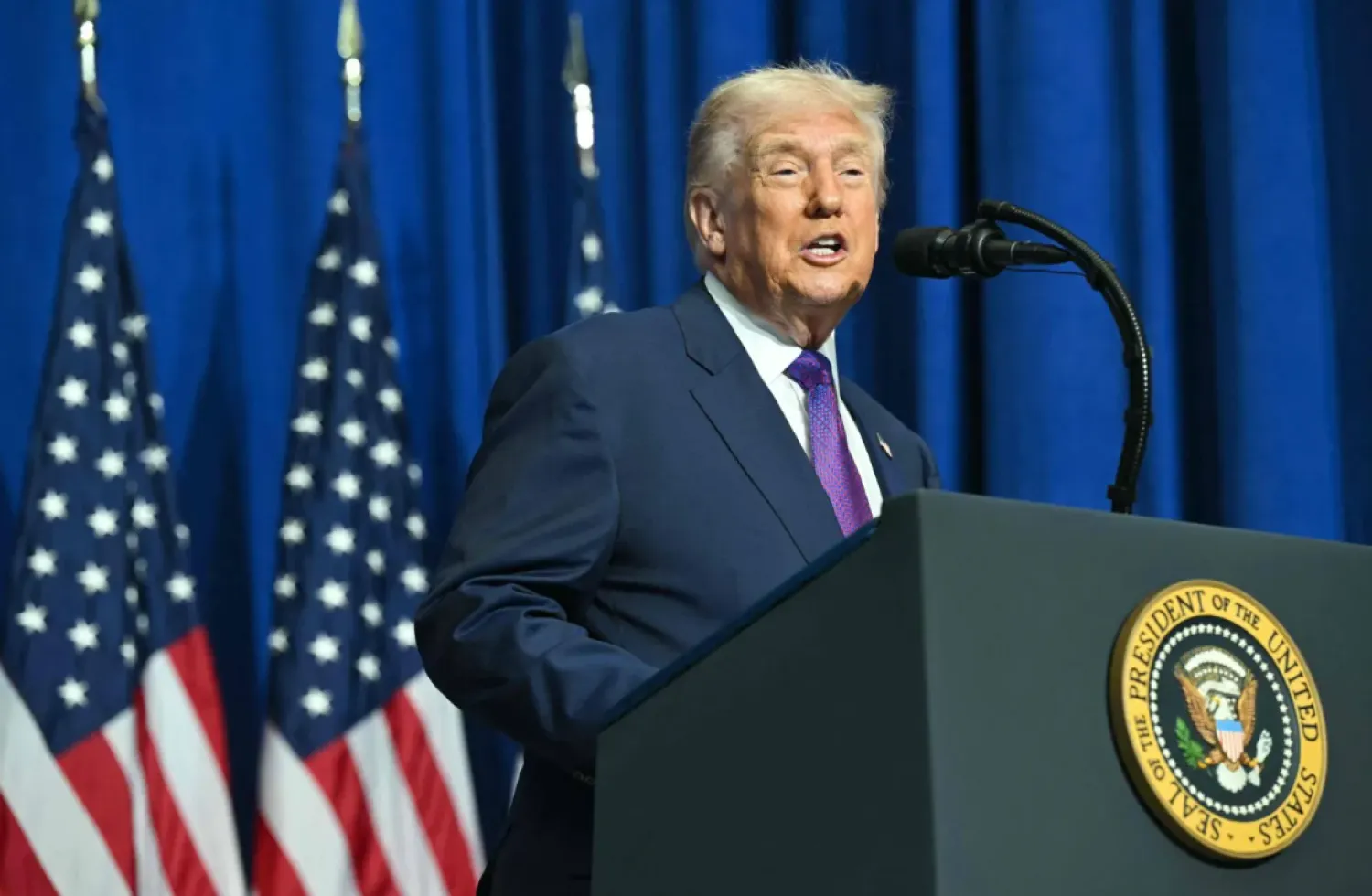
US President Donald Trump speaking in Washington - AFP

US President Donald Trump told the first meeting of his Board of Peace on Thursday that $7 billion has been contributed to a Gaza reconstruction fund that aims to rebuild the enclave once Hamas disarms, an objective that is far from becoming a reality.

The disarmament of Hamas militants and accompanying withdrawal of Israeli troops, the size of the reconstruction fund and the flow of humanitarian aid to the war-battered populace of Gaza are among the major questions likely to test the effectiveness of the board in the weeks and months ahead.

In a flurry of announcements at the end of a long, winding speech, Trump said the United States will make a contribution of $10 billion to the Board of Peace. He said contributing nations had raised $7 billion as an initial down payment for Gaza reconstruction.

Trump first proposed the board last September when he announced his plan to end Israel's war in Gaza. He later made clear the board's remit would be expanded beyond Gaza to tackle other conflicts worldwide.

Trump also said FIFA will raise $75 million for soccer-related projects in Gaza and that the United Nations will chip in $2 billion for humanitarian assistance.

TRUMP SAYS ANY IRAN DEAL MUST BE MEANINGFUL, PROSPECTS SHOULD BE CLEAR IN 10 DAYS

The Board of Peace includes Israel but not Palestinian representatives and Trump's suggestion that the Board could eventually address challenges beyond Gaza has stirred anxiety that it could undermine the UN's role as the main platform for global diplomacy and conflict resolution.

"We're going to strengthen the United Nations," Trump said, trying to assuage his critics. "It's really very important."

The meeting came as Trump threatens war against Iran and has embarked on a massive military buildup in the region in case Tehran refuses to give up its nuclear program.

Trump said he should know in 10 days whether a deal is possible. "We have to have a meaningful deal," he said.

The event had the feel of a Trump campaign rally, with music blaring from his eclectic playlist from Elvis Presley to the Beach Boys. Red Trump hats were given to participants.

Senior US officials said Trump will also announce that several nations are planning to send thousands of troops to participate in an International Stabilization Force that will help keep the peace in Gaza when it eventually deploys.

Hamas, fearful of Israeli reprisals, has been reluctant to hand over weaponry as part of Trump's 20-point Gaza plan that brought about a fragile ceasefire last October in the two-year Gaza war.

Trump said he hoped use of force to disarm Hamas would not be necessary. He said Hamas had promised to disarm and it "looks like they're going to be doing that, but we'll have to find out."