Lebanon Fears Gaza-like Carnage as Israel Ramps Up Airstrikes across the Country

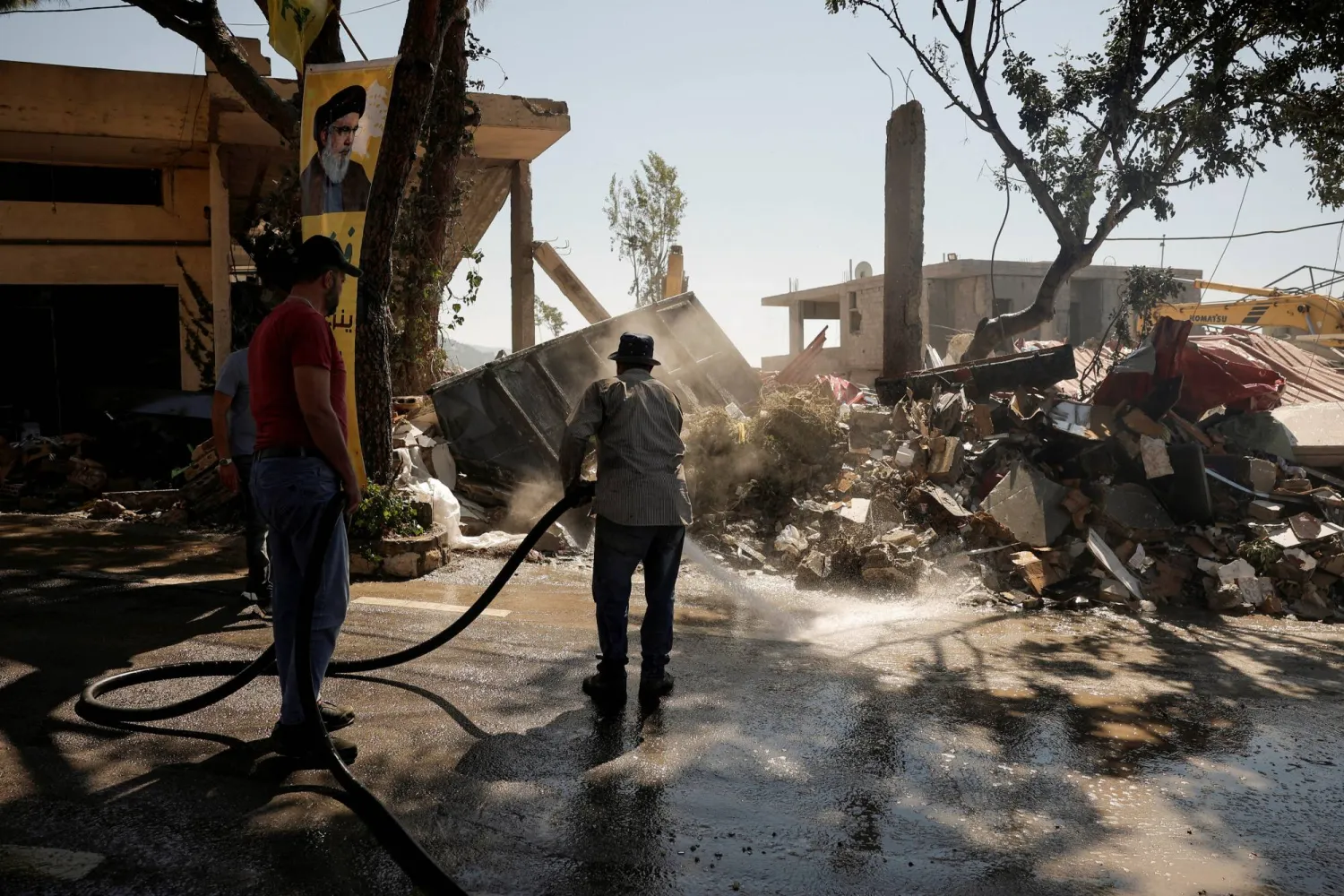
People clean the streets a day after an Israeli strike on residential buildings in the village of Maaysrah, north of Beirut, Lebanon, September 26, 2024. REUTERS/Louisa Gouliamaki.
TT

Lebanon Fears Gaza-like Carnage as Israel Ramps Up Airstrikes across the Country

People clean the streets a day after an Israeli strike on residential buildings in the village of Maaysrah, north of Beirut, Lebanon, September 26, 2024. REUTERS/Louisa Gouliamaki.

When she first heard about the evacuation warnings Israel was sending to residents of Lebanon, Aline Naser’s thoughts immediately turned to Gaza.
For the past year, the 26-year-old Beirut resident has been following with horror the reports about besieged Palestinians in the Gaza Strip ordered to move from one place to the other, fleeing to “humanitarian zones” only to be bombed and ordered to leave again.
The Israeli calls for Lebanese citizens to evacuate ahead of a widening air campaign, delivered via mobile phone alerts, calls and leaflets this week, seemed chillingly familiar, The Associated Press said.
“It’s definitely something on the back of my mind, and we don’t really know where exactly is safe,” she said.
Almost a year after the start of its war in Gaza, Israel has turned its focus on Lebanon, significantly ratcheting up its campaign against its archenemy Hezbollah. Among many in Lebanon, there is fear that Israel’s military operations in Lebanon would follow the same Gaza playbook: Evacuation orders, mass displacement and overwhelming airstrikes. Israel says its strikes target Hezbollah weapons sites and militants.
There are key differences between Gaza and Lebanon and how Israel has so far conducted its operations, which it says aim to push back Hezbollah from the border so that tens of thousands of Israelis displaced by Hezbollah's rocket attacks can return to their homes. Although it has said it is preparing for a possible ground operation, Israel has so far not sent troops into Lebanon.
Still, there are fears that Israel’s actions in Gaza, including the use of overwhelming and what rights groups and the United Nations have described as disproportionate force, would be repeated in Lebanon. Top Israeli officials have threatened to repeat the destruction of Gaza in Lebanon if the Hezbollah fire continues.
On Monday, Israel struck 1,600 targets across Lebanon, killing 492 people and wounding 1,645, and causing a massive wave of displacement as thousands fled from south Lebanon north. It was a staggering one-day toll that shocked a nation used to war. It was by far the deadliest barrage since the monthlong 2006 Israel-Hezbollah war, when an estimated 1,000 people in Lebanon were killed.
Throughout the day, the Israeli military sent warnings to residents to immediately evacuate in anticipation of the strikes and to stay away from places where Hezbollah stores weapons — something most would have no way of knowing.
“Please get out of harm’s way now,” Israeli Prime Minister Benjamin Netanyahu said in a recorded message. “Once our operation is finished, you can come back safely to your homes.”
Israel’s evacuation orders have been a central part of its military campaign in Gaza for the past year. In the first week after launching war, Israel ordered 1.1 million civilians in the Gaza Strip to relocate from the north to the south, sowing confusion and fear in the overcrowded enclave.
Since then, the Israeli military has issued dozens of evacuation orders calling on Palestinians to evacuate to Israeli-designated "humanitarian zones.” Israeli officials say they are targeting Hamas militants who have embedded themselves among the population. Israel’s campaign in Gaza has killed more than 41,000 Palestinians, according to health officials in Gaza. The Health Ministry, part of the territory’s Hamas government, does not differentiate between civilians and combatants, but says that just over half the dead have been women and children.”
With Gaza's borders sealed, residents of the crammed territory are trapped with nowhere to go, whereas in Lebanon, those fleeing Israeli strikes have been able to move to safer areas. Thousands have fled to neighboring Syria, while others have left through the country’s airport.
A second front for Israel Hezbollah started firing rockets on Israel in support of Gaza on Oct. 8, a day after Hamas militants launched an unprecedented attack on Israel, killing some 1,200 people and abducting another 250. Since then, the two sides have been engaged in cross border strikes that have gradually escalated and displaced tens of thousands of civilians on both sides of the border.
Many Lebanese have been following the growing hostilities with a mixture of nonchalance and dread, hoping they would remain contained. Lebanon has been in the throes of an economic meltdown since 2019 and can ill afford another devastating war with Israel.
Hostilities escalated dramatically last week when thousands of explosives hidden in pagers and walkie-talkies used by Hezbollah detonated, killing dozens of people and leaving thousands, including many civilians, with severe injuries to the eyes, face and limbs. Israel is widely believed to be behind the attack. Israel has also killed several top Hezbollah commanders in Beirut.
Meanwhile, intensifying Hezbollah barrages have wounded several people in Israel.
As the region appeared to be teetering toward another all-out war, Jana Bsat, 25, who works for a media analysis company in Beirut, said she now has a bag packed, ready for immediate evacuation. She feels it’s only a matter of time.
“It feels surreal, to be honest. We heard about what was happening in Gaza and now we’re experiencing it for ourselves,” she said.
“I am in disgust of all this fear-mongering and psychological torture,” she said, adding: “But then you remember, it’s all part of a warfare strategy and it’s not going to stop anytime soon.”
Lebanon is not Gaza While Israel’s actions in Lebanon may have echoes of Gaza, the conflicts are different. In Gaza, Israel’s goal is the complete destruction of Hamas, whereas Israel’s stated goal in Lebanon is to push Hezbollah away from its border. Whereas Hamas rules Gaza, Hezbollah is a powerful militia with enormous influence inside Lebanon, and has representatives in the country's parliament and government.
In 2006, Israel flattened entire Beirut neighborhoods and bombed Lebanon's only international airport as well as key infrastructure, including bridges and power stations. By contrast, its current campaign seems to be, for the large part, targeting Hezbollah, although many civilians have also been killed.
Unlike Gaza, Lebanon is also a mixed tapestry of political and religious groups, including Christian and Sunni-majority areas where there is significant opposition to the Iran-backed Shiite Hezbollah.
Ali Safa, a 30-year-old interior designer who fled to Beirut from south Lebanon with his family this week, said he isn’t worried about the Gaza scenario being repeated in Lebanon.
“Gaza is an open prison, it is besieged. Lebanon is much larger, it is not encircled. And it has Hezbollah, which is a much bigger force, much better-equipped than Hamas,” he said.
UN Secretary General Antonio Guterres, speaking at the United Nations Wednesday, said the world “cannot afford Lebanon to become another Gaza.”
Frayed nerves Whether the current hostilities will expand into an all-out war or whether Israel will launch a ground invasion remains to be seen. Israel’s army chief said Wednesday that preparations were underway for a possible ground operation.
Many in Lebanon say they are haunted by the nonstop churn of horrifying images from Gaza over the past year, fearing the same scenario in Lebanon.
For several months, low-flying Israeli fighter jets have launched sonic booms over Lebanon, rattling windows and terrifying residents. More recently, the buzzing sound of Israeli military drones in Lebanese skies have added to the anxiety.
Some have gotten used to it. At a funeral for a Hezbollah commander recently where a few hundred people gathered, hardly anyone flinched when low-flying Israeli planes caused a thundering boom that shook the ground.
Bsat said at some point she, too, got used to hearing sonic booms that made the windows in her house shake.
"The drones I also got used to and now, unfortunately, the bombing,” she said via Whatsapp.
“I’ve come to terms with reality, but my hands still can’t stop shaking as I’m writing this,” she said.
“I’m still dreading what is going to happen here.”



Israel’s Death Penalty Law Perpetuates Racial Discrimination, Says UN Watchdog

Protesters hold placards outside the Red Cross offices in Ramallah, in the Israeli-occupied West Bank, on March 31, 2026, during a rally against a bill approved by Israel's parliament that would allow the execution of Palestinians convicted on terror charges for deadly attacks. (AFP via Getty Images)
TT

Israel’s Death Penalty Law Perpetuates Racial Discrimination, Says UN Watchdog

Protesters hold placards outside the Red Cross offices in Ramallah, in the Israeli-occupied West Bank, on March 31, 2026, during a rally against a bill approved by Israel's parliament that would allow the execution of Palestinians convicted on terror charges for deadly attacks. (AFP via Getty Images)

Israel's new death penalty law permitting the execution of Palestinians convicted of deadly attacks perpetuates racial discrimination against them, a United Nations committee said Friday, urging its immediate repeal.

The law amounts to a grave erosion of human rights, the UN Committee on the Elimination of Racial Discrimination said in a statement.

Under the new law, passed by the Israeli parliament in March, Palestinians in the occupied West Bank convicted by military courts of carrying out deadly attacks classified as "terrorism" will face the death penalty as a default sentence.

"The new law is a severe blow to human rights, rolling back Israel's long-standing de facto moratorium on executions since 1962 and expanding the use of the death penalty," the committee said.

The law is "de facto applicable to Palestinians only" and sets a 90-day deadline for executions once a final judgement is rendered, the committee said.

Furthermore, it said Israel should ensure that all Palestinian detainees "are guaranteed their rights to equal treatment before the law, security of person, protection against violence or bodily harm, and access to justice".

The committee also called on Israel to "end all policies and practices that amount to racial discrimination against and segregation of Palestinians".

It said other countries should "ensure that their resources are not used to enforce or support discriminatory policies and practices against Palestinians living in the Occupied Palestinian Territory".

The committee of 18 independent experts monitors adherence to the Convention on the Elimination of All Forms of Racial Discrimination by its 182 states parties.

Under the convention, which came into force in 1969, countries must eliminate racial discrimination, eradicate practices of segregation and guarantee equality before the law without distinction as to race, color, descent or national or ethnic origin.

Israel ratified the convention in 1979.

In March, UN rights chief Volker Turk branded Israel's new law "cruel and discriminatory", warning that applying it in occupied Palestinian territory "would constitute a war crime".

Israel has only applied the death penalty twice: in 1948, shortly after the state's founding, against a military captain accused of high treason, and then in 1962, when the Nazi war criminal Adolf Eichmann was hanged.

Israel has occupied the West Bank since 1967 and violence in the territory has soared since Hamas's October 7, 2023, attack on Israel triggered the Gaza war.


Activists on Gaza Aid Flotilla Detained by Israel Disembark in Crete

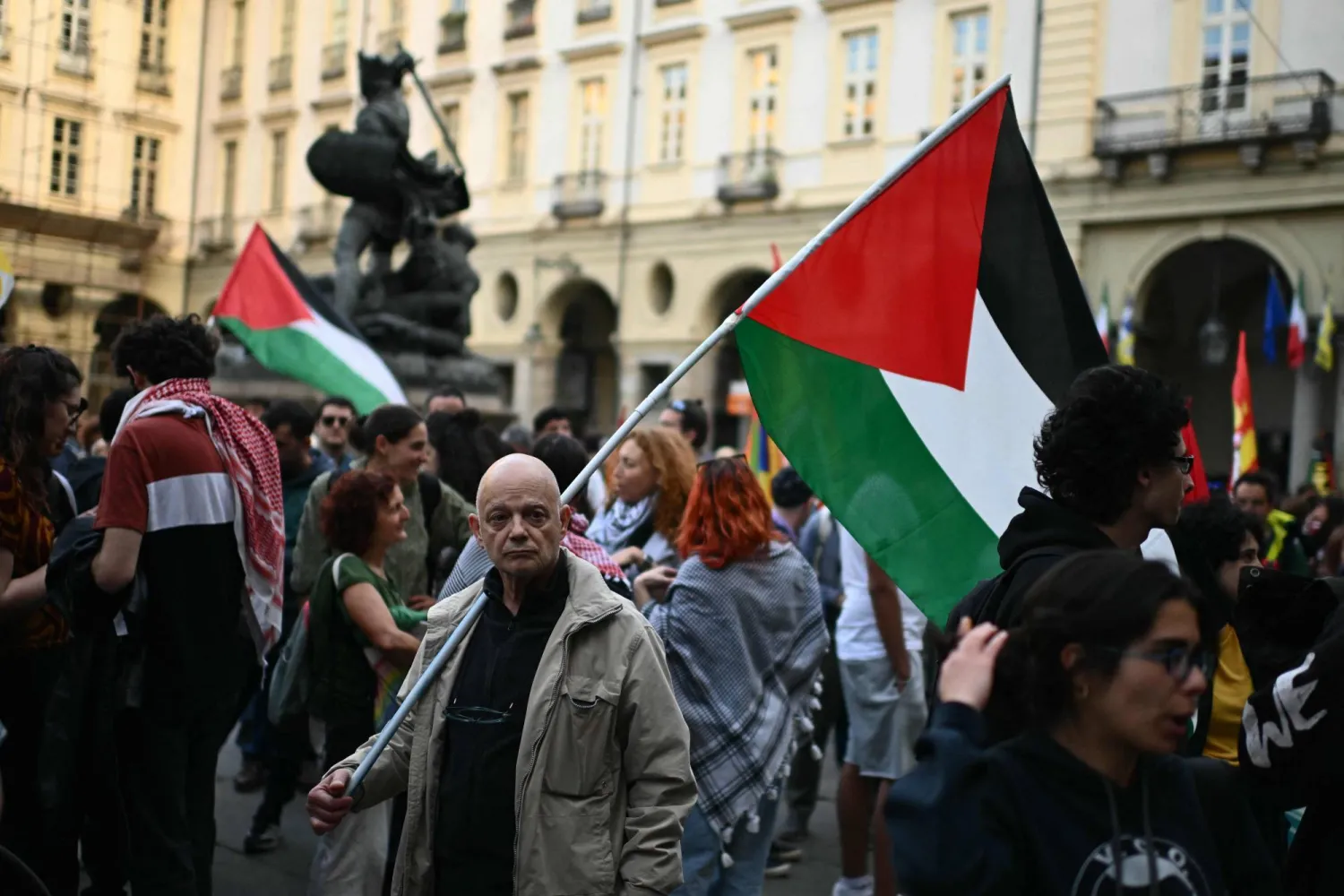
Protesters hold Palestinian flags during a demonstration to condemn the interception of the Global Sumud Flotilla by the Israeli army, in Turin on April 30, 2026. (Photo by MARCO BERTORELLO / AFP)
TT

Activists on Gaza Aid Flotilla Detained by Israel Disembark in Crete

Protesters hold Palestinian flags during a demonstration to condemn the interception of the Global Sumud Flotilla by the Israeli army, in Turin on April 30, 2026. (Photo by MARCO BERTORELLO / AFP)

Dozens of activists on a Gaza-bound aid flotilla which was intercepted by Israeli forces in international waters off Crete disembarked on Friday in the Greek island, an AFP journalist saw.

Escorted by Greek coast guards, some 175 activists were taken in four buses to a town whose name was not disclosed by the authorities.

Israel's foreign ministry earlier said around 175 activists had been taken off more than 20 boats on Thursday. Flotilla organizers put the number at 211.

"In coordination with the Greek government, the individuals transferred from the flotilla vessels to the Israeli vessel will be disembarked on a Greek beach in the coming hours," Israeli Foreign Minister Gideon Saar wrote on X late Thursday, thanking Greece "for its willingness to receive the flotilla participants".

Several European governments with nationals among those arrested have called on Israel to free the activists and called its action a flagrant contravention of international law.

But the United States backed Israeli authorities, calling the flotilla a "stunt".

"The United States expects all our allies...to take decisive action against this meaningless political stunt by denying port access, docking, departure and refueling to vessels participating in the flotilla," State Department spokesman Tommy Pigott said.

Initially made up of more than 50 boats, the flotilla's aim, according to the organizers, was to break the blockade of Gaza and bring humanitarian aid to the Palestinian territory, whose access remains largely restricted despite a fragile ceasefire between Israel and Hamas, in force since October.


Trump Congratulates Zaidi on His Nomination to Be Next Iraqi Prime Minister

This handout photograph taken and released by the Iraqi Prime Minister's Press Office on April 28, 2026 shows new prime minister-designate Ali al-Zaidi talking on the phone at his office in Baghdad. (Iraqi Prime Minister’s Press Office /AFP)
TT

Trump Congratulates Zaidi on His Nomination to Be Next Iraqi Prime Minister

This handout photograph taken and released by the Iraqi Prime Minister's Press Office on April 28, 2026 shows new prime minister-designate Ali al-Zaidi talking on the phone at his office in Baghdad. (Iraqi Prime Minister’s Press Office /AFP)

US President Donald Trump congratulated Ali al-Zaidi on his nomination to be next prime minister of Iraq on Thursday, saying that he looked forward to a highly productive new relationship.

Iraq's alliance of Shiite political blocs, the Coordination Framework, on Monday named Zaidi as its ‌nominee for the ‌post of prime minister, a ‌coalition ⁠statement said.

"We wish ⁠him success as he works to form a new Government free from terrorism that could deliver a brighter future for Iraq," Trump said in a post on Truth Social.

"We look ⁠forward to a strong, vibrant, ‌and highly ‌productive new relationship between Iraq and the United ‌States."

Trump also invited Zaidi to visit ‌Washington after forming a government during a phone call on Thursday in which he congratulated him on his nomination, according to ‌a statement from the Iraqi prime minister's media office.

The call reviewed ⁠strategic ⁠ties between Iraq and the US and ways to strengthen cooperation across multiple fields, the statement said, adding that both sides affirmed joint efforts to support regional stability.

Trump had threatened in January to withdraw Washington's support for Iraq if former Prime Minister Nouri al-Maliki was designated to form a cabinet.