King of Jordan Sends Syria’s Assad Message on Regional Developments

Syrian President Bashar al-Assad holds talks with Jordanian Foreign Minister Ayman al-Safadi in Damascus on Sunday. (SANA)
TT

King of Jordan Sends Syria’s Assad Message on Regional Developments

Syrian President Bashar al-Assad holds talks with Jordanian Foreign Minister Ayman al-Safadi in Damascus on Sunday. (SANA)

Jordanian Foreign Minister Ayman al-Safadi arrived on an official unannounced visit to Damascus on Sunday.

He held talks with President Bashar al-Assad, delivering a verbal message from King Abdullah II on the “current dangerous developments in the region,” said an official Syrian statement.

The message was related to several bilateral and regional affairs, as well as the Syrian crisis, it added.

Assad and Safadi also discussed bilateral ties between their countries and the return of Syrian refugees back to their home country.

Assad stressed that providing the conditions for the safe return was a “priority for the Syrian state,” added the statement. Syria has made strides in this regard, it stressed.

Jordan is doing everything in its power to return the refugees home, Safadi was quoted as saying. Amman supports Syria’s stability and recovery given its importance to the region.

Safadi also held talks with his Syrian counterpart Bassam al-Sabbagh.

Informed sources in Damascus told Asharq Al-Awsat that the surprise visit means Safadi was in Syria to discuss the escalation in the region and the “Arab role Damascus is expected to play to avert the expansion of the war.”

He was also seeking to overcome the impasse in reaching a political solution to the crisis in Syria, they remarked.

Moreover, they noted the drugs and arms smuggling from Syria to Jordan that has been a major cause for concern in the kingdom.

Iran-backed militias in Syria are accused of being behind the smuggling.

Amman has been urging Damascus to intensify its efforts to combat the illicit activity, which has decreased, but not stopped, despite increased efforts.

The sources said Safadi likely discussed this issue in Syria given that Israel has struck smuggling routes between Syria and Lebanon.

Earlier this month, the Jordanian military announced that it had thwarted a drug smuggling attempt through the use of a drone.

The army has been firmly combating the smuggling, resorting to force on occasion.


Israel Strikes East Lebanon, Says Targeting Hezbollah Arms

Smoke rises from the site of an Israeli strike that targeted the southern Lebanese village of Kfar Tebnit on May 21, 2026. (AFP)
TT

Israel Strikes East Lebanon, Says Targeting Hezbollah Arms

Smoke rises from the site of an Israeli strike that targeted the southern Lebanese village of Kfar Tebnit on May 21, 2026. (AFP)

Israel struck a mountainous area in eastern Lebanon on Monday, according to Lebanese state media, with the Israeli military saying it was targeting a shipment of weapons headed for Hezbollah.

"Enemy aircraft launched a strike at dawn against the Al-Shaara region, in the highlands of the Anti-Lebanon mountain range, without resulting in victims or damage," Lebanon's official National News Agency (NNA) said.

The Israeli military said it "struck a weapons shipment transferred from Syria to Lebanon, intended for the Hezbollah terrorist organization".

Hezbollah, which is backed by Iran, emerged badly weakened from two successive wars with Israel since 2023.

The ousting in 2024 of Syrian president Bashar al-Assad, a key ally of the group, cut off a major weapons route.

Hezbollah lawmakers have nonetheless maintained that the group is rebuilding its military capacities, as fighting with Israel has wound down since June.

In October, Lebanese security forces seized a half-ton of explosives transported in a truck from east Lebanon towards Beirut.

Hezbollah acknowledged ownership of the explosives, saying they were intended for "resistance" against Israel.

Lebanese authorities have announced a plan to disarm Hezbollah, but the group has refused to lay down its weapons.


US Envoy Says Lebanon’s Hezbollah Should Disarm ‘Voluntarily'

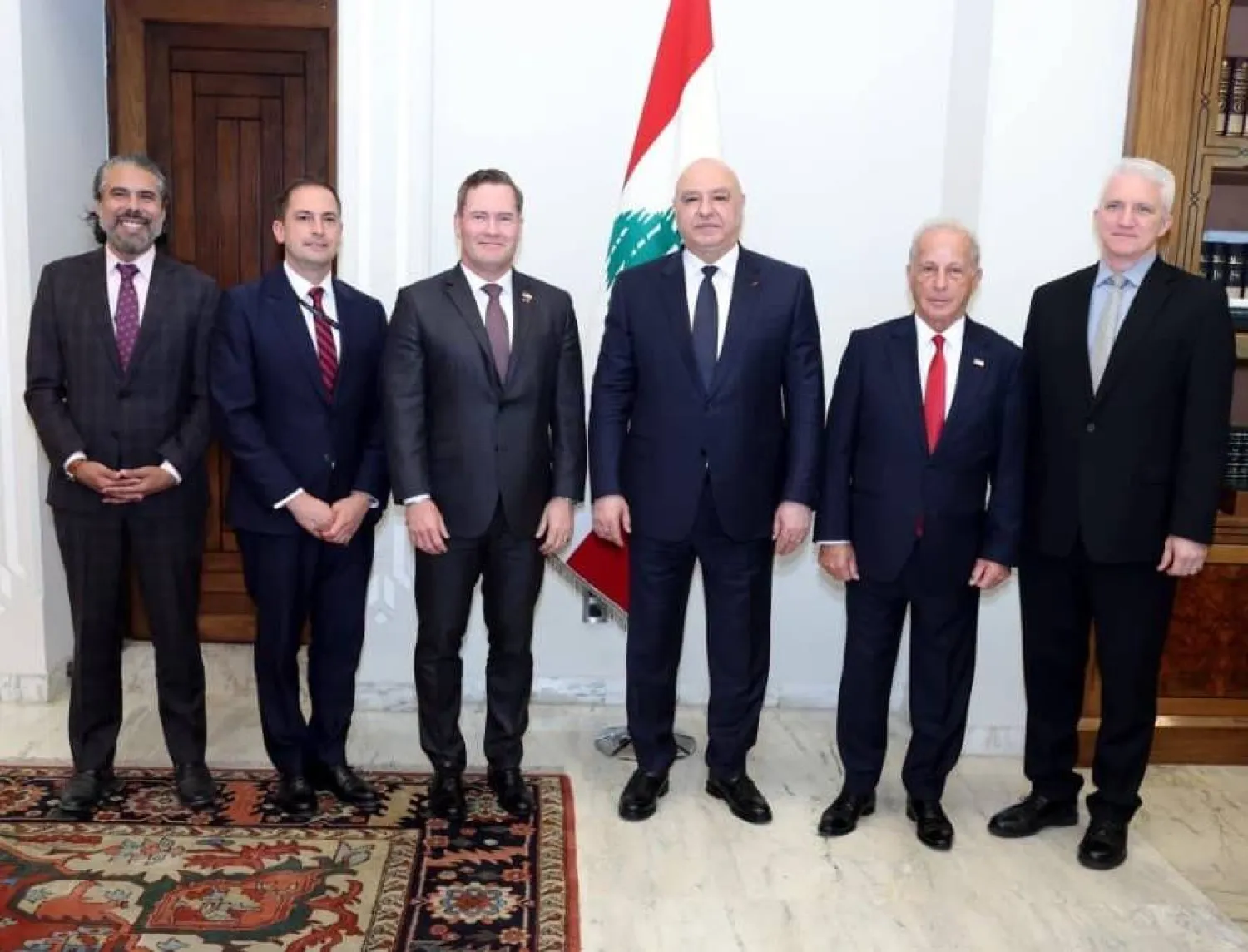
Lebanese President Joseph Aoun receives US envoy Mike Waltz at the Baabda presidential palace on Monday. (NNA)
TT

US Envoy Says Lebanon’s Hezbollah Should Disarm ‘Voluntarily'

Lebanese President Joseph Aoun receives US envoy Mike Waltz at the Baabda presidential palace on Monday. (NNA)

Iran-backed Hezbollah should "voluntarily" lay down its weapons and hand them over to the Lebanese state, visiting US envoy Mike Waltz said on Monday, adding that "no country can have two armies". 

"I think the message should be loud and clear, that Lebanese sovereignty must be fully restored," said Waltz, who is the US ambassador to the United Nations. 

"And the mechanism to do that will be the Lebanese armed forces." 

Waltz held separate talks in Lebanon with President Joseph Aoun and Prime Minister Nawaf Salam.

Hezbollah, which has fought successive wars with Israel, is under pressure to disarm. 

It was the only armed group that refused to hand over its weapons after Lebanon's civil war ended in 1990. 

"I appreciate every Lebanese soldier that steps forward to defend their country, to restore their sovereignty, to defend their people. This is a unique opportunity in history to do that, one," Waltz said. 

"And two, to Hezbollah and to their Iranian backers, no country can have two armies. I hope and pray Hezbollah will disarm. They should do that voluntarily." 


Syria Needs EU Support to Ensure Stability, Kallas Says

High Representative of the European Union for Foreign Affairs Kaja Kallas speaks prior to the Foreign Affairs Council meeting in Brussels, Belgium, 16 November 2026. (EPA)
TT

Syria Needs EU Support to Ensure Stability, Kallas Says

High Representative of the European Union for Foreign Affairs Kaja Kallas speaks prior to the Foreign Affairs Council meeting in Brussels, Belgium, 16 November 2026. (EPA)

European Union foreign ministers will discuss on Monday elevating their relationship with Syria as the war-torn country needs urgent support to ensure stability amid ‌escalating tensions ‌in the ‌region, ⁠the bloc's foreign policy ⁠chief said.

"We really see that Syria needs a lot of investments, to build ⁠up institutions and ‌its ‌reforms," Kaja Kallas ‌told reporters ahead of ‌a monthly foreign ministers meeting in Brussels.

"On the European side we ‌want to see Syrian refugees return but ⁠they ⁠need conditions to return. There's a lot we can do together because the stability of Syria is in our interest and the interest of region."