

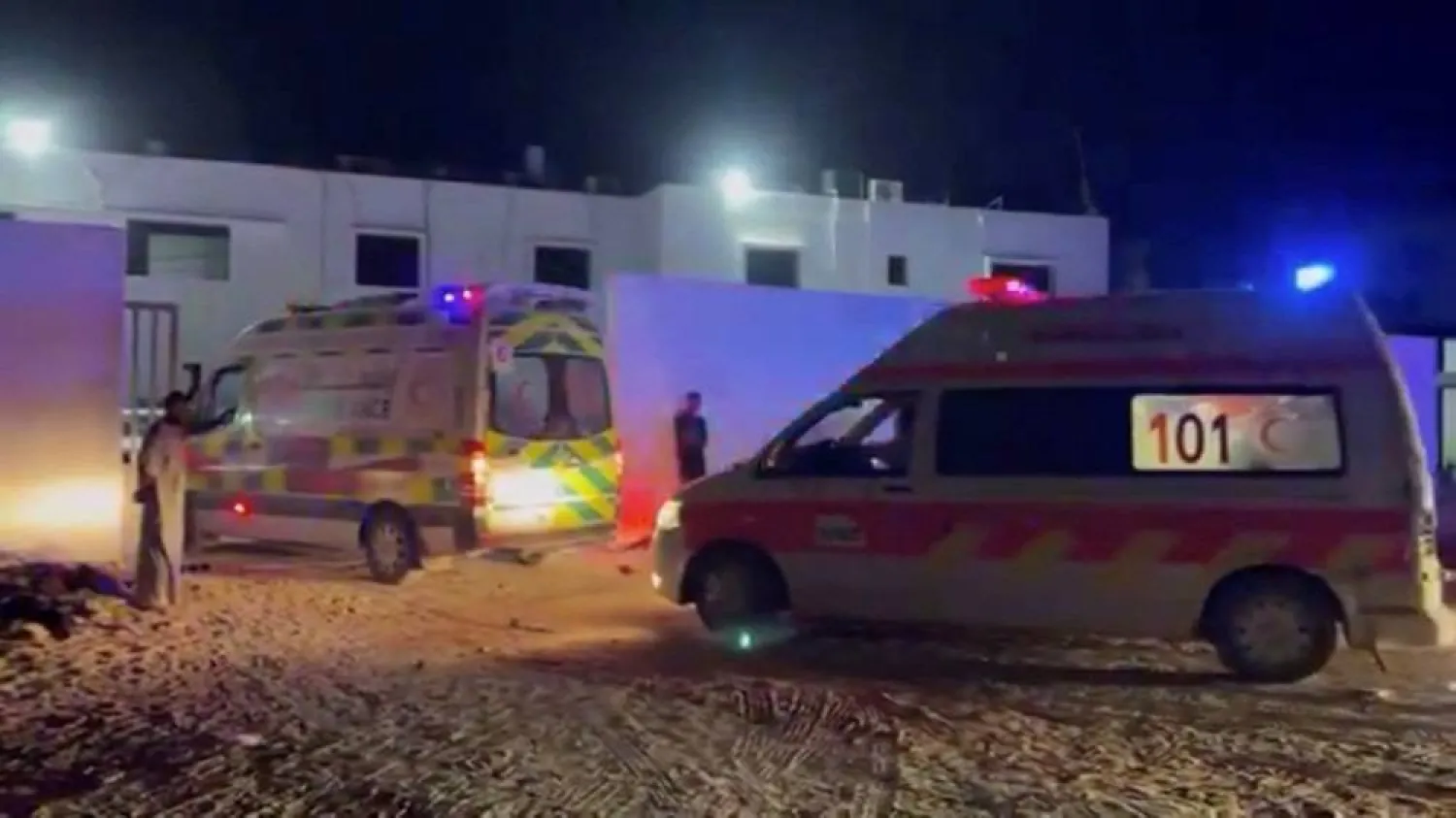

WHO to Evacuate 1,000 Gazan Women, Children for Urgent Medical Care

Ambulances pass through an entrance, during the evacuation of people from Kamal Adwan Hospital in northern Gaza to Al-Shifa Hospital in Gaza City, at Al-Shifa Hospital in Gaza City, in this screen grab taken from a handout video released on October 12, 2024. (Palestine Red Crescent Society/Handout via Reuters)
TT

WHO to Evacuate 1,000 Gazan Women, Children for Urgent Medical Care

Ambulances pass through an entrance, during the evacuation of people from Kamal Adwan Hospital in northern Gaza to Al-Shifa Hospital in Gaza City, at Al-Shifa Hospital in Gaza City, in this screen grab taken from a handout video released on October 12, 2024. (Palestine Red Crescent Society/Handout via Reuters)

Up to 1,000 women and children needing medical care will shortly be evacuated from Gaza to Europe, the head of the World Health Organization's Europe branch said in comments published on Monday.

Israel, which is besieging the war-devastated Palestinian territory, "is committed to 1,000 more medical evacuations within the next months to the European Union," Hans Kluge said in an interview with AFP.

He said the evacuations would be facilitated by the WHO -- the United Nations' health agency -- and the European countries involved.

On Thursday, UN investigators said Israel was deliberately targeting health facilities in Gaza, and killing and torturing medical personnel there, accusing the country of "crimes against humanity".

Rik Peeperkorn, WHO representative in the occupied Palestinian territories, said in May that around 10,000 people needed evacuating from Gaza for urgent medical care.

The WHO Europe has already facilitated 600 medical evacuations from Gaza to seven European countries since the latest war began there in October 2023.

"This would never have happened if we did not keep the dialogue (open)," Kluge said.

"The same (is true) for Ukraine," he added. "I keep the dialogue (open) with all partners.

"Now, 15,000 HIV-AIDS patients in Donbas, the occupied territories (of Ukraine), are getting HIV-AIDS medications," the 55-year-old Belgian said in English, stressing the importance of "not politicizing health".

"The most important medicine is peace," he said, noting that healthcare workers had to be allowed to do their jobs in conflict zones.

- 'Outrage every time' -

Around 2,000 attacks have been registered on health centers in Ukraine since Russia's invasion in February 2022, according to the WHO.

"There may be a kind of acceptance almost but this should cause outrage every single time," he said.

"We will always continue to condemn this in the strongest possible terms."

Kluge expressed concern ahead of Ukraine's third winter of war.

"Eighty percent of the civilian energy grid is damaged or destroyed. We saw it in the hospitals, surgeons operating with a lamp on their heads," he said.

"It will be a very, very tough" winter.

Despite strains on Europe's healthcare systems, he said the 53 countries that make up the WHO European region -- which includes central Asian countries -- were able to come together to prepare for future pandemics.

"In Europe, we did our homework," he said.

- Global pandemic treaty? -

"What we need is a pandemic treaty globally, because even if we do our share, we're never going to stop bugs entering our continent."

A European strategy for pandemics is due to be presented on October 31.

At the same time, the WHO is urging its members to "manage and prepare for the next crisis, while ensuring continuation of essential basic health services" in order to avoid another "rupture" like that which occurred during the Covid pandemic.

Ensuring the security of national health care systems is crucial and should be a priority, he said.

"A minimum of 25 out of 53 countries during the past five years had at least one big health emergency event big enough to test the country's security," he said.

The pandemic has left its mark on Europeans, which Kluge hopes to erase during his next mandate.

"The Covid-19 pandemic set us back two years on non-communicable diseases," he said, requiring countries to double down on diagnosing and treating multidrug resistant tuberculosis, testing for uterus and cervical cancer, and vaccinations.

In addition, Kluge said he also wanted to address worrying trends, such as the health of young people and growing inequalities between men and women.

"It's very clear. We see that the lockdowns during Covid-19 led to a 25-percent increase in anxiety and depression orders," he lamented.

"Twenty-six percent of the women between 15 and 49 years in my region report, at least one time in their lifetime experienced intimate partner violence or non-partner sexual violence," he said.

Kluge has headed the WHO Europe since February 2020 and is expected to be re-elected at the end of October.



Hezbollah Official Says Will Not Intervene in Event of 'Limited' US Strikes on Iran

A bulldozer clears debris near heavily-damaged buildings in the village of Bednayel in Lebanon's eastern Bekaa Valley region on February 21, 2026, following Israeli strikes. (AFP)
TT

Hezbollah Official Says Will Not Intervene in Event of 'Limited' US Strikes on Iran

A bulldozer clears debris near heavily-damaged buildings in the village of Bednayel in Lebanon's eastern Bekaa Valley region on February 21, 2026, following Israeli strikes. (AFP)

A Hezbollah official said Wednesday that the Lebanese militant group would not intervene militarily in the event of "limited" US strikes on its backer Iran, but would consider any attack against supreme leader Ayatollah Ali Khamenei a "red line".

Lebanese authorities fear that Hezbollah would become involved if a potential US attack on Iran triggered a regional war, but the official told AFP on condition of anonymity: "In the event of limited US strikes on Iran, Hezbollah's position will be to not intervene militarily."


Syria Confirms Mass Escape of Militant Relatives from Al-Hol Camp

A general view of Al-Hol camp located in a desert region of Hasakeh province in Syria. Reuters file photo
TT

Syria Confirms Mass Escape of Militant Relatives from Al-Hol Camp

A general view of Al-Hol camp located in a desert region of Hasakeh province in Syria. Reuters file photo

Syria confirmed on Wednesday the mass escape of relatives of suspected ISIS group militants from the Al-Hol camp last month following the withdrawal of Kurdish forces who had overseen the facility.

"When our forces arrived, they found cases of collective escapes due to the camp having been opened up in a haphazard manner," interior ministry spokesman Noureddine al-Baba told a press conference, AFP reported

Al-Hol, the largest camp for relatives of suspected ISIS militants in northeastern Syria, had been under the control of the Kurdish-led Syrian Democratic Forces (SDF).

But last month, Syrian troops drove Kurdish forces from swathes of the north, sparking questions over the fate of the ISIS prisoners and their families.

Under pressure, the SDF withdrew from the camp on January 20, with Syrian security forces taking control a few hours later.

"The SDF withdrew suddenly, without coordination and without informing" the Syrian authorities or the international anti-militant coalition beforehand, al-Baba said.

There was a "chaotic situation" after the Kurdish forces pulled out, he added, and "more than 138 breaches" have been discovered in the camp's 17-kilometre (11-mile) perimeter wall that allowed mass escapes.

After the Kurdish forces withdrew, thousands of women and children fled the camp to parts unknown.

Al-Hol housed 23,500 people, mostly Syrian and Iraqis, the ministry spokesman said.

Around 6,500 foreigners of 44 different nationalities lived in a high-security section of the camp.

Last week, Syrian authorities moved the families still at Al-Hol to another site in the country's north.

Before the Kurdish forces withdrew, the United States military had transferred more than 5,700 detained ISIS suspects from Syrian prisons to Iraq.

The US had previously announced it would transfer around 7,000 detainees.

ISIS swept across Syria and Iraq in 2014, committing massacres and forcing women and girls into sexual slavery.

Backed by US-led forces, Iraq proclaimed the defeat of ISIS in the country in 2017, and the SDF ultimately beat back the group in Syria two years later.

The SDF went on to jail thousands of suspected militants and detain tens of thousands of their relatives in camps.


Australia Tells Families of Diplomats to Leave Israel, Lebanon

A billboard on the road to Beirut International Airport promoting tourism in Lebanon (AP).
TT

Australia Tells Families of Diplomats to Leave Israel, Lebanon

A billboard on the road to Beirut International Airport promoting tourism in Lebanon (AP).

The Australian government has told dependants of Australian diplomats in Israel and Lebanon to leave the two Middle East countries, citing a deteriorating security situation in the region, the foreign ministry said on Wednesday.

The government has also offered voluntary departures to Australian diplomats' dependants in the United Arab Emirates, Jordan and Qatar, it said on an official ministry X account, Reuters reported.

US President Donald Trump laid out his case for a possible attack on Iran in his State of the Union speech to Congress on Tuesday, saying he would not allow the world's biggest sponsor of terrorism to have a nuclear weapon.

Iran and the United States resumed negotiations earlier this month as Washington builds up military capability in the Middle East. Iran has threatened to strike US bases in the region if it is attacked, but Tehran's top diplomat said on Tuesday that a deal with the US was "within reach" if diplomacy is prioritised.

The Australian government continues to advise citizens in Israel and Lebanon to consider leaving while commercial options are still available, the foreign ministry said.

The announcements were made in a series of posts on the foreign ministry's Smartraveller X account.