Massive Displacement from Israel-Hezbollah War Transforms Beirut’s Famed Commercial Street

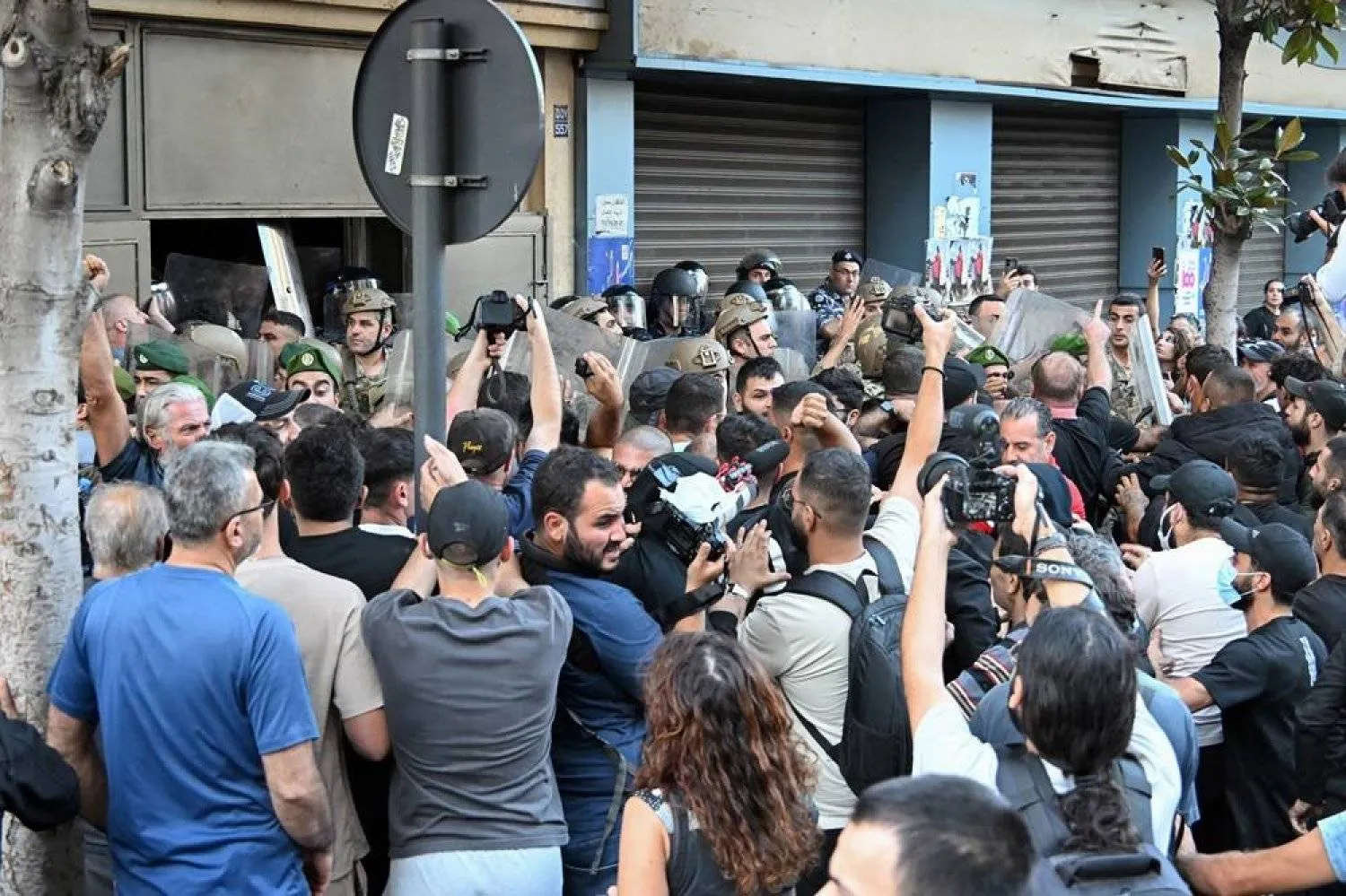
Lebanese civilians argue with army soldiers as they attempt to evict internally displaced people from an old hotel's premises, at Hamra Street in Beirut, Lebanon, 21 October 2024. (EPA)
TT

Massive Displacement from Israel-Hezbollah War Transforms Beirut’s Famed Commercial Street

Lebanese civilians argue with army soldiers as they attempt to evict internally displaced people from an old hotel's premises, at Hamra Street in Beirut, Lebanon, 21 October 2024. (EPA)

Inside what was once one of Beirut’s oldest and best-known cinemas, dozens of Lebanese, Palestinians and Syrians displaced by the Israel-Hezbollah war spend their time following the news on their phones, cooking, chatting and walking around to pass the time.
Outside on Hamra Street, once a thriving economic hub, sidewalks are filled with displaced people, and hotels and apartments are crammed with those seeking shelter. Cafes and restaurants are overflowing, The Associated Press said.
In some ways, the massive displacement of hundreds of thousands of people from south Lebanon, the eastern Bekaa Valley and Beirut’s southern suburbs has provided a boost for this commercial district after years of decline as a result of Lebanon’s economic crisis.
But it is not the revival many had hoped for.
“The displacement revived Hamra Street in a wrong way,” said the manager of a four-star hotel on the boulevard, who requested anonymity to speak candidly about the problems the influx has caused for the neighborhood.
For three weeks after the war intensified in mid-September, his hotel enjoyed full occupancy. Today, it stands at about 65% capacity — still good for this time of year — after some left for cheaper rented apartments.
But, he said, the flow of displaced people has also brought chaos. Traffic congestion, double parking and motorcycles and scooters scattered on sidewalks has become the norm, making it difficult for pedestrians to walk. Tensions regularly erupt between displaced people and the district’s residents, he said.
Hamra Street has long been a bellwether for Lebanon’s turbulent politics. During the country's heyday in the 1960s and early 1970s, it represented everything that was glamorous, filled with Lebanon’s top movie houses and theaters, cafes frequented by intellectuals and artists, and ritzy shops.
Over the past decades, the street has witnessed rises and falls depending on the situation in the small Mediterranean nation that has been marred by repeated bouts of instability, including a 15-year civil war that ended in 1990. In 1982, Israeli tanks rolled down Hamra Street after Israel invaded the country, reaching all the way to west Beirut.
In recent years, the district was transformed by an influx of Syrian refugees fleeing the war in the neighboring nation, and businesses were hammered by the country’s financial collapse, which began in 2019.
Israel dramatically escalated its attacks on parts of Lebanon on Sept. 23, killing nearly 500 people and wounding 1,600 in one day after nearly a year of skirmishes along the Lebanon-Israel border between Israeli troops and the militant Hezbollah group. The intensified attacks sparked an exodus of people fleeing the bombardment, including many who slept in public squares, on beaches or pavements around Beirut.
More than 2,574 people have been killed in Lebanon and over 12,000 wounded in the past year of war, according to the country's Health Ministry, and around 1.2 million people are displaced.
Many have flooded Hamra, a cosmopolitan and diverse area, with some moving in with relatives or friends and others headed to hotels and schools turned into shelters. In recent days several empty buildings were stormed by displaced people, who were forced to leave by security forces after confrontations that sometimes turned violent.
Mohamad Rayes, a member of the Hamra Traders Association, said before the influx of displaced people, some businesses were planning to close because of financial difficulties.
“It is something that cannot be imagined,” Rayes said about the flow of displaced people boosting commerce in Hamra in ways unseen in years. He said some traders even doubled prices because of high demand.
At a cellular shop, Farouk Fahmy said during the first two weeks his sales increased 70%, with people who fled their homes mostly buying chargers and internet data to follow the news.
“The market is stagnant again now,” Fahmy said.
Since many fled their homes with few belongings, men's and women's underwear and pajama sales grew by 300% at the small boutique business owned by Hani, who declined to give his full name for safety reasons.
The 60-year-old movie theater, Le Colisee, a landmark on Hamra Street, had been closed for more than two decades until earlier this year when Lebanese actor Kassem Istanbouli, founder of the Lebanese National Theater, took over and began renovating it. With the massive tide of displacement, he transformed it into a shelter for families who fled their homes in south Lebanon.
Istanbouli, who has theaters in the southern port city of Tyre and the northern city of Tripoli, Lebanon’s second-largest, has turned all three into shelters where people, no matter their nationality, can take refuge.
This week, displaced people in the Beirut movie theater sat on thin mattresses on its red carpeting, checking their phones and reading. Some were helping with the theater's renovation work.
Among them was Abdul-Rahman Mansour, a Syrian citizen, along with his three brothers and their Palestinian-Lebanese mother, Joumana Hanafi. Mansour said they fled Tyre after a rocket attack near their home, taking shelter at a school in the coastal city of Sidon, where they were allowed to stay since their mother is a Lebanese citizen.
When the shelter’s management found out that Mansour and his brothers were Syrian they had to leave because only Lebanese citizens were allowed. With no place to stay, they returned to Tyre.
“We slept for a night in Tyre, but I hope you never witness such a night,” Hanafi said of the intensity of the bombardment.
She said one of her sons knew Istanbouli and contacted him. “We told him, ‘Before anything, we are Syrians.’ He said, ‘It is a shame that you have to say that.’”
Istanbouli spends hours a day at his theaters in Beirut and Tripoli to be close to the displaced people sheltering there.
“Normally people used to come here to watch a movie. Today we are all at the theater and the movie is being played outside,” Istanbouli said of the ongoing war.



Israeli Reservist Rams Vehicle into Palestinian Man Praying in West Bank

Israeli security forces secure a street as they leave the Palestinian village of Bizariya, in the occupied West Bank, where Israeli authorities demolished the house of a Palestinian man killed in July after he and another man reportedly killed an Israeli settler on the same day, on December 24, 2025. (AFP)
TT

Israeli Reservist Rams Vehicle into Palestinian Man Praying in West Bank

Israeli security forces secure a street as they leave the Palestinian village of Bizariya, in the occupied West Bank, where Israeli authorities demolished the house of a Palestinian man killed in July after he and another man reportedly killed an Israeli settler on the same day, on December 24, 2025. (AFP)

An Israeli reservist soldier rammed his vehicle into a Palestinian man as he prayed on a roadside in ​the occupied West Bank on Thursday, after earlier firing shots in the area, the Israeli military said.

"Footage was received of an armed individual running over a Palestinian individual," it said in a statement, adding the individual was a reservist ‌and his ‌military service had ‌been terminated.

The ⁠reservist ​acted "in severe ‌violation of his authority" and his weapon had been confiscated, the military said.

Israeli media reported that he was being held under house arrest.

The Israeli police did not immediately respond to a Reuters request for comment.

The ⁠Palestinian man went to hospital for checks after ‌the attack, but was unhurt ‍and is now ‍at home.

Video which aired on Palestinian ‍TV shows a man in civilian clothing with a gun slung over his shoulder driving an off-road vehicle into a man praying on ​the side of the road.

This year ​was one of the most violent on ⁠record for Israeli civilian attacks against Palestinians in the West Bank, according to United Nations data that shows more than 750 injuries.

More than a thousand Palestinians were killed in the West Bank between October 7, 2023 and October 17, 2025, mostly in operations by security forces and some by settler violence, according to the UN In ‌the same period, 57 Israelis were killed in Palestinian attacks.


Deadly Blast Hits Mosque in Syria’s Homs, Saraya Ansar al-Sunna Claims Responsibility

Syrian security forces stand inside a damaged mosque after several people were killed in an explosion at a mosque as the Syrian Arab News Agency (SANA) said, in Homs, Syria December 26, 2025. REUTERS/Ali Ahmed al-Najjar
TT

Deadly Blast Hits Mosque in Syria’s Homs, Saraya Ansar al-Sunna Claims Responsibility

Syrian security forces stand inside a damaged mosque after several people were killed in an explosion at a mosque as the Syrian Arab News Agency (SANA) said, in Homs, Syria December 26, 2025. REUTERS/Ali Ahmed al-Najjar

A bombing at a mosque in Syria during Friday prayers killed at least eight people and wounded 18 others, authorities said.

Images released by Syria’s state-run Arab News Agency showed blood on the mosque’s carpets, holes in the walls, shattered windows and fire damage. The Imam Ali bin Abi Talib Mosque is located in Homs, Syria's third-largest city.

SANA, citing a security source, said that preliminary investigations indicate that explosive devices were planted inside the mosque. Authorities were searching for the perpetrators, who have not yet been identified, and a security cordon was placed around the building, Syria’s Interior Ministry said in a statement.

In a statement on Telegram, the Saraya Ansar al-Sunna said its fighters "detonated a number of explosive devices" in the mosque.

The same group had previously claimed a suicide attack in June in which a gunman opened fire and then detonated an explosive vest inside a Greek Orthodox church in Dweil’a, on the outskirts of Damascus, killing 25 people as worshippers prayed on a Sunday.

Several countries, including Saudi Arabia, Jordan and Lebanon, condemned the attack. 


Fuel Shortage Forces Gaza Hospital to Suspend Most Services

The sun sets behind a makeshift tent camp for displaced Palestinians set up in an area of al-Bureij camp, in the central Gaza Strip, Wednesday, Dec. 24, 2025. (AP)
TT

Fuel Shortage Forces Gaza Hospital to Suspend Most Services

The sun sets behind a makeshift tent camp for displaced Palestinians set up in an area of al-Bureij camp, in the central Gaza Strip, Wednesday, Dec. 24, 2025. (AP)

A major Gaza hospital has suspended several services because of a critical fuel shortage in the devastated Palestinian territory, which continues to face a severe humanitarian crisis, it said.

Devastated by more than two years of war, the Al-Awda Hospital in the central Gaza district of Nuseirat cares for around 60 in-patients and receives nearly 1,000 people seeking medical treatment each day.

"Most services have been temporarily stopped due to a shortage of the fuel needed for the generators," said Ahmed Mehanna, a senior official involved in managing the hospital.

"Only essential departments remain operational: the emergency unit, maternity ward and pediatrics."

To keep these services running, the hospital has been forced to rent a small generator, he added.

Under normal conditions, Al-Awda Hospital consumes between 1,000 and 1,200 liters of diesel per day. At present, however, it has only 800 liters available.

"We stress that this shutdown is temporary and linked to the availability of fuel," Mehanna said, warning that a prolonged fuel shortage "would pose a direct threat to the hospital's ability to deliver basic services".

He urged local and international organizations to intervene swiftly to ensure a steady supply of fuel.

Despite a fragile truce observed since October 10, the Gaza Strip remains engulfed in a severe humanitarian crisis.

While the ceasefire agreement stipulated the entry of 600 aid trucks per day into Gaza, only 100 to 300 carrying humanitarian assistance can currently enter, according to the United Nations and non-governmental organizations.

The remaining convoys largely transport commercial goods that remain inaccessible to most of Gaza's 2.2 million people.

- Health hard hit -

On a daily basis, the vast majority of Gaza's residents rely on aid from UN agencies and international NGOs for survival.

Gaza's health sector has been among the hardest hit by the war.

During the fighting, the Israeli miliary repeatedly struck hospitals and medical centers across Gaza, accusing Hamas of operating command centers there, an allegation the group denied.

International medical charity Doctors Without Borders now manages roughly one-third of Gaza's 2,300 hospital beds, while all five stabilization centers for children suffering from severe malnutrition are supported by international NGOs.

The war in Gaza was sparked on October 7, 2023, following an unprecedented Hamas attack on Israel that resulted in the deaths of 1,221 people, most of them civilians, according to an AFP tally based on official Israeli figures.

In Israel's ensuing military campaign in Gaza, at least 70,942 people - also mostly civilians - have been killed, according to the health ministry in the Hamas-run territory.