France and Morocco Announce High Speed Rail Investments as Macron Visits Rabat

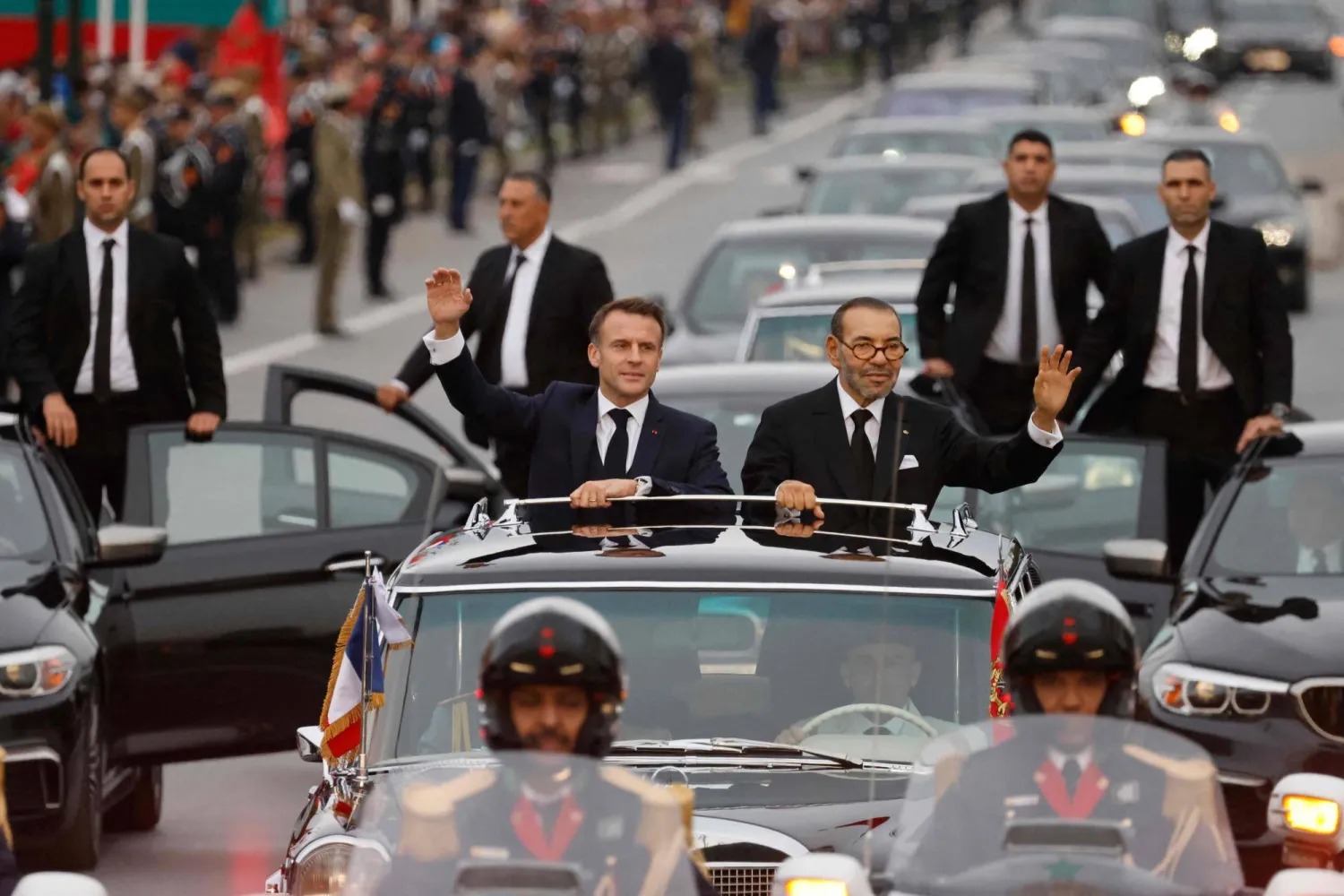
Morocco's King Mohammed VI (R) and France's President Emmanuel Macron greet the crowds as the drive down a road in the capital Rabat on October 28, 2024. (Photo by Ludovic MARIN / POOL / AFP)
TT

France and Morocco Announce High Speed Rail Investments as Macron Visits Rabat

Morocco's King Mohammed VI (R) and France's President Emmanuel Macron greet the crowds as the drive down a road in the capital Rabat on October 28, 2024. (Photo by Ludovic MARIN / POOL / AFP)

Morocco's King Mohammed VI welcomed French President Emmanuel Macron to Morocco on Monday, kicking off a state visit with a series of bilateral agreements, including major investments in renewable energy and transportation.
Macron's trip to Morocco — his first in six years — comes as immigrants, including North Africans, face continued scrutiny in France and while France reassesses its role in its former colonies throughout Africa. Morocco has historically been a key economic and security partner, however relations between the two countries have often been fragile, The Associated Press said.
Among the objectives of Macron's visit, the Elysee Palace said, is “to rebuild the exceptional partnership that links our two countries.”
French and Moroccan flags on Monday flew throughout the capital, where crowds lined the streets to watch the motorcade containing Macron, his wife and members of Morocco's royal family drive to one of their palaces.
Macron and Mohammed VI, who used a cane to walk, later oversaw a ceremonial signing of 22 agreements to facilitate future investments as well as cultural and scientific partnerships. The investments are worth a total of 10 billion euros and include expanding Morocco's high speed rail line southward to Marrakech, which the country hopes to complete before it holds events for the FIFA World Cup in 2030. They also included projects to develop green hydrogen, wind farms and water projects, which Morocco has identified to help insulate the country from the effects of climate change.
In the days leading up to the visit, Moroccan publications lauded the “warm reunion” and a “new honeymoon” between the two countries.
Diplomatic relations have warmed. Macron changed France’s longstanding public position and backed Morocco’s autonomy plan for the disputed Western Sahara. Doing so endeared France to Morocco but alienated it from Algeria, which hosts refugee camps governed by the pro-independence Polisario Front and considers Morocco an occupying power.
France and Morocco have historically partnered on issues ranging from counterterrorism to managing migration. Morocco is the top destination for French investment in Africa and France is Morocco’s top trade partner. Morocco imports French cereals, weapons and renewable energy infrastructure like turbines. France imports goods from Morocco including tomatoes, cars and airplane parts.
Moroccans are among the largest foreign-born communities in France, where North African immigrants are a key political constituency and a focal point of debates about the roles of Islam and immigration in French society.
France’s new Interior Minister Bruno Retailleau, a member of the French delegation in Morocco this week, has pushed for the country to take a hard-line approach toward immigration and seek deals with countries like Morocco to better prevent would-be migrants from crossing into Europe.
On Macron’s last visit to Morocco, he and King Mohammed VI inaugurated Al Boraq, Africa’s first high-speed rail line, made possible by French financing and trains manufactured by the French firm Alstrom. The rail line currently functions from central to northern Morocco, running high speed from Kenitra to Tangiers. The extension will more than double its length.
Despite close ties, relations have at times been fragile between France and Morocco, which was a French protectorate from 1912 to 1956. In 2021, Morocco suspended consular relations after France momentarily reduced the number of visas offered to Moroccans in protest of its refusal to provide documents needed to deport people who migrated to France without authorization. France later reversed the decision.
Relations between the two countries soured further that year, when a 2021 report revealed Morocco’s security services had used Israeli spyware to infiltrate the devices of activists and politicians, including Macron. Morocco denied and sued over the allegations.



Al-Wadiah Border Security Foils Attempt to Smuggle Thousands of Captagon Pills from Yemen 

Members of the Al-Wadiah battalion boast extensive experience allowing them to thwart ongoing smuggling attempts. (Al-Wadiah battalion) 
TT

Al-Wadiah Border Security Foils Attempt to Smuggle Thousands of Captagon Pills from Yemen 

Members of the Al-Wadiah battalion boast extensive experience allowing them to thwart ongoing smuggling attempts. (Al-Wadiah battalion) 

The “Al-Wadiah Port Security and Protection Battalion” thwarted an attempt to smuggle 4,925 Captagon pills bound for Saudi Arabia from areas under Houthi control in Yemen.

Col. Osama Al-Assad, commander of the battalion, said the seizure was made during routine inspection procedures at the land crossing.

Security personnel grew suspicious of an incoming vehicle and, after a thorough search, discovered the pills professionally concealed in an apparent attempt to evade detection.

In remarks to Asharq Al-Awsat, Al-Assad said the confiscated drugs were documented in line with legal procedures and the suspects were referred to the competent authorities for further investigation.

He stressed that coordination with the Saudi side remains strong and ongoing at the highest levels, expressing appreciation to the Kingdom for its continued support to Yemen in general and to the battalion in particular, helping bolster border security between the two neighbors.

In a recent interview with Asharq Al-Awsat, Al-Assad revealed that most drug smuggling networks operating from Yemen into Saudi territory are directly linked to the Houthi militants.

He noted that the battalion had previously arrested a Houthi leader attempting to enter Saudi Arabia using a forged passport and Umrah visa, suggesting the motives were security-related rather than religious.

Regarding the latest operation, Al-Assad said preliminary investigations indicate that most drug shipments intercepted at the crossing originate from Houthi-controlled areas.

He accused the group of relying on drug trafficking as a source of funding for its activities, posing a threat to Yemen’s national security, neighboring countries, and regional stability.

The battalion’s mission includes securing and protecting the Al-Wadiah crossing, combating various forms of smuggling, including drugs, human trafficking, forged documents, and unidentified individuals, and arresting wanted suspects, including members of al-Qaeda and fugitives evading court rulings.


Sudan Government Condemns Ugandan President’s Talks with Hemedti

Hemedti at the presidential palace in Entebbe on Feb. 20, 2026 (President Museveni’s page on X).
TT

Sudan Government Condemns Ugandan President’s Talks with Hemedti

Hemedti at the presidential palace in Entebbe on Feb. 20, 2026 (President Museveni’s page on X).

The Sudanese government has condemned “in the strongest terms” Ugandan President Yoweri Museveni’s meeting with Rapid Support Forces (RSF) commander Mohamed Hamdan Dagalo calling the move “unprecedented” and an affront to humanity and the Sudanese people.

In a statement issued Sunday, Sudan’s Ministry of Foreign Affairs said the ceremonial welcome accorded to Dagalo, known as Hemedti, in the Ugandan capital, Kampala, mocked “the souls of innocent citizens killed in the war, whose dignity was violated and whose property was looted” by the RSF.

The Ministry added that Uganda’s action “contravenes the principles governing member states of regional and international organizations,” particularly the obligation not to offer support to armed groups rebelling against a legitimate government recognized internationally.

Museveni met Hemedti on Friday at the presidential palace in Entebbe, where the two discussed efforts to end the ongoing war in Sudan. The talks also addressed regional and international initiatives aimed at reaching a political settlement to the conflict.

The meeting marked Hemedti’s first prominent regional appearance in several months. According to Dagalo, the discussions included what he described as a “Ugandan vision” for ending the war.

In its statement, Sudan’s Foreign Ministry acknowledged Uganda’s sovereign right to host whomever it chooses in accordance with its national interests. However, it expressed “deep concern” that the meeting could signal a shift in Kampala’s policy toward Sudan.

The Ministry urged the Ugandan government, in the interest of bilateral relations, good neighborliness, and non-interference in internal affairs, to distance itself from the RSF commander and not allow him to use Ugandan territory for political purposes.

Speaking to members of the Sudanese community in Entebbe, Hemedti said his visit came at the invitation of Museveni, who, he claimed, had been asked by Sudan’s government to intervene in efforts to help end the war.

In a post on the social media platform X, Museveni confirmed that he had received the RSF commander at the presidential residence in Entebbe and had listened to a detailed briefing on developments in Sudan.

He stressed that dialogue and a peaceful political settlement remain the only viable path to stability in Sudan and to ensuring security across the region.

Hemedti’s visit to Uganda came just one week after Museveni hosted Malik Agar, Vice Chairman of Sudan’s Sovereignty Council, allegedly as part of regional and international efforts to secure a ceasefire and lay the groundwork for a comprehensive political solution to Sudan’s ongoing conflict.


ISIS Lashes Out at Syria's Sharaa, Announces ‘New Phase of Operations’

A Syrian government soldier outside Al-Aqtan prison in Raqqa, which holds ISIS detainees (AFP)
TT

ISIS Lashes Out at Syria's Sharaa, Announces ‘New Phase of Operations’

A Syrian government soldier outside Al-Aqtan prison in Raqqa, which holds ISIS detainees (AFP)

Syria’s Defense Ministry said on Sunday that a Syrian army soldier and a ‌civilian were killed a day earlier by “unknown assailants” in the northern city of Raqqa.

ISIS claimed ‌responsibility for two attacks targeting Syrian army personnel in northern and eastern Syria.

The militant group said on its Dabiq news agency that it had targeted “an individual of the apostate Syrian regime” in the city of Mayadin in Deir Ezzor province using a pistol, and attacked two other personnel with machine guns in Raqqa.

The attacks came after ISIS blasted Syria’s interim president, Ahmad al-Sharaa, calling him a “puppet without a soul” controlled by Western countries, adding that his fate eventually will be similar to that of ousted leader Bashar Assad.

In an audio message released late Saturday by the group’s spokesman, who identifies himself as Abu Huzaifa al-Ansari, he called on ISIS followers around the world to attack Jewish and Western targets as they have in past years.

The ‌group also said it had begun a “new phase of operations” in Syria.

Al-Ansari sent greetings to ISIS militants from the group’s leader Abu Hafs al-Hashemi al-Qurayshi who was named as the head of the group three years ago.

The audio is the first to be released by the group in months and comes after ISIS was blamed for attacks that left dozens dead or wounded in recent months in Syria, Iraq, Pakistan and other parts of the world.

The latest incidents come two days after ISIS claimed responsibility for another attack in Deir Ezzor that killed a member of the Interior Ministry’s internal security forces and wounded another.

In December, the group was blamed for an attack in central Syria that left three Americans dead and triggered intense US airstrikes on the extremists’ suspected hideouts in the country.