


Israel is Falling far Short of US Ultimatum to Surge Aid to Gaza

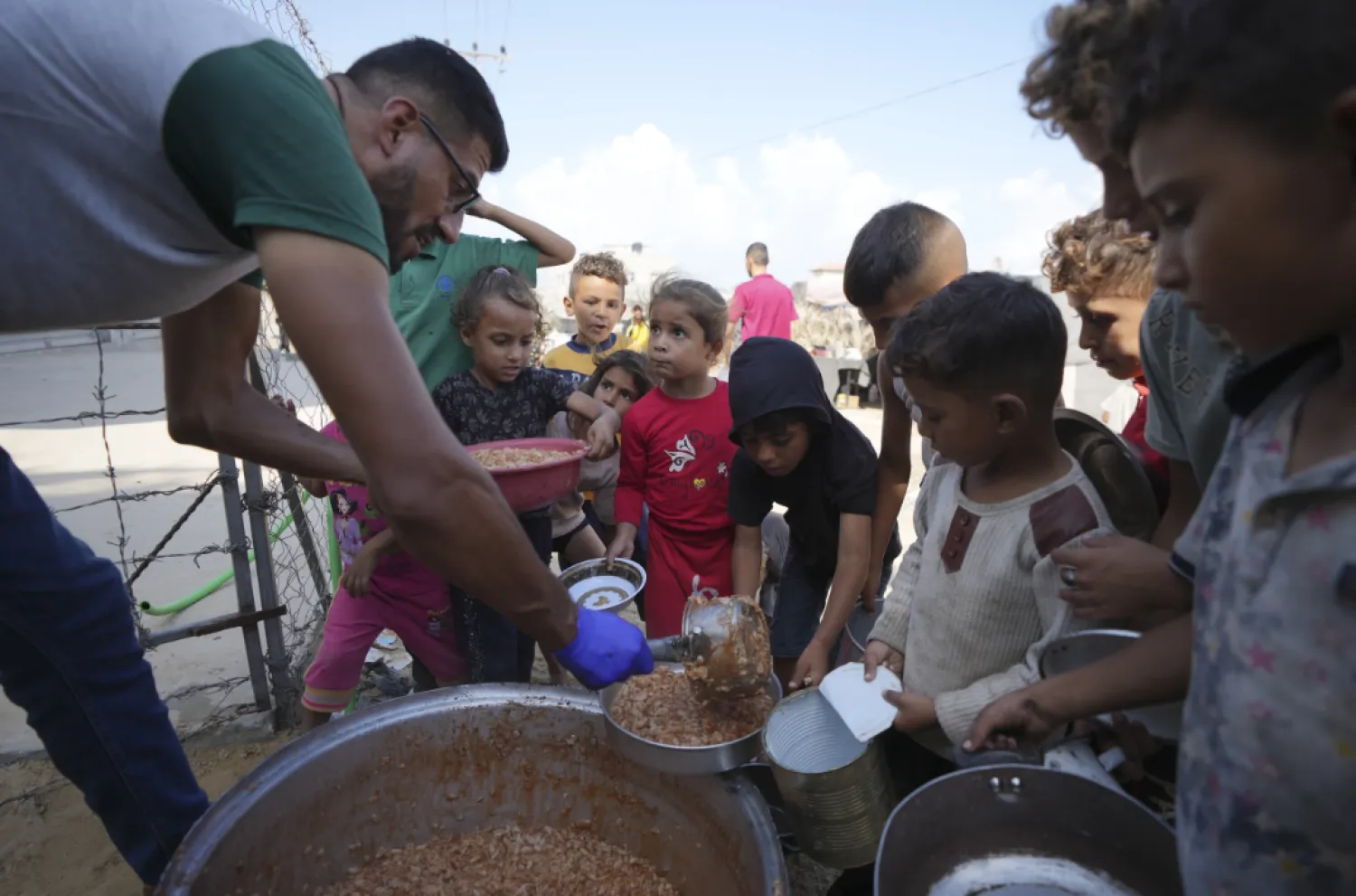
Displaced Palestinian children queue for food in a camp in Deir al-Balah, Gaza Strip, Friday, Oct. 18, 2024. (AP - Photo/Abdel Kareem Hana)
TT

Israel is Falling far Short of US Ultimatum to Surge Aid to Gaza

Displaced Palestinian children queue for food in a camp in Deir al-Balah, Gaza Strip, Friday, Oct. 18, 2024. (AP - Photo/Abdel Kareem Hana)

Halfway through the Biden administration's 30-day ultimatum for Israel to surge the level of humanitarian assistance allowed into Gaza or risk possible restrictions on US military funding, Israel is falling far short, an Associated Press review of UN and Israeli data shows.

Israel also has missed some other deadlines and demands outlined in a Oct. 13 letter from Secretary of State Antony Blinken and Defense Secretary Lloyd Austin. The mid-November deadline — following the US election — may serve as a final test of President Joe Biden 's willingness to check a close ally that has shrugged off repeated US appeals to protect Palestinian civilians during the war against Hamas.

In their letter, Blinken and Austin demanded improvements to the deteriorating humanitarian condition in Gaza, saying that Israel must allow in a minimum of 350 trucks a day carrying desperately needed food and other supplies. By the end of October, an average of just 71 trucks a day were entering Gaza, according to the latest UN figures.

Blinken said the State Department and Pentagon were closely following Israel’s response to the letter.

“There’s been progress, but it’s insufficient, and we’re working on a daily basis to make sure Israel does what it must do to ensure that this assistance gets to people who need it inside of Gaza,” Blinken told reporters.

“It’s not enough to get trucks to Gaza. It’s vital that what they bring with them can get distributed effectively inside of Gaza,” he added.

Blinken and Austin’s letter marked one of the toughest stands that the Biden administration has taken in a year of appeals and warnings to Israel to lessen the harm to Palestinian civilians.

Support for Israel is a bedrock issue for many Republican voters and some Democrats. That makes any Biden administration decision on restricting military funding to the US ally a fraught one for the tight presidential race between Vice President Kamala Harris and former President Donald Trump.

In hard-hit north Gaza in particular, an escalated Israeli military campaign and restrictions on aid has kept all food and other care from reaching populated areas since mid-October, aid organizations say. It could set the stage for famine in coming weeks or months, international monitors say.

And despite US objections, Israeli lawmakers this week voted to effectively ban the UN agency for Palestinian refugees, known as UNRWA. Governments worldwide, the UN and aid organizations say cutting off UNRWA would shatter the aid networks struggling to get food and other supplies to people in Gaza.

“Catastrophic,” Amber Alayyan, a medical program manager for Gaza at Doctors Without Borders, said of the move.

Humanitarian officials are deeply skeptical Israel will significantly improve assistance to Gaza’s civilians even with the US warning — or that the Biden administration will do anything if it doesn’t.

At this point in the war, “neither of those has happened,” said Scott Paul, an associate director of the Oxfam humanitarian organization.

“Over and over and again, we’ve been told” by Biden administration officials “that there are processes to evaluate the situation on the ground” in Gaza “and some movement’s been made to implement US law, and time and again that has not happened,” Paul said.

Before the war, an average of 500 trucks daily brought aid into the territory. Relief groups have said that's the minimum needed for Gaza’s 2.3 million people, most of whom have since been uprooted from their homes, often multiple times.

There has never been a month where Israel came close to meeting that figure since the conflict began, peaking in April at 225 trucks a day, according to Israeli government figures.

By the time Blinken and Austin sent their letter this month, concerns were rising that aid restrictions were starving civilians. The number of aid trucks that Israel has allowed into Gaza has plunged since last spring and summer, falling to a daily average of just 13 a day by the beginning of October, according to UN figures.

By the end of the month, it rose to an average of 71 trucks a day, the UN figures show.

Once supplies get to Gaza, groups still face obstacles distributing the aid to warehouses and then to people in need, organizations and the State Department said this week. That includes slow Israeli processing, Israeli restrictions on shipments, lawlessness and other obstacles, aid groups said.

Data from COGAT, the Israeli military body in charge of humanitarian aid to Gaza, shows aid has fallen to under a third of its levels in September and August. In September, 87,446 tons of aid entered the Gaza Strip. In October, 26,399 tons got in.

Elad Goren, a senior COGAT official, said last week that aid delivery and distribution in the north has been mainly confined to Gaza City.

When asked why aid was not being delivered to other parts of the north — like Jabaliya, a crowded urban refugee camp where Israel is staging an offensive — he said the population there was being evacuated and those who remained had “enough assistance” from previous months.

In other areas like Beit Hanoun and Beit Lahiya, Goren claimed falsely that there was “no population” left there.

COGAT declined to comment on the standard in the US letter. It said it was complying with government directives on aid to Gaza. Israel’s UN Ambassador Danny Danon blamed Hamas for plundering aid.

Paul of Oxfam said no aid at all was reaching populated areas in northern Gaza and only small amounts getting to Gaza City.

“No way” has Israel made progress in getting humanitarian support to the hundreds of thousands of people in north Gaza in particular since the US ultimatum, said Alayyan of Doctors Without Borders.

Israel’s government appeared to blow past another deadline set in Austin and Blinken's letter. It called for Israel to set up a senior-level channel for US officials to raise concerns about reported harm to Palestinian civilians and hold a first meeting by the end of October.

No such channel — requested repeatedly by the US during the war — had been created by the final day of the month.

The US is by far the biggest provider of arms and other military aid to Israel, including nearly $18 billion during the war in Gaza, according to a study for Brown University's Costs of War project.

The Biden administration paused a planned shipment of 2,000-pound bombs to Israel last spring, citing concerns for civilians in an Israeli offensive.

In a formal review in May, the administration concluded that Israel’s use of US-provided weapons in Gaza likely violated international humanitarian law but said wartime conditions prevented officials from determining that for certain in specific strikes.



Germany Moves Troops Out of Iraq, Citing Mideast 'Tensions'

FILE PHOTO: German Defense Minister Ursula von der Leyen visits the Transport Helicopter Regiment 30 (Transporthubschrauberregiment 30) at the Hermann-Koehl-Kaserne in Niederstetten, Germany, August 20, 2018. REUTERS/Ralph Orlowski
TT

Germany Moves Troops Out of Iraq, Citing Mideast 'Tensions'

FILE PHOTO: German Defense Minister Ursula von der Leyen visits the Transport Helicopter Regiment 30 (Transporthubschrauberregiment 30) at the Hermann-Koehl-Kaserne in Niederstetten, Germany, August 20, 2018. REUTERS/Ralph Orlowski

Germany's military has "temporarily" moved some troops out of Erbil in northern Iraq because of "escalating tensions in the Middle East," a German defense ministry spokesman told AFP on Thursday.

Dozens of German soldiers had been relocated away from the base in Erbil, capital of Iraq's autonomous Kurdistan region.

"Only the personnel necessary to maintain the operational capability of the camp in Erbil remain on site," the spokesman said.

The spokesman did not specify the source of the tensions, but US President Donald Trump has ordered a major build-up of US warships, aircraft and other weaponry in the region and threatened action against Iran.

German troops are deployed to Erbil as part of an international mission to train local Iraqi forces.

The spokesman said the German redeployment away from Erbil was "closely coordinated with our multinational partners".


UN: At Least 15 Children Killed in Sudan Drone Strike

The war in Sudan, ongoing since mid-April 2023, has caused extensive destruction across the country (AFP)
TT

UN: At Least 15 Children Killed in Sudan Drone Strike

The war in Sudan, ongoing since mid-April 2023, has caused extensive destruction across the country (AFP)

A drone strike on a displacement camp in Sudan killed at least 15 children earlier this week, the United Nations reported late on Wednesday.

"On Monday 16 February, at least 15 children were reportedly killed and 10 wounded after a drone strike on a displacement camp in Al Sunut, West Kordofan," the UN children's agency said in a statement.

Across the Kordofan region, currently the Sudan war's fiercest battlefield, "we are seeing the same disturbing patterns from Darfur -- children killed, injured, displaced and cut off from the services they need to survive," UNICEF's Executive Director Catherine Russell said.


MSF Will Keep Operating in Gaza 'as Long as We Can'

(FILES) A Palestinian man walks on his crutches to the Doctors Without Borders or Medecins Sans Frontieres (MSF) clinic, in the al-Rimal neighborhood of Gaza City on new year's Eve, December 31, 2025. (Photo by Omar AL-QATTAA / AFP)
TT

MSF Will Keep Operating in Gaza 'as Long as We Can'

(FILES) A Palestinian man walks on his crutches to the Doctors Without Borders or Medecins Sans Frontieres (MSF) clinic, in the al-Rimal neighborhood of Gaza City on new year's Eve, December 31, 2025. (Photo by Omar AL-QATTAA / AFP)

The head of Doctors Without Borders in the Palestinian territories told AFP the charity would continue working in Gaza for as long as possible, following an Israeli decision to end its activities there.

In early February, Israel announced it was terminating all the activities in Gaza by the medical charity, known by its French acronym MSF, after it failed to provide a list of its Palestinian staff.

MSF has slammed the move, which takes effect on March 1, as a "pretext" to obstruct aid.

"For the time being, we are still working in Gaza, and we plan to keep running our operations as long as we can," Filipe Ribeiro told AFP in Amman, but said operations were already facing challenges.

"Since the beginning of January, we are not anymore in the capacity to get international staff inside Gaza. The Israeli authorities actually denied any entry to Gaza, but also to the West Bank," he said.

Ribeiro added that MSF's ability to bring medical supplies into Gaza had also been impacted.

"They're not allowed for now, but we have some stocks in our pharmacies that will allow us to keep running operations for the time being," he said.

"We do have teams in Gaza that are still working, both national and international, and we have stocks."

In December, Israel announced it would prevent 37 aid organizations, including MSF, from working in Gaza from March 1 for failing to submit detailed information about their Palestinian employees, drawing widespread condemnation from NGOs and the United Nations.

It had alleged that two MSF employees had links with Palestinian militant groups Hamas and Islamic Jihad, which the medical charity has repeatedly and vehemently denied.

MSF says it did not provide the names of its Palestinian staff because Israeli authorities offered no assurances regarding their safety.

Ribeiro warned of the massive impact the termination of MSF's operations would have for healthcare in war-shattered Gaza.

"MSF is one of the biggest actors when it comes to the health provision in Gaza and the West Bank, and if we are obliged to leave, then we will create a huge void in Gaza," he said.

The charity says it currently provides at least 20 percent of hospital beds in the territory and operates around 20 health centers.

In 2025 alone, it carried out more than 800,000 medical consultations, treated more than 100,000 trauma cases and assisted more than 10,000 infant deliveries.