


Lebanon Military Says One Soldier Killed, 18 Hurt in Israeli Strike on Army Center

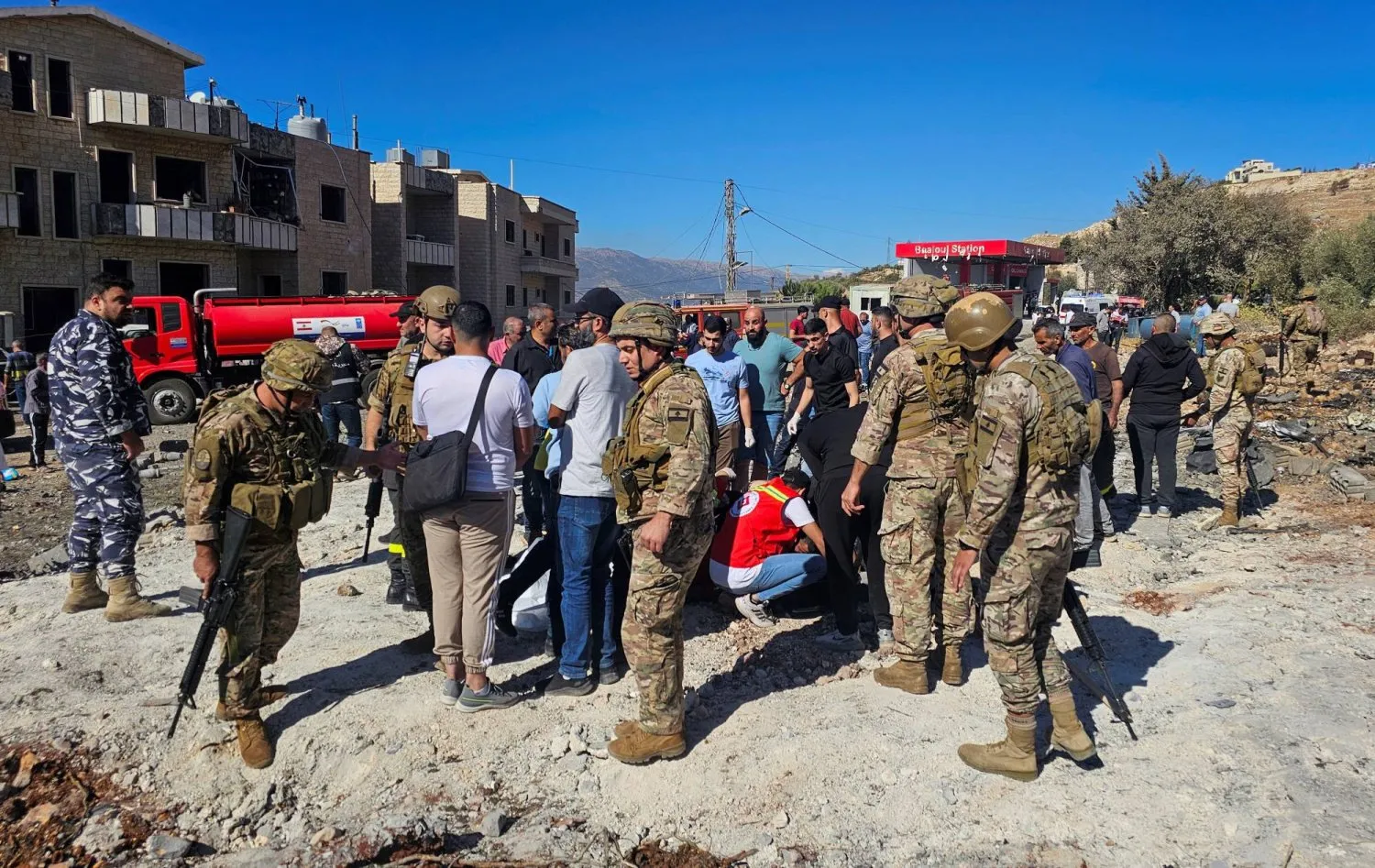
Lebanese army soldiers and people stand at the site of an Israeli strike in the town of Baaloul, in the western Bekaa Valley, Lebanon October 19, 2024. REUTERS/Maher Abou Taleb
TT

Lebanon Military Says One Soldier Killed, 18 Hurt in Israeli Strike on Army Center

Lebanese army soldiers and people stand at the site of an Israeli strike in the town of Baaloul, in the western Bekaa Valley, Lebanon October 19, 2024. REUTERS/Maher Abou Taleb

An Israeli strike on a Lebanese army center on Sunday killed one soldier and wounded 18 others, the Lebanese military said.

It was the latest in a series of Israeli strikes that have killed over 40 Lebanese troops, even as the military has largely kept to the sidelines in the war between Israel and Hezbollah.

There was no immediate comment from the Israeli military, which has said previous strikes on Lebanese troops were accidental and that they are not a target of its campaign against Hezbollah.

Lebanon's caretaker prime minister, Najib Mikati, condemned it as an assault on US-led ceasefire efforts, calling it a “direct, bloody message rejecting all efforts and ongoing contacts” to end the war.

“(Israel is) again writing in Lebanese blood a brazen rejection of the solution that is being discussed,” a statement from his office read.

The strike occurred in southwestern Lebanon on the coastal road between Tyre and Naqoura, where there has been heavy fighting between Israel and Hezbollah.

Hezbollah began firing rockets, missiles and drones into Israel after Hamas' Oct. 7, 2023, attack out of the Gaza Strip ignited the war there. Hezbollah has portrayed the attacks as an act of solidarity with the Palestinians and Hamas. Iran supports both armed groups.

Israel has launched retaliatory airstrikes since the rocket fire began, and in September the low-level conflict erupted into all-out war, as Israel launched waves of airstrikes across large parts of Lebanon and killed Hezbollah's top leader, Hassan Nasrallah, and several of his top commanders.

Israeli airstrikes early Saturday pounded central Beirut, killing at least 20 people and wounding 66, according to Lebanon's Health Ministry. Hezbollah has continued to fire regular barrages into Israel, forcing people to race for shelters and occasionally killing or wounding them.

Israeli attacks have killed more than 3,500 people in Lebanon, according to Lebanon’s Health Ministry. The fighting has displaced about 1.2 million people, or a quarter of Lebanon’s population.

On the Israeli side, about 90 soldiers and nearly 50 civilians have been killed by bombardments in northern Israel and in battle following Israel's ground invasion in early October. Around 60,000 Israelis have been displaced from the country's north.

Hezbollah fired barrages of rockets into northern and central Israel on Sunday, some of which were intercepted.

Israel's Magen David Adom rescue service said it was treating two people in the central city of Petah Tikva, a 23-year-old man who was lightly wounded by a blast and a 70-year-old woman suffering from smoke inhalation from a car that caught fire. The first responders said they also treated two women in their 50s who were wounded in northern Israel.

It was unclear whether the injuries and damage were caused by the rockets or interceptors.

The Biden administration has spent months trying to broker a ceasefire, and US envoy Amos Hochstein was back in the region last week.

The emerging agreement would pave the way for the withdrawal of Hezbollah fighters and Israeli troops from southern Lebanon below the Litani River in accordance with the UN Security Council resolution that ended the 2006 war. Lebanese troops would patrol the area, with the presence of UN peacekeepers.



Syria Confirms Mass Escape of Militant Relatives from Al-Hol Camp

A general view of Al-Hol camp located in a desert region of Hasakeh province in Syria. Reuters file photo
TT

Syria Confirms Mass Escape of Militant Relatives from Al-Hol Camp

A general view of Al-Hol camp located in a desert region of Hasakeh province in Syria. Reuters file photo

Syria confirmed on Wednesday the mass escape of relatives of suspected ISIS group militants from the Al-Hol camp last month following the withdrawal of Kurdish forces who had overseen the facility.

"When our forces arrived, they found cases of collective escapes due to the camp having been opened up in a haphazard manner," interior ministry spokesman Noureddine al-Baba told a press conference, AFP reported

Al-Hol, the largest camp for relatives of suspected ISIS militants in northeastern Syria, had been under the control of the Kurdish-led Syrian Democratic Forces (SDF).

But last month, Syrian troops drove Kurdish forces from swathes of the north, sparking questions over the fate of the ISIS prisoners and their families.

Under pressure, the SDF withdrew from the camp on January 20, with Syrian security forces taking control a few hours later.

"The SDF withdrew suddenly, without coordination and without informing" the Syrian authorities or the international anti-militant coalition beforehand, al-Baba said.

There was a "chaotic situation" after the Kurdish forces pulled out, he added, and "more than 138 breaches" have been discovered in the camp's 17-kilometre (11-mile) perimeter wall that allowed mass escapes.

After the Kurdish forces withdrew, thousands of women and children fled the camp to parts unknown.

Al-Hol housed 23,500 people, mostly Syrian and Iraqis, the ministry spokesman said.

Around 6,500 foreigners of 44 different nationalities lived in a high-security section of the camp.

Last week, Syrian authorities moved the families still at Al-Hol to another site in the country's north.

Before the Kurdish forces withdrew, the United States military had transferred more than 5,700 detained ISIS suspects from Syrian prisons to Iraq.

The US had previously announced it would transfer around 7,000 detainees.

ISIS swept across Syria and Iraq in 2014, committing massacres and forcing women and girls into sexual slavery.

Backed by US-led forces, Iraq proclaimed the defeat of ISIS in the country in 2017, and the SDF ultimately beat back the group in Syria two years later.

The SDF went on to jail thousands of suspected militants and detain tens of thousands of their relatives in camps.


Australia Tells Families of Diplomats to Leave Israel, Lebanon

A billboard on the road to Beirut International Airport promoting tourism in Lebanon (AP).
TT

Australia Tells Families of Diplomats to Leave Israel, Lebanon

A billboard on the road to Beirut International Airport promoting tourism in Lebanon (AP).

The Australian government has told dependants of Australian diplomats in Israel and Lebanon to leave the two Middle East countries, citing a deteriorating security situation in the region, the foreign ministry said on Wednesday.

The government has also offered voluntary departures to Australian diplomats' dependants in the United Arab Emirates, Jordan and Qatar, it said on an official ministry X account, Reuters reported.

US President Donald Trump laid out his case for a possible attack on Iran in his State of the Union speech to Congress on Tuesday, saying he would not allow the world's biggest sponsor of terrorism to have a nuclear weapon.

Iran and the United States resumed negotiations earlier this month as Washington builds up military capability in the Middle East. Iran has threatened to strike US bases in the region if it is attacked, but Tehran's top diplomat said on Tuesday that a deal with the US was "within reach" if diplomacy is prioritised.

The Australian government continues to advise citizens in Israel and Lebanon to consider leaving while commercial options are still available, the foreign ministry said.

The announcements were made in a series of posts on the foreign ministry's Smartraveller X account.


Security Council Sanctions 4 RSF Commanders over Atrocities in Sudan’s El-Fasher

Security Council Sanctions 4 RSF Commanders over Atrocities in Sudan’s El-Fasher
TT

Security Council Sanctions 4 RSF Commanders over Atrocities in Sudan’s El-Fasher

Security Council Sanctions 4 RSF Commanders over Atrocities in Sudan’s El-Fasher

The UN Security Council has announced sanctions on four commanders from the Rapid Support Forces for atrocities committed in the October takeover of the Darfur city of El-Fasher.

The four are high-ranking members of the RSF, which a UN probe last week determined had committed acts of genocide in their 18-month siege and eventual capture of El-Fasher.

They are RSF deputy commanders Abdelrahim Hamdan Daglo and Gedo Hamdan Ahmed, Brigadier General Al-Fateh Abdullah Idris and field commander Tijani Ibrahim.

Since April 2023, Sudan has been gripped by what the UN has called a "war of atrocities" between the RSF and Sudan's regular army, killing tens of thousands and creating the world's largest hunger and displacement crises.

For a year and a half, the RSF besieged North Darfur state capital El-Fasher -- the region's last major city to evade their control -- before storming the city on October 26.

The campaign, which the UN fact-finding mission described as "three days of horror", was marked by summary executions, systematic sexual violence and mass detention -- primarily targeting the city's ethnic Zaghawa population.

Abdelrahim, brother of RSF chief Mohamed Hamdan Daglo, appears in footage "giving direct orders to his fighters to not take captives but to kill everyone", according to the sanctions announcement.

He is already sanctioned by the United States, the United Kingdom and the European Union.

Idris, commonly referred to as Abu Lulu, became known as "the Butcher of El-Fasher" for graphic videos he himself posted of the takeover.

"Abu Lulu has filmed himself smiling and killing people while they begged for mercy, as well as videos where he makes ethnically targeted executions," AFP quoted the Security Council as saying.

He, Ahmed and Ibrahim were slapped with US sanctions last week over their roles in the "ethnic killings, torture, starvation and sexual violence" committed in El-Fasher.