With UNRWA Fate Unclear, UN and Israel Argue over Who’s Responsible for Palestinians

Palestinians, including children, hold metal pots and pans as they gather to receive food cooked by a charity kitchen, in Khan Younis, southern Gaza Strip, 10 January 2025. (EPA)
TT

With UNRWA Fate Unclear, UN and Israel Argue over Who’s Responsible for Palestinians

Palestinians, including children, hold metal pots and pans as they gather to receive food cooked by a charity kitchen, in Khan Younis, southern Gaza Strip, 10 January 2025. (EPA)

The United Nations and Israel are arguing over who must fill the gap if the UN Palestinian relief agency UNRWA stops working in the Gaza Strip and West Bank later this month when an Israeli law comes into force.

UNRWA still operates in the Palestinian territories, but it is unclear what awaits the nearly 75-year-old agency when the law banning its operation on Israeli land and contact with Israeli authorities takes effect.

The UN and Israel have been engaged in tit-for-tat letter writing since the law on UNRWA was passed in late October. Shortly after, the UN told Israel it was not the world body's responsibility to replace UNRWA in the Palestinian territory - Gaza and the West Bank, including East Jerusalem.

In a letter to the UN General Assembly and Security Council late on Thursday, Secretary-General Antonio Guterres said if UNRWA was forced to stop operating then Israel "would be left to ensure that the range of services and assistance which UNRWA has been providing are provided" in accordance with its obligations under international law.

Guterres wrote that while other UN agencies were prepared to continue providing services and assistance to the Palestinians - to the extent they can - that "must not be viewed as releasing Israel from its obligations."

The United Nations views Gaza and the West Bank, including East Jerusalem, as Israeli-occupied territory. International law requires an occupying power to agree to and facilitate relief programs and ensure food, medical care, hygiene and public-health standards.

In a Dec. 18 letter to the world body, Israel's UN Ambassador Danny Danon said the new legislation "does not in any way undermine Israel's steadfast commitment to international law." He also rejected UN claims that Israel would be responsible for filling any gap left by UNRWA.

He wrote that Israel does not exercise effective control over Gaza and therefore is not an occupying power, adding that the law of military occupation also does not apply. He said that in the West Bank the responsibility of the Palestinian Authority for civilian affairs "must not be overlooked."

"In Jerusalem, all residents are entitled to government and municipal services under Israeli law," said Danon, adding that included health and education services. Israel annexed East Jerusalem in a move not recognized abroad.

HEALTH, EDUCATION AT RISK

Israel has long been critical of UNRWA. It says UNRWA staff took part in the Oct. 7, 2023, Hamas attack on Israel. The UN has said nine UNRWA staff may have been involved and were fired. A Hamas commander in Lebanon - killed in September by Israel - was also found to have had an UNRWA job.

The United States has said its ally Israel must ensure the new law does not further impede aid deliveries and critical services, including by UNRWA, in Gaza, which has been engulfed in a humanitarian crisis during the war between Israel and Palestinian Hamas group.

But it has also questioned UN contingency planning.

State Department officials met this week with the transition team of incoming US President Donald Trump - who takes office on Jan. 20 - and raised concerns about how the crisis in Gaza could deepen once the UNRWA law is implemented, said a US official.

UNRWA, established by the UN General Assembly, provides aid, health and education services to millions of Palestinians in Gaza, the West Bank, including East Jerusalem, and neighboring Arab countries - Syria, Lebanon and Jordan.

Guterres said UNRWA's unique role could not be replaced. UN officials say it is the health, education and social services UNRWA provides in the Palestinian territory that would suffer most as other agencies cannot match its ability to deliver such help.

Danon argued that "replacing UNRWA with relief schemes that will adequately provide essential assistance to Palestinian civilians is not at all impossible," citing the aid operation in Gaza where he said other UN agencies were equipped to provide the necessary response "as they do elsewhere in the world."

Other agencies working in Gaza and the West Bank include the children's organization UNICEF, the World Food Program, the World Health Organization, and the UN Development Program. But top UN officials and the Security Council describe UNRWA as the backbone of the current humanitarian operation in Gaza.

Israel launched an assault on Hamas in Gaza after the fighters killed 1,200 people in southern Israel on Oct. 7, 2023, and took some 250 hostages, according to Israeli tallies.

More than 46,000 people have been killed in Gaza since then, according to Palestinian health officials. Much of the enclave has been laid waste and most of the 2.3 million people have been displaced multiple times. Food experts warn of a looming famine.


Aid Groups Petition Israel’s Top Court to Halt Ban on Gaza, West Bank Operations 

Palestinian Red Crescent workers load medical supplies to be transported to Gaza, at the launch of a joint logistical operation with the European Union and the Red Cross, in the West Bank city of Beitunia, Tuesday, Feb. 24, 2026. (AP)
TT

Aid Groups Petition Israel’s Top Court to Halt Ban on Gaza, West Bank Operations 

Palestinian Red Crescent workers load medical supplies to be transported to Gaza, at the launch of a joint logistical operation with the European Union and the Red Cross, in the West Bank city of Beitunia, Tuesday, Feb. 24, 2026. (AP)

Around 17 international humanitarian organizations have petitioned Israel’s Supreme Court to block an imminent order that would force 37 NGOs to cease operations in Gaza, the West Bank and east Jerusalem, warning of catastrophic consequences for civilians.

Organizations, including Doctors Without Borders (MSF), Oxfam, the Norwegian Refugee Council and CARE, were notified on December 30 that their Israeli registrations had expired and that they had 60 days to renew them by providing lists of their Palestinian staff.

If they fail to do so, they will have to cease operations in Gaza and the occupied West Bank, including east Jerusalem, from March 1.

The petitioners said enforcement has already begun in practice, with supplies blocked and visas denied to foreign staff.

“We haven't been able to get international staff inside Gaza since the beginning of January. Israeli authorities denied any entry to Gaza, but also to the West Bank,” MSF head of mission in the Palestinian territories Filipe Ribeiro told AFP last week.

The petition, described as unprecedented in its scale, seeks an urgent interim injunction from Israel's top court to suspend the closures pending full judicial review.

The 17 petitioners, which include some of the NGOs hit by the ban, argued the Israeli measures are incompatible with an occupying power's obligations under international humanitarian law.

The NGOs said compliance would expose local employees to potential retaliation, undermine the principle of humanitarian neutrality and violate European data protection law.

“Turning humanitarian organizations into an information-gathering arm for a party to the conflict stands in total contradiction to the principle of neutrality,” the petition stated.

The petitioners said they have proposed practical alternatives to handing over staff lists to Israel, including “independent sanctions screening” and “donor-audited vetting systems.”

The organizations noted that they collectively support or implement more than half of all food assistance in Gaza, 60% of field hospital operations and all inpatient treatment for children suffering severe acute malnutrition.


Baghdad Airport Closed Due to 'Technical Problem'

A passenger takes his belongings after inspection at the departure hall of Baghdad's International airport on March 14, 2023. (Photo by AHMAD AL-RUBAYE / AFP)
TT

Baghdad Airport Closed Due to 'Technical Problem'

A passenger takes his belongings after inspection at the departure hall of Baghdad's International airport on March 14, 2023. (Photo by AHMAD AL-RUBAYE / AFP)

Iraq's transport ministry said Wednesday a temporary shutdown of Baghdad International Airport was caused by an "emergency technical problem,” denying reports of any security threat.

The closure prompted speculation on social media, but officials stressed that the halt in operations was purely technical and repairs were already underway.

Ministry spokesman Maytham Alsafi said the fault required "immediate precautionary action,” adding that technical teams had begun assessments and repairs, the state-run Iraqi News Agency reported.

He said the airport would reopen "within hours" once maintenance work and final checks were completed.

Alsafi rejected claims of domestic or foreign security risks behind the closure, calling the reports baseless and urging media outlets to verify information through official channels.


Johnson: Ukraine War Result of West’s Failure to Punish Assad for Using Chemical Weapons 

20 August 2023, Syria, Idlib: Children play next to a destroyed building with a mural painted on it during a commemoration event for the 10th anniversary of the Ghouta chemical attack. (Anas Alkharboutli/dpa)
TT

Johnson: Ukraine War Result of West’s Failure to Punish Assad for Using Chemical Weapons 

20 August 2023, Syria, Idlib: Children play next to a destroyed building with a mural painted on it during a commemoration event for the 10th anniversary of the Ghouta chemical attack. (Anas Alkharboutli/dpa)

Former British Prime Minister Boris Johnson said that the war in Ukraine was the result of the West's failure to support Ukraine after Russia’s invasion of Crimea in 2014, as well as its inability to punish Bashar al-Assad for using chemical weapons against his own people in Syria and the debacle of the US withdrawal from Afghanistan.

Speaking on Sunday ahead of the fourth anniversary of Russia's full-scale invasion of Ukraine, Johnson told the BBC: “I think (Russian President Vladimir) Putin was emboldened by a Western failure in Syria to punish Assad for using chemical weapons.”

“Putin was further emboldened in February 2022 by what he'd seen in Afghanistan, and a sort of general sense that the West was on the back foot. He'd seen those appalling pictures of Americans being forced to flee Afghanistan and the UK pulling out as well, and that really did embolden him,” he added.

Last November, Syria’s permanent representative to the Organization for the Prohibition of Chemical Weapons (OPCW), Dr. Mohammed Katoub, warned that remnants of chemical weapons across the country pose a direct threat to civilians in more than 100 suspected locations.

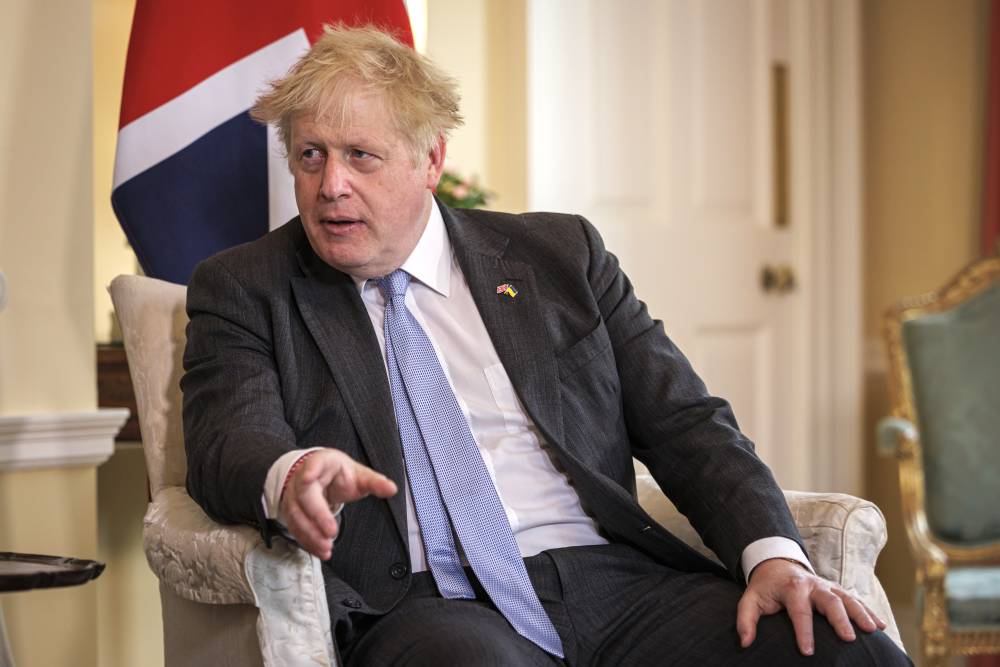
28 April 2022, United Kingdom, London: UK's Prime Minister Boris Johnson speaks with Swiss President Ignazio Cassis (not pictured) during their meeting at 10 Downing Street. (Rob Pinney/PA Wire/dpa)

Katoub said that toxic remnants remain in areas previously struck or used for weapons production and that many of these locations are close to population centers, raising fears of accidental exposure.

Speaking on the first working day of the restored Syrian mission in The Hague, Katoub told the state-run channel Al-Ikhbariah that the Assad regime continued to use chemical weapons for 12 years.

He said the most recent documented incident occurred on December 5, 2024, in the village of Khattab, in the Hama countryside.

Based on reports from the Syrian Network for Human Rights (SNHR), the Assad regime is responsible for the sarin gas attack on Damascus' Ghouta district on August 21, 2013.

Assad regime forces launched four simultaneous chemical attacks on populated areas in eastern and western Ghouta, including the town of Muadamiyat al-Sham, using at least ten rockets loaded with sarin gas, with a total estimated quantity of approximately 200 liters.

The rockets were launched from designated launchers after midnight, taking advantage of weather conditions that kept the toxic gases close to the ground, resulting in the largest possible number of victims while they slept, a clear indication of a premeditated intent to target civilians demanding political change.

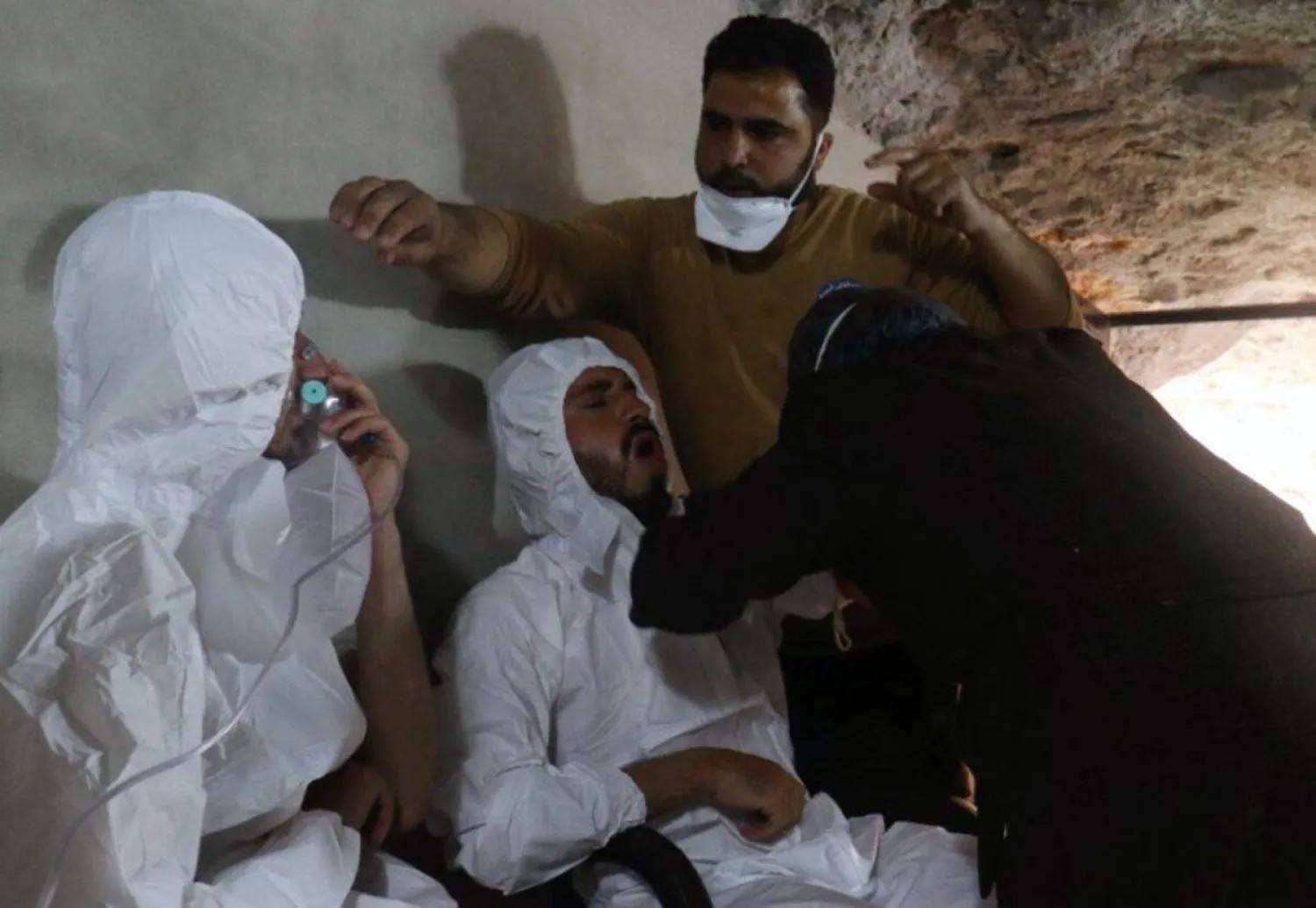
A man breathes through an oxygen mask while another receives treatment after a gas attack on the town of Khan Sheikhoun in Syria's Idlib province on April 4, 2017. (Reuters)

This was compounded by a stifling regime blockade imposed since the end of 2012, which prevented the entry of fuel, medicine, and medical supplies needed to treat the wounded, exacerbating the humanitarian catastrophe.

On the morning of April 4, 2017, at approximately 06:49 am, fixed-wing Syrian regime warplanes targeted Khan Sheikoun city in Idlib’s southern suburbs using a missile loaded with poison gas which is believed was a nerve gas.

SNHR documented the deaths of 91 civilians, including 32 children and 23 women, who were asphyxiated by poison gas, which caused cardiac arrest and respiratory muscle paralysis in victims. Additionally, about 520 others suffered from suffocation symptoms, including 12 Civil Defense personnel and six media activists.

On April 7, 2018, the regime launched a chemical attack on Douma city in the Damascus suburbs. SNHR documented that 43 civilians, including 19 children and 17 women died of suffocation, while nearly 550 others were injured.