


Mediators on Standby for Obstacles as Gaza Ceasefire Starts

 Palestinians transport belongings amidst building rubble in a ruined neighborhood of Gaza's southern city of Rafah on January 20, 2025, as residents return following a ceasefire deal a day earlier between Israel and the Palestinian Hamas group. (AFP)
Palestinians transport belongings amidst building rubble in a ruined neighborhood of Gaza's southern city of Rafah on January 20, 2025, as residents return following a ceasefire deal a day earlier between Israel and the Palestinian Hamas group. (AFP)
TT

Mediators on Standby for Obstacles as Gaza Ceasefire Starts

 Palestinians transport belongings amidst building rubble in a ruined neighborhood of Gaza's southern city of Rafah on January 20, 2025, as residents return following a ceasefire deal a day earlier between Israel and the Palestinian Hamas group. (AFP)
Palestinians transport belongings amidst building rubble in a ruined neighborhood of Gaza's southern city of Rafah on January 20, 2025, as residents return following a ceasefire deal a day earlier between Israel and the Palestinian Hamas group. (AFP)

Sunday's delayed start to the Gaza ceasefire and incidents on Monday in which Israeli troops shot at Palestinians approaching them underline some of the hiccups likely to face a deal that will play out in the shadow of mutual mistrust and bitterness.

Qatar and Egypt, which brokered the deal alongside the US, have set up a communications hub to tackle any problems, where officials who worked on the deal for months hope to head off new clashes between foes locked in a years-long cycle of Gaza wars.

"These kinds of deals are never easy to maintain," said Majed Al-Ansari, spokesperson for Qatar's foreign ministry.

Particularly in a war zone the situation can shift very quickly, either by accident or through political posturing on one side or another, he said.

"Any party could consider a threat a reason to violate the parameters of the agreement, and therefore we would end up with having to go in and to find a way to resume the ceasefire."

With just over an hour to go before the ceasefire was due to take effect on Sunday, Prime Minister Benjamin Netanyahu announced that Israel would not observe the halt to fighting until Hamas handed over the names of the three hostages to be released later in the day.

Fighting continued almost three hours past the deadline, while a Hamas official in the coordination room set up in Cairo discussed the delay, which Hamas put down to unspecified "technical issues" with officials.

The issue was eventually dealt with and the three hostages were released on schedule in the afternoon in exchange for 90 Palestinian prisoners freed from Israeli jails late that night, setting off emotional scenes as they returned to their families.

"We don't expect things to go according to plan," said one official briefed on the negotiations, adding that issues of this kind were not expected to derail a process that diplomats and officials have been working on for months.

"It's hard to believe that after all the work the mediators have put in and the assurances they received, both from the US and the mediators, that this deal would derail on day one," the official said.

The multi-phase deal will see an initial six-week ceasefire, during which 33 hostages will be gradually exchanged for hundreds of Palestinian prisoners, people displaced from northern Gaza will be allowed to return to their homes and Israeli troops will pull back from some positions.

During the first phase, negotiations will begin for the release of the remaining 64 hostages, consisting of men of military age and for the full withdrawal of Israeli troops. But few expect the process to go without problems.

OBSTACLES AHEAD

With an extremely low level of trust between both sides who have fought each other for generations, potential pitfalls run from accidental or deliberate confrontations during the period of withdrawal to disputes over the identity and state of hostages to be released or returned.

So far, Hamas has not said how many of the hostages are still alive. A list of the remaining 30 hostages due for release in the first phase and whether they are alive or dead is expected to be handed over on Saturday.

The Israeli military says it is seeking to avoid situations in which Gaza residents come too close to Israeli troops that are pulling back. Already on Monday, troops fired on at least eight Palestinians who approached them, medics in Gaza said.

To prevent this, it will publish maps and guidelines as the agreement progresses, making clear which areas should not be approached as the withdrawal proceeds, an Israeli military official said.

"The areas will change as the troops gradually withdraw from the Gaza Strip," the military official said.

In Israel, the deal is viewed with deep suspicion by some, who say it leaves Hamas in control of Gaza and others who worry that it effectively abandons the hostages not included in the first phase.

Already, hardliner Itamar Ben-Gvir resigned as National security Minister on the morning of the ceasefire and pulled his party from Netanyahu's coalition and others may follow.

Israeli public radio reported that Israeli officials were shocked to see the three hostages released in the center of Gaza on Sunday getting out of a car in the middle of a large crowd of people held back by Hamas fighters in uniform, and will inform the mediators that they regard such scenes as unacceptable.

But mediators are counting on positive momentum as the release of hostages and prisoners continues over the coming weeks to ease opposition.

"The pictures we have seen yesterday of the three Israeli hostages meeting with their families, embraced by their families. These are the pictures that would change public opinion in Israeli politics," Ansari said. "The same goes also for the Palestinian populace, when they see 90 of their women and children coming back to their families."

"These are the kind of pictures that change public opinion. They apply real pressure on the leadership to maintain the deal."



A Blast in Gaza Wounds Soldier and Israel Accuses Hamas of Ceasefire Violation

A woman sits next to her tent on an alley of a makeshift tent camp for displaced Palestinians in Deir al-Balah, central Gaza Strip, Tuesday, Dec. 23, 2025. (AP Photo/Abdel Kareem Hana)
TT

A Blast in Gaza Wounds Soldier and Israel Accuses Hamas of Ceasefire Violation

A woman sits next to her tent on an alley of a makeshift tent camp for displaced Palestinians in Deir al-Balah, central Gaza Strip, Tuesday, Dec. 23, 2025. (AP Photo/Abdel Kareem Hana)

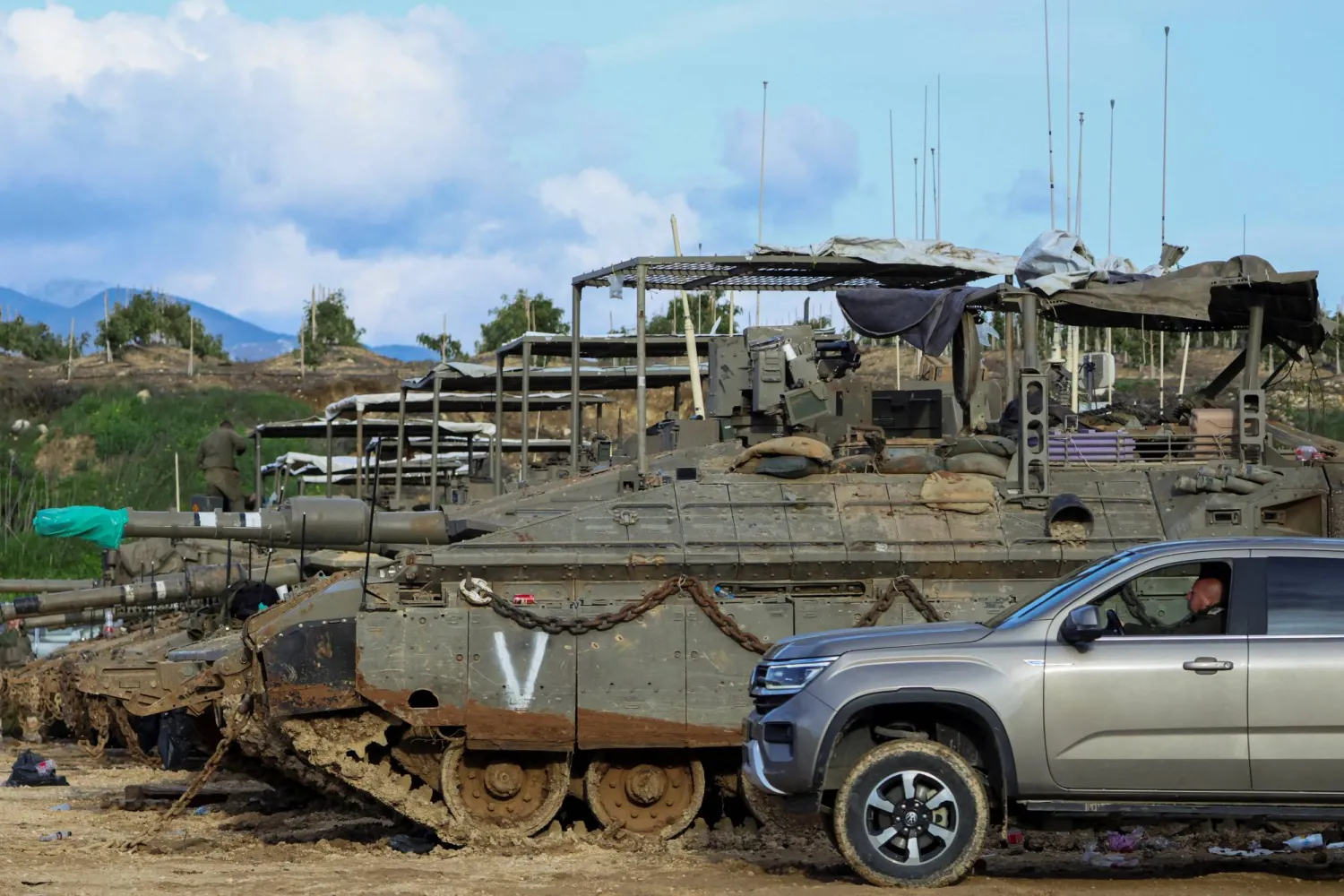
An explosive device detonated in Gaza on Wednesday, injuring one Israeli soldier and prompting Israel to accuse Hamas of violating the US-backed ceasefire. It was the latest incident to threaten the tenuous truce that has held since Oct. 10 as each side accuses the other of violations.

The blast came as Hamas met with Turkish officials in Ankara to discuss the second stage of the ceasefire. Though the agreement has mostly held, its progress has slowed, The AP news reported.

All but one of the 251 hostages taken in the Hamas-led attack on Oct. 7, 2023, that sparked the war have been released, alive or dead, in exchange for Palestinian prisoners and detainees. The ceasefire's second phase has even bigger challenges: the deployment of an international stabilization force, a technocratic governing body for Gaza, the disarmament of Hamas and further Israeli troop withdrawals from the territory.

Israel vows to ‘respond accordingly’ Israel's military said the explosive detonated beneath a military vehicle as soldiers were “dismantling” militant infrastructure in the southern city of Rafah. The lightly injured soldier was taken to a hospital, the military said.

Prime Minister Benjamin Netanyahu in a statement called the incident a violation of the ceasefire and said Israel would "respond accordingly.”

Israel previously launched strikes in Gaza in response to alleged ceasefire violations. On Oct. 19, Israel said two soldiers were killed by Hamas fire and it responded with a series of strikes that killed over 40 Palestinians, according to local health officials.

Hamas accuses Israel of violating the ceasefire by not allowing enough aid into the territory and continuing to strike civilians. Palestinian health officials say over 370 Palestinians have been killed by Israeli fire since the truce.

On Friday, Israeli troops fired over the ceasefire line in northern Gaza, killing at least five Palestinians, including a baby, according to a local hospital that received the casualties.

Turkish Foreign Minister Hakan Fidan met with a Hamas delegation led by Khalil al-Haya to discuss the ceasefire's second phase, according to ministry officials.

Fidan reaffirmed Türkiye's efforts to defend the rights of Palestinians and outlined ongoing efforts to address shelter and other humanitarian needs in Gaza, the officials said.

The Hamas delegation said they had fulfilled the ceasefire’s conditions but that Israel’s continued attacks were blocking progress toward the next stage. They also asserted that 60% of the trucks allowed into Gaza were carrying commercial goods rather than aid.

According to the officials, the meeting also discussed reconciliation efforts between the Palestinian factions and the situation in the Israeli-occupied West Bank, stressing that Israel’s actions there were “unacceptable.”


Algeria Passes Law Declaring French Colonisation a Crime

Members of the committee drafting the law criminalizing colonialism (File Photo/ Algerian Parliament)
TT

Algeria Passes Law Declaring French Colonisation a Crime

Members of the committee drafting the law criminalizing colonialism (File Photo/ Algerian Parliament)

Algeria's parliament unanimously approved on Wednesday a law declaring France's colonisation of the country a crime, and demanding an apology and reparations.

Standing in the chamber, lawmakers wearing scarves in the colors of the national flag chanted "long live Algeria" as they applauded the passage of the bill, which states that France holds "legal responsibility for its colonial past in Algeria and the tragedies it caused".

The vote comes as the two countries are embroiled in a major diplomatic crisis, and analysts say that while Algeria's move is largely symbolic, it is still politically significant, AFP reported.

Parliament speaker Brahim Boughali told the APS state news agency before the vote that it would send "a clear message, both internally and externally, that Algeria's national memory is neither erasable nor negotiable".

The legislation lists the "crimes of French colonisation", including nuclear tests, extrajudicial killings, "physical and psychological torture", and the "systematic plundering of resources".

It states that "full and fair compensation for all material and moral damages caused by French colonisation is an inalienable right of the Algerian state and people".

France's rule over Algeria from 1830 until 1962 remains a sore spot in relations between the two countries.

The period was marked by mass killings and large-scale deportations, all the way up to the bloody war of independence from 1954-1962.

Algeria says the war killed 1.5 million people, while French historians put the death toll lower at 500,000 in total, 400,000 of them Algerian.

French President Emmanuel Macron has previously acknowledged the colonisation of Algeria as a "crime against humanity", but has stopped short of offering an apology.

Asked last week about the vote, French foreign ministry spokesman Pascal Confavreux said he would not comment on "political debates taking place in foreign countries".

Hosni Kitouni, a researcher in colonial history at the University of Exeter in the UK, said that "legally, this law has no international scope and therefore is not binding for France".

But "its political and symbolic significance is important: it marks a rupture in the relationship with France in terms of memory," he said.


Türkiye, Hamas Discuss Gaza Ceasefire Deal’s Second Phase, Turkish Source Says

Palestinian children play next to tents in a makeshift camp for displaced people set up on the beach in Gaza City, Tuesday, Dec. 16, 2025. (AP)
TT

Türkiye, Hamas Discuss Gaza Ceasefire Deal’s Second Phase, Turkish Source Says

Palestinian children play next to tents in a makeshift camp for displaced people set up on the beach in Gaza City, Tuesday, Dec. 16, 2025. (AP)

Turkish Foreign Minister Hakan Fidan on Wednesday ​met with Hamas political bureau officials in Ankara to discuss the ceasefire in Gaza and advancing the ‌agreement to ‌its ‌second ⁠phase, ​a ‌Turkish Foreign Ministry source said according to Reuters.

The source said the Hamas officials told Fidan that they had fulfilled ⁠their requirements as ‌part of the ‍ceasefire ‍deal, but that Israel's ‍continued targeting of Gaza aimed to prevent the agreement from ​moving to the next phase.

The Hamas members ⁠also said humanitarian aid entering Gaza was not sufficient, and that goods like medication, equipment for housing, and fuel were needed, the source ‌added.