


Arab Proposal Aims to Counter Trump’s Plan to Displace Palestinians

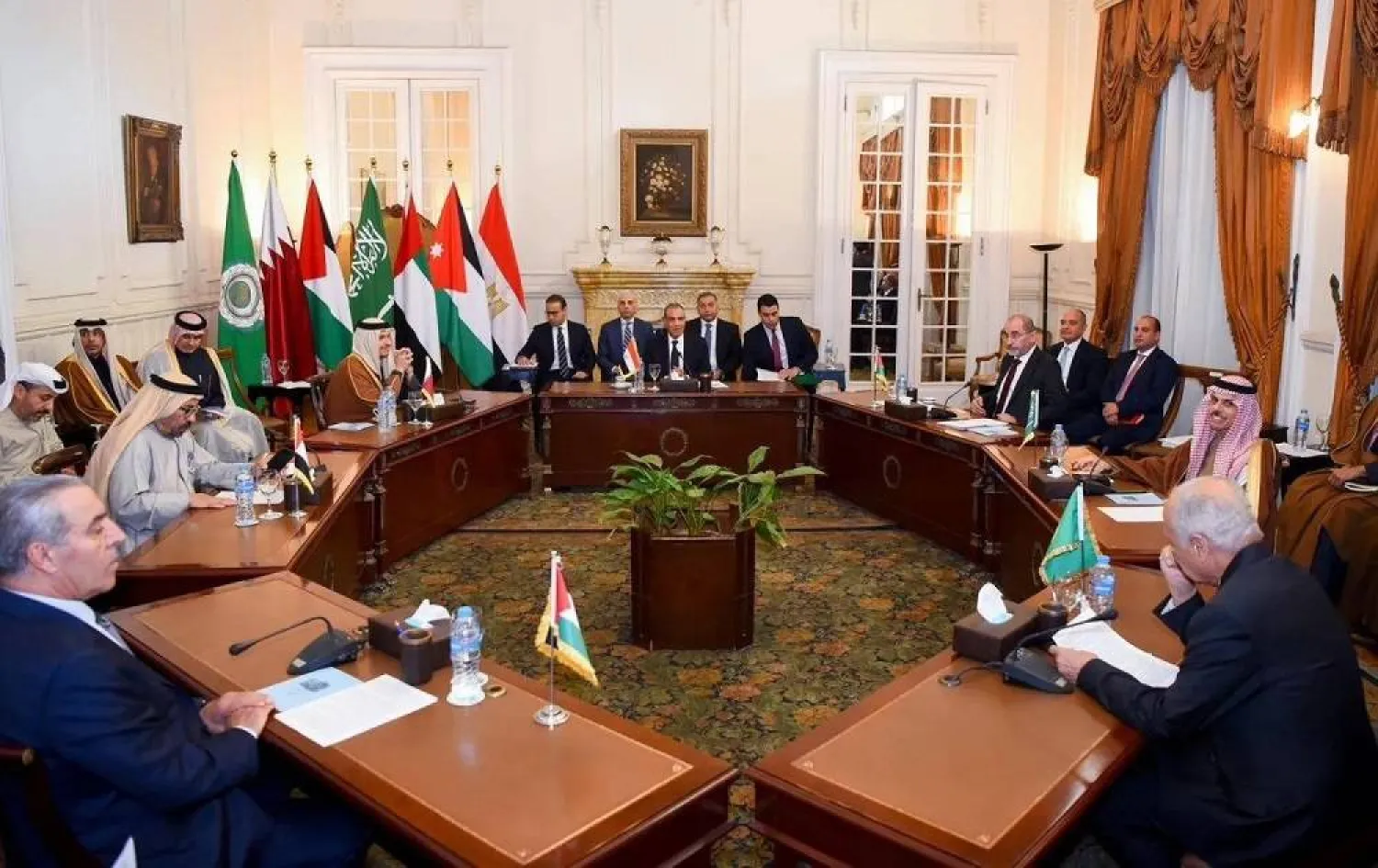
The foreign ministers of Egypt, Saudi Arabia, Jordan, the UAE, and Qatar meet in Cairo a few days ago. (Egyptian Foreign Ministry).
TT

Arab Proposal Aims to Counter Trump’s Plan to Displace Palestinians

The foreign ministers of Egypt, Saudi Arabia, Jordan, the UAE, and Qatar meet in Cairo a few days ago. (Egyptian Foreign Ministry).

An emergency Arab League summit, set to take place in Egypt at the end of this month, will discuss an Arab proposal aimed at ensuring Palestinians remain on their land. This initiative directly counters US President Donald Trump’s plan advocating for the displacement of Palestinians from Gaza.

Arab League Secretary-General Ahmed Aboul Gheit said the summit will present a unified Arab stance as an alternative to Trump’s. He emphasized that the plan will be based on Palestinian consensus and supported by broad Arab and international backing.

According to Arab League spokesperson Gamal Roshdy, the summit will focus on a reconstruction plan for Gaza while ensuring Palestinians remain in their homeland.

Egypt’s Ministry of Foreign Affairs confirmed that Cairo will host the emergency summit on February 27 to address the latest serious developments concerning Palestine. The meeting comes amid Trump’s continued push to relocate Palestinians from Gaza to other countries, including Egypt and Jordan.

Aboul Gheit firmly rejected any Arab concessions regarding Palestinian land, reiterating the Arab world’s commitment to a two-state solution. He slammed Trump for seeks to strip Palestinians of their rights, adding: “Neither he nor anyone else can buy Gaza.”

In late January, Egyptian President Abdel Fattah al-Sisi denounced any forced relocation of Palestinians, calling it an “injustice” that Egypt would not accept.

The Arab League also issued a statement last week rejecting Trump’s plan, saying it violates international law and undermines the two-state solution that is seen as the only viable path to lasting peace and security between Palestinians and Israelis.

The upcoming summit’s Arab proposal revolves around three key objectives: rejecting the forced displacement of Palestinians, launching a large-scale reconstruction initiative for Gaza and restoring the Palestinian Authority’s (PA) governance over the territory, leading to elections after a transitional period.

According to an Arab diplomatic source, Egypt and other Arab states are working on a framework to allow the PA to resume its administration of Gaza with minimal resistance from Hamas, which currently rules the coastal enclave.

Egypt has also announced plans to host an international conference, in collaboration with the United Nations, to facilitate Gaza’s reconstruction.

In remarks to Asharq Al-Awsat, political analyst Ashraf Al-Ashry noted that the proposal aims to prevent forced displacement, while enabling the PA to re-establish control over Gaza, ultimately paving the way for Palestinian elections.

Palestinian political analyst Shafiq Al-Talouli echoed this sentiment, stressing that Arab countries are taking serious steps to turn their vision for Palestine into reality by ensuring the establishment of an independent Palestinian state.

“The most effective way to counter displacement efforts is Arab unity,” he stressed.

Moreover, he said post-war planning must focus on transferring control of Gaza back to the PA given that several European countries support this approach.

Such a step requires urgent Palestinian reconciliation, especially between Fatah and Hamas, he remarked.



Cairo to Host Hamas Delegation Next Week to Advance Gaza Ceasefire Deal

Palestinians walk through the ruins of destroyed buildings in Gaza City, Sunday, Jan. 4, 2026. (AP)
TT

Cairo to Host Hamas Delegation Next Week to Advance Gaza Ceasefire Deal

Palestinians walk through the ruins of destroyed buildings in Gaza City, Sunday, Jan. 4, 2026. (AP)

A Palestinian source told Asharq Al-Awsat on Tuesday that Cairo will host a delegation from Hamas next week for talks aimed at advancing a ceasefire agreement in Gaza.

The source, who is close to Hamas, said the visit is expected to focus on the provisions of the second phase of the ceasefire deal, most notably finalizing the names of a technocratic committee to administer Gaza, in an effort to move forward with implementation of the agreement.

The talks will be led by senior Hamas figure and chief negotiator Khalil al-Hayya, though no exact date for the meeting has been announced.

Two Palestinian sources close to Fatah also stressed the importance of Egypt’s role in shaping arrangements for the second phase of the deal, particularly in the face of obstacles posed by Israeli Prime Minister Benjamin Netanyahu.

On Tuesday, Netanyahu said the Rafah border crossing would not be reopened until the return of the last remaining body.

Israel’s public broadcaster reported that the Israeli premier is insisting the crossing between Gaza and Egypt remain closed until the body of the final Israeli captive held in the enclave, Ran Gvili, is returned.

He was quoted as saying that agreements with the US administration underpin this position.

The move marks a reversal from earlier expectations that the crossing would reopen at the start of the first phase of the Gaza agreement on Oct. 10.

It follows a report published Sunday by the Israeli daily Haaretz, which cited informed sources as saying the Rafah crossing was set to reopen soon in both directions, with European forces playing a main role in running it.

Those forces had already arrived in Israel and were ready to deploy in the area, it revealed.


Report: Iran’s Foreign Minister to Visit Lebanon on Thursday

16 March 2018, Austria, Vienna: Abbas Araqchi, then Deputy Foreign Minister of Iran, gives an interview in Vienna. (dpa)
TT

Report: Iran’s Foreign Minister to Visit Lebanon on Thursday

16 March 2018, Austria, Vienna: Abbas Araqchi, then Deputy Foreign Minister of Iran, gives an interview in Vienna. (dpa)

Iran's Foreign Minister Abbas Araqchi told the Mehr news ​agency he will visit Lebanon on Thursday with an economic delegation.

A US-backed ceasefire agreed in November 2024 ended more than ‌a year ‌of ‌fighting ⁠between ​Israel ‌and Lebanon's Hezbollah, but it also required the disarmament of the Iran-aligned group.

Lebanon has sought to distance itself ⁠from Iran, with its Foreign ‌Minister Youssef Raji ‍last ‍month declining an ‍invitation to visit Tehran citing "current conditions" as not permitting the visit, and he instead ​invited Araqchi to visit Beirut for talks.


Latest Israeli Escalation in Lebanon Raises Questions about All-out War

Rescue workers search for possible victims in a building destroyed by an Israeli strike in the southern port city of Sidon, Lebanon, early Tuesday, Jan. 6, 2026. (AP)
TT

Latest Israeli Escalation in Lebanon Raises Questions about All-out War

Rescue workers search for possible victims in a building destroyed by an Israeli strike in the southern port city of Sidon, Lebanon, early Tuesday, Jan. 6, 2026. (AP)

The Israeli airstrike that struck a three-storey building on Tuesday in the industrial zone of Sainiq, in the Sidon district in southern Lebanon, was part of a broader wave of attacks that on Monday targeted the western Bekaa Valley, Jezzine, and areas around Sidon.

With intensive drone flights over Baalbek and its outskirts, followed by surveillance over Tyre and Zahrani, the picture pointed to a new wave of escalation extending beyond the South that stretches from north of the Litani River to the Awali basin and parts of the Bekaa.

Timing

The escalation raises serious questions, Lebanese President Joseph Aoun said, particularly as the “Mechanism” committee is set to meet on Wednesday.

The committee is tasked with halting hostilities and identifying practical steps to restore security and stability in the South, including Israel’s withdrawal to the international border, the release of Lebanese detainees, and the completion of the Lebanese Army’s deployment in line with UN Security Council Resolution 1701.

In a statement, Aoun stressed that Israel’s continued attacks aim to derail local, regional, and international efforts to contain the escalation, despite Lebanon’s cooperation and the measures adopted by the government to extend state authority south of the Litani.

He added that these steps were implemented by the Lebanese Army “with professionalism, discipline, and precision.”

He renewed his call for effective international intervention to curb Israel’s actions and to enable the Mechanism committee to fulfill its mandate with the consensus of the parties concerned and sustained international support.

On Monday, Israel launched a series of strikes across eastern and southern Lebanon after issuing evacuation warnings to residents. Overnight, it continued air raids without warning on Zahrani and Sarafand.

At dawn on Tuesday, it struck a three-storey building in an industrial area in Ghazieh, near the coastal city of Sidon — about 40 kilometres south of Beirut — wounding one person, levelling the building, damaging nearby structures, and sparking a fire.

Later on Tuesday, an Israeli drone struck an area near a house in the village of Kfardounine, followed by another strike on a home in Khirbet Selm that killed two people, according to Lebanon’s National News Agency.

The Israeli army said it had targeted “multiple military infrastructures” belonging to Hezbollah and Hamas, including weapons depots and military facilities above and below ground.

The statement said Hezbollah used these sites to advance “terrorist plans” and rebuild its capabilities. It also cited strikes on Hamas weapons-production sites in southern Lebanon allegedly used to arm the Palestinian group and plan attacks against Israeli forces and Israel.

Signals on the ground

The latest strikes carry several overlapping signals: a clear return to escalation; an expansion of operations to include areas north of the Litani, the Awali basin, and parts of the Bekaa; and a shift beyond targeting Hezbollah’s military infrastructure alone, with attacks on sites Israel says belong to Hamas.

This has brought strikes into predominantly Sunni areas, such as Manara in the western Bekaa.

Beyond the South

Retired Brigadier Khalil Helou told Asharq Al-Awsat that the recent developments reflect a broader Israeli strategy aimed at increasing pressure on the Lebanese government and state institutions, particularly the army, to accelerate implementation of the second phase of the plan to impose state monopoly over arms, especially north of the Litani, effectively across all of Lebanon.

He said Israel’s approach in Lebanon cannot be separated from the situation in Gaza and Iran, arguing that these arenas are interconnected within a single strategic vision that also intersects with US policy.

“What we are witnessing today is the outcome of wider political and security understandings that emerged after the meeting between Benjamin Netanyahu and Donald Trump, even if the details were never made public,” he said. The leaders met in late December.

Intelligence-driven operations

Helou described Israel’s recent strikes as “limited military operations with an intelligence-driven character rather than open political signaling.”

The absence of prior warnings in some cases, he added, points to targeted assassinations or precision strikes on sites believed to have particular military importance.

Dahiyeh a possible target, war unlikely

On potential escalation scenarios, Helou said strikes on Beirut’s southern suburb of Dahiyeh have become more conceivable than before within Israel’s margin of maneuver.

He nonetheless ruled out a full-scale war, arguing that Hezbollah is currently unable to mount a response even if the scope of attacks widens.

Iran

Turning to Iran, Helou said internal developments and debates within the Iranian regime play a decisive role in shaping Tehran’s regional behavior.

Any major decision by Hezbollah remains directly tied to Iranian guidance, he added.

“The Lebanese scene cannot be read in isolation from what is unfolding daily in Iran, where the broader strategic picture is being drawn,” he remarked.

Meanwhile, Israel’s Walla news site reported that there is no intention to scale back Israeli military presence along the Lebanese border and that operations will continue as required, even if this entails expanding their geographic scope to include areas north of the Litani, the Awali basin, parts of the Bekaa, and Beirut’s southern suburbs.

The escalation comes ahead of a military meeting of the Mechanism committee and before a Cabinet session Thursday devoted to reviewing the Lebanese Army’s final report on arms control south of the Litani and preparations for a second phase north of the river.

Haaretz, meanwhile, reported that Trump told Netanyahu he was granting him limited leeway for any military operation against Hezbollah.

Helou said the next phase is likely to see intensified strikes and mounting pressure aimed at enforcing the second phase of disarmament across Lebanon without sliding into a comprehensive war, describing the current trajectory as a “calculated escalation serving broader political and military objectives.”