
Israel's Mission Against Hamas 'Not Accomplished', Says New Military Chief 

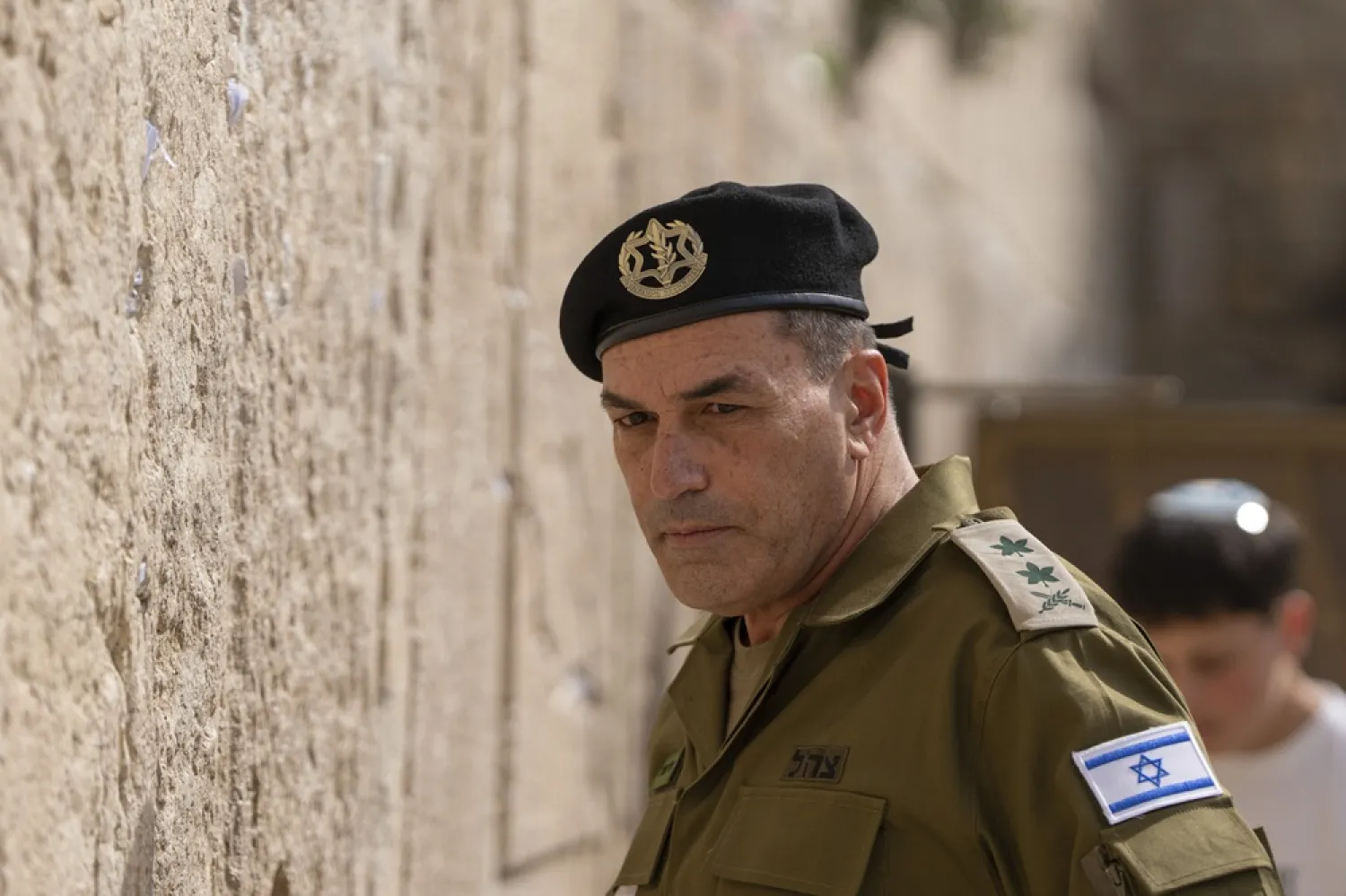
Israel's incoming military chief of staff, Lt. Gen. Eyal Zamir places notes in the Western Wall, the holiest site where Jews can pray, in Jerusalem's Old City on Wednesday, March 5, 2025. (AP)
TT

Israel's Mission Against Hamas 'Not Accomplished', Says New Military Chief 

Israel's incoming military chief of staff, Lt. Gen. Eyal Zamir places notes in the Western Wall, the holiest site where Jews can pray, in Jerusalem's Old City on Wednesday, March 5, 2025. (AP)

New armed forces chief Lieutenant General Eyal Zamir said during his inauguration in Tel Aviv on Wednesday that Israel's mission to defeat Palestinian group Hamas was "not accomplished".  

"I accept command of the (Israeli military) with modesty and humility... Hamas has indeed suffered a severe blow, but it has not yet been defeated. The mission is not yet accomplished," Zamir said, amid deadlock in negotiations on next steps in a ceasefire with Hamas in Gaza. 

Prime Minister Benjamin Netanyahu told Zamir that Israel is "determined" to achieve victory in the multi-front war that began with Hamas's October 2023 attack.  

"A very heavy responsibility rests on your shoulders, the results of the war will have significance for generations, we are determined to achieve... victory" Netanyahu told Zamir during his inauguration. 

Former tank commander and director of the defense ministry Zamir replaces outgoing chief of staff Lieutenant General Herzi Halev, who resigned admitting he failed to fulfil his mandate.  

Zamir, 59, is being sworn in at a sensitive time in Israel's war with Hamas, with the ceasefire that took effect on January 19 hanging in the balance.  

Announcing his appointment last month, Netanyahu said he had high hopes that Zamir would help achieve Israel's goal of "absolute victory" against Hamas. 

Zamir will also take over operations in the occupied West Bank, where the military has deployed tanks in recent weeks for the first time in 20 years.  

His appointment also comes at a moment of high tension for Israel with its arch-foe Iran.  

Zamir wrote in a 2022 policy paper for the Washington Institute for Near East Policy that Israel needed to adopt a tougher approach in order to stop Iran from developing nuclear weapons. 

Pushing for greater cooperation with the United States against what he called the "Iran axis", Zamir advocated "offensive action" in order to guarantee success.  

His position on Iran mirrors that of Netanyahu, who recently said that Israel plans to "finish the job against Iran's terror axis".  

Zamir, who led key operations during the second Palestinian intifada or uprising, served as Netanyahu's military secretary from 2012 to 2015.  

He is the founder of the right-wing think tank Israel Defense and Security Forum.  

In contrast to Halevi, who avoided the spotlight, Zamir comes across as a powerful figure.  

At a defense ministry event a day after his appointment, Zamir, a father of three, was quoted as saying that 2025 would be "a year of continued fighting". 

"The war has demonstrated that we must be self-reliant," he said.  

As head of the defense ministry, Zamir is credited with some of Israel's biggest and most significant defense procurements.  

"He understands very well what big wars are all about and how to fight them," said Amir Avivi, a former Israeli general who now runs a network for former security officials.  

Zamir cuts a powerful frame, his burly build sending a clear message that he means business.  

Avivi, who has known Zamir for more than 20 years and spent a year with him at the Israeli College for National Security, described him as being "mission-oriented", "detail-oriented" and "strict". 

He said Zamir has a "deep understanding" of the Gaza front and even authored "a very detailed plan to conquer all of Gaza" while serving as head of Southern Command from 2015 to 2018.  

Saying he had spoken with Zamir since his appointment, Avivi added: "I think he has a very clear understanding that he was chosen for one thing -- to bring total victory to Israel on all fronts."  

Jonathan Conricus, a former Israeli army spokesman who served with Zamir, also said the incoming chief would have to "navigate strategic challenges of the most sensitive nature", including restoring public trust.  

Born in Israel's southernmost city Eilat, Zamir, whose paternal grandfather immigrated from Yemen and whose mother's family arrived from Syria, joined the military in 1984.  

Unlike previous chiefs of staff, who served in the distinguished paratroopers' unit or in the Golani infantry brigade, Zamir began his career in the Armored Corps.  

He served through the first and second intifadas holding senior combat and command roles. 

In 2002, he led a brigade that captured the refugee camp adjacent to the West Bank city of Jenin, a hotbed of Palestinian militancy.  

The army laid siege to the camp for more than a month amid fierce fighting that saw hundreds of homes levelled, and 52 Palestinians and 23 Israeli soldiers killed.  

Zamir was later appointed head of the army's southern command, where he led efforts to cut off Hamas tunnels.  

From 2018 to 2021, he served as deputy chief of staff under Lieutenant General Aviv Kochavi, tasked with implementing the military's multi-year plan. 


Sudan Once again Tops International Rescue Committee Crises Watchlist

FILE PHOTO: Sudanese people, who fled the conflict in Geneina in Sudan's Darfur region, receive rice portions from Red Cross volunteers in Ourang on the outskirts of Adre, Chad July 25, 2023. REUTERS/Zohra Bensemra/File Photo
TT

Sudan Once again Tops International Rescue Committee Crises Watchlist

FILE PHOTO: Sudanese people, who fled the conflict in Geneina in Sudan's Darfur region, receive rice portions from Red Cross volunteers in Ourang on the outskirts of Adre, Chad July 25, 2023. REUTERS/Zohra Bensemra/File Photo

Sudan has once again topped a watchlist of global humanitarian crises released by the International Rescue Committee (IRC) aid organization, as warring sides press on with a conflict that has killed tens of thousands of people.

It is the third time in a row Sudan has headed the list, which was published on Tuesday. It highlights the 20 countries most at risk of new or worsened humanitarian emergencies.

"What the IRC is seeing on the ground is not a tragic accident. The world is not simply failing to respond to crisis; actions and words are producing, prolonging, and rewarding it," IRC CEO David Miliband said in a statement.

"The scale of the crisis in Sudan, ranking first on this year’s Watchlist for the third year in a row and now the largest humanitarian crisis ever recorded, is a signature of this disorder."

War erupted in April 2023 from a power struggle between the Sudanese army and the paramilitary Rapid Support Forces ahead of a planned transition to civilian rule, and triggered the world's largest displacement crisis. More than 12 million people have already been displaced by the ongoing war in Sudan, where humanitarian workers lack resources to help those fleeing, many of whom have been raped, robbed or bereaved by the violence.

Sudan is followed by the Palestinian territories, South Sudan, Ethiopia and Haiti, according to the list.

The IRC said although these countries are home to just 12% of the global population, they account for 89% of those in humanitarian need. It added that the countries are projected to host more than half of the world's extreme poor by 2029.

The remaining countries on the list are Myanmar, Democratic Republic of Congo, Mali, Burkina Faso, Lebanon, Afghanistan, Cameroon, Chad, Colombia, Niger, Nigeria, Somalia, Syria, Ukraine and Yemen.


Torrential Rains and Flash Floods Kill 37 in Moroccan City of Safi

People inspect the damage caused by flash floods in Safi, Morocco, Monday, Dec. 15, 2025. (AP Photo/Abderrazak Gouach)
TT

Torrential Rains and Flash Floods Kill 37 in Moroccan City of Safi

People inspect the damage caused by flash floods in Safi, Morocco, Monday, Dec. 15, 2025. (AP Photo/Abderrazak Gouach)

Floods triggered by torrential rains have killed at least 37 people in the Moroccan coastal city of Safi, the Interior Ministry said Monday.

Authorities said heavy rain and flash floods overnight inundated about 70 homes and businesses and swept away 10 vehicles. The Interior Ministry reported 14 people hospitalized.

Local outlets reported that schools announced three days of closures. Rains also caused flooding and damage elsewhere throughout Morocco, including the northern city of Tetouan and the mountain town of Tinghir.

Safi, a city on Morocco’s Atlantic shore more than 320 kilometers (200 miles) from the capital, Rabat, is a major hub for the country’s critical fishing and mining industries. Both employ thousands to catch, mine and process the commodities for export. The city, with a population of more than 300,000 people, is home to a major phosphate processing plant.

Videos shared on social media showed cars stranded and partially submerged as floodwaters surged through Safi’s streets.

Climate change has made weather patterns more unpredictable in Morocco. North Africa has been plagued by several years of drought, hardening soils and making mountains, deserts and plains more susceptible to flooding. Last year, floods in normally arid mountains and desert areas killed nearly two dozen people in Morocco and Algeria.

This week's floods came after 22 people were killed in a two-building collapse in the Moroccan city of Fez. Morocco has invested in disaster risk initiatives although local governments often do not enforce building codes and drainage systems can be lacking in some cities. Infrastructural inequities were a focus of youth-led protests that swept the country earlier this year.

"This is a disaster, I have never seen anything like this in my lifetime," Khalil Sidki, 67, a Safi resident and member of the local branch of the Moroccan Association of Human Rights, told The Associated Press.

He said the flooding caught people by surprise in a commercial area. In reaction, many shopkeepers locked themselves inside their stores, but as water levels climbed up to 4 meters (13 feet), shops were submerged, killing those trapped inside, he said. Another Safi resident described similar scenes.

Moroccan authorities launched an investigation into the cause of the flooding. Safi received 46 millimeters (less than 2 inches) of rainfall over 24 hours — a level Houcine Youabid from Morocco’s General Directorate of Meteorology described as “normal” for the region. He said infrastructure issues could have combined with the rainfall to contribute to the flooding.

Parts of the North African nation experienced heavy rain and snow over the weekend, and authorities issued alerts for similar conditions throughout the coming days.


US Army Names 2 Iowa Guard Members Killed in Attack in Syria

 This undated combo photo created with images released by the Iowa National Guard shows Sgts. William Nathaniel Howard, left, and Edgar Brian Torres-Tovar. (Iowa National Guard via AP)
This undated combo photo created with images released by the Iowa National Guard shows Sgts. William Nathaniel Howard, left, and Edgar Brian Torres-Tovar. (Iowa National Guard via AP)
TT

US Army Names 2 Iowa Guard Members Killed in Attack in Syria

 This undated combo photo created with images released by the Iowa National Guard shows Sgts. William Nathaniel Howard, left, and Edgar Brian Torres-Tovar. (Iowa National Guard via AP)
This undated combo photo created with images released by the Iowa National Guard shows Sgts. William Nathaniel Howard, left, and Edgar Brian Torres-Tovar. (Iowa National Guard via AP)

The two Iowa National Guard members killed in a weekend attack that the US military blamed on the ISIS group in Syria were identified Monday.

The US Army named them as Sgt. Edgar Brian Torres-Tovar, 25, of Des Moines, and Sgt. William Nathaniel Howard, 29, of Marshalltown.

Iowa Gov. Kim Reynolds ordered all flags in Iowa to fly at half-staff in their honor, saying that, “We are grateful for their service and deeply mourn their loss.”

The Pentagon’s chief spokesman, Sean Parnell, has said a civilian working as a US interpreter also was killed. Three other Guard members were wounded in the attack, the Iowa National Guard said Monday, with two of them in stable condition and the other in good condition.

The attack was a major test for the rapprochement between the United States and Syria since the ouster of autocratic leader Bashar al-Assad a year ago, coming as the US military is expanding its cooperation with Syrian security forces. Hundreds of American troops are deployed in eastern Syria as part of a coalition fighting ISIS.

The shooting Saturday in the Syrian desert near the historic city of Palmyra also wounded members of the country's security forces and killed the gunman. The assailant had joined Syria’s internal security forces as a base security guard two months ago and recently was reassigned amid suspicions that he might be affiliated with ISIS, a Syrian official said.

The man stormed a meeting between US and Syrian security officials who were having lunch together and opened fire after clashing with Syrian guards, Interior Ministry spokesperson Noureddine al-Baba said Sunday.

Al-Baba acknowledged that the incident was “a major security breach” but said that in the year since Assad’s fall, “there have been many more successes than failures” by security forces.

The Army said Monday that the incident is under investigation, but military officials have blamed the attack on an ISIS member.

President Donald Trump said over the weekend that “there will be very serious retaliation” for the attack and that Syrian President Ahmed al-Sharaa was “devastated by what happened,” stressing that Syria was fighting alongside US troops.

Trump welcomed Sharaa, who led the lightning opposition offensive that toppled Assad's rule, to the White House for a historic meeting last month.