Israel Says Two Hezbollah Members Hit in South Lebanon Airstrike

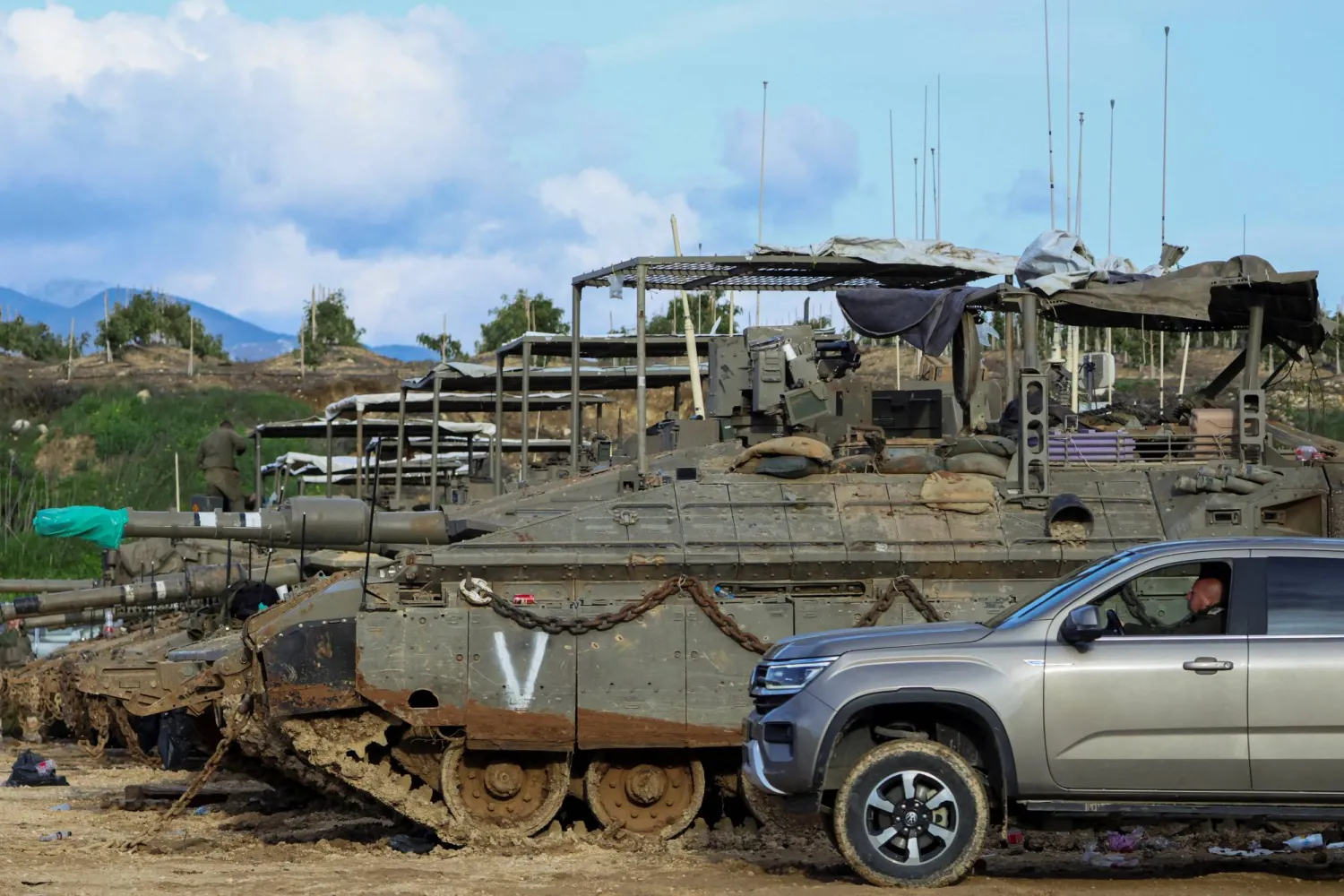
This picture taken from a position in northern Israel, near the border with Lebanon, shows an Israeli flag (L) on a destroyed building, and a Lebanese flag (R) painted on a damaged building in the southern Lebanese village of Mais al-Jabal on November 25, 2024, amid the ongoing war between Israel and Hezbollah. (AFP)
TT

Israel Says Two Hezbollah Members Hit in South Lebanon Airstrike

This picture taken from a position in northern Israel, near the border with Lebanon, shows an Israeli flag (L) on a destroyed building, and a Lebanese flag (R) painted on a damaged building in the southern Lebanese village of Mais al-Jabal on November 25, 2024, amid the ongoing war between Israel and Hezbollah. (AFP)

The Israeli military said it carried out an airstrike in southern Lebanon on Monday targeting two Hezbollah members, with Lebanese health authorities reporting one person killed and three wounded.

It was the latest in a series of deadly strikes in the area despite a ceasefire agreement that took effect in November after more than a year of hostilities between Israel and Hezbollah.

"A short while ago, two Hezbollah terrorists who served as observation operatives and directed terrorist activities were struck by the (military) in the area of Yohmor in southern Lebanon," the army said in a statement.

The Lebanese health ministry's emergency unit said the "Israeli airstrike on a van in the village of Yohmor... led to one death", according to the official National News Agency (NNA), adding that three other people were wounded.

The agency reported that an Israeli drone had targeted a motorcycle with two riders, but a passing van was also hit by shrapnel, and "fires erupted in it" and a nearby shop.

The attack came a day after NNA and the health ministry reported four deaths in Israeli strikes on southern Lebanon.

Israeli Defense Minister Israel Katz said Sunday that the military had targeted the south Lebanon town of Ainata after "a stray bullet from a Hezbollah operative's funeral" hit the windshield of a vehicle in the northern Israeli community of Avivim.

"We will not allow shooting from Lebanese territory toward northern communities -- we will respond strongly to any violation of the ceasefire," Katz said.

Israel's military also said "a gunshot hit a parked vehicle in the area of Avivim. No injuries were reported. The shot most likely originated from Lebanese territory."

NNA cited the health ministry as saying that the strike on Ainata "led to the death of two people", after reporting earlier fatalities in Israeli strikes on Mais al-Jabal and Bint Jbeil, also in south Lebanon.

The November 27 truce largely halted the fighting between Hezbollah and Israel, which included two months of open war in which Israel sent in ground troops.

But Israel has continued to carry out strikes on Lebanese territory since the agreement took effect.

Under the agreement, Israel had been expected to withdraw from Lebanon by February 18 after missing a January deadline, but it has kept troops at five locations it deems "strategic".

The ceasefire also required Hezbollah to pull back north of the Litani River, about 30 kilometres (20 miles) from the border, and to dismantle any remaining military infrastructure in the south.


Egypt, Pakistan Seek to Boost Relations

Egyptian President Abdel Fattah El-Sisi received in Cairo Pakistan’s Chief of Army Staff Field Marshall Asim Munir last month (Egyptian Presidency)
TT

Egypt, Pakistan Seek to Boost Relations

Egyptian President Abdel Fattah El-Sisi received in Cairo Pakistan’s Chief of Army Staff Field Marshall Asim Munir last month (Egyptian Presidency)

Egypt and Pakistan on Saturday discussed on Saturday ways of advancing and strengthening bilateral relations in political and economic fields, with a view to serving the interests of peoples of both countries.

During a phone call, Egyptian Foreign Minister Badr Abdelatty and Pakistan's Deputy Prime Minister and Foreign Minister Ishaq Dar praised the remarkable progress in bilateral relations and affirmed commitment to continuing efforts to boost cooperation in various fields, in light of the historical ties and common interests shared by the two nations.

They discussed developments in the Middle East, particularly the latest situation in Gaza, according to Foreign Ministry Spokesman Tamim Khalaf.

Abdelatty underscored the importance of full implementation of the first phase of the Sharm El-Sheikh Agreement.

He stressed that both parties to the conflict must honor all their commitments in order to proceed to the second phase.

The Egyptian PM highlighted the importance of the effective implementation of the plan announced by US President Donald Trump.

A Foreign Ministry statement noted that the two sides discussed the ongoing consultations on the draft UN Security Council resolution regarding developments in Gaza as well as relevant security arrangements.

Abdelatty and Dar stressed the importance of ensuring that the resolution contributes to solidifying the end of the war and creating conditions conducive to achieving a just and comprehensive peace that fulfills the aspirations of the Palestinian people, including their right to self-determination and the establishment of an independent state.

Late last month, Egyptian President Abdel Fattah El-Sisi received in Cairo Pakistan’s Chief of Army Staff Field Marshall Asim Munir and emphasized Egypt’s keenness to continue strengthening and advancing bilateral cooperation in various fields.

This cooperation aims to achieve the common aspirations of the Egyptian and Pakistani peoples and contribute to boosting efforts for development and prosperity in both countries, the President had said.

The meeting also covered ways to enhance regional security and peace, both in the Middle East and South Asia.

There was a strong emphasis on intensifying consultation between the two countries to avoid escalation and address common challenges. The meeting also included exploring avenues for cooperation in the field of counter-terrorism and extremism.

In July, El-Sisi met with Pakistan's Chairman Joint Chiefs of Staff Committee Lt. Gen. Sahir Shamshad Mirza and discussed ways of promoting bilateral cooperation, especially in military and security fields, alongside exchanging expertise in combating terrorism and extremism.

During his meeting with Dar on Saturday, Abdelatty highlighted Egypt’s efforts to host the international conference on early recovery, reconstruction, and development in Gaza, in cooperation with international partners.

He invited his Pakistani counterpart to participate actively in the upcoming event.

Earlier, Abdelatty had emphasized the urgent need to initiate early recovery and reconstruction plans in Gaza as soon as possible.

He said this should be done within a comprehensive vision that protects the rights of the Palestinians, in accordance with both the Arab-Islamic plan for early recovery and reconstruction and US President Donald Trump's Middle East peace plan.

Last month, Egypt and Pakistan said they are strengthening their military cooperation as Egypt’s Commander-in-Chief of the Armed Forces, Minister of Defense and Military Production, Gen. Abdel Mageed Saqr, met with Gen. Munir in Cairo.

Saqr had expressed his “appreciation for the close ties between the armed forces of both countries,” emphasizing “the importance of bolstering efforts to achieve security and stability amid the rapid changes on the regional and international scenes.”


Gaza Health Ministry Confirms Received Bodies of 15 Palestinians under Truce Deal

 Temporary tents stretch along the beachfront in Deir al-Balah, in the central Gaza Strip, Saturday, Nov. 15, 2025. (AP)
Temporary tents stretch along the beachfront in Deir al-Balah, in the central Gaza Strip, Saturday, Nov. 15, 2025. (AP)
TT

Gaza Health Ministry Confirms Received Bodies of 15 Palestinians under Truce Deal

 Temporary tents stretch along the beachfront in Deir al-Balah, in the central Gaza Strip, Saturday, Nov. 15, 2025. (AP)
Temporary tents stretch along the beachfront in Deir al-Balah, in the central Gaza Strip, Saturday, Nov. 15, 2025. (AP)

The health ministry in Hamas-run Gaza confirmed Saturday it had received the bodies of 15 Palestinians the day before under the US-brokered ceasefire exchange deal.

"The Ministry of Health announces the receipt of 15 bodies of martyrs who were released yesterday, Friday, by the Israeli occupation through the Red Cross. This brings the total number of bodies received to 330" as part of the deal, the ministry said, adding it had so far identified 97.

They were returned in exchange for the remains of 73-year-old Israeli hostage Meny Godard, which Hamas returned via the Red Cross on Thursday.


After Assad's Fall, Syrians and EU Officials Hold Rare Meeting in Damascus

Syrian Minister of Foreign Affairs and Expatriates Asaad al-Shaibani leaves the stage after addressing delegates during a day of dialogue with Syrian civil society, a first step towards structured dialogue with the Syrian government and the European Union, at Conference Palace near Damascus on November 15, 2025. (AFP)
TT

After Assad's Fall, Syrians and EU Officials Hold Rare Meeting in Damascus

Syrian Minister of Foreign Affairs and Expatriates Asaad al-Shaibani leaves the stage after addressing delegates during a day of dialogue with Syrian civil society, a first step towards structured dialogue with the Syrian government and the European Union, at Conference Palace near Damascus on November 15, 2025. (AFP)

Representatives of Syria’s civil society held rare open discussions Saturday in Damascus in the presence of officials from the European Union and the transitional government. They touched on sensitive topics including sectarian tensions, ethnic divisions and people killed by different sides.

The EU-organized meetings known as “The Day of Dialogue” are the first to be held in Damascus after taking place in past years in Brussels. Saturday's meetings came nearly a year after the fall of the 54-year Assad family rule in Syria in a stunning offensive by opposition groups in early December.

The meetings that used to take place within the framework of the Brussels Conferences were mostly boycotted by then-President Bashar al-Assad’s government. The EU said Saturday's meetings were organized in cooperation with Syrian civil society and the Syrian transitional authorities.

“The meeting that used to be held to talk about Syria is now being held in Syria,” Syria’s Foreign Minister Asaad al-Shaibani said in a speech at the opening session held at a conference center in the southern outskirts of Damascus.

Al-Shaibani added that Saturday’s meetings represent “a solid partnership with the civil society and our partners in the European Union.”

Michael Ohnmacht, chargé d’affaires of the EU delegation to Syria, said 500 people from Syria’s different religious and ethnic groups took part in the meetings and “this is something very positive.”

“This is what we hope for Syria’s future, to see this inclusive state which will be a state in the form of all its citizens,” Ohnmacht said.

Despite the changes in Syria over the past year, sectarian violence in the country’s coastal region in March and the southern province of Sweida in July between pro-government gunmen and members of the country’s Druze and Alawite minorities left hundreds of people dead.

Such acts of violence show that Syria still faces major crises in the 14-year conflict that has left half a million people dead.

“Today’s dialogue is the beginning of change and rebuilding Syria only happens through partnership based on respect between the state and civil society,” said Social Affairs Minister Hind Kabawat.

During one of the sessions on transitional justice and the fate of the missing, Syrians demanded answers on issues still pending, such as more than 130,000 people who went missing under Assad's rule while an ethnic Kurd spoke about state discrimination they have faced for decades. Another spoke about violence against some women who belong to minority sects.

Mazen Darwish, a Syrian lawyer and one of the country’s most prominent activists who was repeatedly jailed in Syria before he went into exile years ago, said no one regrets the fall of the Assad family rule adding that this does not mean that “the future of Syria will be rosy and great.”

“Today we have an opportunity in Syria and we have to take advantage of it,” Darwish said.