


Hundreds of Thousands Flee as Israel Seizes Rafah in New Gaza 'Security Zone'

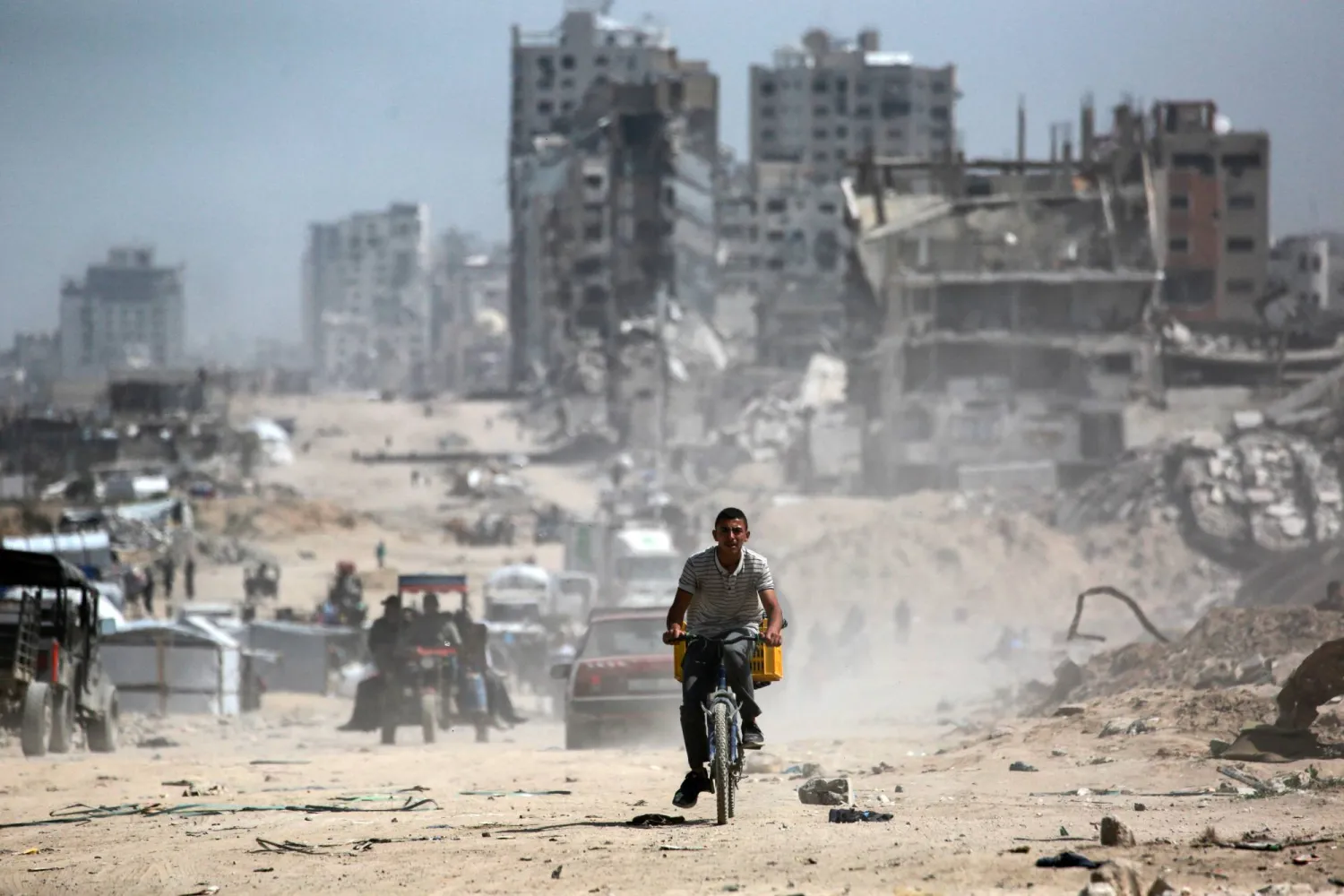
A youth rides a bicycle as people commute along the al-Rashid road, the only route linking the northern and southern parts of the Palestinian territory, on April 2, 2025. (Photo by Bashar TALEB / AFP)
TT

Hundreds of Thousands Flee as Israel Seizes Rafah in New Gaza 'Security Zone'

A youth rides a bicycle as people commute along the al-Rashid road, the only route linking the northern and southern parts of the Palestinian territory, on April 2, 2025. (Photo by Bashar TALEB / AFP)

Hundreds of thousands of fleeing Gazans sought shelter on Thursday in one of the biggest mass displacements of the war, as Israeli forces advanced into the ruins of the city of Rafah, part of a newly announced "security zone" they intend to seize.

A day after declaring their intention to capture large swathes of the crowded enclave, Israeli force pushed into the city on Gaza's southern edge which had served as a last refuge for people fleeing other areas for much of the war, reported Reuters.

Gaza's health ministry reported at least 97 people killed in Israeli strikes in the past 24 hours, including at least 20 killed in an airstrike around dawn in Shejaia suburb of Gaza City.

Rafah "is gone, it is being wiped out," a father of seven among the hundreds of thousands who had fled from Rafah to neighboring Khan Younis, told Reuters via a chat app.

"They are knocking down what is left standing of houses and property," said the man who declined to be identified for fear of repercussions.

After a strike killed several people in Khan Younis, Adel Abu Fakher was checking the damage to his tent.

"Is anything left for us? There’s nothing left for us. We’re being killed while asleep," he said.

The assault to capture Rafah is a major escalation in the war, which Israel restarted last month after effectively abandoning a ceasefire in place since January.

GAZANS FEAR PERMANENT DEPOPULATION

Israel has not spelled out its longterm aims for the security zone its troops are now seizing. Prime Minister Benjamin Netanayahu said troops were taking an area he called the "Morag Axis", a reference to an abandoned former Israeli settlement once located between Rafah on Gaza's southern edge and the adjacent main southern city Khan Younis.

Gazans who had returned to homes in the ruins during the ceasefire have now been ordered to flee communities on the northern and southern edges of the strip.

They fear that Israel's intention is to depopulate those areas indefinitely, leaving many hundreds of thousands of people permanently homeless in one of the poorest and most crowded territories on earth. The security zone includes some of Gaza's last agricultural land and critical water infrastructure.

Since the first phase of the ceasefire expired at the start of March with no agreement to prolong it, Israel has imposed a total blockade on all goods reaching Gaza's 2.3 million residents, recreating what international organizations describe as a humanitarian catastrophe after weeks of relative calm.

Israel's stated goal since the start of the war has been the destruction of the Hamas group which ran Gaza for nearly two decades and led the attack on Israeli communities in October 2023 that precipitated the war.

But with no effort made to establish an alternative administration, Hamas-led police returned to the streets during the ceasefire. Fighters still hold 59 dead and living hostages which Israel says must be handed over to extend the truce; Hamas says it will free them only under a deal that ends the war.

Israeli leaders say they have been encouraged by signs of protest in Gaza against Hamas, with hundreds of people demonstrating in north Gaza's Beit Lahiya on Wednesday opposing the war and demanding Hamas quit power. Hamas calls the protesters collaborators and says Israel is behind them.

The war began with a Hamas attack on Israeli communities on October 7, 2023 with gunmen killing 1,200 people and taking more than 250 hostages according to Israeli tallies. Israel's campaign has so far killed more than 50,000 Palestinians, Gaza health authorities say.

Rafah residents said most of the local population had followed Israel's order to leave, as Israeli strikes toppled buildings there. But a strike on the main road between Khan Younis and Rafah stopped most movement between the two cities.

Movement of people and traffic along the western coastal road near Morag was also limited by bombardment, said residents.

"Others stayed because they don't know where to go, or got fed up of being displaced several times. We are afraid they might be killed or at best detained," said Basem, a resident of Rafah who declined to give a second name.

Markets have emptied and prices for basic necessities have soared under Israel's total blockade of food, medicine and fuel.

The Palestinian Health Ministry, which is based in the Israeli-occupied West Bank but has nominal authority over hospitals in Gaza, said Gaza's entire healthcare system was at risk of collapse.



Hezbollah Chief Accuses Lebanese Authorities of Working ‘in the Interest of What Israel Wants’

Hezbollah leader Naim Qassem
TT

Hezbollah Chief Accuses Lebanese Authorities of Working ‘in the Interest of What Israel Wants’

Hezbollah leader Naim Qassem

Hezbollah leader Naim Qassem on Sunday said moves to disarm the group in Lebanon are an "Israeli-American plan,” accusing Israel of failing to abide by a ceasefire agreement sealed last year.

Under heavy US pressure and fears of expanded Israeli strikes, the Lebanese military is expected to complete Hezbollah's disarmament south of the Litani River -- located about 30 kilometers from the border with Israel -- by the end of the year.

It will then tackle disarming the Iran-backed movement in the rest of the country.

"Disarmament is an Israeli-American plan," Qassem said.

"To demand exclusive arms control while Israel is committing aggression and America is imposing its will on Lebanon, stripping it of its power, means that you are not working in Lebanon's interest, but rather in the interest of what Israel wants."

Despite a November 2024 ceasefire that was supposed to end more than a year of hostilities between Israel and Hezbollah, Israel has kept up strikes on Lebanon and has maintained troops in five areas it deems strategic.

According to the agreement, Hezbollah was required to pull its forces north of the Litani River and have its military infrastructure in the vacated area dismantled.

Israel has questioned the Lebanese military's effectiveness and has accused Hezbollah of rearming, while the group itself has rejected calls to surrender its weapons.

"The deployment of the Lebanese army south of the Litani River was required only if Israel had adhered to its commitments... to halting the aggression, withdrawing, releasing prisoners, and having reconstruction commence," Qassem said in a televised address.

"With the Israeli enemy not implementing any of the steps of the agreement... Lebanon is no longer required to take any action on any level before the Israelis commit to what they are obligated to do."

Lebanese army chief Rodolphe Haykal told a military meeting on Tuesday "the army is in the process of finishing the first phase of its plan.”

He said the army is carefully planning "for the subsequent phases" of disarmament.


Israel Army Ends Crackdown on West Bank Town after Attack

Smoke rises following an explosion detonated by the Israeli army, which said it was destroying buildings used by Palestinian militants in the West Bank Jenin refugee camp, Sunday, February 2, 2025. © Majdi Mohammed, AP
TT

Israel Army Ends Crackdown on West Bank Town after Attack

Smoke rises following an explosion detonated by the Israeli army, which said it was destroying buildings used by Palestinian militants in the West Bank Jenin refugee camp, Sunday, February 2, 2025. © Majdi Mohammed, AP

The Israeli military said on Sunday it had ended its operation in a town in the occupied West Bank that it had sealed off after a Palestinian from the area killed two Israelis.

Around 50 residents of Qabatiya were briefly detained during the two-day operation, the official Palestinian news agency Wafa reported, quoting the town's mayor Ahmed Zakarneh.

The attacker's father and two brothers remained in custody, it added.

The military launched the operation on Friday, shortly after a 34-year-old Palestinian fatally stabbed an 18-year-old Israeli woman and ran over a man in his sixties with his vehicle.

When contacted by AFP on Sunday morning, the military confirmed the end of its operation in the area.

Defense Minister Israel Katz previously said the army had completely sealed off the town.

Wafa also reported that Israeli troops had withdrawn from Qabatiya, near the city of Jenin.

Zakarneh said the town had been in a state of "total paralysis" during the military activity.

Israeli army bulldozers tore up pavement on several streets and erected roadblocks to halt traffic, he said, adding that around 50 houses were searched.

Wafa reported that a school had been turned into a detention and interrogation center.

AFPTV footage filmed on Saturday showed Israeli soldiers carrying automatic rifles and patrolling the streets, where several armoured vehicles were deployed.

Shops were closed, though men and children were seen walking through the village.

On Sunday, the Israeli army said it had sealed off the assailant's home and was finalising "the procedures required for its demolition".

Israeli authorities argue that demolishing the homes of Palestinians who carry out attacks against Israelis has a deterrent effect.

Critics, however, condemn the practice as collective punishment that leaves families homeless.


Arab League Council Holds Extraordinary Session on Latest Developments in Somalia

A general view shows the opening session of the meeting of Arab foreign ministers at the Arab League Headquarters (Reuters)
TT

Arab League Council Holds Extraordinary Session on Latest Developments in Somalia

A general view shows the opening session of the meeting of Arab foreign ministers at the Arab League Headquarters (Reuters)

At the request of the Federal Republic of Somalia and with the support of Arab League member states, the Arab League Council on Sunday began its extraordinary session at the league’s General Secretariat, at the level of permanent representatives and under the chairmanship of the United Arab Emirates, to discuss developments regarding the Israeli occupation authorities’ declaration on mutual recognition with the Somaliland region.

The Kingdom’s delegation to the meeting was headed by its Permanent Representative to the Arab League Ambassador Abdulaziz bin Abdullah Al-Matar, SPA reported.

The meeting is discussing ways to strengthen the unified Arab position in addressing this step, to affirm full solidarity with Somalia, and to support its legitimate institutions in a manner that contributes to preserving security and stability in the region.

The meeting also aims to reaffirm the Arab League’s categorical rejection of any unilateral measures or decisions that could undermine Somalia’s sovereignty and territorial integrity, and to emphasize commitment to the principles of international law and the relevant resolutions of the Arab League and the African Union.