

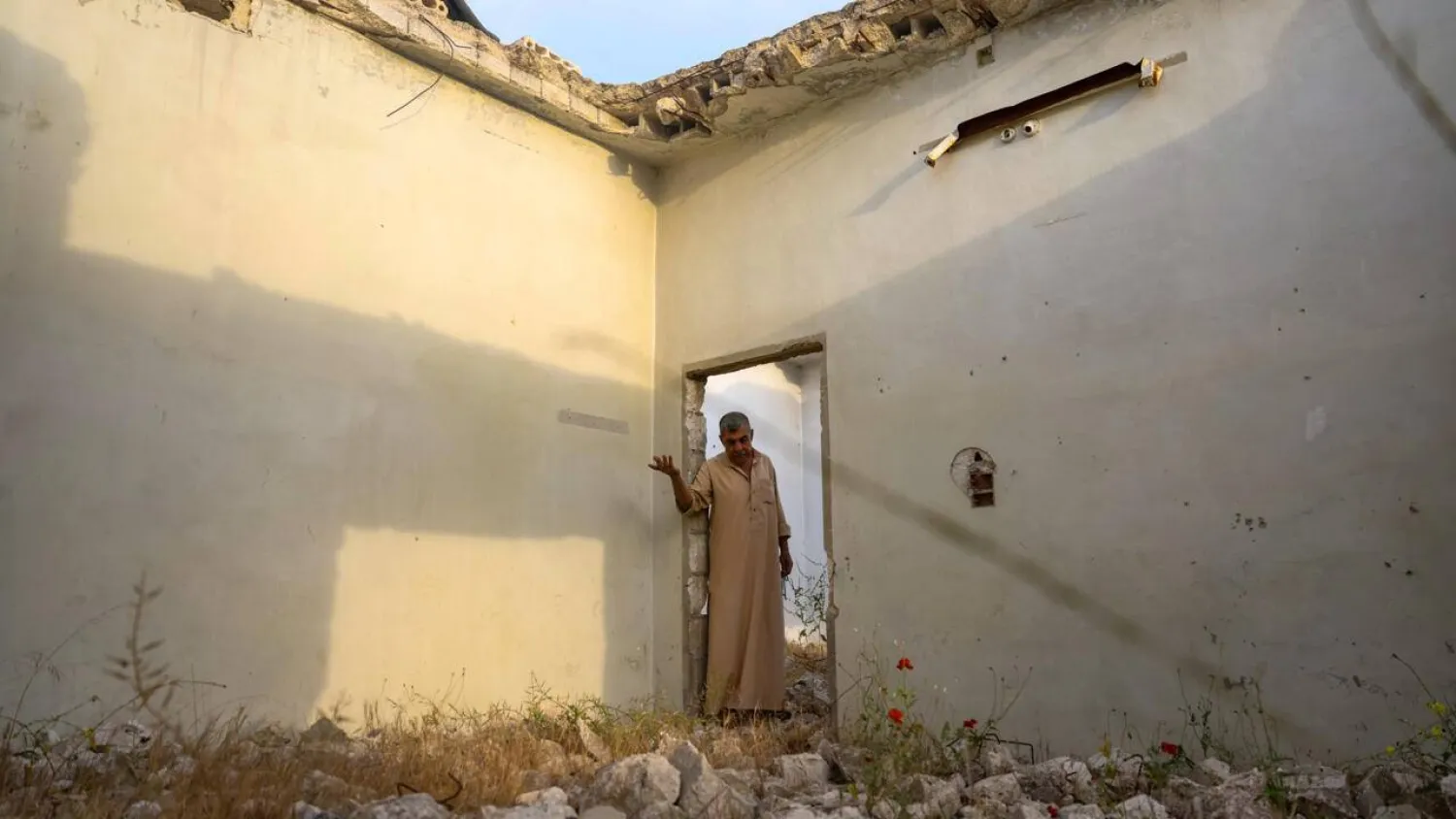

Displaced Syrians Leave Camps to Pitch Tents near Destroyed Homes

Aref Shamtan, 73: 'I feel good here, even among the rubble'. Omar HAJ KADOUR / AFP
TT

Displaced Syrians Leave Camps to Pitch Tents near Destroyed Homes

Aref Shamtan, 73: 'I feel good here, even among the rubble'. Omar HAJ KADOUR / AFP

Aref Shamtan, 73, preferred to pitch a tent near his destroyed home in northwest Syria rather than stay in a camp for the displaced following longtime ruler Bashar al-Assad's ouster.

"I feel good here, even among the rubble," Shamtan said, sipping tea at the tent near his field.

When he and his son returned after Assad's December 8 overthrow, Shamtan found his village of Al-Hawash, nestled among farmland in central Hama province, badly damaged.

The roof of their house was gone and its walls were cracked.

But "living in the rubble is better than living in the camps" near the border with Türkiye, where he had been since 2011 after fleeing the fighting, Shamtan said.

Since the opposition factions ousted Assad after nearly 14 years of war, 1.87 million Syrians who were refugees abroad or internally displaced have returned to their areas of origin, the United Nations' International Organization for Migration says.

The IOM says the "lack of economic opportunities and essential services pose the greatest challenge" for those returning home.

Shamtan, who cannot afford to rebuild, decided around two months ago to leave the camp with his family and young grandchildren, and has started planting his farmland with wheat, said AFP.

Al-Hawash had been controlled by Assad's forces and was along the front lines with neighboring Idlib province, which became a bastion for opposition factions, particularly Hayat Tahrir al-Sham, the group that led the offensive that toppled Assad.

'Nothing here'

"We can't stay in the camps," Shamtan insisted, even if "the village is all destroyed... and life is non-existent", lacking basic services and infrastructure.

"We decided... to live here until things improve. We are waiting for organizations and the state to help us," he said.

"Life is tough."

Local official Abdel Ghafour al-Khatib, 72, has also returned after fleeing in 2019 with his wife and children for a camp near the border.

"I just wanted to get home. I was overjoyed... I returned and pitched a worn-out tent. Living in my village is the important thing," he said.

"Everyone wants to return," he said. But many cannot even afford the transport to do so in a country where 90 percent of people live in poverty.

"There is nothing here -- no schools, no health clinics, no water and no electricity," Khatib said, sitting on the ground in the tent near the remains of his home.

The war, which erupted in 2011 after Assad's brutal repression of anti-government protests, killed more than 500,000 people and displaced half of the pre-war population internally or abroad, with many fleeing to Idlib province.

More than six million people remain internally displaced, according to the IOM.

With the recent lifting of Western sanctions, Syria's new authorities hope for international support to launch reconstruction, which the UN estimates could cost more than $400 billion.

IOM chief Amy Pope said on Monday that "the lifting of sanctions sends a powerful message of hope to millions of displaced Syrians", cautioning, however, that "hope must be matched with concrete support".

'No home'

After being repeatedly displaced, Souad Othman, 47, returned with her three daughters and son to Al-Hawash around a week ago.

"Everything has changed -- the homes are damaged and there is nothing left in their place," said Othman, whose husband died during the war.

The roof of her home has collapsed and its walls are cracked, but she still chose to return, eking out a living through manual labor.

A small bed sits out in the open, protected only by blankets on a clothesline, with a makeshift cooking area set up on the rubble.

She said she borrowed $80 to pay for a battery for two solar panels.

"There are snakes and insects here. We can't live without light during the night," she said.

AFP aerial footage of camps in northwest Syria showed some former structures empty of residents.

Jalal al-Omar, 37, who is responsible for part of a camp near the village of Qah in Idlib province, said around 100 families had left for his home village of Treimsa in the Hama region.

But around 700 other families cannot afford to return, he said, also noting the lack of infrastructure in Treimsa, where people have to travel miles just to buy bread.

"People don't want to stay in the camps, they want to return to their villages. But the lack of essential services... prevents their return," he said.

"I myself have no home. I'm waiting... for a place to shelter in the village," he added.


UN: At Least 15 Children Killed in Sudan Drone Strike

The war in Sudan, ongoing since mid-April 2023, has caused extensive destruction across the country (AFP)
TT

UN: At Least 15 Children Killed in Sudan Drone Strike

The war in Sudan, ongoing since mid-April 2023, has caused extensive destruction across the country (AFP)

A drone strike on a displacement camp in Sudan killed at least 15 children earlier this week, the United Nations reported late on Wednesday.

"On Monday 16 February, at least 15 children were reportedly killed and 10 wounded after a drone strike on a displacement camp in Al Sunut, West Kordofan," the UN children's agency said in a statement.

Across the Kordofan region, currently the Sudan war's fiercest battlefield, "we are seeing the same disturbing patterns from Darfur -- children killed, injured, displaced and cut off from the services they need to survive," UNICEF's Executive Director Catherine Russell said.


MSF Will Keep Operating in Gaza 'as Long as We Can'

(FILES) A Palestinian man walks on his crutches to the Doctors Without Borders or Medecins Sans Frontieres (MSF) clinic, in the al-Rimal neighborhood of Gaza City on new year's Eve, December 31, 2025. (Photo by Omar AL-QATTAA / AFP)
TT

MSF Will Keep Operating in Gaza 'as Long as We Can'

(FILES) A Palestinian man walks on his crutches to the Doctors Without Borders or Medecins Sans Frontieres (MSF) clinic, in the al-Rimal neighborhood of Gaza City on new year's Eve, December 31, 2025. (Photo by Omar AL-QATTAA / AFP)

The head of Doctors Without Borders in the Palestinian territories told AFP the charity would continue working in Gaza for as long as possible, following an Israeli decision to end its activities there.

In early February, Israel announced it was terminating all the activities in Gaza by the medical charity, known by its French acronym MSF, after it failed to provide a list of its Palestinian staff.

MSF has slammed the move, which takes effect on March 1, as a "pretext" to obstruct aid.

"For the time being, we are still working in Gaza, and we plan to keep running our operations as long as we can," Filipe Ribeiro told AFP in Amman, but said operations were already facing challenges.

"Since the beginning of January, we are not anymore in the capacity to get international staff inside Gaza. The Israeli authorities actually denied any entry to Gaza, but also to the West Bank," he said.

Ribeiro added that MSF's ability to bring medical supplies into Gaza had also been impacted.

"They're not allowed for now, but we have some stocks in our pharmacies that will allow us to keep running operations for the time being," he said.

"We do have teams in Gaza that are still working, both national and international, and we have stocks."

In December, Israel announced it would prevent 37 aid organizations, including MSF, from working in Gaza from March 1 for failing to submit detailed information about their Palestinian employees, drawing widespread condemnation from NGOs and the United Nations.

It had alleged that two MSF employees had links with Palestinian militant groups Hamas and Islamic Jihad, which the medical charity has repeatedly and vehemently denied.

MSF says it did not provide the names of its Palestinian staff because Israeli authorities offered no assurances regarding their safety.

Ribeiro warned of the massive impact the termination of MSF's operations would have for healthcare in war-shattered Gaza.

"MSF is one of the biggest actors when it comes to the health provision in Gaza and the West Bank, and if we are obliged to leave, then we will create a huge void in Gaza," he said.

The charity says it currently provides at least 20 percent of hospital beds in the territory and operates around 20 health centers.

In 2025 alone, it carried out more than 800,000 medical consultations, treated more than 100,000 trauma cases and assisted more than 10,000 infant deliveries.


Egyptian-Turkish Military Talks Focus on Strengthening Partnership

The Commander of the Egyptian Air Force during his meeting with the Turkish Air Force chief in Cairo on Wednesday (Egyptian military spokesperson)
TT

Egyptian-Turkish Military Talks Focus on Strengthening Partnership

The Commander of the Egyptian Air Force during his meeting with the Turkish Air Force chief in Cairo on Wednesday (Egyptian military spokesperson)

Senior Egyptian and Turkish air force commanders met in Cairo on Wednesday for talks focused on strengthening military partnership and expanding bilateral cooperation, in the latest sign of warming defense ties between the two countries.

The meeting brought together the Commander of the Egyptian Air Force, Lt. Gen. Amr Saqr, and his Turkish counterpart, Gen. Ziya Cemal Kadioglu, to review a range of issues of mutual interest amid growing cooperation between the two air forces.

Egypt’s military spokesperson said the talks reflect the Armed Forces’ commitment to deepening military collaboration with friendly and partner nations.

Earlier this month, Egypt and Türkiye signed a military cooperation agreement during talks in Cairo between Egyptian President Abdel Fattah el-Sisi and his Turkish counterpart, President Recep Tayyip Erdogan.

Sisi highlighted similar viewpoints on regional and international issues, while Erdogan noted that enhanced cooperation and forthcoming joint steps would help support regional peace.

Cairo and Ankara also signed an agreement last August on the joint production of vertical take-off and landing (VTOL) drones. Production of unmanned ground vehicles has also begun under a partnership between the Turkish firm HAVELSAN and Egypt’s Kader Factory.

During the talks, Saqr underscored the importance of coordinating efforts to advance shared interests and expressed hope for closer ties that would benefit both air forces.

Kadioglu, for his part, stressed the depth of bilateral partnership and the strong foundations of cooperation between the two countries’ air forces.

According to the military spokesperson, Kadioglu also toured several Egyptian Air Force units to review the latest training and armament systems introduced in recent years.

Military cooperation between Egypt and Türkiye has gained momentum since 2023, following the restoration of full diplomatic relations and reciprocal presidential visits that reflected positively on the defense sector.

In September last year, the joint naval exercise “Sea of Friendship 2025” was held in Turkish territorial waters, aimed at enhancing joint capabilities and exchanging expertise against a range of threats.
