
Aoun’s Visit to Baghdad Eases Strained Ties between Lebanon, Iraq 

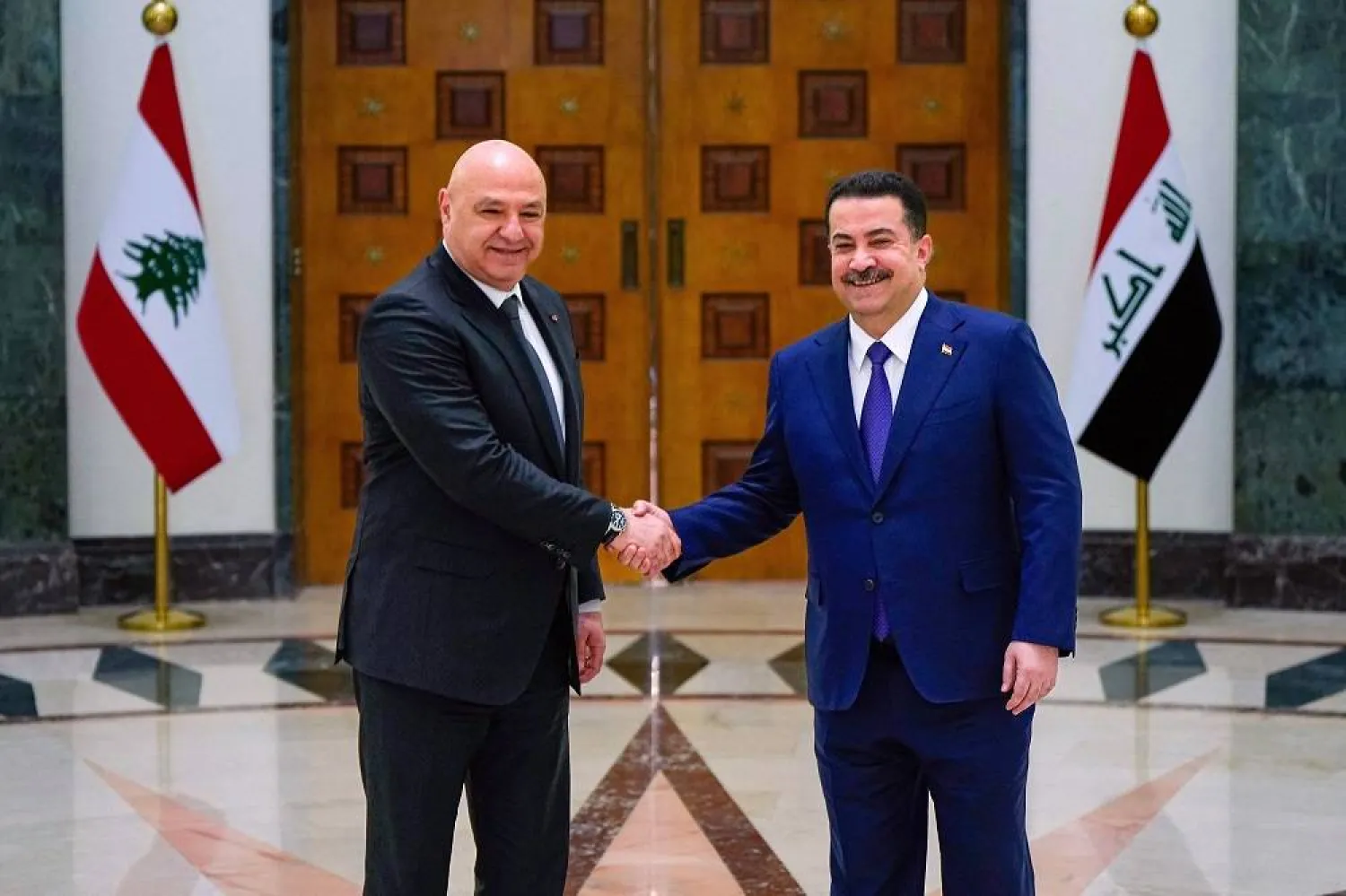
This handout pictured released the Iraq's Prime Minister's Media Office shows Prime Minister Mohammed Shia al-Sudani (R) meeting Lebanese President Joseph Aoun at the government palace in the Green Zone in Baghdad, on June 1, 2025. (Iraqi Prime Minister’s Press Office / Handout / AFP)
TT

Aoun’s Visit to Baghdad Eases Strained Ties between Lebanon, Iraq 

This handout pictured released the Iraq's Prime Minister's Media Office shows Prime Minister Mohammed Shia al-Sudani (R) meeting Lebanese President Joseph Aoun at the government palace in the Green Zone in Baghdad, on June 1, 2025. (Iraqi Prime Minister’s Press Office / Handout / AFP)

Lebanese President Joseph Aoun arrived in Baghdad on Sunday on an official visit for talks with top Iraqi officials.

Ties between Lebanon and Iraq had been strained over Aoun’s recent remarks about Iraq’s Popular Mobilization Forces (PMF). The president also did not attend the Arab League summit in Baghdad last month, with Prime Minister Nawaf Salam participating instead.

However, the reception accorded to Aoun on Sunday eased all tensions. He was warmly welcomed by Prime Minister Mohammed Shia al-Sudani at Baghdad International Airport and they later held bilateral talks.

At a press conference following their meeting, Aoun quoted Iraq’s top Shiite Authority Ali al-Sistani when speaking about the need for authorities to derive lessons from the past and to work on establishing a better future for the people.

This work should be based on practical plans for managing the country that are based on competency and integrity, away from foreign meddling and while keeping the possession of weapons limited to the state, he added.

Aoun expressed his gratitude to Sudani “for everything you have constantly offered Lebanon, such as aid in every field.”

“Every Lebanese person now truly believes that during each crisis, they can turn to Iraq that will come to Lebanon’s aid in actions, not just in words,” he stressed.

For his part, Sudani underlined the Iraqi government and people’s “keenness on supporting Lebanon and strengthening its state institutions.”

Iraq supports Lebanon’s unity, stability and territorial integrity, he added.

A statement from Sudani’s office said the leaders discussed bilateral ties and opportunities for cooperation between their countries in various fields. They also tackled regional developments.

Aoun expressed his gratitude for Iraq’s support to Lebanon, saying he was keen on expanding cooperation to meet the interests of the people in both countries.

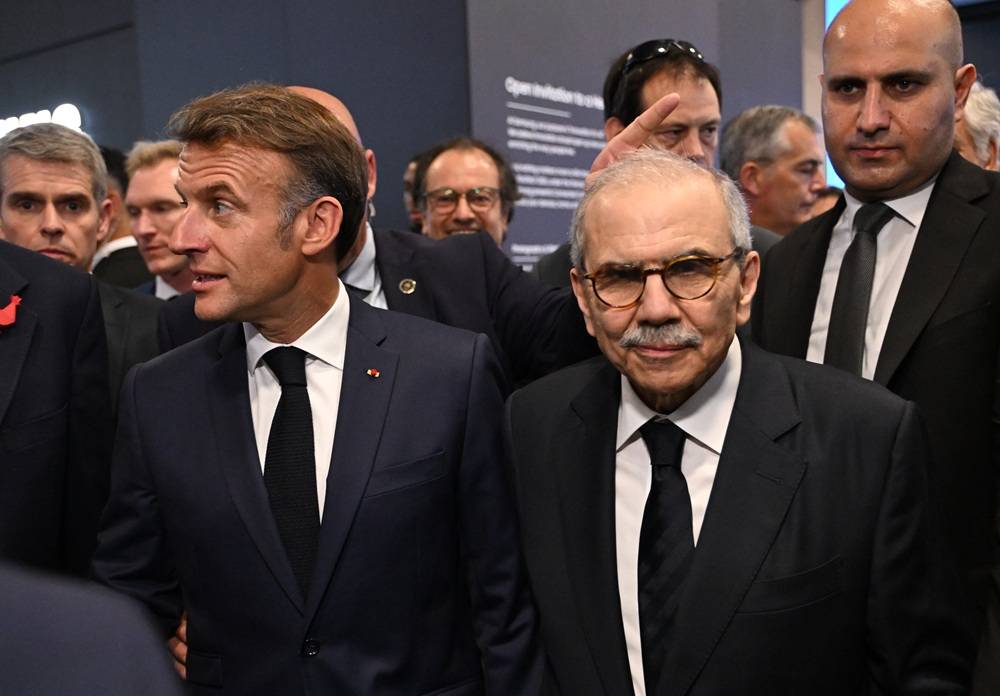
Aoun also held talks with Iraqi President Abdul Latif Rashid.

Aoun is expected to discuss with officials the possibility of Iraq continuing to provide Lebanon with fuel to operate power plants. They will also address security affairs and other issues.

In April, Aoun had declared that Lebanon will not replicate the PMF experience in Iraq in Lebanon as part of efforts to merge Hezbollah with the Lebanese army. Hezbollah will also not act as an independent unit inside the army.

His remarks had angered Baghdad, which stressed that the PMF is a military institution and part of Iraq's armed forces.

Iraq summoned Lebanon’s ambassador in Baghdad at the time to protest the statements.


Israeli Strike Kills Three in Gaza, Medics Say

 Members of civil defense personnel use a fire hose at the site of an Israeli airstrike on a car in the central Gaza Strip, April 23, 2026. (Reuters)
Members of civil defense personnel use a fire hose at the site of an Israeli airstrike on a car in the central Gaza Strip, April 23, 2026. (Reuters)
TT

Israeli Strike Kills Three in Gaza, Medics Say

 Members of civil defense personnel use a fire hose at the site of an Israeli airstrike on a car in the central Gaza Strip, April 23, 2026. (Reuters)
Members of civil defense personnel use a fire hose at the site of an Israeli airstrike on a car in the central Gaza Strip, April 23, 2026. (Reuters)

An Israeli strike killed at least three in Gaza on Friday, according to Palestinian health officials.

The strike hit a crowded area in Gaza City near an area where local police are stationed to guard a bank, said the medics and eyewitnesses.

Gaza's interior ministry said ‌that the strike ‌had killed two policemen and ‌wounded ⁠two others, in ⁠a statement on Friday.

Reuters has previously reported that Israel has heightened its attacks on Gaza's Hamas-run police force that the group has used to reestablish governance in the areas it controls ⁠in the strip.

It was not immediately ‌clear whether ‌any of Gaza's police force had been killed in ‌the attack.

The Israeli military did not ‌immediately respond to a request for comment on the incident.

Violence in Gaza has persisted despite the October 2025 ceasefire, with Israel conducting ‌near-daily attacks on Palestinians.

At least 790 Palestinians have been killed since ⁠the ceasefire ⁠deal took effect, according to local medics, while Israel says gunmen have killed four of its soldiers.

Israel and Hamas have exchanged blame for ceasefire violations.

More than 72,000 Gazans have been killed since the war started in October 2023, most of them civilians, according to Gaza health authorities.

Hamas' October 7, 2023, attacks on Israel killed 1,200 people, according to Israeli tallies.


UN Says Israeli Strikes in Lebanon, Hezbollah Rockets into Israel May Breach International Law

People carry the coffin of Lebanese journalist Amal Khalil during her funeral procession in the village of Baisariyah, southern Lebanon, 23 April 2026. (EPA)
TT

UN Says Israeli Strikes in Lebanon, Hezbollah Rockets into Israel May Breach International Law

People carry the coffin of Lebanese journalist Amal Khalil during her funeral procession in the village of Baisariyah, southern Lebanon, 23 April 2026. (EPA)

The UN human rights office said on Friday it has documented patterns of attacks on civilians in populated areas and residential buildings in Lebanon and Israel that may amount to serious violations of international humanitarian law.

The report covers the first three weeks of the latest escalation, which began after Hezbollah launched attacks on Israel on March 2, prompting Israel to respond with a large-scale military offensive.

Since then, nearly 2,500 people have been killed in Lebanon, according to Lebanese authorities, amid widespread displacement and heavy damage to civilian infrastructure. US President Donald Trump on Thursday announced a three-week extension to a ceasefire.

The Israeli military and Hezbollah did ‌not immediately respond to ‌Reuters requests for comment about the report.

RESIDENTIAL BUILDINGS STRUCK, OHCHR ‌SAYS

The ⁠Office of the ⁠United Nations High Commissioner for Human Rights documented several cases in which Israeli strikes hit, and in some instances destroyed, multi-storey residential buildings, killing entire families in Lebanon, which may constitute serious violations of international humanitarian law, OHCHR spokesperson Thameen Al-Kheetan said.

The report cited the example of an Israeli strike on March 8 that hit a multi-storey residential building in the town of Sir el-Gharbiyeh, in the Nabatiyeh governorate. The strike killed at least 13 civilians inside the building, ⁠including five women, five men, two boys and a girl.

The office ‌said incidents such as this raised concerns about compliance ‌with the principles of distinction, proportionality and precautions in attack under international humanitarian law.

The report also ‌said the OHCHR had found Hezbollah was firing unguided rockets that lacked the precision ‌required to strike specific military targets, and damaged buildings and other civilian infrastructure in Israel, which likely violated international humanitarian law.

While the office noted that notifications, including blanket evacuation warnings, had been issued by Israeli forces before some strikes in Lebanon, it identified cases in which warnings were either not given, were ‌ineffective, or prevented many civilians from evacuating safely.

WARNING AFTER JOURNALIST KILLED

Meanwhile, the OHCHR also said on Friday that attacks on journalists could ⁠amount to war ⁠crimes if they were deliberate.

An Israeli strike on Wednesday killed Lebanese journalist Amal Khalil and injured photographer Zeinab Faraj, who was accompanying her in southern Lebanon.

Rescue teams, including the Lebanese Red Cross, faced obstruction by the Israeli military when trying to reach them, Lebanon's health ministry said.

"This included the use of a sound grenade and live fire targeting an ambulance, delaying access to the site," Al-Kheetan added.

The Israeli military said the Israeli Air Force troops struck a vehicle and a structure after two vehicles in southern Lebanon were identified as leaving a Hezbollah military site, and crossed the Forward Defense Line, which posed an immediate threat.

It received reports that two journalists were injured, the army said, but it did not prevent rescue teams from reaching the area. The army does not deliberately target journalists or medical teams and the incident is under review, it added.


Unexploded Bombs Littering Gaza Threaten Recovery for Decades, UN Warns

Palestinians examine the destruction after an Israeli strike on a residential building in Rafah, Gaza Strip on March 3, 2024. © Hatem Ali, AP
TT

Unexploded Bombs Littering Gaza Threaten Recovery for Decades, UN Warns

Palestinians examine the destruction after an Israeli strike on a residential building in Rafah, Gaza Strip on March 3, 2024. © Hatem Ali, AP

War-torn Gaza is heavily contaminated by unexploded ordnance, which frequently kill and maim people and could threaten recovery efforts far into the future, the UN said Friday.

Unexploded ordnance, ranging from undetonated bombs or grenades to simple bullets, has become a common sight in the Gaza Strip since the start of Israel's war in the Palestinian territory, sparked by Hamas's unprecedented attack on October 7, 2023.

The United Nations Mine Action Service (UNMAS) said it had data suggesting that since the start of the conflict, more than 1,000 people had been killed in Gaza due to "indirect conflict", from the remnants of war, AFP reported.

Julius Van der Walt, UNMAS chief in the Occupied Palestinian Territory, stressed that that number was certainly a severe under-estimate.

Half of the known casualties were children, he told reporters in Geneva.

Speaking along side him at a press conference on mine action work worldwide, Narmina Strishenets of Save the Children UK, also highlighted the heavy toll on youngsters.

A report by the organization published last year found that in 2024, the use of explosive weapons in Gaza left an average of 475 children each month with potentially lifelong disabilities, including amputations.

Today, Strishenets said, Gaza has "the largest cohort of child amputees" in the world.

- 'High density' -

Van der Walt said UNMAS had so far been unable to conduct an extensive survey of the full scope of the problem, but "the evidence already suggests a high density of explosive ordnance contamination across the Gaza Strip".

So far, UNMAS had identified "more than 1,000 items of explosive ordnance", during missions conducted over the past 2.5 years.

Compared to Gaza's small geographic size, that means there is about one piece of explosive ordnance "every 600 metres", he pointed out.

And those are only the items that have been found.

"We have barely scratched the surface in understanding what is the level of contamination," he acknowledged.

Adding to the danger was Gaza's very high population density.

Prior to the conflict, Gaza was one already of the most densely-populated places on Earth, with around 6,000 people per square kilometre, Van der Walt said, pointing out that the war had effectively halved the space available, and doubled the density.

"Explosive weapons are being used all across the territories, including in densely-populated refugee camps," he said, pointing to a recent case where explosive ordnance was found inside a tent where people had been living for several weeks.

At the same time, "humanitarian convoys risk detonation as they travel throughout the Gaza Strip, and early recovery efforts are essentially stalled before they can even begin", he said.

- $541 million -

Van der Walt pointed to an assessment that, in a best case scenario, it will cost around $541 million to address the explosive ordnance threat, if all necessary permissions are granted and the equipment required is accessible.

He warned that the contamination, including within mountains of debris, was so vast and so varied, that it was "very close to impossible to ... do a full assessment", and that ordnance would likely remain a problem for decades to come.

He pointed to the World War II bombs that continue to be discovered during construction projects in Britain.

"We can anticipate something along those lines" in Gaza, he said.