


Sudan's Military Accepts UN Proposal of a Weeklong Ceasefire in El Fasher for Aid Distribution

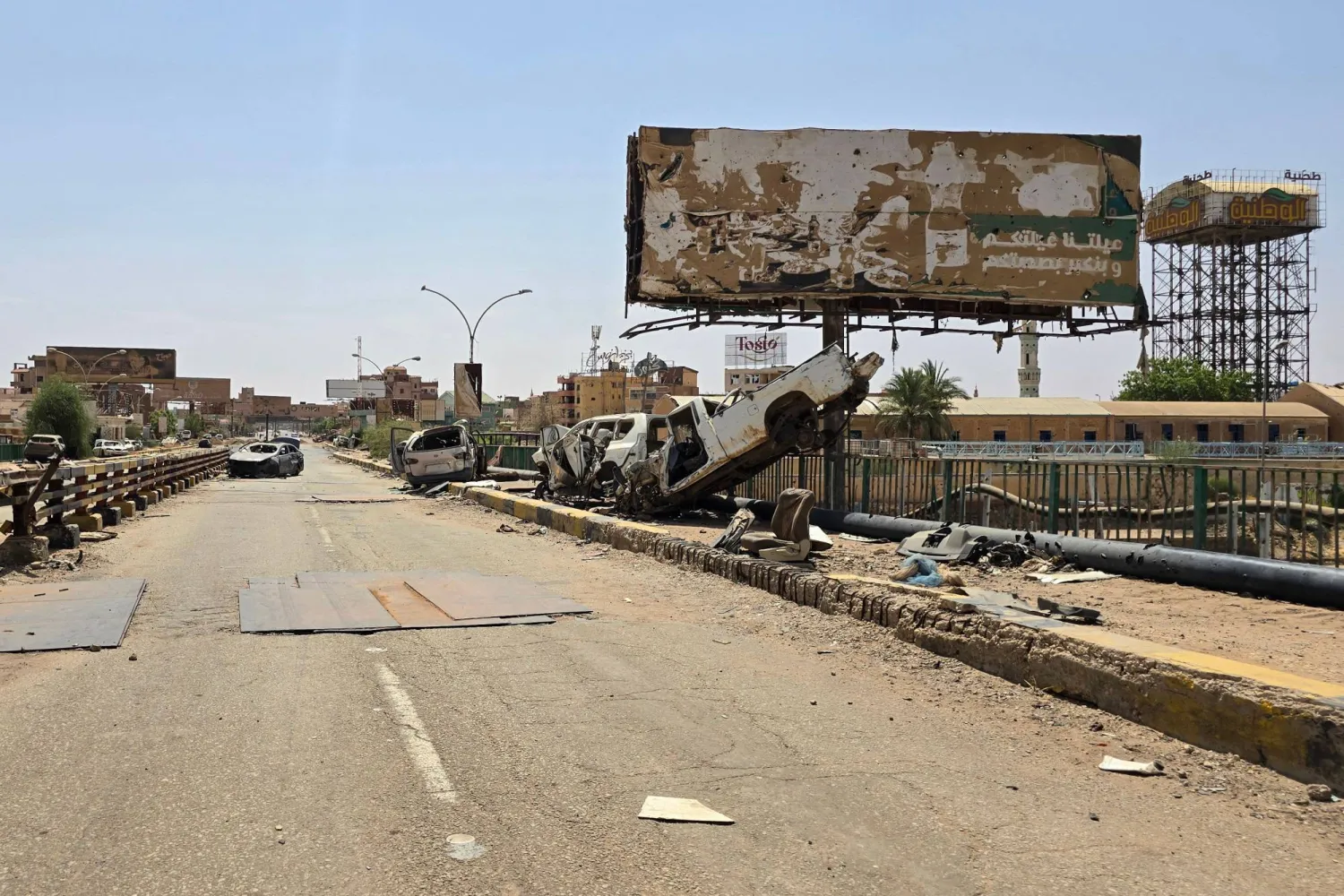
The wreckage of cars lie on the remains of the Shambat Bridge, which connects Omdurman and Bahri, on June 24, 2025 in the Sudanese capital region. (AFP)
TT

Sudan's Military Accepts UN Proposal of a Weeklong Ceasefire in El Fasher for Aid Distribution

The wreckage of cars lie on the remains of the Shambat Bridge, which connects Omdurman and Bahri, on June 24, 2025 in the Sudanese capital region. (AFP)

Sudan's military agreed to a proposal from the United Nations for a weeklong ceasefire in El Fasher to facilitate UN aid efforts to the area, the army said Friday.

UN Secretary-General António Guterres called Sudanese military leader Gen. Abdel-Fattah Burhan and asked him for the humanitarian truce in El Fasher, the capital of North Darfur province, to allow aid delivery.

Burhan agreed to the proposal and stressed the importance of implementing relevant UN Security Council resolutions, but it’s unknown whether the paramilitary Rapid Support Forces would agree and comply with the ceasefire.

“We are making contacts with both sides with that objective, and that was the fundamental reason for that phone contact. We have a dramatic situation in El Fasher,” Guterres told reporters on Friday.

No further details were revealed about the specifics of the ceasefire, including when it could go into effect.

Sudan plunged into war in April 2023 when simmering tensions between the Sudanese army and the rival RSF escalated into battles in the capital, Khartoum, and spread across the country, killing more than 20,000 people.

The war has also driven more than 14 million people from their homes and pushed parts of the country into famine. UNICEF said earlier this year that an estimated 61,800 children have been internally displaced since the war began.

Guterres said on Friday that a humanitarian truce is needed for effective aid distribution, and it must be agreed upon several days in advance to prepare for a large-scale delivery in the El Fasher area, which has seen repeated waves of violence recently.

El Fasher, more than 800 kilometers (500 miles) southwest of Khartoum, is under the control of the military. The RSF has been trying to capture El Fasher for a year to solidify its control over the entire Darfur region. The paramilitary’s attempts included launching repeated attacks on the city and two major famine-stricken displacement camps on its outskirts.



French FM Says Iran Must Stop Being ‘Destabilizing Power’

 French Minister for Europe and Foreign Affairs Jean-Noel Barrot holds a press conference at the Pine Residence, the official residence of the French ambassador to Lebanon, in Beirut, Lebanon February 6, 2026. (Reuters)
French Minister for Europe and Foreign Affairs Jean-Noel Barrot holds a press conference at the Pine Residence, the official residence of the French ambassador to Lebanon, in Beirut, Lebanon February 6, 2026. (Reuters)
TT

French FM Says Iran Must Stop Being ‘Destabilizing Power’

 French Minister for Europe and Foreign Affairs Jean-Noel Barrot holds a press conference at the Pine Residence, the official residence of the French ambassador to Lebanon, in Beirut, Lebanon February 6, 2026. (Reuters)
French Minister for Europe and Foreign Affairs Jean-Noel Barrot holds a press conference at the Pine Residence, the official residence of the French ambassador to Lebanon, in Beirut, Lebanon February 6, 2026. (Reuters)

French Foreign Minister Jean-Noel Barrot said during a visit to Lebanon that Iran should stop being a "destabilizing power", citing its nuclear program and support for "terrorist" groups that threaten regional and European countries.

During a press conference in Beirut, where the government has committed to disarming the Iran-backed Hezbollah group, Barrot also called on "groups supported by Iran" to exert "the utmost restraint" in the event of any military escalation involving the country.

In Lebanon, he met with President Joseph Aoun, Prime Minister Nawaf Salam, parliament Speaker Nabih Berri and FM Youssef Raggi.

Barrot had flown to Lebanon after stops in Iraq and Syria.


US Says ‘Key Participant’ in 2012 Attack on Benghazi Mission Arrested

Attorney General Pam Bondi, center, flanked by FBI Director Kash Patel, left, and Jeanine Pirro, US Attorney for the District of Columbia, appears before reporters at the Justice Department, Friday, Feb. 6, 2026, in Washington, to announce the capture of a key participant in the 2012 attack on a US compound that killed four Americans in Benghazi, Libya. (AP)
TT

US Says ‘Key Participant’ in 2012 Attack on Benghazi Mission Arrested

Attorney General Pam Bondi, center, flanked by FBI Director Kash Patel, left, and Jeanine Pirro, US Attorney for the District of Columbia, appears before reporters at the Justice Department, Friday, Feb. 6, 2026, in Washington, to announce the capture of a key participant in the 2012 attack on a US compound that killed four Americans in Benghazi, Libya. (AP)

One of the "key participants" behind the 2012 attack on the US mission in Benghazi that left the ambassador and three other Americans dead has been arrested, officials said Friday.

Attorney General Pam Bondi said the suspect, Zubayr al-Bakoush, has been brought to the United States and will face murder and other charges.

Speaking at a press conference, Bondi and FBI Director Kash Patel declined to say where Bakoush was arrested, saying only that it was "overseas."

"Bakoush will now face American justice on American soil," Bondi said. "We will prosecute this alleged terrorist to the fullest extent of the law. He'll face charges related to murder, terrorism, arson, among others."

Fox News broadcast what it said was exclusive footage of Bakoush's arrival at a military base in Virginia outside Washington.

In the footage, an elderly grey-haired man struggles to descend a flight of stairs from a plane and is then placed on a stretcher, where he lies shivering.

US ambassador Chris Stevens and three American staff were killed in the September 11, 2012 attack on the US consulate in Libya's second-largest city -- an assault blamed on an Al-Qaeda-linked group.

Militants armed with automatic weapons and grenades stormed the US compound at a time when the oil-rich North African country was torn by civil war.

They set the building ablaze, killing Stevens and IT specialist Sean Smith through smoke inhalation, and then also attacked a CIA annex where two contractors died, both former Navy SEALs.

The assault, the first to claim the life of an American ambassador since 1979, deeply shocked the United States and caused a political storm for then President Barack Obama's administration.

The State Department, then headed by Hillary Clinton, was accused by its political foes of deadly mistakes and negligence over the bloodshed, which came 11 years to the day after al-Qaeda's 9/11 attacks.

The United States has previously convicted at least two Libyans for involvement in the Benghazi attack.

Ahmed Abu Khatallah was sentenced to 22 years in prison in 2018 and Mustafa al-Imam was sentenced to nearly 20 years in 2020.


Hezbollah Accepts Resignation of Senior Security Official Wafiq Safa amid Restructuring

Lebanon’s Hezbollah members carry Hezbollah flags during the funeral of a fellow fighter, in al-Ghaziyeh village, southern Lebanon May 26, 2015. REUTERS/Ali Hashisho
TT

Hezbollah Accepts Resignation of Senior Security Official Wafiq Safa amid Restructuring

Lebanon’s Hezbollah members carry Hezbollah flags during the funeral of a fellow fighter, in al-Ghaziyeh village, southern Lebanon May 26, 2015. REUTERS/Ali Hashisho

Lebanon's Hezbollah accepted the resignation of senior security official Wafiq Safa on Friday, the first time an official of his rank has stepped down, sources familiar with the group's thinking told Reuters. 

Safa, who heads Hezbollah's liaison and coordination unit responsible for working with Lebanese security agencies, survived an Israeli assassination attempt in October 2024. 

A source said "the resignation and ‌its acceptance were ‌part of an internal restructuring ‌move" ⁠following losses ‌Hezbollah sustained in last year's war with Israel, adding that southern commander Hussein Abdullah was appointed to replace Safa. 

Israel and Lebanon agreed to a US-brokered ceasefire in 2024 to end more than a year of cross-border fire between Israel and Hezbollah, ⁠which had culminated in Israeli strikes that severely weakened the ‌Iran-backed group. Since then, the ‍sides have traded ‍accusations of ceasefire violations. 

Lebanon has faced growing ‍pressure from the US and Israel to disarm Hezbollah, and its leaders fear that Israel could dramatically escalate strikes across the battered country to push Lebanon's leaders to confiscate Hezbollah's arsenal more quickly. 

Hezbollah has fought numerous conflicts with Israel since ⁠it was founded by Iran's Revolutionary Guards in 1982. It kept its arms after the end of Lebanon's 1975-1990 civil war, using them against Israeli troops who occupied the South until 2000. 

Safa, whom Middle East media reports said was born in 1960, oversaw negotiations that led to a 2008 deal in which Hezbollah exchanged the bodies of Israeli soldiers captured in 2006 for Lebanese ‌prisoners in Israel. The 2006 incident triggered a 34-day war with Israel.