


Trump Signs Order Lifting Sanctions on Syria, White House Says

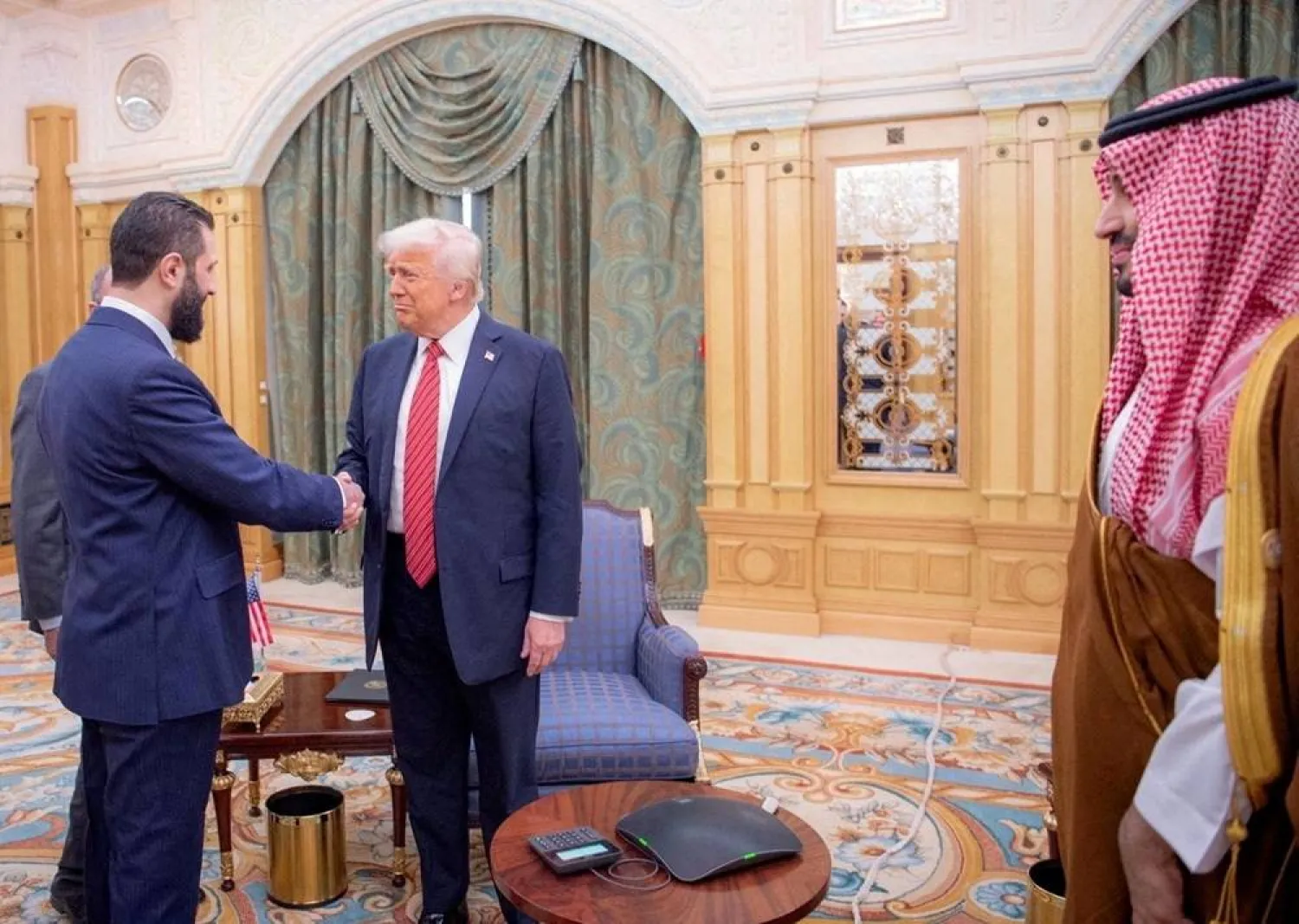
US President Donald Trump meets with Syrian President Ahmed al-Sharaa in Riyadh, Saudi Arabia, in this handout released on May 14, 2025. (SPA)
TT

Trump Signs Order Lifting Sanctions on Syria, White House Says

US President Donald Trump meets with Syrian President Ahmed al-Sharaa in Riyadh, Saudi Arabia, in this handout released on May 14, 2025. (SPA)

President Donald Trump signed on Monday an executive order terminating a US sanctions program on Syria, allowing an end to the country's isolation from the international financial system and building on Washington's pledge to help it rebuild after a devastating civil war.

The move will allow the US to maintain sanctions on Syria's ousted former president Bashar al-Assad, his associates, human rights abusers, drug traffickers, people linked to chemical weapons activities, the ISIS group and its affiliates and proxies for Iran, White House spokeswoman Karoline Leavitt told reporters in a briefing.

Assad was toppled in December in a lightning offensive by opposition factions and Syria has since taken steps to re-establish international ties.

Syrian Foreign Minister Asaad al-Shibani said Trump's termination of the Syria sanctions program would "open door of long-awaited reconstruction and development," according to a post by the foreign minister on social media platform X.

He said the move would "lift the obstacle" against economic recovery and open the country to the international community.

Syria's President Ahmed al-Sharaa and Trump met in Riyadh in May where, in a major policy shift, Trump unexpectedly announced he would lift US sanctions on Syria, prompting Washington to significantly ease its measures.

Some in Congress are pushing for the measures to be totally repealed, while Europe has announced the end of its economic sanctions regime.

"Syria needs to be given a chance, and that's what's happened," US Special Envoy for Syria Thomas Barrack told reporters in a briefing call. He described Monday's move as "the culmination of a very tedious, detailed, excruciating process of how do you unwrap these sanctions."

The White House in a fact sheet said the order directs the Secretary of State to review the terrorism designations of Hayat Tahrir al-Sham, a group that Sharaa led that has roots in al-Qaeda, as well as Syria's designation as a state sponsor of terrorism.

The White House said the administration would continue to monitor Syria's progress on key priorities including "taking concrete steps toward normalizing ties with Israel, addressing foreign terrorists, deporting Palestinian terrorists and banning Palestinian terrorist groups."

Syrians hope the easing of sanctions will clear the way for greater engagement by humanitarian organizations working in the country, encouraging foreign investment and trade as it rebuilds.

In the aftermath of Trump's announcement in May, the US Treasury Department issued a general license that authorized transactions involving the interim Syrian government as well as the central bank and state-owned enterprises.

However, the US has imposed layers of sanctions against Syria, some of which are authorized by legislation, including the Caesar Act. Repealing the measures is necessary for Syria to attract long-term investment without parties fearing the risk of violating US sanctions.

"We are now, pursuant to the executive order, going to look at suspension criteria for the Caesar Act," a senior administration official said.

Most of the US sanctions on Syria were imposed on Assad's government and key individuals in 2011 after civil war erupted in the country.

The dismantling of the US sanctions program on Syria includes terminating from Tuesday a national emergency declared in 2004 and revoking linked executive orders, according to the order signed on Monday.

The executive order also directs additional actions, including some with respect to waivers of export controls and other restrictions, the order read.


Türkiye Begins Black Box Analysis of Jet Crash That Killed Libyan Military Chief and 7 Others

Libyan national flags fly at half-mast in Tripoli on December 24, 2025, after the head of Libya's armed forces and his four aides died in a plane crash in Türkiye. (AFP)
TT

Türkiye Begins Black Box Analysis of Jet Crash That Killed Libyan Military Chief and 7 Others

Libyan national flags fly at half-mast in Tripoli on December 24, 2025, after the head of Libya's armed forces and his four aides died in a plane crash in Türkiye. (AFP)

The technical analysis of the recovered black boxes from a jet crash that killed eight people, including western Libya’s military chief, began as the investigation proceeded in cooperation with Libyan authorities, the Turkish Ministry of Defense said Thursday.

The private jet with Gen. Muhammad Ali Ahmad al-Haddad, four other military officials and three crew members crashed on Tuesday after taking off from Türkiye’s capital, Ankara, killing everyone on board. Libyan officials said the cause of the crash was a technical malfunction on the plane.

The high-level Libyan delegation was on its way back to Tripoli after holding defense talks in Ankara aimed at boosting military cooperation between the two countries.

The wreckage was scattered across an area covering 3 square kilometers (more than a square mile), complicating recovery efforts, according to the Turkish Interior Minister Ali Yerlikaya.

A 22-person delegation, including five family members, arrived from Libya early on Wednesday to assist in the investigation.


Lebanese President: We are Determined to Hold Parliamentary Elections on Time

President Joseph Aoun between Prime Minister Nawaf Salam and Speaker Nabih Berri (Lebanese Presidency file photo)
TT

Lebanese President: We are Determined to Hold Parliamentary Elections on Time

President Joseph Aoun between Prime Minister Nawaf Salam and Speaker Nabih Berri (Lebanese Presidency file photo)

Lebanese President Joseph Aoun reiterated on Thursday that the country’s parliamentary elections are a constitutional obligation that must be carried out on time.

Lebanon’s state-run National News Agency quoted Aoun as saying that he, alongside Prime Minister Nawaf Salam and Parliament Speaker Nabih Berri, is determined to hold the elections on schedule.

Aoun also emphasized that diplomatic efforts have continued unabated to keep the specter of war at bay, noting that "things are heading in a positive direction".

The agency also cited Berri reaffirming that the elections will take place as planned, with "no delays, no extensions".

The Lebanese parliamentary elections are scheduled for May next year.


Israel Calls Countries Condemning New West Bank Settlements ‘Morally Wrong’

Newly constructed buildings are pictured in the Israeli settlement of Givat Zeev near the Palestinian city of Ramallah in the occupied West Bank on October 24, 2025. (AFP)
TT

Israel Calls Countries Condemning New West Bank Settlements ‘Morally Wrong’

Newly constructed buildings are pictured in the Israeli settlement of Givat Zeev near the Palestinian city of Ramallah in the occupied West Bank on October 24, 2025. (AFP)

Israel reacted furiously on Thursday to a condemnation by 14 countries including France and Britain of its approval of new settlements in the occupied West Bank, calling the criticism discriminatory against Jews.

"Foreign governments will not restrict the right of Jews to live in the Land of Israel, and any such call is morally wrong and discriminatory against Jews," Foreign Minister Gideon Saar said.

"The cabinet decision to establish 11 new settlements and to formalize eight additional settlements is intended, among other things, to help address the security threats Israel is facing."

On Sunday, Israel's far-right Finance Minister Bezalel Smotrich announced that authorities had greenlit the settlements, saying the move was aimed at preventing the establishment of a Palestinian state.

Fourteen countries, including Britain, France, Germany, Spain and Canada, then issued a statement urging Israel to reverse its decision, "as well as the expansion of settlements".

Such unilateral actions, they said, "violate international law", and risk undermining a fragile ceasefire in Gaza in force since October 10.

They also reaffirmed their "unwavering commitment to a comprehensive, just and lasting peace based on the two-state solution... where two democratic states, Israel and Palestine, live side-by-side in peace and security".

Israel has occupied the West Bank following the 1967 Arab-Israeli war.

Excluding east Jerusalem, which was occupied and annexed by Israel in 1967, more than 500,000 Israelis live in the West Bank, along with about three million Palestinian residents.

Earlier this month, the United Nations said the expansion of Israeli settlements in the West Bank, all of which are illegal under international law, had reached its highest level since at least 2017.
