


Egypt Marks ‘June 30’ Anniversary Amid New Challenges

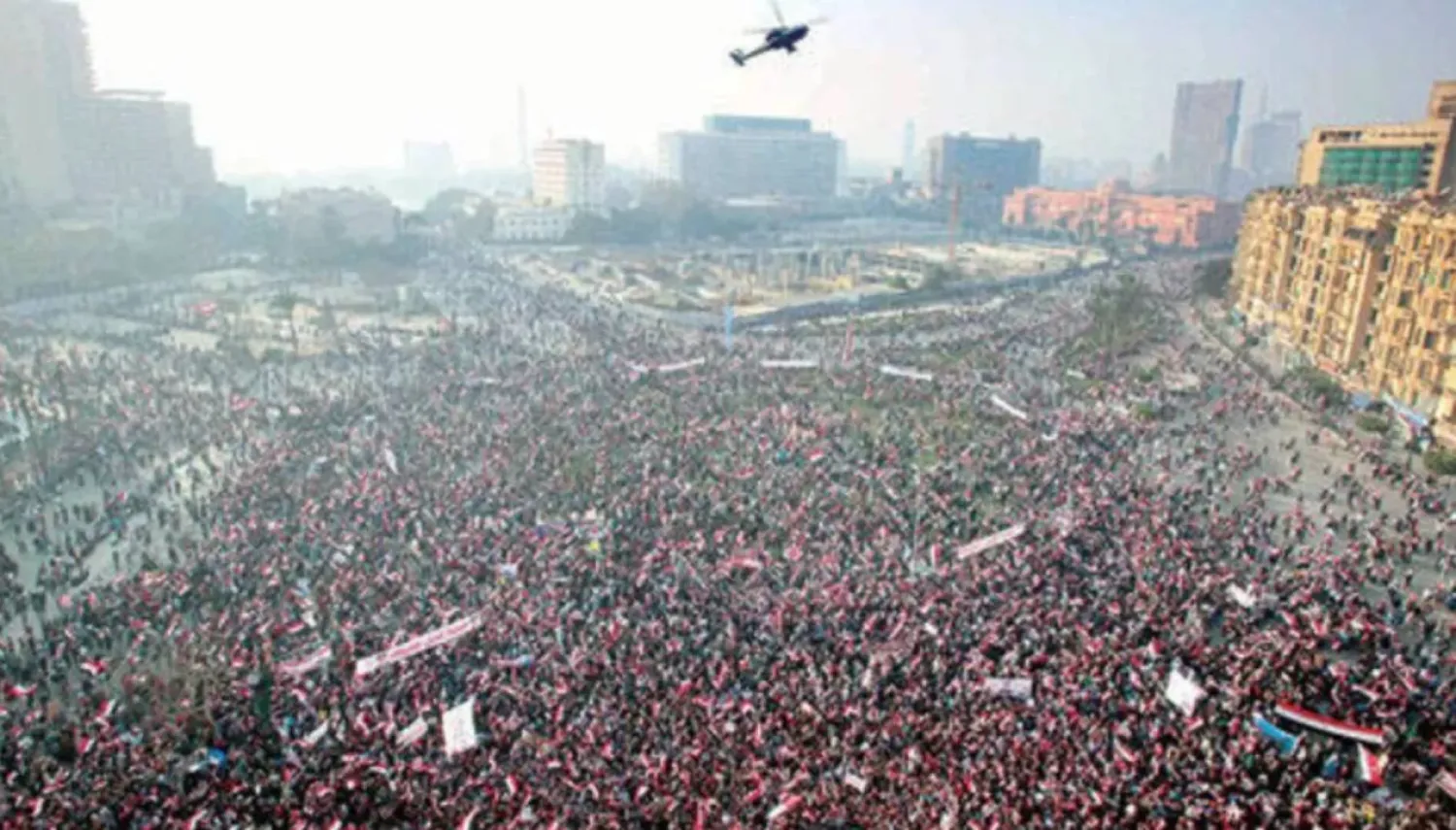
An Egyptian army helicopter flies over a pro-Sisi rally in Cairo's Tahrir Square in 2014 (EPA)
TT

Egypt Marks ‘June 30’ Anniversary Amid New Challenges

An Egyptian army helicopter flies over a pro-Sisi rally in Cairo's Tahrir Square in 2014 (EPA)

Egypt marked the 12th anniversary of the June 30 uprising on Monday with President Abdel Fattah el-Sisi vowing to press ahead with national development despite deepening economic strains and regional instability.

In a televised address, el-Sisi said the 2013 uprising, which ousted the Muslim Brotherhood from power, had thwarted chaos and terrorism, steering the country back onto what he called the “right path.”

“The revolution was a national epic that confronted terrorism and conspiracies, broke the waves of chaos, and foiled attempts at blackmail and abduction,” el-Sisi said. “It marked the beginning of our journey toward the New Republic.”

Egypt, he said, had “defeated terrorism, faced internal and external challenges, and embarked on comprehensive development to build a modern nation.”

But the president acknowledged that the road ahead remains difficult, citing “heavy burdens and enormous challenges” as the country grapples with high inflation, a weakening currency and the impact of global conflicts.

“The strength of Egypt lies not only in its weaponry, but in your awareness, your unity, and your rejection of division, despair and hatred,” Sisi told Egyptians. “You are the true shield and beating heart of this nation.”

El-Sisi also warned that this year’s anniversary comes at a time of escalating regional violence. “The entire region is burning—from Gaza to Sudan, Libya, Syria, Yemen and Somalia,” he said, urging warring parties and the international community to “heed the voice of reason” and work toward peace.

“Egypt has always been a supporter of peace,” el-Sisi added. “Peace is not born of bombing, nor imposed by force, nor achieved through normalization rejected by peoples.” He cited the Egypt-Israel peace deal of the 1970s, brokered by the United States, as a model for difficult but possible reconciliation.

Analysts speaking to Asharq Al-Awsat said Egypt faced “existential threats” in the aftermath of the 2013 events, and now confronts a new wave of challenges requiring bold reforms and swift action.

El-Sisi pledged to prioritize easing the burden on ordinary Egyptians, especially in the face of rising regional volatility.

“We do not bow, and we will not turn away from our aspirations,” he said. “This is Egypt—resilient in the face of challenges, built by the will of its people, and kept alive by their devotion.”

Twelve years after the mass protests that toppled the Muslim Brotherhood-backed government, Egypt is grappling with fresh economic and geopolitical headwinds that are testing the country's resilience and reform agenda.

The June 30, 2013 uprising ended the presidency of Mohamed Morsi - Egypt’s first elected Islamist leader - after just one year in power. Millions took to the streets demanding his removal, accusing the Brotherhood of consolidating power and mismanaging the country.

Morsi and senior Brotherhood leaders were later jailed on charges including espionage, incitement and violence. The group was outlawed and designated a terrorist organization by Egyptian authorities.

The aftermath of the Brotherhood’s fall brought a raft of challenges. Egypt faced international criticism, deteriorating ties with several countries, and a suspension of its African Union membership. Domestically, the country was rocked by a wave of militant attacks, particularly in the restive North Sinai region.

But over time, Egypt managed to stabilize both its security and foreign relations. Ties with regional rivals such as Türkiye and Qatar were restored, and strategic partnerships were expanded with the European Union, the United States, Russia, and China. At home, authorities declared terrorism in Sinai had been defeated and launched long-term development projects in the peninsula.

Still, new challenges are emerging. The ongoing Gaza war and its fallout have heightened regional instability, triggering tensions in the Red Sea that have severely hit Suez Canal revenues, a vital source of hard currency. According to government figures, canal earnings have dropped by 61% in recent months, exacerbating Egypt’s economic crisis, marked by soaring inflation and a weakened currency.

“Over the past 12 years, Egypt has overcome the post-June 30 turmoil, most notably terrorism, and maintained its stability in an increasingly volatile region,” said Abdel Moneim Said, a member of Egypt’s Senate. “The Brotherhood has lost ground in Egyptian society. Their presence is now largely confined to online voices with no political influence.”

Egypt’s years-long military campaign in North Sinai was described by el-Sisi in 2022 as “the first line of defense” for the nation. In 2023, Sisi announced the state had succeeded in preventing the region from becoming a permanent hub for terrorism, and pledged continued investment in its development.

Amr El-Shobaki, a senior political analyst at Al-Ahram Center for Political and Strategic Studies, said Egypt had faced “existential threats” in the immediate aftermath of the uprising. “Cairo successfully contained the threat of terrorism, which at one point endangered the capital and other key cities,” he said.

However, El-Shobaki warned of a shifting landscape. “The country is now facing pressing economic challenges - rising prices, inflation, and lack of clear priorities,” he said, referencing public backlash over a recent high-profile incident in Monufia involving teenage girls, which sparked widespread criticism of government performance, weak political opposition, and state media’s limited crisis coverage.

Still, Senator Said described such scrutiny as “normal and healthy,” saying criticism of government oversight and parliamentary accountability was a sign of a functioning public discourse.

As Egypt looks ahead, analysts say the country must balance its security gains with urgent reforms to restore economic confidence and manage public expectations in a turbulent region.

Egypt’s government came under fire following a deadly road crash that killed 19 schoolgirls and injured three others in Monufia province, north of Cairo, just days ahead of the June 30 anniversary. The incident sparked public outrage and renewed parliamentary calls for accountability, further highlighting concerns over government performance, priorities, and political opposition.

The accident, which took place on the Regional Ring Road last Friday, prompted several members of parliament to demand the dismissal of officials. The criticism underscored what lawmakers and analysts say is a deeper issue of weak governance, bureaucratic inefficiency, and lack of clear national priorities.

Senator Said said Egypt’s current challenge lies in “harnessing talent, encouraging investment, completing economic reforms, and dismantling bureaucracy.” He expressed cautious optimism, pointing to positive indicators such as declining birth rates and rising remittances from Egyptians abroad.

El-Shobaki said Egypt had already overcome existential threats in the past, but now faces a different kind of test: institutional reform and political renewal.

“Today’s challenge is reforming the institutions that were once under threat,” he said. “Addressing the economic crisis requires serious reform at both institutional and political levels.”

In response to mounting economic pressures - worsened by global crises and regional instability - Egypt has pursued a series of policy shifts aimed at attracting foreign investment and boosting private sector participation. The Egyptian pound has fallen steeply in recent months, trading above 50 to the dollar in unofficial markets. Officially, the rate stands at 49.6 pounds per dollar.

Cairo also secured an $8 billion loan agreement with the International Monetary Fund (IMF), tied to a sweeping economic reform plan that includes reducing the state's role in the economy and divesting from certain sectors.

But experts warn that reforms must go deeper to yield tangible results.

“The main challenge today is economic,” said economist Mostafa Badra. “With inflation rising and prices soaring, Egypt must improve the pound’s value by attracting investment, increasing exports, and building a stronger industrial base.”

He cautioned that relying on the sale of state assets without building a sustainable industrial sector “will not solve the crisis.”

Former Deputy Prime Minister and political economist Ziad Bahaa-Eldin has repeatedly urged the government to adopt a long-term economic strategy. He has also highlighted the unresolved question of the state’s role in the economy, which continues to fuel debate among economists and policymakers.

As Egypt marks over a decade since the Brotherhood's fall, analysts say the focus must now shift from security victories to structural reforms if the country is to regain economic stability and rebuild public trust.



Maliki Can Withdraw as Candidacy as Iraq PM the Easy or Hard Way

Members of the Coordination Framework hold a meeting. (Iraqi News Agency)
TT

Maliki Can Withdraw as Candidacy as Iraq PM the Easy or Hard Way

Members of the Coordination Framework hold a meeting. (Iraqi News Agency)

Iraqi Former Prime Minister Nouri al-Maliki declined at the last minute to attend a meeting of the pro-Iran Coordination Framework on Monday night that was aimed at settling the crisis over his nomination as prime minister.

Instead of declaring that he was pulling out as candidate, as had been expected, Maliki informed his close circle that he is “following through with his nomination to the end,” trusted sources told Asharq Al-Awsat.

Iraq has come under intense pressure from the US to withdraw the nomination. In January, President Donald Trump warned Baghdad against picking Maliki as its PM, saying the United States would no longer help the country.

“Last time Maliki was in power, the Country descended into poverty and total chaos. That should not be allowed to happen again. Because of his insane policies and ideologies, if elected, the United States of America will no longer help Iraq,” Trump wrote on Truth Social.

Maliki also dismissed as “extortion and intimidation” talks of renewed US sanctions on Iraq, added the sources.

However, circles within the Coordination Framework have started to “despair” with the impasse over naming a new prime minister and are weighing the possibility of taking “difficult” choices, they revealed. Maliki has become a prisoner of his own nomination.

The Sunni Progress Party (Takadum) had voiced its reservations over Maliki’s nomination before Trump made his position clear and which has since weighed heavily on Iraq.

‘Indefinitely’

Maliki’s decision to skip the Framework’s meeting on Monday forced the coalition to postpone it “indefinitely”, exposing more differences inside the alliance that have been festering for months. The dispute over the post of prime minister is threatening to evolve into one that threatens the unity of the coalition itself.

Several sources told Asharq Al-Awsat that Maliki had sent the Framework a written message on Monday night informing them that he will not attend the meeting because “he was aware that discussions will seek to pressure him to withdraw his candidacy.”

Maliki was the one to call for the meeting to convene in the first place, they revealed.

Reports have been rife in Iraq that Shiite, Sunni and Kurdish political leaderships have all received warnings that the US would take measure against Iraq if Maliki continued to insist on his nomination.

Former Foreign Minister Hoshyar Zebari told Dijlah TV that “Shiite parties” had received two new American messages reiterating the rejection of Maliki’s nomination.

Necessary choice

Maliki and the Framework are now at an impasse, with the latter hoping the former PM would take it upon himself to withdraw his candidacy in what a leading Shiite figure said would help protect the unity of the coalition.

Leading members of the coalition were hoping to give Maliki enough time to decide himself to withdraw, but as time stretches on, the coalition may take matters into its own hands and take “necessary” choices, said the figure.

Other sources revealed, however, that Maliki refuses to voluntarily withdraw from the race believing that this is a responsibility that should be shouldered by the Framework. This has effectively left the alliance with complex and limited choices to end the crisis.

Sources close to Maliki said he has made light of US threats to impose sanctions, saying that if they were to happen, Iraq will emerge on the other side stronger, citing other countries that came out stronger after enduring years of pressure.

Moreover, he is banking on an American change in position, saying mediators have volunteered to “polish his image before Trump and his team.” Members of Maliki’s State of Law coalition declined to comment on this information.

Sources inside the Framework said the coalition may “ultimately withdraw Maliki’s nomination if he becomes too much of a burden on an already weary alliance.”

Doing so may cost them a strong ally in Maliki and force the Framework to yield to Washington’s will, said the Shiite figure. “Maliki may come off as stubborn and strong, but he is wasting his realistic options at this critical political juncture,” it added.

The Framework is divided between a team that is banking on waiting to see how the US-Iran tensions will play out to resolve the crisis and on Maliki voluntarily withdrawing his nomination. The other team is calling for the coalition to resolve the crisis through an internal vote.

Leading Shiite figures told Asharq Al-Awsat that opponents of Maliki’s nomination in the coalition have no choice but to apply internal pressure inside the Framework, which is on the verge of collapse.


Australia Bars Citizen Held in Syria’s Roj Camp from Returning Home

Members of Australian families believed to be linked to ISIS leave Roj camp near Derik, Syria February 16, 2026. REUTERS/Orhan Qereman
TT

Australia Bars Citizen Held in Syria’s Roj Camp from Returning Home

Members of Australian families believed to be linked to ISIS leave Roj camp near Derik, Syria February 16, 2026. REUTERS/Orhan Qereman

Australia has barred one of its citizens from returning home from a Syrian detention camp because of security concerns, the government said Wednesday.

The unidentified person is among a group of 34 Australian women and children at the Roj camp related to suspected members of ISIS.

"I can confirm that one individual in this cohort has been issued a temporary exclusion order, which was made on advice from security agencies," Home Affairs Minister Tony Burke said in a statement sent to AFP.

"At this stage security agencies have not provided advice that other members of the cohort meet the required legal thresholds for temporary exclusion orders."

The minister can make temporary exclusion orders lasting up to two years to prevent terrorist activities or politically motivated violence.

The Australians were released from the camp on Monday but failed to reach the capital Damascus on their way home, a Kurdish official told AFP in Syria.

The official said they were turned back to the detention camp, citing "poor coordination" with the Syrian authorities.

Prime Minister Anthony Albanese underscored his government's refusal to help repatriate the women and children.

"You make your bed, you lie in it," he said, accusing the group of aligning with an ideology that seeks to "undermine and destroy our way of life".

"We are doing nothing to repatriate or to assist these people," he told reporters Wednesday.

"I think it's unfortunate that children are caught up in this. That's not their decision but it's the decision of their parents or their mother."

The humanitarian organization Save the Children Australia filed a lawsuit in 2023 on behalf of 11 women and 20 children in Syria, seeking their repatriation.

But the Federal Court ruled against Save the Children, saying the Australian government did not control their detention in Syria.


Saudi Intervention Ends Socotra Power Crisis

Socotra power generators restarted after Saudi intervention (X)
TT

Saudi Intervention Ends Socotra Power Crisis

Socotra power generators restarted after Saudi intervention (X)

Electricity has returned to Yemen’s Socotra archipelago after urgent Saudi intervention ended days of outages that disrupted daily life and crippled vital institutions, including the general hospital, the university and the technical institute.

The breakthrough followed a sudden shutdown of the power plants after the operating company withdrew and disabled control systems, triggering widespread blackouts and deepening hardship for residents.

The Saudi Program for the Development and Reconstruction of Yemen said its engineering and technical teams moved immediately after receiving an appeal from local authorities. Specialists were dispatched to reactivate operating systems that had been encrypted before the company left the island.

Generators were brought back online in stages, restoring electricity across most of the governorate within a short time.

The restart eased intense pressure on the grid, which had faced rising demand in recent weeks after a complete halt in generation.

Health and education facilities were among the worst affected. Some medical departments scaled back services, while parts of the education sector were partially suspended as classrooms and laboratories were left without power.

Socotra’s electricity authority said the crisis began when the former operator installed shutdown timers and password protections on control systems, preventing local teams from restarting the stations. Officials noted that the archipelago faced a similar situation in 2018, which was resolved through official intervention.

Local sources said the return of electricity quickly stabilized basic services. Water networks resumed regular operations, telecommunications improved, and commercial activity began to recover after a period of economic disruption linked to the outages.

Health and education rebound

In the health sector, stable power, combined with operational support, secured the functioning of Socotra General Hospital, the archipelago’s main medical facility.

Funding helped provide fuel and medical supplies and support healthcare staff, strengthening the hospital’s ability to receive patients and reducing the need to transfer cases outside the governorate, a burden that had weighed heavily on residents.

Medical sources said critical departments, including intensive care units and operating rooms, resumed normal operations after relying on limited emergency measures.

In education, classes and academic activities resumed at Socotra University and the technical institute after weeks of disruption.

A support initiative covered operational costs, including academic staff salaries and essential expenses, helping curb absenteeism and restore the academic schedule.

Local authorities announced that studies at the technical institute would officially restart on Monday, a move seen as a sign of gradual stabilization in public services.

Observers say sustained technical and operational support will be key to safeguarding electricity supply and preventing a repeat of the crisis in a region that depends almost entirely on power to run its vital sectors.