

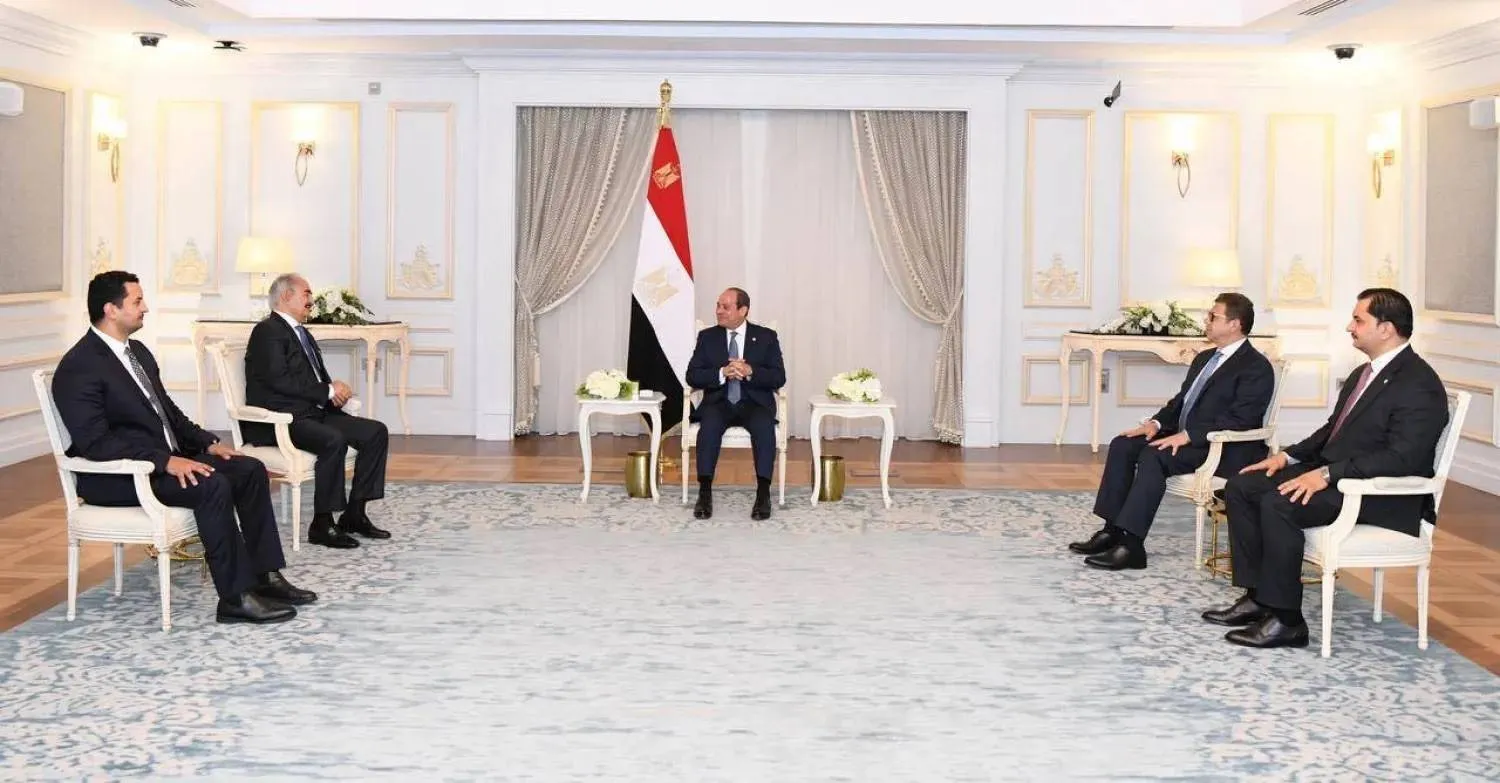

Sisi Calls for Coordination between Libyan Parties to Set Roadmap

Sisi meets Haftar and his sons Saddam and Khalid in the presence of the head of the Egyptian General Intelligence. (Egyptian Presidency)
TT

Sisi Calls for Coordination between Libyan Parties to Set Roadmap

Sisi meets Haftar and his sons Saddam and Khalid in the presence of the head of the Egyptian General Intelligence. (Egyptian Presidency)

Egyptian President Abdel Fattah el-Sisi has called for increased coordination among Libyan factions to establish a clear political roadmap aimed at resolving the ongoing crisis.

This came during his meeting on Monday with Field Marshal Khalifa Haftar, commander of Libya’s National Army, in the new city of Al-Alamein on Egypt’s northwestern coast. Major General Hassan Rashad, also attended.

The talks focused on several pressing issues, including foreign interference in Libya, the stalled political roadmap, and the disruption of general elections. Both sides stressed the importance of stabilizing Libya, with Egypt stressing that Libya’s security is integral to its own national security. According to Egyptian presidential spokesperson Ambassador Mohamed El-Shenawy, Egypt is fully committed to supporting Libyan efforts to maintain unity, sovereignty, and to resume development.

Sisi also highlighted the necessity of preserving the unity and cohesion of Libya’s state institutions and stressed the need for all parties to coordinate in order to create a comprehensive political roadmap that would pave the way for simultaneous presidential and parliamentary elections.

Libyan political analyst Youssef Hosseini noted that this visit coincides with three major regional shifts: the end of the Iran-Israel conflict and attempts to reshape the regional order, unprecedented security deterioration in western Libya with fears of expanded militia warfare, and escalating economic tensions over Eastern Mediterranean water rights amid disputes between Türkiye, Greece, and Egypt. Libya firmly rejects Greek offshore drilling near Crete, reaffirming its sovereign rights in the region.

The Egyptian presidency also underscored the importance of confronting foreign interventions and called for the withdrawal of all foreign forces and mercenaries from Libya. It praised the Libyan army’s national role in combating terrorism, especially in eastern Libya.

A Libyan academic, speaking anonymously, described the meeting as crucial amid intense international rivalry over Libya, emphasizing the need for Egypt to play a greater role in supporting Libya’s security institutions and unifying its military forces.

Haftar, for his part, expressed deep appreciation for Egypt’s pivotal role in restoring Libya’s security and stability, praising its longstanding support for the Libyan people and efforts to share developmental expertise through Egyptian companies.

His visit follows a meeting with Sisi six months ago, focusing on key principles for a secure transition in Libya.

Meanwhile, the UN advisory committee overseeing Libya’s transition has proposed four potential political roadmaps: holding presidential and legislative elections within two years; electing a bicameral legislature within two years; adopting a constitution before elections, which includes reviewing the controversial 2017 draft; or activating a dialogue mechanism to replace current political bodies with a constituent assembly chosen through consensus.



Syrian Leader Announces Support for Lebanese Counterpart to Disarm Hezbollah

Syrian President Ahmed al-Sharaa attends the Ministry of Awqaf conference titled "Unity of Islamic Discourse" at the Conference Palace in Damascus, Syria, February 16, 2026. (Reuters)
TT

Syrian Leader Announces Support for Lebanese Counterpart to Disarm Hezbollah

Syrian President Ahmed al-Sharaa attends the Ministry of Awqaf conference titled "Unity of Islamic Discourse" at the Conference Palace in Damascus, Syria, February 16, 2026. (Reuters)

Syrian President Ahmed al-Sharaa on Monday declared his support for his Lebanese counterpart Joseph Aoun in the latter's effort to disarm Hezbollah, state media reported.

The Middle East war expanded to Lebanon on March 2, after Tehran-backed Hezbollah fired rockets towards Israel in response to the killing of Iranian supreme leader Ali Khamenei on the first day of US-Israeli attacks on Iran, prompting Israeli retaliation.

Since March 2, Israel has been conducting large-scale air raids on Lebanon and incursions with ground troops, killing at least 486 people according to the Lebanese health ministry.

"We stand alongside Lebanese president Joseph Aoun in disarming Hezbollah," Sharaa said during a video conference with top European officials.

The Syrian army has bolstered its troop deployments on the country's borders with Lebanon and Iraq, a Syrian government source told AFP on Wednesday.

"We have reinforced our defensive forces along the border as a precaution to prevent the repercussions of the conflict from spilling over onto Syrian territory, and to combat cross-border organizations and prevent them from using Syrian soil," Sharaa said.

On Monday, Aoun accused Hezbollah of seeking the "collapse" of the Lebanese state with its decision to launch rockets towards Israel.

Iran-backed Hezbollah was a prominent ally of former Syrian president Bashar al-Assad, sending forces to help him in the civil war.

His brutal rule was brought to an end in December 2024 and he was replaced by new authorities hostile to Hezbollah.


Lebanese President Lashes Out at Hezbollah, Says Open to Negotiations with Israel

Members of the Lebanese Civil Defense inspect a damaged building after an Israeli strike on Beirut's southern suburbs, following renewed hostilities between Hezbollah and Israel amid the US-Israeli conflict with Iran, Lebanon, March 9, 2026. (Reuters)
TT

Lebanese President Lashes Out at Hezbollah, Says Open to Negotiations with Israel

Members of the Lebanese Civil Defense inspect a damaged building after an Israeli strike on Beirut's southern suburbs, following renewed hostilities between Hezbollah and Israel amid the US-Israeli conflict with Iran, Lebanon, March 9, 2026. (Reuters)

Lebanese President Joseph Aoun on Monday accused Hezbollah of working towards the "collapse" of the state, after the pro-Iran group launched an attack on Israel, expressing Beirut's readiness for "direct negotiations" with Israel. 

Begun after Hezbollah launched rockets towards Israel a week ago, Israel's bombing campaign has killed at least 394 people and displaced more than half a million. 

"Whoever launched those missiles wanted to bring about the collapse of the Lebanese state, plunging it into aggression and chaos... all for the sake of the Iranian regime's calculations and this is what we have thwarted so far and what we will continue working to bring down and foil," Aoun told top European officials in an online meeting. 

He added that the party's rocket launches "were an almost transparent trap and ambush for Lebanon, the Lebanese state, and the Lebanese people". 

To stop the war, the Lebanese president proposed a four-point initiative and called on the international community to help implement it. 

It included "establishing a full truce" with Israel, "logistical support" for the army to disarm Hezbollah, and "direct negotiations (with Israel) under international auspices". 

The EU's top diplomat called for a 2024 ceasefire to be upheld to prevent Lebanon from "sliding into chaos," saying Israel's "heavy-handed" response to Hezbollah attacks was further destabilizing the region.  

"Israel should cease its operations in Lebanon," EU foreign policy chief Kaja Kallas said in a statement after crisis talks with a dozen Middle East leaders including Aoun.  

She likewise called for Hezbollah to "disarm and cease all actions against Israel," saying: "Diplomacy and a return to the ceasefire offer the best chance of averting Lebanon from sliding into chaos." 


Israel Says Killed Head of Hezbollah Unit in South Lebanon

This photograph taken during a media tour organized by the Hezbollah shows a man installing a flag of Hezbollah on the balcony of a damaged building at Nabi Sheet town after an Israeli military operation in the Bekaa Valley of Lebanon, on March 7, 2026.  (Photo by FADEL itani / AFP)
This photograph taken during a media tour organized by the Hezbollah shows a man installing a flag of Hezbollah on the balcony of a damaged building at Nabi Sheet town after an Israeli military operation in the Bekaa Valley of Lebanon, on March 7, 2026. (Photo by FADEL itani / AFP)
TT

Israel Says Killed Head of Hezbollah Unit in South Lebanon

This photograph taken during a media tour organized by the Hezbollah shows a man installing a flag of Hezbollah on the balcony of a damaged building at Nabi Sheet town after an Israeli military operation in the Bekaa Valley of Lebanon, on March 7, 2026.  (Photo by FADEL itani / AFP)
This photograph taken during a media tour organized by the Hezbollah shows a man installing a flag of Hezbollah on the balcony of a damaged building at Nabi Sheet town after an Israeli military operation in the Bekaa Valley of Lebanon, on March 7, 2026. (Photo by FADEL itani / AFP)

Israel announced on Monday that its military had killed the head of Hezbollah's Nasr unit operating in part of southern Lebanon during renewed fighting with the Iran-backed armed group.

Defense minister Israel Katz "was briefed on the elimination of the commander of Hezbollah's Nasr Unit", Abu Hussein Ragheb, during an overnight strike, a statement from the defence ministry said, Reuters reported.

The Nasr unit operates in an eastern sector south of Lebanon's Litani River and opened Hezbollah's cross-border attacks on Israel following Hamas's attack in October 2023.