


Lebanese President Acknowledges ‘Slow Progress’ in Talks with Hezbollah on Disarmament

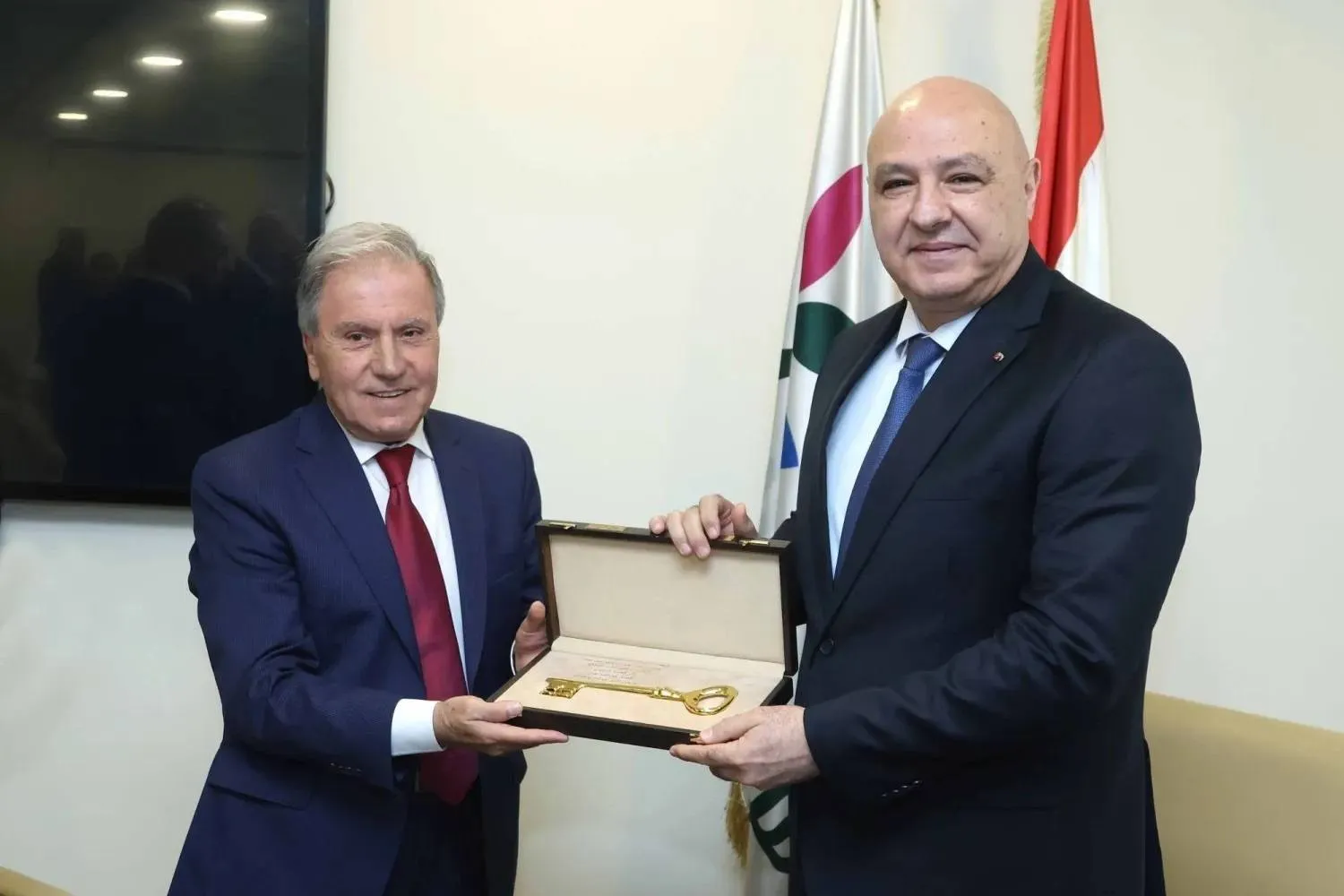
Aoun receives the key to the area of Sin al-Fil, where he lived before his election. (Lebanese Presidency)
TT

Lebanese President Acknowledges ‘Slow Progress’ in Talks with Hezbollah on Disarmament

Aoun receives the key to the area of Sin al-Fil, where he lived before his election. (Lebanese Presidency)

Lebanese President Joseph Aoun acknowledged on Friday that negotiations with Hezbollah over its weapons are ongoing, though progressing slowly.

Speaking amid heightened tensions along the southern border with Israel, Aoun emphasized that dialogue is being conducted directly with Hezbollah, not through a formal security committee, and expressed cautious optimism over a gradual breakthrough.

“There is some responsiveness to the ideas we’re discussing, even if things are moving at a slow pace,” said Aoun, stressing that neither party desires war, which would carry severe consequences for all sides.

His remarks come as Hezbollah issued its first public response to the recent visit by US envoy Tom Barrack, rejecting the American proposal focused on centralizing arms under the Lebanese state.

Hezbollah insisted it is only concerned with implementing UN Resolution 1701, which calls for Israel’s withdrawal from Lebanese territory and a cessation of hostilities.

Aoun reiterated Lebanon’s demand for Israel to adhere to the ceasefire agreement and withdraw from the remaining five occupied hills in the south, noting that full army deployment remains hindered in areas still under Israeli control.

During his visit to Beirut this week, Barrack pushed for a “monopoly of arms” by the Lebanese state, declaring that the US will only support Lebanon if its government commits to ensuring that only official forces carry weapons.

In a statement, he reinforced that Hezbollah, in its entirety, is viewed by Washington as a foreign terrorist organization, with no distinction between its political and military wings.

He added that the responsibility now lies with Lebanon’s political leadership and army to seize this opportunity and build a future free of Hezbollah’s grip.

Hezbollah MP Ihab Hamadeh dismissed the American initiative, affirming that the group is aligned with the stance of parliament and ally Speaker Nabih Berri and will only engage within the framework of Resolution 1701.

He acknowledged a general agreement on the principle of state monopoly over arms, but argued that this must be accompanied by a comprehensive national defense strategy, especially in light of ongoing Israeli attacks.

Meanwhile, Israeli airstrikes have intensified, targeting South Lebanon throughout the week. On Friday, an Israeli drone strike killed a Hezbollah member in Bint Jbeil, while other raids reportedly hit weapons depots and rocket launch sites. Tensions escalated further when an Israeli soldier shot a Lebanese civilian near the border.

In response to repeated attacks, residents of the border town Aita al-Shaab issued a strongly worded statement condemning the government’s inaction and warning that they may resort to self-defense.

“Security is not a luxury; it is our right,” the statement read.


‘Shockingly High’ Number of Gaza Children Still Acutely Malnourished After Truce, UN Says 

Displaced Palestinian students attend class at a tent school in the Tal Al-Hawa neighborhood in Gaza City, Gaza Strip, 09 December 2025. (EPA)
TT

‘Shockingly High’ Number of Gaza Children Still Acutely Malnourished After Truce, UN Says 

Displaced Palestinian students attend class at a tent school in the Tal Al-Hawa neighborhood in Gaza City, Gaza Strip, 09 December 2025. (EPA)

Thousands of children have been admitted for treatment for acute malnutrition in Gaza since an October ceasefire that was supposed to enable a major increase in humanitarian aid, the UN children's agency said on Tuesday.

UNICEF, the biggest provider of malnutrition treatment in Gaza, said that 9,300 children were treated for severe acute malnutrition in October, when the first phase of an agreement to end the two-year Israel-Hamas war came into effect.

While this is down from a peak of over 14,000 in August, the number is still significantly higher than during a brief February-March ceasefire and indicates that aid flows remain insufficient, UNICEF spokesperson Tess Ingram told a Geneva press briefing by video link from Gaza.

"It's still a shockingly high number," she said. "The number of children admitted is five times higher than in February, so we need to see the numbers come down further."

Ingram described meeting underweight babies weighing less than 1 kilogram born in hospitals "their tiny chests heaving with the effort of staying alive."

UNICEF is able to import considerably more aid into the enclave than it was before the October 10 agreement, but obstacles remain, she said, citing delays and denials of cargoes at crossings, route closures and ongoing security challenges.

"We have seen some improvement, but we continue to call for all of the available crossings into the Gaza Strip to be open," she added.

There are not enough commercial supplies entering Gaza, she added, saying that meat was still prohibitively expensive at around $20 a kilogram.

"Most families can't access this, and that's why we're still seeing high rates of malnutrition," she said.

In August, a UN-backed hunger monitor determined that famine conditions were affecting about half a million people - or a quarter of Gaza's population.

Children were severely affected by hunger as the war progressed, with experts warning that the effects could cause lasting damage.


Sudan’s RSF Advances Could Trigger New Refugee Exodus, UNHCR Chief Warns 

Women displaced from el-Fasher stand in line to receive food aid at the newly established El-Afadh camp in al-Dabba, in Sudan's Northern State, Nov. 16, 2025. (AP)
TT

Sudan’s RSF Advances Could Trigger New Refugee Exodus, UNHCR Chief Warns 

Women displaced from el-Fasher stand in line to receive food aid at the newly established El-Afadh camp in al-Dabba, in Sudan's Northern State, Nov. 16, 2025. (AP)

Advances by paramilitary Rapid Support Forces in Sudan could trigger another exodus across the country's borders, UN High Commissioner for Refugees, Filippo Grandi, told Reuters.

The RSF took over Darfur's city of el-Fasher in late October in one of its biggest gains of the 2-1/2-year war with Sudan's army. This month, advances have continued eastward into the Kordofan region and they seized the country's biggest oil field.

Most of the estimated 40,000 people that the United Nations says have been displaced by the latest violence in Kordofan - a region comprised of three states in central and southern Sudan - have sought refuge within the country, Grandi said, but that could change if violence spreads to a large city like El Obeid.

"If that were to be - not necessarily taken - but engulfed by the war, I am pretty sure we would see more exodus," said Grandi in an interview from Port Sudan late on Monday.

"We have to remain...very alert in neighboring countries in case this happens," he said.

MILLIONS HOMELESS

Already, the war has uprooted nearly 12 million people, including 4.3 million who have fled across borders to Chad, South Sudan and elsewhere, in the world's biggest displacement crisis. However, some have returned to the capital Khartoum, which is now back in Sudanese army control.

Humanitarian workers lack resources to help those fleeing, many of whom have been raped, robbed or bereaved by the violence, said Grandi, who met with survivors who fled mass killings in el-Fasher.

"We are barely responding," said Grandi, referring to a Sudan response plan, which is just a third funded largely due to Western donor cuts. UNHCR lacks resources to relocate Sudanese refugees from an unstable area along Chad's border, he said.

FAMILIES TORN APART BY CONFLICT

Most of those who trekked hundreds of kilometers from el-Fasher and Kordofan to Sudan’s al-Dabba camp on the banks of the Nile north of Khartoum, which Grandi visited last week, are women and children. Their husbands and sons were killed or conscripted along the way.

Some mothers said they disguised their sons as girls to protect them from being abducted by fighters, Grandi said.

"Even fleeing is difficult because people are continuously stopped by the militias," he said.

Grandi began his UNHCR career in Khartoum in the 1980s, when Sudan sheltered refugees from other African wars. He is on his last trip as UNHCR chief before his term ends this month. A successor has yet to be named from over a dozen candidates.


International Court Sentences Sudanese Militia Leader to 20 Years in Prison for Darfur Atrocities

Ali Muhammad Ali Abd al-Rahman, a leader of the Sudanese Janjaweed militia, at the International Criminal Court, ICC, in The Hague, Netherlands, Tuesday, Dec. 9, 2025. (AP Photo/Peter Dejong, Pool)
TT

International Court Sentences Sudanese Militia Leader to 20 Years in Prison for Darfur Atrocities

Ali Muhammad Ali Abd al-Rahman, a leader of the Sudanese Janjaweed militia, at the International Criminal Court, ICC, in The Hague, Netherlands, Tuesday, Dec. 9, 2025. (AP Photo/Peter Dejong, Pool)

Judges at the International Criminal Court sentenced a leader of the feared Sudanese Janjaweed militia to 20 years imprisonment Tuesday for war crimes and crimes against humanity committed in the catastrophic conflict in Darfur more than 20 years ago.

At a hearing last month, prosecutors sought a life sentence for Ali Muhammad Ali Abd–Al-Rahman who was convicted in October of 27 counts of war crimes and crimes against humanity that included ordering mass executions and bludgeoning two prisoners to death with an ax in 2003-2004, The Associated Press said.

“He committed these crimes knowingly, wilfully, and with, the evidence shows, enthusiasm and vigor,” prosecutor Julian Nicholls told judges at the sentencing hearing in November.

Abd-Al-Rahman, 76, stood and listened, but showed no reaction as Presiding Judge Joanna Korner passed the sentence.
