


The Latest Child to Starve to Death in Gaza Weighed Less than When She Was Born

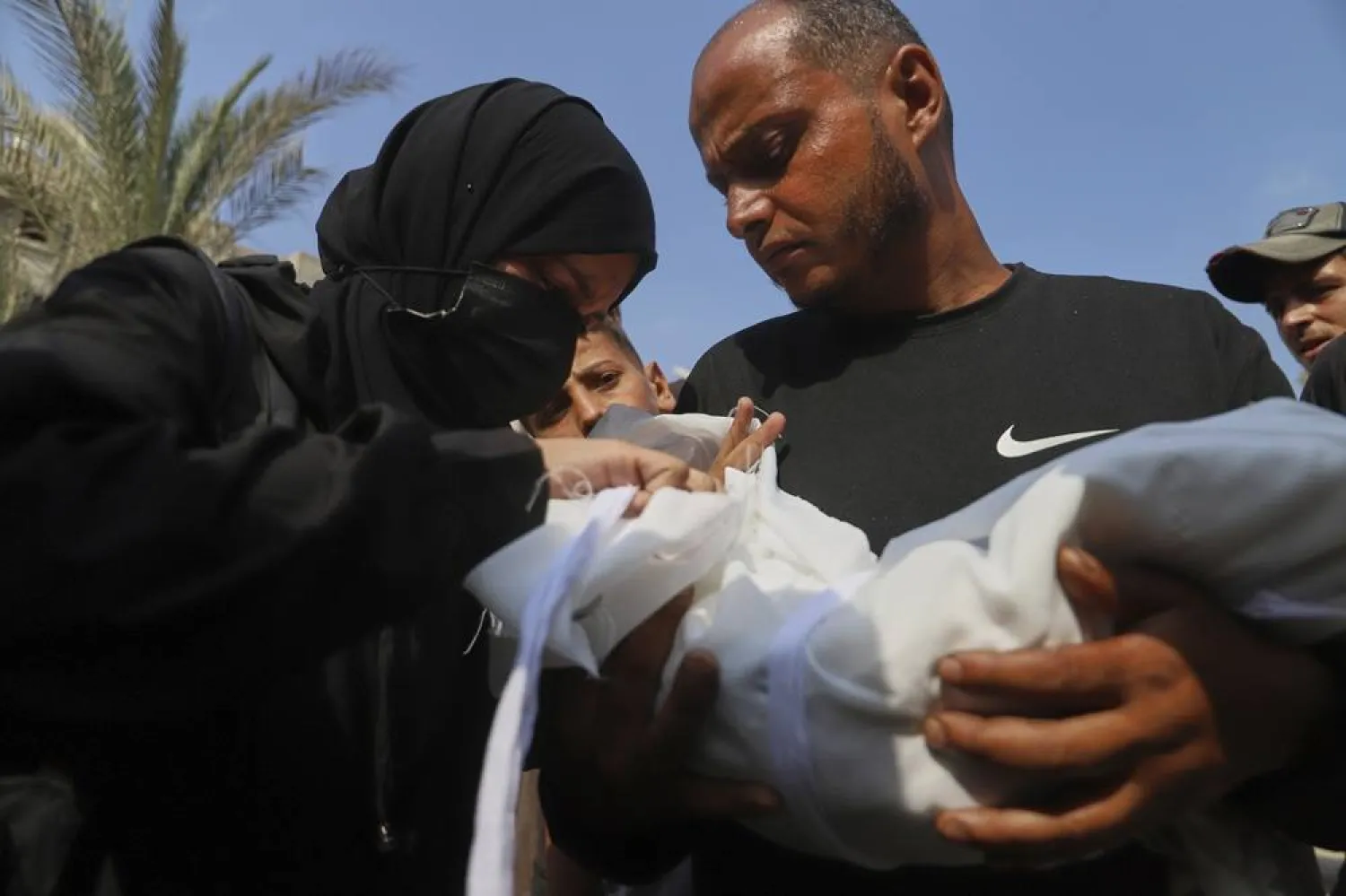
Ahmed Abu Halib and his wife Esraa Abu Halib, left, mourn over the body of their 5-month-old baby, Zainab, who died from malnutrition-related causes, according to the family and the hospital, during her funeral outside the Nasser Hospital, in Khan Younis, Gaza Strip, Saturday, July 26, 2025. (AP)
TT

The Latest Child to Starve to Death in Gaza Weighed Less than When She Was Born

Ahmed Abu Halib and his wife Esraa Abu Halib, left, mourn over the body of their 5-month-old baby, Zainab, who died from malnutrition-related causes, according to the family and the hospital, during her funeral outside the Nasser Hospital, in Khan Younis, Gaza Strip, Saturday, July 26, 2025. (AP)

A mother pressed a final kiss to what remained of her five-month-old daughter and wept. Esraa Abu Halib's baby now weighed less than when she was born.

On a sunny street in shattered Gaza, the bundle containing Zainab Abu Halib represented the latest death from starvation after 21 months of war and Israeli restrictions on aid.

The baby was brought to the pediatric department of Nasser Hospital on Friday. She was already dead. A worker at the morgue carefully removed her Mickey Mouse-printed shirt, pulling it over her sunken, open eyes. He pulled up the hems of her pants to show her knobby knees. His thumb was wider than her ankle. He could count the bones of her chest.

The girl had weighed over 3 kilograms (6.6 pounds) when she was born, her mother said. When she died, she weighed less than 2 kilograms (4.4 pounds).

A doctor said it was a case of "severe, severe starvation."

She was wrapped in a white sheet for burial and placed on the sandy ground for prayers. The bundle was barely wider than the imam’s stance. He raised his open hands and invoked Allah once more.

Zainab was one of 85 children to die of malnutrition-related causes in Gaza in the past three weeks, according to the latest toll released by the territory’s Health Ministry on Saturday. Another 42 adults died of malnutrition-related causes in the same period, it said.

"She needed a special baby formula which did not exist in Gaza," Zainab's father, Ahmed Abu Halib, told The Associated Press as he prepared for her funeral prayers in the hospital’s courtyard in the southern city of Khan Younis.

Dr. Ahmed al-Farah, head of the pediatric department, said the girl had needed a special type of formula that helps with babies allergic to cow's milk.

He said she hadn't suffered from any diseases, but the lack of the formula led to chronic diarrhea and vomiting. She wasn’t able to swallow as her weakened immune system led to a bacterial infection and sepsis, and quickly lost more weight.

'Many will follow'

The child's family, like many of Gaza's Palestinians, lives in a tent, displaced. Her mother, who also has suffered from malnutrition, said she breastfed the girl for only six weeks before trying to feed her formula.

"With my daughter’s death, many will follow," she said. "Their names are on a list that no one looks at. They are just names and numbers. We are just numbers. Our children, whom we carried for nine months and then gave birth to, have become just numbers." Her loose robe hid her own weight loss.

The arrival of children suffering from malnutrition has surged in recent weeks, al-Farah said. His department, with a capacity of eight beds, has been treating about 60 cases of acute malnutrition. They have placed additional mattresses on the ground.

Another malnutrition clinic, affiliated with the hospital, receives an average of 40 cases weekly, he said.

"Unless the crossings are opened and food and baby formula are allowed in for this vulnerable segment of Palestinian society, we will witness unprecedented numbers of deaths," he warned.

Doctors and aid workers in Gaza blame Israel’s restrictions on the entry of aid and medical supplies. Food security experts warn of famine in the territory of over 2 million people.

‘Shortage of everything’

After ending the latest ceasefire in March, Israel cut off the entry of food, medicine, fuel and other supplies completely to Gaza for 2 ½ months, saying it aimed to pressure Hamas to release hostages.

Under international pressure, Israel slightly eased the blockade in May. Since then, it has allowed in around 4,500 trucks for the UN and other aid groups to distribute, including 2,500 tons of baby food and high-calorie special food for children, Israel's Foreign Ministry said last week. Israel says baby formula has been included, plus formula for special needs.

The average of 69 trucks a day, however, is far below the 500 to 600 trucks a day the UN says are needed for Gaza. The UN says it has been unable to distribute much of the aid because hungry crowds and gangs take most of it from its arriving trucks.

Separately, Israel has backed the US-registered Gaza Humanitarian Foundation, which in May opened four centers distributing boxes of food supplies. More than 1,000 Palestinians have been killed by Israeli forces since May while trying to get food, mostly near those new aid sites, the UN human rights office says.

Much of Gaza's population now relies on aid.

"There was a shortage of everything," the mother of Zainab said as she grieved. "How can a girl like her recover?"



UAE Forces Accused of Committing Violations against Detainees Held in Secret Prisons in Yemen

A view from inside the Dabba facility. (Asharq Al-Awsat)
TT

UAE Forces Accused of Committing Violations against Detainees Held in Secret Prisons in Yemen

A view from inside the Dabba facility. (Asharq Al-Awsat)

United Arab Emirates forces are accused of running a secret prison in Yemen's Dabba area in the eastern city of Mukalla.

Asharq Al-Awsat toured the facility, bearing witness to the dire conditions in which the detainees were held as they waited in despair for their fate.

The walls themselves tell a story of despair with prisoners having etched pleas for mercy and prayers to God, with one prisoner writing a single word - "mother" - summing up his suffering.

Asharq Al-Awsat entered the facility as part of a tour for the media and rights groups. The UAE is accused of running several illegal prisons in Yemen, setting them up without coordination with the legitimate authorities.

Etchings on the wall by some of the detainees in the Dabba facility. (Asharq Al-Awsat)

Minister of Media, Tourism and Culture Moammar Al-Eryani said these detention centers are not affiliated with the state.

Dabba, he added, embodies the illegal practices that used to happen outside the state's control.

The state did not task any local or foreign party to set up the detention centers where prisoners have been tortured, he said.

These practices are a flagrant violation of the Yemeni constitution, international law and humanitarian law, he stressed.

Minister of Media, Tourism and Culture Moammar Al-Eryani at the Dabba center. (Asharq Al-Awsat

"Cells" at Dabba were nothing more than steel containers of varying sizes, some as small as 1 mete by 50 centimeters.

Along with the writings on the wall, Asharq Al-Awsat noted the blood stains in the cells, reflecting the horrors the detainees had to endure.

Al-Eryani said the state was restoring the rule of law, not seeking to settle scores. "Opening these facilities to the media is a message that the state was not afraid of the truth. Rather it wants to document it and tackle the issue through legal means," he added.

"We are not asking for political cover, but support for the state of law," he urged.

A Yemeni military source told Asharq Al-Awsat that the Dabba facility used to be a military air defense base.

Speaking on condition of anonymity, he revealed that people were held in the prison without charge, while those freed usually ended up suffering from severe trauma.


Aoun Stresses Keenness on Keeping Lebanon out of 'Suicidal Adventures'

17 January 2025, Lebanon, Baabda: Lebanese President Joseph Aoun speaks during a press conference at Baabda Palace. (dpa)
TT

Aoun Stresses Keenness on Keeping Lebanon out of 'Suicidal Adventures'

17 January 2025, Lebanon, Baabda: Lebanese President Joseph Aoun speaks during a press conference at Baabda Palace. (dpa)

Lebanese President Joseph Aoun stressed on Tuesday that his country has "cleaned vast areas south of the Litani River of illegal weapons".

Speaking to the diplomatic corps, he added that the plan to impose to state monopoly over arms and control over all of Lebanese territories "has been unprecedented in 40 years".

Lebanon is keen on preventing itself from being dragged into "suicidal adventures, whose price we paid dearly for in the past," he declared.

Without referring to Hezbollah, Aoun described as an "adventure" the Iran-backed party's decision to launch the "support war" against Israel in October 2023 in solidarity with Hamas in Gaza.

Aoun did not touch on Hezbollah's refusal to lay down its weapons in areas north of the Litani, which is the second phase of the state's plan to impose state monopoly over arms.

Aoun made his remarks days after Hezbollah Secretary-General Sheikh Naim Qassem declared that the party would not lay down its weapons, deepening the rift between the president and the party.

Informed sources had previously told Asharq Al-Awsat that relations between the two sides had cooled in recent weeks with contacts between them at the "bare minimum".

Continuing his address to the diplomatic corps, Aoun said that since he was elected to office a year ago, Lebanon has not made a single violation of the ceasefire with Israel, save for two "individual incidents".

The authorities have since arrested the perpetrators, he added. In the meantime, the army is the sole party in control of the South.

He stressed that the army succeeded in imposing its control over the South "despite all provocations, ongoing Israeli attacks, criticism and accusations of treason."

The ceasefire, he noted, was agreed in November 2024, before he assumed office. "It is an international agreement that we respect" and that will prevent Lebanon from being dragged into "suicidal adventures," he went on to say.

Aoun hoped that during his second year in office, all Lebanese territories would come under the authority of the state alone and that all Lebanese prisoners held by Israel would be released. He hoped that reconstruction of areas destroyed by Israel in the war would kick off.

He also hoped that the entire country would come under the control of the armed forces alone, "so that Lebanon would not be dragged into the conflicts of others."


Syrian Military, SDF Announce New Truce After Guards Leave Camp Housing ISIS Families

Members of the Syrian army ride a vehicle en route to al-Hassakeh, following the withdrawal of the Syrian Democratic Forces, Syria, January 20, 2026. (Reuters)
TT

Syrian Military, SDF Announce New Truce After Guards Leave Camp Housing ISIS Families

Members of the Syrian army ride a vehicle en route to al-Hassakeh, following the withdrawal of the Syrian Democratic Forces, Syria, January 20, 2026. (Reuters)

Guards from the Kurdish-led Syrian Democratic Forces (SDF) abandoned a camp Tuesday in northeast Syria housing thousands of people linked to the ISIS group, and the Syrian military said that allowed detainees to escape.

Hours later, the Syrian government and the SDF announced a new four-day truce after a previous ceasefire broke down. The two sides have been clashing for two weeks, amid a breakdown in negotiations over a deal to merge their forces together.

The al-Hol camp houses mainly women and children who are relatives of ISIS members. Thousands of accused ISIS militants are separately housed in prisons in northeast Syria.

Syria's interior ministry accused the SDF of allowing the release of “a number of detainees from the ISIS militant (group) along with their families.” The AP could not independently confirm if detainees had escaped from the camps or how many.

The SDF subsequently confirmed that its guards had withdrawn from the camp, but did not say whether any detainees escaped. The group blamed “international indifference toward the issue of the (ISIS) terrorist organization and the failure of the international community to assume its responsibilities in addressing this serious matter."

It said its forces had redeployed in other areas "that are facing increasing risks and threats” from government forces.

An official with the US military’s Central Command who spoke on condition of anonymity because they were not authorized to speak publicly said, “We are aware of the reports and are closely monitoring the situation.”

The SDF and the government also traded blame over the escape Monday of ISIS members from a prison in the northeastern town of Shaddadi.

The Syrian defense ministry in a statement said it is prepared to take over al-Hol camp and the prisons and accused the SDF of using them as “bargaining chips.”

At its peak in 2019, some 73,000 people were living at al-Hol camp. Since then the number has declined with some countries repatriating their citizens.

Sheikhmous Ahmad, a Kurdish official overseeing camps for displaced in northeastern Syria, told The Associated Press that the al-Hol's current population is about 24,000, about 14,500 of whom are Syrians and nearly 3,000 Iraqis.

He added that about 6,500 from other nationalities are held in a highly secured section of the camp, many of whom are die-hard ISIS supporters who came from around the world to join the extremist group.

Government and SDF trade blame over prison break

Earlier Tuesday, Syria's interior ministry said that 120 ISIS members had escaped Monday from the prison in Shaddadi, amid clashes between government forces and the SDF. Security forces recaptured 81 of them, the statement said.

Also Tuesday, the SDF accused “Damascus-affiliated factions” of cutting off water supplies to the al-Aqtan prison near the city of Raqqa, which it called a “blatant violation of humanitarian standards.”

The SDF, the main US-backed force that fought ISIS in Syria, controls more than a dozen prisons in the northeast where some 9,000 ISIS members have been held for years without trial.

ISIS was defeated in Iraq in 2017 and in Syria two years later, but the group’s sleeper cells still carry out deadly attacks in both countries.

Under a deal announced Sunday, government forces were to take over control of the prisons from the SDF, but the transfer did not go smoothly.

New ceasefire deal announced

The Syrian military announced Tuesday evening a new four-day ceasefire. The SDF confirmed the deal and said “it will not initiate any military action unless our forces are subjected to attacks.”

Elham Ahmad, a senior official with the Kurdish-led local administration in northeast Syria, told journalists Tuesday that an earlier ceasefire had fallen apart after SDF leader Mazloum Abdi requested a five-day grace period to implement the conditions and Syrian Interim President Ahmed al-Sharaa refused.

She blamed the government for violating the agreement but called for a return to dialogue.

In response to a journalist's question regarding whether the SDF had requested help from Israel - which previously intervened in clashes between government forces and groups from the Druze religious minority last year - Ahmad said “certain figures” from Israel had communicated with the SDF. She added that the SDF is ready to accept support from any source available.

A statement from al-Sharaa’s office said government forces will not enter Kurdish-majority areas until plans are agreed upon for their “peaceful integration” and that Kurdish villages will be patrolled by “local security forces drawn from the residents of the area.”

It said Abdi will put forward nominees from the SDF for the posts of deputy defense minister, governor of al-Hassakeh province, representatives in the parliament, and for other positions in Syrian state institutions.

SDF disappointment

SDF officials have expressed disappointment that the US did not intervene on their behalf. The group was long the main US partner in Syria in the fight against ISIS, but that has changed as the Trump administration has developed closer ties with al-Sharaa's government.

US envoy to Syria Tom Barrack in a statement Tuesday urged the SDF to move forward with integration into the new Syrian government and army and appeared to warn the Kurdish-led force that no help would be coming from Washington if it continued fighting.

He said SDF's role as the primary anti-ISIS force "has largely expired, as Damascus is now both willing and positioned to take over security responsibilities” and that “recent developments show the US actively facilitating this transition, rather than prolonging a separate SDF role."

Since toppling Bashar al-Assad in December 2024, Syria’s new leaders have struggled to assert full authority over the war-torn country. An agreement was reached in March that would merge the SDF with Damascus, but it didn’t gain traction.

Earlier this month, clashes broke out in the city of Aleppo, followed by the government offensive that seized control of Deir Ezzor and Raqqa provinces, critical areas under the SDF that include oil and gas fields, river dams along the Euphrates and border crossings.

Al-Sharaa postponed a planned trip to Germany Tuesday amid the ongoing tensions.