


SDF Offers Tribes in Syria’s Deir Ezzor Role in Talks, Right to Name Governor

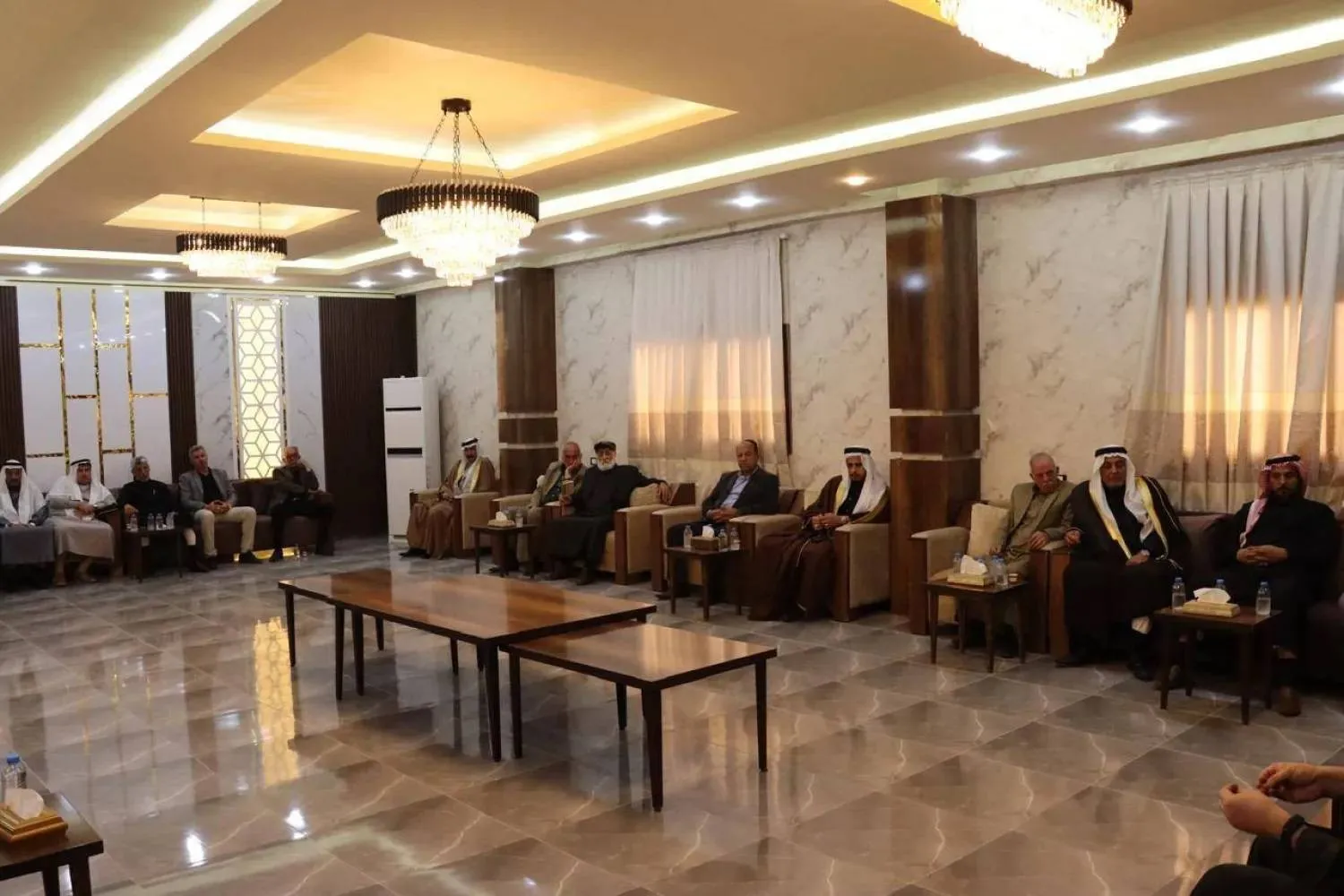
SDF commander Mazloum Abdi meets with Deir Ezzor delegates. (SDF)
TT

SDF Offers Tribes in Syria’s Deir Ezzor Role in Talks, Right to Name Governor

SDF commander Mazloum Abdi meets with Deir Ezzor delegates. (SDF)

Arab tribal leaders, who took part in recent meetings with the US-backed Syrian Democratic Forces (SDF) and the Autonomous Administration in northeast Syria, said they were offered a greater role in governing Deir Ezzor province and a seat at the table in any future talks with the Damascus government, according to tribal sources.

The meetings, held at the US-led coalition’s base in al-Shaddadi, south of Hasakah, were led by SDF commander Mazloum Abdi and senior officials from the Kurdish-led administration.

Discussions centered on the latest international efforts to revive dialogue with Damascus, including Abdi’s talks with the French foreign minister and US Syria envoy in Paris, as well as earlier meetings in Amman.

At the heart of the discussions was a March 1 agreement between Abdi and Syrian President Ahmed al-Sharaa that envisages integrating the SDF and local governing bodies into Syrian state institutions by the end of the year.

Tribal sources told Asharq Al-Awsat that leaders were presented with a proposal consisting of three main elements: first, a formal role for Arab tribes in upcoming negotiations with Damascus; second, a 50% quota for tribal figures from eastern, northern, and western Deir Ezzor - areas under SDF influence - in a newly structured provincial council, with nominees selected in coordination between tribal elders and the SDF.

The third clause would give Arab tribes the authority to name the governor of Deir Ezzor, replacing the current system of presidential appointment.

In a statement following the meeting, the SDF said Abdi had assured Deir Ezzor residents that local civilian and military bodies would have a say in any future settlement with the Syrian government, emphasizing that the SDF remained the “guarantor of stability and security” and would continue its mission without hesitation.

Abdi also reportedly clarified that the handover of Deir Ezzor’s institutions, civilian and military alike, to the government would be limited to those that operated in SDF-controlled areas prior to the fall of the former regime at the end of last year. Similar arrangements would later extend to the cities of Raqqa and Hasakah.

According to the sources, Abdi stressed that the SDF had no intention of surrendering territory or dismantling the Autonomous Administration. Instead, any rapprochement with Damascus would be based on mutual understandings and a comprehensive integration process acceptable to both sides.

Committees from both the SDF and the administration are expected to meet with government officials in the coming days to push forward with the plan.

During the transitional phase, local councils and security agencies under the Autonomous Administration in Deir Ezzor will continue operating normally, with a view to developing a new, participatory administrative system at the provincial level.

Observers say Abdi’s remarks point to a possible breakthrough in efforts to incorporate the SDF as a unified bloc within the Syrian Ministry of Defense, alongside the integration of administrative institutions into the broader state framework. These understandings remain in their early stages, however, and a final deal is yet to be reached.

A planned follow-up meeting in Paris on July 25 between Syrian government officials and an Autonomous Administration delegation was postponed at the request of Damascus, which informed the SDF through the US-led coalition that a new date would be set soon.

Meanwhile, for the third consecutive day, unknown gunmen have targeted SDF positions in Deir Ezzor countryside, despite the presence of coalition forces.

On Monday, two assailants on a motorcycle fired at an SDF military vehicle near the town of al-Sour in northern Deir Ezzor, causing material damage but no casualties, according to an SDF military source and local residents.

A similar attack on Sunday struck an SDF outpost in the nearby village of Ruwaished, leading to a brief exchange of fire but no injuries. On Saturday, the SDF reported one of its fighters was killed and another wounded when gunmen believed to be ISIS sympathizers attacked a vehicle in the village of al-Zar, east of Deir Ezzor.



7 Killed in Drone Strike on Hospital in Sudan's Kordofan

A Sudanese man rides his decorated bicycle as others (unseen) rally in support of the Sudanese armed forces. (Photo by Ebrahim Hamid / AFP)
TT

7 Killed in Drone Strike on Hospital in Sudan's Kordofan

A Sudanese man rides his decorated bicycle as others (unseen) rally in support of the Sudanese armed forces. (Photo by Ebrahim Hamid / AFP)

A drone strike Sunday on an army hospital in the besieged southern Sudan city of Dilling left "seven civilians dead and 12 injured", a health worker at the facility told AFP.

The victims included patients and their companions, the medic said on condition of anonymity, explaining that the army hospital "serves the residents of the city and its surroundings, in addition to military personnel".

Dilling, in the flashpoint state of South Kordofan, is controlled by the Sudanese army but is besieged by the Rapid Support Forces (RSF).

The greater Kordofan region is currently facing the fiercest fighting in Sudan's war between the army and the RSF, as both seek to wrest control of the massive southern region.

The UN has repeatedly warned the region is in danger of witnessing a repeat of the atrocities that unfolded in North Darfur state capital El-Fasher, including mass killing, abductions and sexual violence.


Iraq's Election Result Ratified by Supreme Federal Court as Premiership Remains up for Grabs

Election workers gather parliamentary election ballots after the polls closed in Baghdad, Iraq, Nov. 11, 2025. (AP Photo/Hadi Mizban, File)
TT

Iraq's Election Result Ratified by Supreme Federal Court as Premiership Remains up for Grabs

Election workers gather parliamentary election ballots after the polls closed in Baghdad, Iraq, Nov. 11, 2025. (AP Photo/Hadi Mizban, File)

The result of last month’s parliamentary elections in Iraq was ratified by the Supreme Federal Court on Sunday, confirming that the party of caretaker prime minister Mohammed Shia al-Sudani won the largest number of seats — but not enough to assure him a second term.

The court confirmed that the voting process met all constitutional and legal requirements and had no irregularities affecting its validity.

The Independent High Electoral Commission submitted the final results of the legislative elections to the Supreme Federal Court on Monday for official certification after resolving 853 complaints submitted regarding the election results, according to The AP news.

Al-Sudani's Reconstruction and Development Coalition won 46 seats in the 329-seat parliament. However, in past elections in Iraq, the bloc taking the largest number of seats has often been unable to impose its preferred candidate.

The coalition led by former Prime Minister Nouri al-Maliki won 29 seats, the Sadiqoun Bloc, which is led by the leader of the Asaib Ahl al-Haq militia, Qais al-Khazali, won 28 seats, and the Kurdistan Democratic Party, led by Masoud Barzani, one of the two main Kurdish parties in the country, won 27 seats.

The Taqaddum (Progress) party of ousted former Parliament Speaker Mohammed al-Halbousi also won 27 seats, setting the stage for a contest over the speaker's role.


Hamas Confirms the Death of a Top Commander in Gaza after Israeli Strike

Destroyed buildings, amid a ceasefire between Israel and Hamas, in Khan Younis in the southern Gaza Strip November 18, 2025. (Reuters)
TT

Hamas Confirms the Death of a Top Commander in Gaza after Israeli Strike

Destroyed buildings, amid a ceasefire between Israel and Hamas, in Khan Younis in the southern Gaza Strip November 18, 2025. (Reuters)

Hamas on Sunday confirmed the death of a top commander in Gaza, a day after Israel said it had killed Raed Saad in a strike outside Gaza City.

The Hamas statement described Saad as the commander of its military manufacturing unit. Israel had described him as an architect of the Oct. 7, 2023, attack that sparked the war in Gaza, and asserted that he had been “engaged in rebuilding the terrorist organization” in a violation of the ceasefire that took effect two months ago, The AP news reported.

Israel said it killed Saad after an explosive device detonated and wounded two soldiers in the territory’s south.

Hamas also said it had named a new commander but did not give details.

Saturday's strike west of Gaza City killed four people, according to an Associated Press journalist who saw their bodies arrive at Shifa Hospital. Another three were wounded, according to Al-Awda hospital. Hamas in its initial statement described the vehicle struck as a civilian one.

Israel and Hamas have repeatedly accused each other of truce violations.

Israeli airstrikes and shootings in Gaza have killed at least 391 Palestinians since the ceasefire took hold, according to Palestinian health officials. Israel has said recent strikes are in retaliation for militant attacks against its soldiers, and that troops have fired on Palestinians who approached the “Yellow Line” between the Israeli-controlled majority of Gaza and the rest of the territory.

Israel has demanded that Palestinian militants return the remains of the final hostage, Ran Gvili, from Gaza and called it a condition of moving to the second and more complicated phase of the ceasefire. That lays out a vision for ending Hamas’ rule and seeing the rebuilding of a demilitarized Gaza under international supervision.

Israel’s two-year campaign in Gaza has killed more than 70,660 Palestinians, roughly half of them women and children, according to the territory’s Health Ministry, which does not distinguish between militants and civilians in its count. The ministry, which operates under the Hamas-run government, is staffed by medical professionals and maintains detailed records viewed as generally reliable by the international community.