

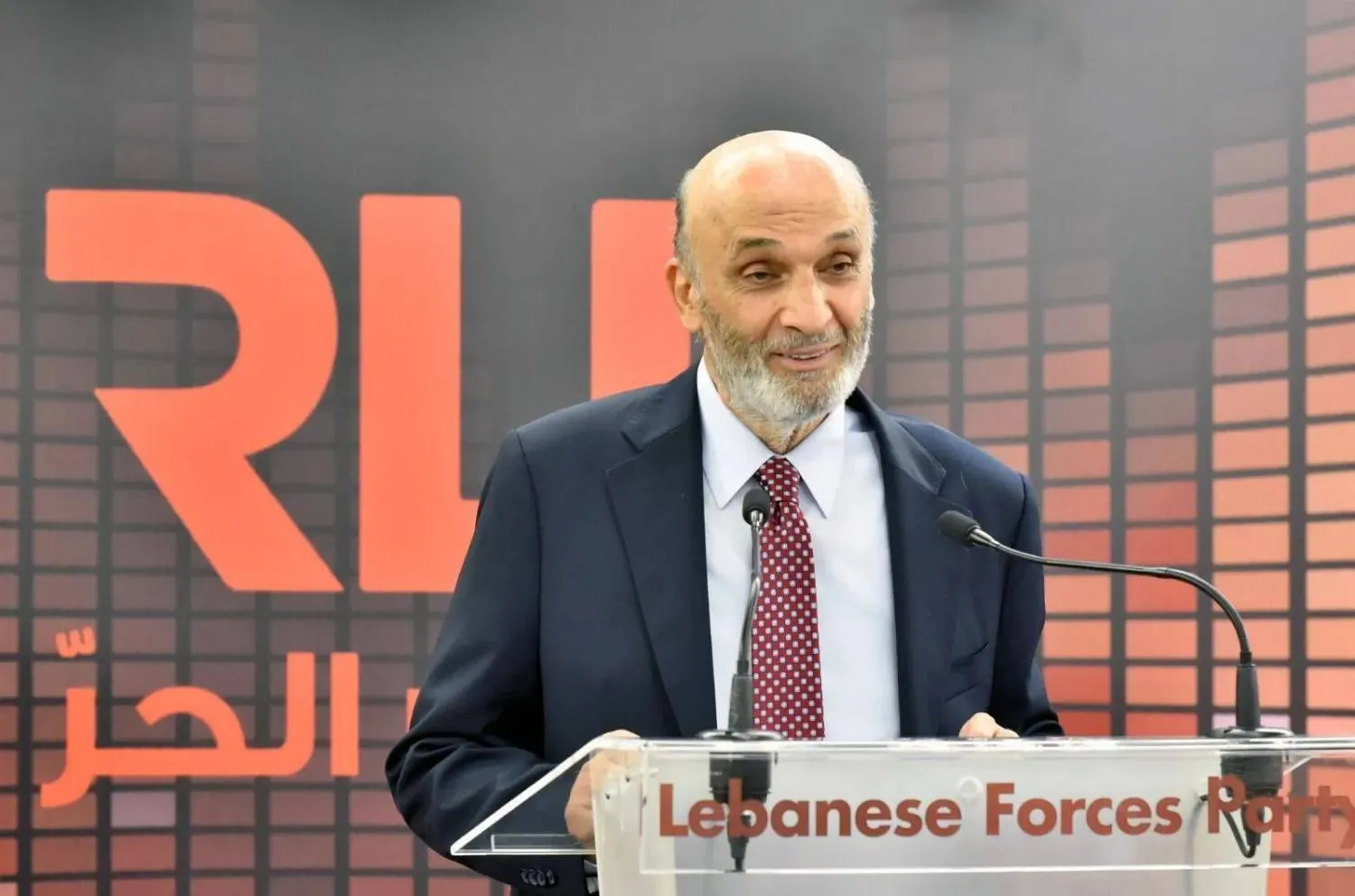

Geagea: Hezbollah Set Lebanon Back a Hundred Years

Lebanese Forces leader Samir Geagea. (Lebanese Forces)
TT

Geagea: Hezbollah Set Lebanon Back a Hundred Years

Lebanese Forces leader Samir Geagea. (Lebanese Forces)

Lebanese Forces leader Samir Geagea accused on Saturday Hezbollah of “setting Lebanon back a hundred years”, saying its weapons arsenal has “brought Israel to Lebanon”.

He made his remarks ahead of a highly-anticipated government meeting on Tuesday aimed at approving an executive mechanism to implement the “state monopoly over arms”. Hezbollah, meanwhile, has said laying down its weapons effectively means “handing over Lebanon to Israel.”

The government meeting is in line with the “broad lines set by President Joseph Aoun in his swearing in speech,” said Agriculture Minister Nizar Hani.

He told local radio that the speech set a timeframe for limiting the possession of weapons to the state.

This issue enjoys “broad political consensus among members of government. No one is expected to boycott the government meeting, including the Shiite duo of Hezbollah and Amal,” he added.

Geagea said that Hezbollah is adopting rhetoric “that is unintelligible to others and it, in turn, does not understand the rhetoric of the majority of the Lebanese people.”

Seventy-five percent of the Lebanese people do not want this reality that is imposed on them, but Hezbollah insists on it, he charged.

“Hezbollah’s actions have effectively set Lebanon back a hundred years, if not more,” he lamented.

Moreover, Geagea rejected claims that Hezbollah cannot lay down its arms as long as Israel continues to occupy some areas in the South. Hezbollah’s weapons and “the wars it has waged are the reason why Israel is in the South,” he stressed.

“Hezbollah claims that its weapons will force Israel out of the South, while in fact, the arms are the reason it is there,” he continued.

“Any hope for Israel to quit the South should be sought through other channels, because Hezbollah’s weapons have failed miserably,” he stated.

“Israel does not want to occupy Lebanon, not because it is an angelic country, but because this is not part of its strategy,” he explained.

Despite the challenges, Geagea said the “future still looks good even though Lebanon wasted the past six months due to its lax approach and delusions that it can hold dialogue with Hezbollah.”

He noted that the president enjoys full legitimacy and the parliament granted the government its vote of confidence twice. “So, now these authorities are demanded to work without waiting for Hezbollah’s reply, because it will not,” Geagea added.

“The Lebanese people are awaiting these authorities to take the desired decision to take Lebanon out of the hole that Hezbollah landed it in and to open the chapter of a new different future,” he said.

On the other side of the divide, Hezbollah MP Hussein Jishi said: “The government will tackle the issue of state sovereignty and the weapons. We believe in the state and want it to be strong. We want the weapons to be in its possession, but we have to ask: Where was the state in confronting the (Israeli) violations of the past eight months? What has it done? Has it defended its people?”

“We want a state that can defend its people. We support a state that possesses the weapons. But what kind of state is this that remains incapable against the enemy?” he wondered.

“The demand for the resistance (Hezbollah) to lay down its weapons without finding an alternative to it is effectively a blatant demand to surrender Lebanon to Israel,” he claimed.



Syrian Foreign Ministry: Talks with SDF Have Not Yielded Tangible Results

SDF fighters are seen at a military parade in Qamishli. (Reuters file)
TT

Syrian Foreign Ministry: Talks with SDF Have Not Yielded Tangible Results

SDF fighters are seen at a military parade in Qamishli. (Reuters file)

A source from the Syrian Foreign Ministry said on Friday that the talks with the Kurdish Syrian Democratic Forces (SDF) over their integration into state institutions “have not yielded tangible results.”

Discussions about merging the northeastern institutions into the state remain “hypothetical statements without execution,” it told Syria’s state news agency SANA.

Repeated assertions over Syria’s unity are being contradicted by the reality on the ground in the northeast, where the Kurds hold sway and where administrative, security and military institutions continue to be run separately from the state, it added.

The situation “consolidates the division” instead of addressing it, it warned.

It noted that despite the SDF’s continued highlighting of its dialogue with the Syrian state, these discussions have not led to tangible results.

It seems that the SDF is using this approach to absorb the political pressure on it, said the source. The truth is that there is little actual will to move from discussion to application of the March 10 agreement.

This raises doubts over the SDF’s commitment to the deal, it stressed.

Talk about rapprochement between the state and SDF remains meaningless if the agreement is not implemented on the ground within a specific timeframe, the source remarked.

Furthermore, the continued deployment of armed formations on the ground that are not affiliated with the Syrian army are evidence that progress is not being made.

The persistence of the situation undermines Syria’s sovereignty and hampers efforts to restore stability, it warned.


Terrorist Attack on Mosque in Syria’s Homs Draws Wide Condemnation

 A view shows an interior of a damaged mosque after several people were killed in an explosion in Homs, Syria December 26, 2025. (Reuters)
A view shows an interior of a damaged mosque after several people were killed in an explosion in Homs, Syria December 26, 2025. (Reuters)
TT

Terrorist Attack on Mosque in Syria’s Homs Draws Wide Condemnation

 A view shows an interior of a damaged mosque after several people were killed in an explosion in Homs, Syria December 26, 2025. (Reuters)
A view shows an interior of a damaged mosque after several people were killed in an explosion in Homs, Syria December 26, 2025. (Reuters)

Condemnations poured in across the Arab world and international community of the terrorist attack that targeted a mosque in Syria’s Homs city on Friday.

An explosion killed at least eight worshippers with the extremist group Saraya Ansar al-Sunna claiming responsibility.

In a statement on Telegram, the group said its fighters “detonated a number of explosive devices” in the Imam Ali Bin Abi Talib Mosque in the central Syrian city.

Syria's interior ministry said in a statement that “a terrorist explosion” targeted the mosque and that authorities had “begun investigating and collecting evidence to pursue the perpetrators of this criminal act.”

The Saudi Ministry of Foreign Affairs condemned the attack, stressing the Kingdom’s “categorical rejection of terrorism and extremism in all their forms, including attacks on mosques and places of worship and the targeting of innocent civilians.”

It expressed the Kingdom’s “solidarity with Syria in this tragic incident and its support for the Syrian government’s efforts to uphold security and stability.”

Türkiye slammed the attack, saying it stands by Syria and its efforts to support stability, security and unity “despite all the provocations.”

The Iraqi Foreign Ministry strongly condemned the “heinous terrorist attack,” saying Baghdad rejects all forms of terrorism, violence and extremism regardless of their motives.

It slammed the attack against civilians and places of worship, saying they aim to create instability and sow strife in society.

The ministry underlined Iraq’s support for regional and international efforts aimed at eliminating terrorism and drying up its sources of funding.

The United Arab Emirates condemned the attack, saying it rejects all forms of violence and terrorism that aim to undermine security and stability.

Jordan’s Foreign Ministry slammed the attack, voicing its full support to Syria in its reconstruction process “based on principles that ensure its territorial unity, sovereignty, security and stability.”

In Beirut, President Joseph Aoun slammed the Homs attack, saying Lebanon stands by Syria in its war on terrorism. He offered his condolences to the Syrian people.

Qatar slammed the attack, saying it fully stands by the Syrian government and all the measures it takes to preserve security.

France said the blast was an “act of terrorism” designed to destabilize the country, while United Nations Secretary General Antonio Guterres condemned the “unacceptable” attack and said the perpetrators should be brought to justice.


Iran Wants Iraqi PM Who ‘Takes into Consideration’ Interests of Both Countries

Iranian Ambassador to Iraq Mohammad Kazem Al-e Sadegh. (IRNA)
TT

Iran Wants Iraqi PM Who ‘Takes into Consideration’ Interests of Both Countries

Iranian Ambassador to Iraq Mohammad Kazem Al-e Sadegh. (IRNA)

Iranian Ambassador to Iraq Mohammad Kazem Al-e Sadegh said on Friday that the armed Iraqi factions that proposed limiting the possession of arms to the state have reached a point where they can take decisions by themselves, denying that they are Tehran’s “proxies.”

Speaking to Dijlah television, he added that describing those factions as “proxies” insults them. Moreover, the fact that Iran supported them during the war on ISIS does not mean that they are working on its behalf.

A heated debated is raging in Iraq over the future of the armed forces and their arsenal amid internal and foreign pressure to impose state monopoly over weapons, especially as pro-Iran factions have been gaining influence.

Commenting on the Iraqi parliamentary elections that took place in November, the ambassador said the rise in seats held by the factions is the “choice of the people.”

On who should be appointed prime minister, Al-e Sadegh stressed that the choice to rename Mohammed Shia al-Sudani to the post is a “purely” Iraqi decision.

He added, however, that Tehran backs the formation of a government that is based on “partnership, consensus and balance,” hoping that the new PM will “take into consideration” Iraq and Iran’s interests.

Al-e Sadegh slammed the role of the United States in Iraq, saying American jets “are spying on Iran from Iraqi skies.” He also described as “unjustified” Washington’s appointment of a special envoy to Iraq.

The ambassador underscored the strength of relations between Baghdad and Tehran, saying he can never imagine that they could be severed.

Some 35 percent of Iraqis live in areas bordering Iran, so people from both countries enjoy deep social and tribal ties, he explained.