Salam to Beirut Port Explosion Victims: Justice Will Be Achieved, No Matter the Delay

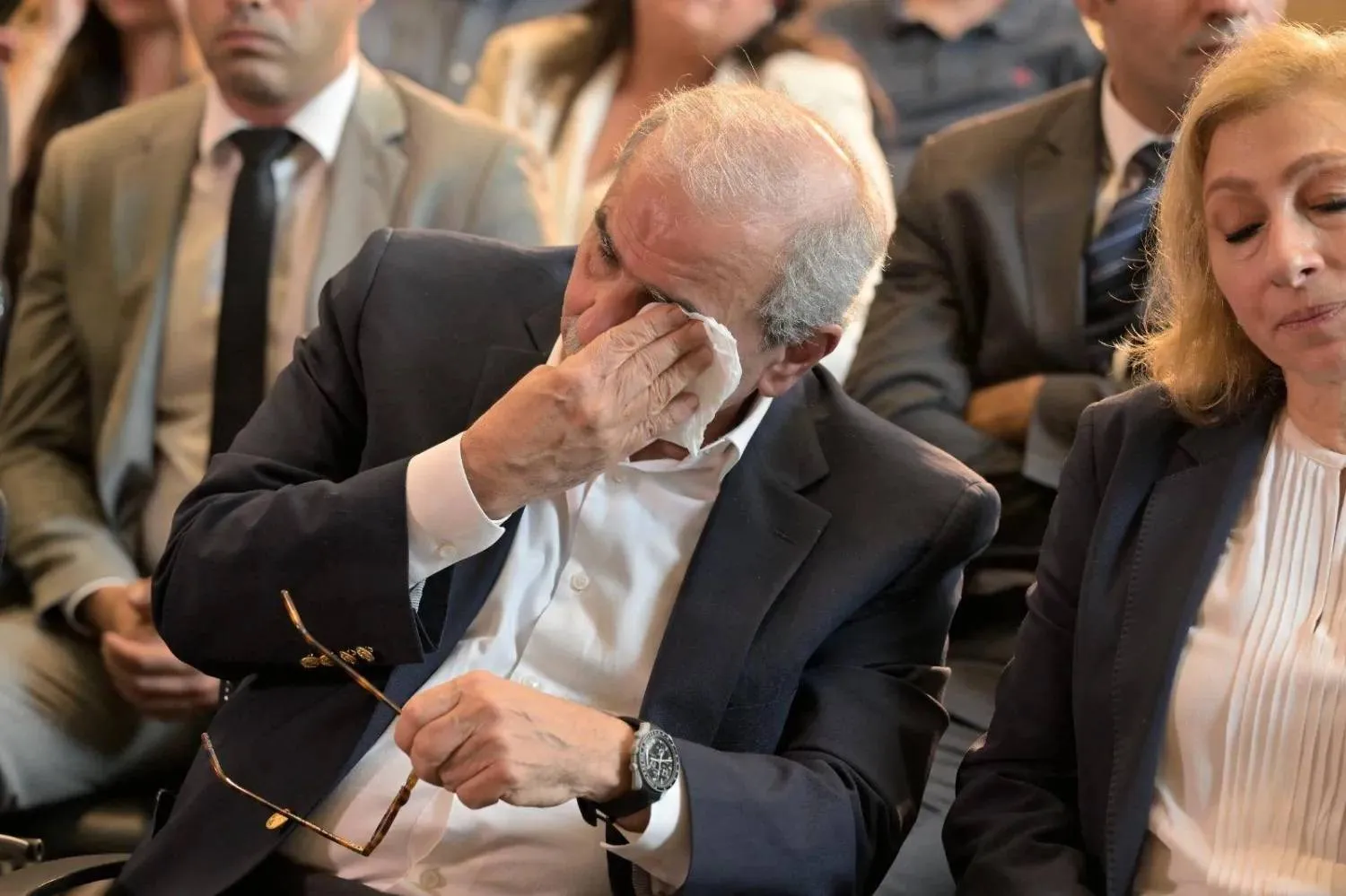
Prime Minister Nawaf Salam wipes his tears as he listens to a relative of a Beirut port explosion victim speak about her plight. (Asharq A-Awsat)
TT

Salam to Beirut Port Explosion Victims: Justice Will Be Achieved, No Matter the Delay

Prime Minister Nawaf Salam wipes his tears as he listens to a relative of a Beirut port explosion victim speak about her plight. (Asharq A-Awsat)

Lebanese Prime Minister Nawaf Salam reiterated on Sunday his government’s commitment to ensure that decisions of war and peace will be restricted to it alone, vowing that it will impose its sovereignty throughout the country.

Speaking during a dialogue session with relatives of the victims of the August 4, 2020, Beirut Port explosion, he stressed that justice “will be achieved in the case, no matter the delay.”

“There can be no other option but for the truth to prevail,” he declared.

He renewed his government policy pledge to “build a strong, just, sovereign, free and independent state” that will not spare an effort in ending Israeli occupation of all Lebanese territories.

It will be a state of law where impunity does not exist and where justice can be achieved, Salam went on to say.

He also vowed to carry out political, financial and administrative reforms.

The government will hold a highly anticipated meeting on Tuesday that will discuss the state’s efforts to impose its sovereignty throughout the country and to have monopoly over the possession of weapons, which puts it at odds with Hezbollah.

The Iran-backed party has repeatedly said it will not lay down its arms before Israel withdraws from all Lebanese territories.

The Shiite duo of Hezbollah and its ally Amal have yet to declare their position on the cabinet meeting.

Several Lebanese forces and foreign powers, especially the United States, have been pressuring Lebanon to set a timeframe for the disarmament.

The Lebanese Forces has been adamant about the government setting a timeframe during its meeting on Tuesday.

Sources from the LF told Asharq Al-Awsat that failure to do so “will leave the country exposed to all options,” including Israeli strikes and even a new war between Israel and Hezbollah.

“We will not accept anything less than a timeframe,” they added.

The government must make its decision based on the Taif Accord, its policy statement, ceasefire with Israel and President Joseph Aoun’s swearing in speech.

The speech and government were clear that the state should have monopoly over weapons and that all armed groups must lay down their weapons within two to three months, the sources said.

It appears that the majority of the Lebanese powers share this view, save for Hezbollah and Amal.

Justice Minister and Kataeb member Adel Nassar expressed frustration with the duo, posting on X: “Hezbollah will not be allowed to drag Lebanon and its people along with it if it chose suicide by refusing to lay down its arms.”

Hezbollah MP Ali Fayyad reiterated the party’s stance that it will not engage in discussions about its weapons before Israel withdraws from Lebanese territories.

“Israel wants the Lebanese to clash with each other, while we are keen that they reach understandings,” he said.


Emergency Declared in Libya's Zawiya Refinery amid Clashes Near Facility

Reuters file photo of Libya's Sharara oilfield
TT

Emergency Declared in Libya's Zawiya Refinery amid Clashes Near Facility

Reuters file photo of Libya's Sharara oilfield

An emergency was declared in Libya's Zawiya refinery, west of the capital Tripoli, amid clashes near the facility, ⁠two engineers told ⁠Reuters on Friday.

Zawiya, 40 km (25 miles) west ⁠of Tripoli, is home to Libya's biggest functioning refinery, with a capacity of 120,000 barrels per day.

The refinery ⁠is ⁠connected to the country's 300,000 bpd Sharara oilfield.


More than Half of Lebanon Population Depends on Aid, Says EU Official

European Union Commissioner for Equality, Preparedness and Crisis Management Hadja Lahbib arrives for a meeting of the College of European Commissioners in Brussels, Belgium, May 6, 2026. REUTERS/Yves Herman
TT

More than Half of Lebanon Population Depends on Aid, Says EU Official

European Union Commissioner for Equality, Preparedness and Crisis Management Hadja Lahbib arrives for a meeting of the College of European Commissioners in Brussels, Belgium, May 6, 2026. REUTERS/Yves Herman

More than half of Lebanon's population depends on humanitarian aid, a European Union official said on Friday, as Israel continues its attacks on the country despite a ceasefire in the two-month-long war with militant group Hezbollah.

"At present, more than three million people, meaning more than half of the population here in Lebanon, depend on humanitarian aid to survive," EU crisis management chief Hadja Lahbib told reporters after meeting Lebanese President Joseph Aoun in Beirut.

Lahbib said that since the start of the war on March 2 the 27-member bloc has provided 100 million euros in aid and sent six planes carrying humanitarian aid, with a seventh expected on Saturday.

Israeli strikes in Lebanon have killed more than 2,700 people and displaced over one million since early March, according to authorities.

The UN launched an emergency appeal in March for $308 million in humanitarian aid for Lebanon, but in two months it has raised just $126 million, according to UN agencies.

Lahbib, who said that the ceasefire has opened "a narrow window of hope", called for Hezbollah "to cease its attacks and be disarmed" and said that "Israel must put an end to its bombardments".

"For a ceasefire to lead to peace, courage is needed -- political courage to address the root causes of this conflict."

Israel and Lebanon are set to hold a third round of talks in Washington next week to end the war, despite Hezbollah's opposition to direct negotiations.


Who Are the Radwan Commanders Israel Has Killed in Lebanon?

Rescue workers search through the rubble of a building destroyed in an Israeli airstrike targeting Beirut’s southern suburbs, a day after the attack that took place on the evening of Wednesday, May 7, 2026 (AP). 
TT

Who Are the Radwan Commanders Israel Has Killed in Lebanon?

Rescue workers search through the rubble of a building destroyed in an Israeli airstrike targeting Beirut’s southern suburbs, a day after the attack that took place on the evening of Wednesday, May 7, 2026 (AP). 

Israel’s announcement that it had killed Ahmad Ghaleb Ballout in a strike targeting the Haret Hreik area of Beirut’s southern suburbs on Wednesday renewed focus on the series of assassinations targeting commanders of Hezbollah’s Radwan Force since the outbreak of the Gaza war.

The strikes seem to be a concentrated campaign aimed at weakening the leadership structure of the group’s elite unit.

Since the early months of the confrontation, the Radwan Force has become a primary target of Israeli strikes, both in south Lebanon and Beirut’s southern suburbs, as Israel pursued field and military commanders responsible for offensive operations and oversight of drone, assault and combined operations units.

Israeli army spokeswoman Ella Waweya said the military “carried out a strike on Wednesday and eliminated Ahmad Ghaleb Ballout, a commander in the Radwan Force, Hezbollah’s elite commando unit, in Beirut’s southern suburbs.”

According to the Israeli account, Ballout held several positions within the Radwan Force over the years, most notably operations commander, where he was responsible for the unit’s “combat readiness and mobilization against the Israeli army.”

Waweya said Ballout also played a role in “efforts to restore the capabilities of the Radwan Force,” particularly what Israel refers to as the “plan to occupy the Galilee,” long viewed by Israel’s military establishment as one of the main threats posed by Hezbollah’s elite unit.

Over recent months, details have gradually emerged about commanders who played central roles within the force before becoming direct targets in the ongoing assassination campaign.

Wissam al-Tawil: The first major target

Wissam Hassan al-Tawil was the first prominent Radwan commander whose killing was announced by Israel after the start of the confrontation linked to Hamas’ Oct. 7 attack on Israel. Born in 1970 in Tyre, he joined Hezbollah at a young age and rose through the group’s military ranks.

According to the Israeli announcement, Tawil “was known as one of the overseers of the external operations and military manufacturing portfolio” and was also a member of Hezbollah’s central Shura Council, making him one of the influential military figures within the organization.

On Jan. 8, 2024, an Israeli drone targeted the vehicle carrying him in the southern town of Khirbet Selm, in what marked the beginning of a new phase in the targeting of Radwan commanders.

Mohammad Nasser: Commander of the western sector

Mohammad Nasser emerged as one of the leading commanders of the Aziz Unit, part of the Radwan Force and responsible for the western sector of the southern front.

Born in 1965 in the southern town of Haddatha, he joined Hezbollah in 1986 and participated in operations against the Israeli army during the occupation period. His military role later expanded to include fighting alongside Syrian government forces between 2011 and 2016.

After the killing of commander Hassan Mohammad al-Hajj in Syria in 2015, Nasser took command of the Aziz Unit and oversaw operations involving drones, rockets and combined attacks during Hezbollah’s campaign of support for Hamas.

In July 2024, Israel announced it had killed him in a strike targeting his vehicle in Tyre.

Ibrahim Aqil and Ahmad Wahbi: Targeting the most experienced circle

While the assassination of field commanders placed operational pressure on the Radwan Force, targeting leaders involved in planning and training appeared even more sensitive for Hezbollah, as reflected in the killings of Ibrahim Aqil and Ahmad Wahbi.

Aqil, who served as commander of the Radwan Force and was among the founding figures of Hezbollah’s military wing, joined the group in the 1980s before becoming one of its leading military commanders.

His name was linked to sensitive security and military files. The United States accuses him of involvement in the 1983 bombing of the US Embassy in Beirut and the attack on the US Marine barracks the same year. Within Hezbollah, he was a member of the Jihad Council and played a major role in developing the Radwan Force’s military capabilities. He also helped oversee operations in Syria after Hezbollah became involved in the conflict there.

On Sept. 20, 2024, Israel killed him in an airstrike targeting a meeting of Radwan Force commanders that he was chairing in the Jamous area of Beirut’s southern suburbs. Several senior commanders in the unit were also killed in the strike.

Ahmad Wahbi: Architect of training and ambushes

Ahmad Wahbi was regarded as one of the key architects behind the training of Radwan Force fighters. He joined Hezbollah shortly after its founding and took part in operations against the Israeli occupation before being captured by Israel in 1984.

His name later emerged as one of those involved in the 1997 Ansariya ambush targeting Israel’s Shayetet 13 naval commando unit, before he assumed responsibilities related to central training within Hezbollah.

According to the Israeli military, Wahbi had overseen training for the Radwan Force since 2012 and played a pivotal role in developing its manpower and military capabilities. He also assumed additional responsibilities after the killing of Wissam al-Tawil.

In the same strike that killed Ibrahim Aqil in September 2024, Wahbi was killed alongside several Radwan commanders, in what was described as one of the heaviest blows suffered by the force since its establishment.