


Israel Faces Growing Global Condemnation over Military Expansion in Gaza

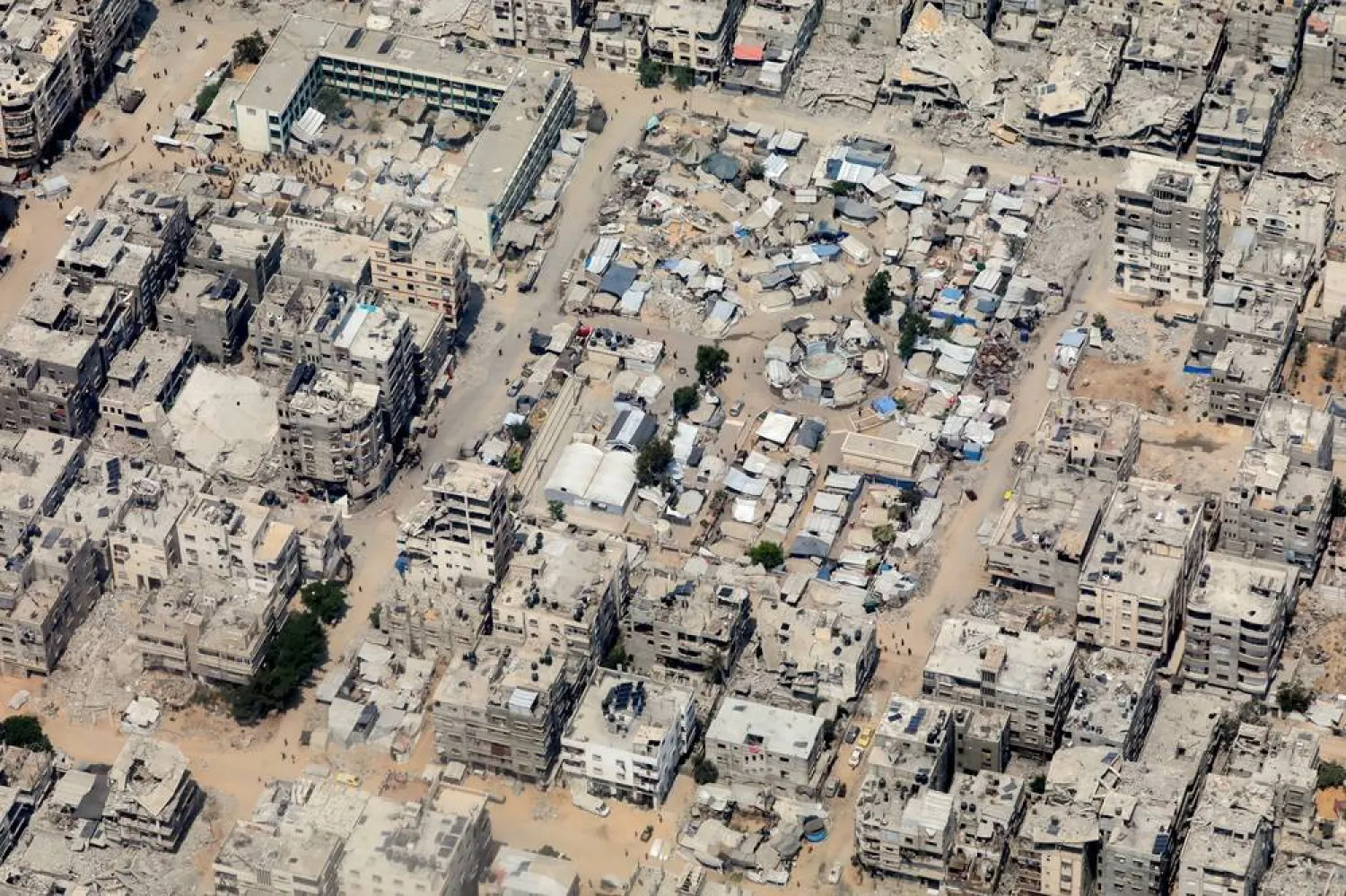
 An aerial view from a Jordanian military aircraft shows the Gaza Strip, before humanitarian aid is airdropped over it, in Gaza, August 9, 2025. (Reuters)
An aerial view from a Jordanian military aircraft shows the Gaza Strip, before humanitarian aid is airdropped over it, in Gaza, August 9, 2025. (Reuters)
TT

Israel Faces Growing Global Condemnation over Military Expansion in Gaza

 An aerial view from a Jordanian military aircraft shows the Gaza Strip, before humanitarian aid is airdropped over it, in Gaza, August 9, 2025. (Reuters)
An aerial view from a Jordanian military aircraft shows the Gaza Strip, before humanitarian aid is airdropped over it, in Gaza, August 9, 2025. (Reuters)

International condemnation grew Saturday over Israel's decision for a military takeover of Gaza City, while little appeared to change immediately on the ground in the territory shattered by 22 months of war.

Health officials said that 11 Palestinians seeking aid were shot dead, and 11 adults died of malnutrition-related causes in the past 24 hours.

US special envoy Steve Witkoff was expected to meet with Qatar’s prime minister in Spain on Saturday to discuss a new proposal to end the war, according to two officials familiar with the talks, who spoke on condition of anonymity because they weren't authorized to speak with the media.

Mediators Egypt and Qatar are preparing a new ceasefire framework that would include the release of all hostages — dead and alive — in one go in return for the war’s end and the withdrawal of Israeli forces, two Arab officials have told The Associated Press.

‘Shut the country down’

Families of hostages were rallying again Saturday evening to pressure the government of Prime Minister Benjamin Netanyahu amid new fears over the 50 remaining hostages, with 20 of them thought to be alive and struggling.

“The living will be murdered and the fallen will be lost forever” if the offensive goes ahead, said Einav Zangauker, whose son Matan is held in Gaza. She called on Israelis to “help us save the hostages, the soldiers and the state of Israel ... Shut the country down.”

A joint statement by nine countries including Germany, Britain, France and Canada said that the “strongly reject” Israel's decision for the large-scale military operation, saying it will worsen the “catastrophic humanitarian situation," endanger hostages and further risk mass displacement. They said any attempts at annexation or settlement in Gaza violate international law.

A separate statement by more than 20 countries including ceasefire mediators Egypt and Qatar along with Saudi Arabia, Türkiye and the United Arab Emirates called Israel's decision a “dangerous and unacceptable escalation.” Meanwhile, Russia said Israel's plan will aggravate the “already extremely dramatic situation” in Gaza.

The UN Security Council planned an emergency meeting Sunday. And Germany has said it won’t authorize any exports of military equipment to Israel that could be used in Gaza until further notice.

Killed while seeking aid

Officials at Nasser and Awda hospitals said that Israeli forces killed at least 11 people seeking aid in southern and central Gaza. Some had been waiting for aid trucks, while others had been approaching aid distribution points.

Israel’s military denied opening fire and said that it was unaware of the incidents. The military secures routes leading to distribution sites run by the Israeli-backed and US-supported Gaza Humanitarian Foundation, which didn't immediately respond to a request for comment.

Two witnesses told the AP that Israeli troops fired toward crowds approaching a GHF distribution site on foot in the Netzarim corridor, a military zone that bisects Gaza. One witness, Ramadan Gaber, said that snipers and tanks fired on aid-seekers, forcing them to retreat.

In Deir al-Balah in central Gaza, some aid-seekers cheered the latest airdrops of aid. Hundreds of people rushed to grab what they could, though many have called the process degrading. Aid organizations have called airdrops expensive, insufficient and potentially dangerous for people on the ground.

Israel's military said that at least 106 packages of aid were airdropped Saturday as Italy and Greece joined the multi-country effort for the first time. Footage from Italy's defense ministry showed not only packages being parachuted over Gaza but the dry and devastated landscape below.

“This way is not for humans, it is for animals,” said one man at the scene, Mahmoud Hawila, who said he was stabbed while trying to secure an airdropped package.

Barefoot children collected rice, pasta and lentils that had spilled from packages onto the ground.

The United Nations and partners, whose existing aid delivery system has been criticized by Israel, has called repeatedly for more of the trucks waiting outside Gaza to be allowed not just into the territory, but safely to destinations inside it for distribution.

More deaths from hunger

Gaza's Health Ministry said that 11 more adults died of malnutrition-related causes over the past 24 hours, bringing the total to 114 since it began counting such adult deaths in late June. It said that 98 children have died of malnutrition-related causes since the war began with the Hamas-led attack on southern Israel on Oct. 7, 2023, with gunmen killing around 1,200 people and abducting 251.

Israel is “forcing Palestinians into a state of near-starvation to the point that they abandon their land voluntarily,” Turkish Foreign Minister Hakan Fidan told a news conference in Egypt.

The toll from hunger isn't included in the ministry's death toll of 61,300 Palestinians in the war. The ministry, part of the Hamas-run government and staffed by medical professionals, doesn't distinguish between fighters or civilians, but says around half of the dead have been women and children. The UN and independent experts consider it the most reliable source on war casualties.

Israel disputes the ministry's figures, but hasn't provided its own.


Rafah Crossing Traffic Lags Two Weeks after Reopening

Humanitarian and relief aid crosses Rafah Crossing (Egyptian Red Crescent)
TT

Rafah Crossing Traffic Lags Two Weeks after Reopening

Humanitarian and relief aid crosses Rafah Crossing (Egyptian Red Crescent)

Despite nearly two weeks since the reopening of the Rafah crossing in both directions, the number of people and humanitarian aid entering the Gaza Strip falls short of what was agreed under the “Gaza ceasefire agreement,” according to an official from the Egyptian Red Crescent in North Sinai.

The daily movement of individuals to and from Gaza does not exceed 50 people, Khaled Zayed, head of the Egyptian Red Crescent in North Sinai, told Asharq Al-Awsat. He said this figure represents only one-third of what was agreed upon in the ceasefire deal.

He added that truck traffic stands at about 100 per day, despite Gaza’s population requiring the entry of around 600 trucks daily.

On Feb. 2, Israel reopened the Rafah crossing on the Palestinian side for individual travel, allowing Palestinians to leave and return to the enclave. Indicators show that most of those departing Gaza are patients and wounded individuals, who are being received at Egyptian hospitals.

This comes as Egyptian Foreign Minister Badr Abdelatty stressed the need to “ensure the unhindered delivery of humanitarian aid and not obstruct movement through the Rafah crossing.”

In his remarks during a ministerial Security Council session on developments in the Middle East on Wednesday, he underscored the importance of “halting all measures aimed at displacing residents or altering the demographic character of the occupied Palestinian territories.”

Israel took control of the Rafah border crossing in May 2024, about nine months after the outbreak of the war in Gaza. The reopening of the crossing was part of the first phase of the ceasefire agreement that entered into force last October, though the deal remains fragile.

The Egyptian Red Crescent announced the departure of the 14th group of wounded, sick, and injured Palestinians arriving and leaving through the crossing.

In a statement on Thursday, it said humanitarian efforts to receive and see off Palestinians include a comprehensive package of relief services, psychological support for children, distribution of suhoor and iftar meals, and heavy clothing, in addition to providing “return bags” for those heading back to Gaza.

At the same time, the Red Crescent dispatched the 142nd “Zad Al-Ezza” convoy, which includes 197,000 food parcels and more than 235 tons of flour as part of the “Iftar for One Million Fasters” campaign in Gaza.

The convoy also carries more than 390 tons of medicines, relief, and personal care supplies, as well as about 760 tons of fuel, according to the organization’s statement.

Zayed said the daily number of individuals crossing through Rafah over the past two weeks does not compare with what was stipulated in the ceasefire agreement.

With the reopening of the Rafah crossing on the Palestinian side, Israel’s Arabic-language public broadcaster Makan reported that 150 people were expected to leave Gaza, including 50 patients, while 50 people would be allowed to enter the enclave.

Despite what he described as Israeli obstacles, Zayed said allowing the movement of individuals and the wounded represents “an unsatisfactory breakthrough in the humanitarian situation in Gaza,” stressing the need to fulfill the ceasefire’s obligations and advance early recovery efforts inside the territory.

The total number of Palestinians who have left through the Rafah crossing since it reopened on both sides does not exceed 1,000, according to Salah Abdel Ati, head of the International Commission to Support Palestinian Rights.

He said around 20,000 wounded and sick Palestinians require urgent evacuation, and that Israeli restrictions are hindering access to medical care, adding that the humanitarian situation requires continued pressure by mediators on Israel.

Abdelatty told Asharq Al-Awsat he was counting on the outcome of the first meeting of the Board of Peace to adopt easing measures, including lifting Israeli restrictions and establishing guarantees for the ceasefire in the Palestinian territories, as well as securing the funding needed for Gaza’s early recovery, in line with US President Donald Trump’s peace plan for the enclave.

According to a statement by the Egyptian Red Crescent, Egypt continues relief efforts at all logistical hubs to facilitate the entry of humanitarian aid, which has exceeded 800,000 tons, with the participation of more than 65,000 volunteers from the Egyptian Red Crescent.


US Slaps Sanctions on Sudan’s RSF Commanders over El-Fasher Killings

FILE - A Sudanese child, who fled el-Fasher city with family after Sudan's RSF attacked the western Darfur region, receives treatment at a camp in Tawila, Sudan, Nov. 2, 2025. (AP Photo/Mohammed Abaker, File)
TT

US Slaps Sanctions on Sudan’s RSF Commanders over El-Fasher Killings

FILE - A Sudanese child, who fled el-Fasher city with family after Sudan's RSF attacked the western Darfur region, receives treatment at a camp in Tawila, Sudan, Nov. 2, 2025. (AP Photo/Mohammed Abaker, File)

The United States announced sanctions on Thursday on three Sudanese Rapid Support Forces (RSF) commanders over their roles in the "horrific campaign" of the siege and capture of El-Fasher.

The US Treasury said the RSF carried out "ethnic killings, torture, starvation, and sexual violence" in the operation.

Earlier Thursday, the UN's independent fact-finding mission on Sudan said the siege and seizure of the city in Darfur bore "the hallmarks of genocide."

Its investigation concluded that the seizure last October had inflicted "three days of absolute horror," and called for those responsible to be brought to justice.

"The United States calls on the Rapid Support Forces to commit to a humanitarian ceasefire immediately," US Treasury Secretary Scott Bessent said in a statement.

"We will not tolerate this ongoing campaign of terror and senseless killing in Sudan."

The Treasury noted that the three sanctioned individuals were part of the RSF's 18-month siege of and eventual capture of El-Fasher.

They are RSF Brigadier General Elfateh Abdullah Idris Adam, Major General Gedo Hamdan Ahmed Mohamed and field commander Tijani Ibrahim Moussa Mohamed.

Bessent warned that Sudan's civil war risks further destabilizing the region, "creating conditions for terrorist groups to grow and threaten the safety and interests of the United States."

The UN probe into the takeover of El-Fasher -- after the 18-month siege -- concluded that thousands of people, particularly from the Zaghawa ethnic group, "were killed, raped or disappeared."


Israel's Netanyahu Says No Reconstruction of Gaza before Demilitarization

Israel’s Prime Minister Benjamin Netanyahu - File Photo/AFP
TT

Israel's Netanyahu Says No Reconstruction of Gaza before Demilitarization

Israel’s Prime Minister Benjamin Netanyahu - File Photo/AFP

Israeli Prime Minister Benjamin Netanyahu said on Thursday there would be no reconstruction of war-shattered Gaza before the disarmament of Hamas, as the "Board of Peace" convened for its inaugural meeting in Washington.

Around two dozen world leaders and senior officials met for the first meeting of the board, which was set up after the United States, Qatar and Egypt negotiated a ceasefire in October to halt two years of war in the Gaza Strip.

"We agreed with our ally the US there will be no reconstruction of Gaza before the demilitarization of Gaza," Netanyahu said during a televised speech at a military ceremony on Thursday, AFP reported.

The meeting in Washington will also look at how to launch the International Stabilization Force (ISF) that will ensure security in Gaza.

One of the most sensitive issues before the board is the future of the Islamist movement Hamas, which fought the war with Israel and still exerts influence in the territory.

Disarmament of the group is a central Israeli demand and a key point in negotiations over the ceasefire's next stage.

US officials including Steve Witkoff, Trump's friend and roving negotiator, have insisted that solid progress is being made and that Hamas is feeling pressure to give up weapons.

Israel has suggested sweeping restrictions including seizing small personal rifles from Hamas.

It remains unclear whether, or how, the Palestinian technocratic committee formed to handle day-to-day governance of Gaza will address the issue of demilitarization.

The 15-member National Committee for the Administration of Gaza (NCAG) will operate under the supervision of the "Board of Peace", and its head, Ali Shaath, is attending the meeting in Washington on Thursday.
