Syria, Jordan, US Agree to Back Ceasefire Enforcement in Sweida

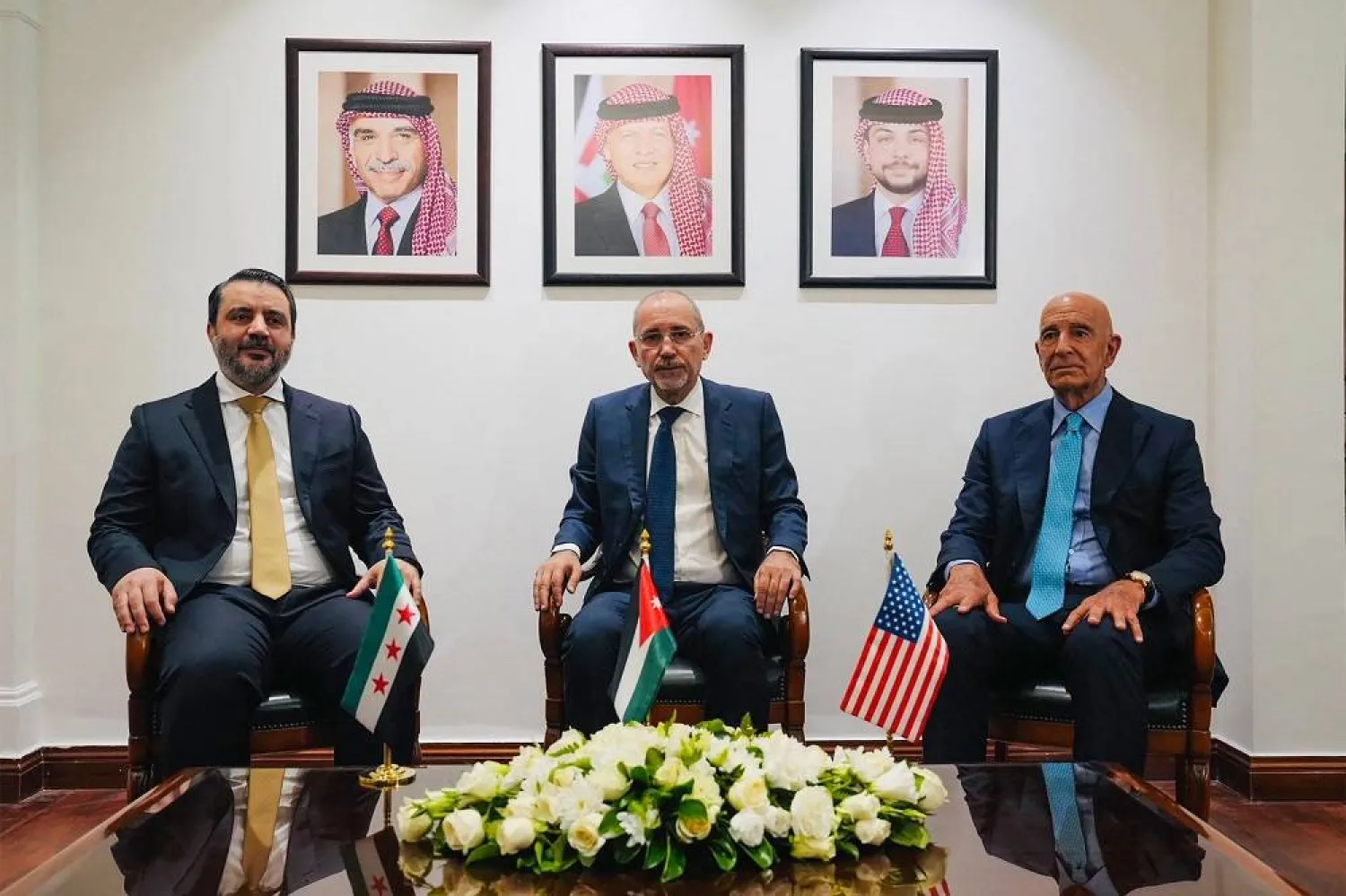
This handout picture released by the Jordanian Foreign Ministry shows (L to R) Syria's interim Foreign Minister Asaad al-Shaibani, Jordan's Foreign Minister Ayman Safadi, and US special envoy for Syria Tom Barrack meeting in Amman on August 12, 2025. (Jordanian Foreign Ministry / AFP)
TT

Syria, Jordan, US Agree to Back Ceasefire Enforcement in Sweida

This handout picture released by the Jordanian Foreign Ministry shows (L to R) Syria's interim Foreign Minister Asaad al-Shaibani, Jordan's Foreign Minister Ayman Safadi, and US special envoy for Syria Tom Barrack meeting in Amman on August 12, 2025. (Jordanian Foreign Ministry / AFP)

Syria, Jordan and the United States agreed on Tuesday to form a joint task force to support Damascus’ efforts to uphold a ceasefire in the Sweida province in southern Syria and end the crisis there, the three countries said in a joint statement.

The agreement was reached during talks in Jordan between Syrian Foreign Minister Asaad al-Shaibani, his Jordanian counterpart Ayman Safadi, and US special envoy to Syria Tom Barrack, the statement said.

The meeting discussed ways to help rebuild Syria “on foundations that guarantee its security, stability, sovereignty, unity and non-interference in its internal affairs.”

Jordan and the United States welcomed Damascus’ steps, including “full investigations and holding all perpetrators of crimes and violations in Sweida accountable” and its readiness to cooperate with relevant UN agencies in the probe, the Syrian foreign ministry said.

They also praised Syria’s moves to expand humanitarian aid access to all areas of Sweida, restore disrupted services, start community reconciliation, and promote civil peace.

Both countries reiterated their “full solidarity” with Syria’s security, stability, sovereignty and territorial integrity. Sweida and its communities were an “integral part of Syria” whose residents’ rights must be preserved in the rebuilding process, the statement said.

The three sides agreed to meet again in the coming weeks to continue Tuesday’s discussions.

Barrack said on X: “Syria remains steadfastly committed to a united process that honors and protects all its constituencies, fostering a shared future for the Syrian people despite intervening forces seeking to disrupt and displace its communities.”

“Delivering justice and ending impunity are paramount to achieving lasting peace,” he stressed.

“The Syrian government has pledged to utilize all resources to hold perpetrators of the Sweida atrocities accountable, ensuring no one escapes justice for violations against its citizens,” he added. “Syria will fully cooperate with the UN to investigate these crimes.”

During a meeting with Shaibani, Safadi reaffirmed Jordan’s rejection of foreign interference in Syria and its support for the country’s security, sovereignty and territorial integrity, according to a Jordanian foreign ministry statement.

The FMs condemned repeated Israeli air strikes and incursions into Syria, calling them a “flagrant violation of international law” that threatened regional stability.

They discussed efforts to cement the Sweida truce, agreed last month after violence between armed groups in the mainly Druze province killed hundreds.

On X, Shaibani said Syria was committed to protecting Sweida’s Druze, Bedouin and Christian residents and to countering any sectarian or inciting rhetoric. “Our Druze people are an integral part of Syria... we reject any attempt to marginalize them under any pretext,” he said.

He pledged accountability for all violations in Sweida “regardless of the party involved,” saying justice was essential to building a state governed by law.


Netanyahu Says Extensive West Bank Military Operation ‘On the Way’ After Attack

Israeli Prime Minister Benjamin Netanyahu speaks during a toast-raising event hosted by his Likud party, in Tel Aviv, Israel, September 17, 2026. REUTERS/Amir Cohen
TT

Netanyahu Says Extensive West Bank Military Operation ‘On the Way’ After Attack

Israeli Prime Minister Benjamin Netanyahu speaks during a toast-raising event hosted by his Likud party, in Tel Aviv, Israel, September 17, 2026. REUTERS/Amir Cohen

Israeli Prime Minister Benjamin Netanyahu on Friday warned of an imminent large-scale military operation in the West Bank and vowed to displace some residents of Hebron after Palestinian gunmen killed two soldiers in an attack. The prime minister’s office also said it had instructed the army to close off the occupied West Bank, where the shooting occurred.

The attack, which happened at a checkpoint near the Palestinian city in the southern occupied West Bank, also left three soldiers wounded. It came days before Israeli elections in which Netanyahu is facing a tight race.

The two gunmen who carried out the attack were killed in a shootout with soldiers.

In a visit to Hebron after the attack, Netanyahu said Israeli forces would enter the neighborhood of the attackers and displace its residents.

"We will evacuate the residents, we will go from house to house, we will also seize the weapons there, and all the terrorist infrastructure will be dealt with and destroyed," Netanyahu said, according to his office.

"The defense minister and I are considering a very extensive (army) operation in Judea and Samaria, such as has not been carried out since the Six Day War," Netanyahu added, referring to the 1967 Arab-Israeli war.

"The army is ready to execute it and we will set the timing, but it is on the way."

He said the military would apply a model previously used in refugee camps in the northern West Bank. A large-scale military operation dubbed "Iron Wall" launched in January 2025 forcibly displaced tens of thousands of people across several refugee camps, according to the UN rights office.

As of July this year, 33,362 Palestinian refugees displaced from the three camps had not been permitted to return, according to the UN.

Nearly two years on, Israel's military remains present in Jenin refugee camp, which before Iron Wall was a bastion of armed Palestinian militants fighting Israeli occupation.

The army also remains in two refugee camps in the nearby city of Tulkarem.

In all three camps the army demolished dozens of houses in the dense patchwork of alleys in order to ease access for its troops and armoured vehicles, the military said, and set up operational centres for troops in the homes of residents.

"The Jenin refugee camp model is on its way to Hebron," Israeli Defense Minister Israel Katz said on X Friday.

"Every clan neighborhood in Hebron from which the terrorists emerged today will be evacuated of its residents, and the terror infrastructure in the neighborhood will be addressed and dismantled," he said, referring to the large families, or clans, that hold much influence in the city of Hebron.


Houthis Deplete Motorcycle Market for Military Use

Yemenis on their motorcycles at a market in Sanaa (Asharq Al-Awsat)
TT

Houthis Deplete Motorcycle Market for Military Use

Yemenis on their motorcycles at a market in Sanaa (Asharq Al-Awsat)

As living conditions deteriorate and job opportunities shrink in Houthi-controlled areas of Yemen, the group is stepping up purchases of motorcycles from markets in Sanaa and other cities for distribution to its militants on the front lines, driving up prices and making the vehicles increasingly unaffordable for young people who depend on them for their livelihoods.

Informed sources in Sanaa told Asharq Al-Awsat that the Houthis had allocated funds to purchase hundreds of motorcycles over the past two weeks in Sanaa, Amran, Hodeidah, Dhamar and Ibb for use in military operations.

The sources said increased demand had pushed up prices and reduced supply, making it harder for residents, particularly workers and low-income young people, to purchase motorcycles and earn enough to support their families.

According to the sources, the move followed the group's failure to recruit a number of motorcycle owners and riders in Sanaa and other cities, prompting it to buy the vehicles directly from local markets and distribute them to its militants for use on the front lines.

The sources linked the intensified purchases to airstrikes targeting Houthi reinforcements and vehicles in recent weeks, as well as severe fuel shortages.

They said motorcycles allow militants to travel through ravines, dry riverbeds and rugged terrain that heavy military vehicles struggle to navigate. They are also used to transport militants and supplies to the front lines and evacuate the dead and wounded.

The use of motorcycles in combat operations is not new for the Houthis. The group has relied on them across several fronts throughout the years of war, taking advantage of their small size and maneuverability.

According to the sources, motorcycles continue to be used on the Taiz, Al-Dhalea and western coast fronts, while the Houthis seek to acquire additional vehicles to support their military movements.

New Competition for a Source of Livelihood

The Houthi purchases have created new competition for a vehicle that many residents consider an affordable means of earning a living, at a time when employment opportunities are dwindling and living costs are rising.

Residents of Sanaa told Asharq Al-Awsat that motorcycles are more than a means of transportation. They represent an investment in small businesses and a direct source of income, whether through delivery services, transporting goods or commuting to work.

They warned that rising prices threaten to deprive more young people and workers of employment opportunities that depend on motorcycle ownership.

A motorcycle showroom owner in southern Sanaa said Houthi supervisors had purchased dozens of motorcycles from his business over the past two weeks.

Speaking to Asharq Al-Awsat on condition of anonymity, the owner said motorcycle prices ranged from 280,000 to 500,000 Yemeni rials per vehicle, depending on the model and specifications. The exchange rate imposed by the Houthis stands at approximately 530 rials to the US dollar.

He added that demand had increased in recent days as the group intensified efforts to supply its front-line forces.

The showroom owner said the surge in purchases had driven up prices and further weakened the ability of residents, particularly low-income young people, to acquire motorcycles and use them to support their families.

For many, he added, securing the initial capital needed to start even a small business has become increasingly difficult.


Arab League Strongly Denounces Houthi Attacks on Dammam Airport, Shaybah Oil Field

Arab League Strongly Denounces Houthi Attacks on Dammam Airport, Shaybah Oil Field
TT

Arab League Strongly Denounces Houthi Attacks on Dammam Airport, Shaybah Oil Field

Arab League Strongly Denounces Houthi Attacks on Dammam Airport, Shaybah Oil Field

The Arab League strongly rejected the attacks launched by the Houthi militia targeting King Fahd International Airport in Dammam and the Shaybah oil field in Eastern Region, which resulted in casualties, injuries, and material damage to the targeted facilities.

In a statement issued today, the Arab League affirmed its categorical rejection of continued Houthi attacks on Saudi territory, describing them as a violation of the Kingdom's sovereignty and a direct threat to its security, stability, and the safety of citizens and residents, SPA reported.

The league stressed that the repeated targeting of airports, oil facilities, and civilian infrastructure constitutes a highly dangerous escalation threatening civil aviation safety and energy security.

Reiterating its full solidarity with the Kingdom, the Arab League affirmed its support for all measures taken to safeguard Saudi security, sovereignty, and territorial integrity, emphasizing that the Kingdom's security is an integral part of collective Arab security.

It called on the international community to assume its responsibilities to halt these attacks and prevent their recurrence, extending sincere condolences to the families of the victims and wishing a speedy recovery to the injured.