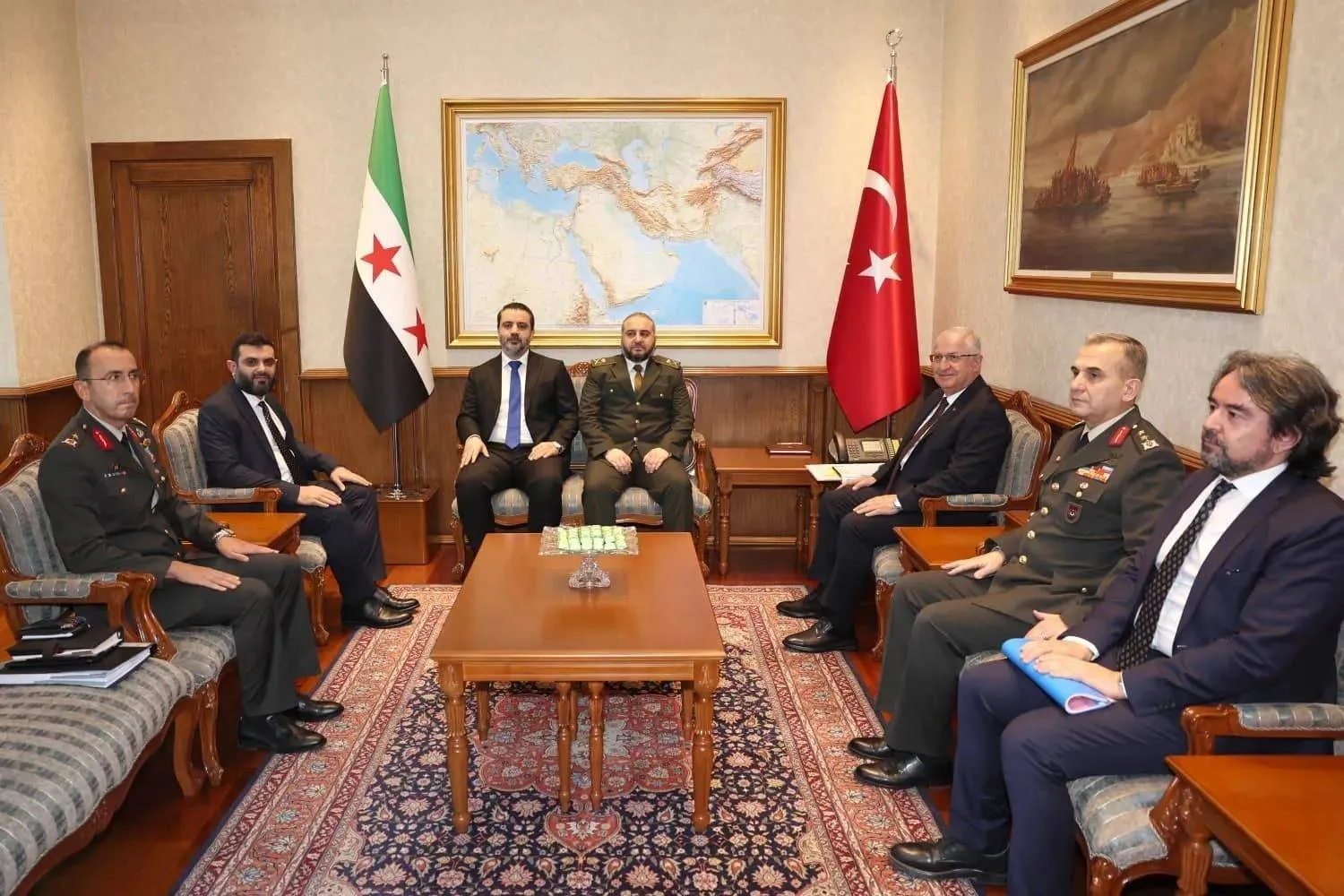
Türkiye to Equip, Train Syrian Army Under New Defense Pact

Turkish defense minister meets Syrian defense, foreign and intelligence chiefs in Ankara (Turkish Defense Ministry on X)
TT

Türkiye to Equip, Train Syrian Army Under New Defense Pact

Turkish defense minister meets Syrian defense, foreign and intelligence chiefs in Ankara (Turkish Defense Ministry on X)

Türkiye has pledged to support Syria in its fight against terrorism and to bolster its defense and security capabilities under a newly signed military cooperation agreement, a senior Turkish defense official said on Thursday.

The memorandum of understanding, signed in Ankara on Wednesday by Turkish Defense Minister Yasar Guler and his Syrian counterpart Merhaf Abu Qasra, provides for the supply of weapons systems, logistical equipment and, if needed, military advice to the Syrian army on their use, the official told a weekly ministry briefing.

“Thanks to the knowledge and expertise of our armed forces, we will continue to support Syria in its war on terror and in strengthening its defensive and security capabilities,” the official said, calling the agreement “another important step” in defense cooperation with Damascus.

The deal sets out plans for joint military training, intelligence sharing, procurement of weapons and related logistics, as well as technical assistance and specialized training in areas such as counter-terrorism, demining, cyber defense, military engineering, logistics and peacekeeping, according to the Turkish and Syrian defense ministries.

The signing, attended by Syrian Foreign Minister Assad al-Shibani and intelligence chief Hussein Salameh, followed months of negotiations and earlier talks between the Syrian delegation and Turkish Foreign Minister Hakan Fidan.

Discussions touched on developments in Syria, unrest in Sweida, and the refusal of the Kurdish-led Syrian Democratic Forces (SDF) to implement a March 10 deal with Damascus to integrate into state institutions.

Warning to Kurdish-led forces

The Turkish defense official accused the SDF – which Ankara regards as a terrorist organization linked to the outlawed Kurdistan Workers’ Party (PKK) and which is backed by the United States – of violating all terms of the March agreement and undermining Syria’s political unity and territorial integrity.

“The separatist rhetoric voiced by the SDF at a conference in Hasaka on Aug. 8 contradicts the agreement with the Syrian government,” the official said, in Türkiye’s first formal response to the meeting held by the Autonomous Administration of North and East Syria under the banner “Conference for Unity of Stance.”

He said Damascus had taken a comprehensive approach to ending ethnic, religious and sectarian divisions, but that the SDF’s “provocative and divisive behavior” was obstructing that process.

“We expect the SDF to fully comply with the agreement signed with Damascus and to implement it swiftly on the ground to build a stable, peaceful, safe and terrorism-free Syria,” he added. “From the start, we have defended Syria’s political unity and territorial integrity, and this memorandum reinforces that commitment.”

Fidan, speaking alongside Shibani at a news conference in Ankara on Wednesday, also warned the SDF against “buying time,” saying Türkiye would not remain idle in the face of unaddressed security concerns.

Turkish sources revealed that Ankara does not plan a direct military operation against the SDF but will back any Syrian army action, and has conveyed that position to Washington.

Syrian refugee returns

In a separate update, Turkish authorities said 411,000 Syrian refugees had voluntarily returned home since the fall of President Bashar al-Assad’s government on Dec. 8, 2024.

Since 2016, a total of about 1.15 million Syrians have gone back voluntarily, reducing the number of Syrians in Türkiye under temporary protection to 2.54 million, official figures showed.


Gaza Aid Flotilla Says Israeli Forces Intercepted 10 Boats, Contact Lost with 23 Vessels

Boats belonging to the Global Sumud Flotilla, carrying activists and humanitarian aid, depart for Gaza from the port of Marmaris, Türkiye, Thursday, May 14, 2026, in an attempt to break the Israeli naval blockade. (AP)
TT

Gaza Aid Flotilla Says Israeli Forces Intercepted 10 Boats, Contact Lost with 23 Vessels

Boats belonging to the Global Sumud Flotilla, carrying activists and humanitarian aid, depart for Gaza from the port of Marmaris, Türkiye, Thursday, May 14, 2026, in an attempt to break the Israeli naval blockade. (AP)

The organizers of a flotilla of aid vessels bound for Gaza said on Monday that Israeli forces had intercepted 10 of their boats and that contact had been lost with a total 23 vessels in the eastern Mediterranean. 

Earlier on Monday, Israel's foreign ministry had said on X that it "will not allow any breach of the lawful naval blockade on Gaza".  

Ships from the Global Sumud Flotilla ‌had set sail ‌for a third time on Thursday from southern Türkiye, ‌after ⁠earlier attempts to deliver ⁠aid to Gaza were intercepted by Israel in international waters. 

Live video showed military vessels approaching the vessels on Monday. 

"Military vessels are currently intercepting our fleet and (Israeli) forces are boarding the first of our boats in broad daylight," the Global Sumud Flotilla initially said on X. 

"We demand safe passage for our legal, non-violent humanitarian mission." 

The group said 10 boats had been ⁠intercepted and contact lost with 23 of the 54 vessels ‌in the flotilla, naming some two dozen ‌Turks among those on the intercepted vessels, some 250 nautical miles (463 km) from ‌Gaza. It said there were 426 people taking part in the flotilla ‌from 39 countries.  

Israel's foreign ministry also called on "all participants in this provocation to change course and turn back immediately".  

The previous flotilla departed from Spain on April 12. But Israeli forces intercepted vessels in that group, taking more than 100 pro-Palestinian ‌activists to Crete and detaining two others in Israel. 

Last October, Israel's military halted another flotilla assembled by the same ⁠organization, arresting ⁠Swedish activist Greta Thunberg and more than 450 participants. 

Palestinians and international aid bodies, along with Türkiye and a number of other countries, say supplies reaching Gaza are still insufficient, despite a ceasefire reached in October that included guarantees of increased aid. 

Most of Gaza's more than 2 million people have been displaced, many now living in bombed-out homes and makeshift tents pitched on open ground, roadsides, or atop the ruins of destroyed buildings. 

Israel, which controls all access to the Gaza Strip, denies withholding supplies for its residents. Its foreign ministry said more than 1.58 million tons of humanitarian aid and thousands of tons of medical supplies have entered Gaza since October 2025. 


Carrying Gaza Children's Dreams to the Top of the World

Hundreds of thousands of people are still living in tents in the Gaza Strip, pictured in January, and conditions remain dire despite the ceasefire. Bashar Taleb / AFP/File
TT

Carrying Gaza Children's Dreams to the Top of the World

Hundreds of thousands of people are still living in tents in the Gaza Strip, pictured in January, and conditions remain dire despite the ceasefire. Bashar Taleb / AFP/File

Climber Mostafa Salameh is carrying a kite scribbled with dreams of Gaza's children to the summit of Mount Everest, seeking to raise awareness of the war's toll on its youngest victims.

Tucked among his expedition gear is the kite in red, black, white and green of the Palestinian flag, marked with handwritten messages from children in the battered territory.

The war, sparked by Hamas's October 2023 attack on Israel, has killed more than 72,000 people in Gaza, according to the territory's health ministry which operates under Hamas authority.

The simple wishes -- shaped by loss, grief and displacement -- reflect hope for a future beyond conflict.

Palestinian-Jordanian Salameh, 56, also wants to raise $10 million for the UK-based charity Al-Khair Foundation, which provides nutrition, sanitation, shelter and psychological support to Gazans.

"We have all these dreams of the children of Gaza that's going to go up to the top of the world because they can't do anything now in Gaza," Salameh told AFP in a video interview.

"They don't have homes or education. Everything is being done in a tent. And they don't have access to clean water, proper food or proper medication," said the mountaineer, who met the children at the Rafah border after they crossed into Egypt.

The war has displaced nearly Gaza's entire population and reduced swathes of the Palestinian territory to rubble.

Hundreds of thousands of people are still living in tents and conditions remain dire despite a ceasefire that took effect in October last year.

For Salameh, the expedition hopes to shine a light on the plight of the children and amplify their voices.

"The whole world is closing their eyes when it comes to Palestine," said Salameh, who hopes to make the summit before the spring climbing season wraps up in the next few weeks.

"It's about awareness on what these children are going through and at the same time to raise money."

The messages inscribed on the kite reflect both ambition and grief -- children hoping to become doctors or engineers to rebuild their shattered homes, alongside stark reminders of loss.

One girl, Munira, asked Salameh to write the number 47 on the kite.

"I said, what is number 47? And she replied that it was the number of all her family members who have been killed," he said.

- 'A little change' -

Born in Kuwait to Palestinian parents and raised in a refugee camp, Salameh's own journey has been shaped by struggle and determination.

He was working at a hotel in Edinburgh in 2004, pursuing a career in hospitality, when a vivid dream changed his life.

He saw that he was standing on the top of Everest, reciting the azan, the Islamic call to prayer.

"This is where the journey started. I had never climbed a mountain in my life before that," he said.

He made his first attempt to scale the world's highest peak a year later at the age of 35. But he made it to the summit only on his third attempt in 2008.

Since then, he has completed the Explorer's Grand Slam -- a challenge that involves climbing the highest peaks on each continent and skiing to both the North and South Poles.

Many of his expeditions have been for a purpose -- raising funds for Syria, blind children and cancer patients.

Although he had vowed not to return to the Everest, the war in Gaza became the motivation that he needed.

"I'm a Jordanian originally, my family is from Palestine, and I relate to what these kids are going through," he said.

After nine months of preparation, Salameh is hoping the climb will result in something both symbolic and tangible.

"When you have some cause that you really believe in, in your heart and soul and mind, I think it can push you to go and do it," he said.

"If we can make a little change, I would be happy."

Beyond the summit, his ambitions remain rooted in a broader aspiration.

"My dream is to see Palestine free one day and that we can go and visit."


Is Anger at Iran Beginning to Spread Among Lebanon’s Shiites?

A woman carries the body of six-month-old Mariam Fahs during her funeral after she was killed in an Israeli strike on the town of Saksakiyeh (AP) 
TT

Is Anger at Iran Beginning to Spread Among Lebanon’s Shiites?

A woman carries the body of six-month-old Mariam Fahs during her funeral after she was killed in an Israeli strike on the town of Saksakiyeh (AP) 

Growing frustration is emerging within Lebanon’s Shiite community, extending beyond the traditional political discourse of Hezbollah and the Amal Movement to target Iran directly, as many residents feel the war launched in support of Tehran ended in the destruction of their villages, the displacement of their families and the loss of their loved ones.

The discontent has become increasingly visible on social media, particularly among supporters of the Amal Movement led by Parliament Speaker Nabih Berri, as well as among Hezbollah supporters, with ideological and political slogans no longer able to contain the scale of anger and despair.

The growing resentment comes despite continued statements by Hezbollah officials thanking Iran and emphasizing its role in supporting the “resistance,” while also relying on Tehran to pressure for a ceasefire.

But a large segment of the Shiite community now sees a contradiction between that rhetoric and daily reality, as tens of thousands of displaced people endure harsh humanitarian conditions with no clear prospect of return or reconstruction.

Ideological rhetoric meets southern anger

In that context, remarks by Hezbollah-affiliated cleric Sheikh Assad Qasir sparked widespread debate after he said that “preserving the Islamic Republic in Iran is a religious duty that takes precedence over preserving individuals because it constitutes a guarantee for preserving Islam itself.”

Qasir based his remarks on ideas attributed to Iran’s late supreme leader Khomeini and on the concept of sacrifice embodied in the battle of Karbala. But the rhetoric prompted angry reactions from many residents who increasingly view the war through the lens of their human and material losses.

Zeinab, a displaced woman from southern Lebanon, said: “The war was launched under the slogan of supporting Iran, but today we feel we were left alone. Even Hezbollah and Amal MPs do not ask about the people living in displacement centers.”

She added: “I feel dying under the roof of our home would be easier than the life of displacement we are living today. We can no longer endure this psychological and economic suffering, and nobody feels what we are going through.”

‘The south matters more than all conflicts’

Mona, a mother of two renting a home in Mount Lebanon, said the experience of recent months had changed the convictions of many within the pro-resistance environment.

“The war started under major slogans, but the result was the destruction of our villages, the loss of our young men and the displacement of our families. Today people feel anguish for the south more than anything else,” she remarked.

She added bitterly: “Many have reached the conclusion that the south and its people matter more than all regional conflicts. People in the south are now saying: let Iran and the whole world burn, as long as the south survives.”

Collapse of the ‘single axis’ slogan

Umm Mohammed also expressed deep disappointment with the idea of the “single axis.”

“For years they told us we were one axis and that we had to support every battle fought by this axis. But when war came upon us, we felt we were alone,” she said.

She continued: “Tehran said it would not enter negotiations before a ceasefire in Lebanon, then later said the ceasefire agreement was reached through negotiations with America, while Israeli bombardment and occupation continue expanding every day.”

The state option

Like many Lebanese, Leila called for supporting the Lebanese state in pursuing direct negotiations with Israel to end the war.

“Iran works for its own interests, and that is its right, but why don’t we also think about the interests of our people and our country?” she asked. “We are tired of waiting and of tying the fate of the south to the calculations of other countries.”

She stressed that many people now demand that the Lebanese state alone manage negotiations and the war file because the current situation means “more destruction and losses without any clear horizon.”

Anger over declining Iranian support

Political analyst Ali al-Amin spoke of “a clear shift” within the Shiite community in its perception of Iran and growing feelings of anger and disappointment among Hezbollah supporters over developments in southern Lebanon.

Al-Amin told Asharq Al-Awsat that Iranian influence was not based solely on sectarian or political ties, but also on the network of support and services provided by Hezbollah with Iranian backing, which for years represented a source of security for many families.

He said that feeling had weakened amid scenes of destroyed southern villages, displaced residents and mounting casualties, while many people no longer saw Iranian support commensurate with the scale of the losses.

According to Al-Amin, a large part of Hezbollah’s support base is now questioning why Iran has not responded directly or exerted real military pressure on Israel despite repeated talk of the “unity of fronts” and Iran’s missile capabilities.

“This reality has generated a feeling among some that Iran uses Hezbollah and the Shiite community within its regional calculations without being prepared to pay a real price to protect Lebanon or curb the ongoing war and destruction,” he remarked.

He added that the disappointment had opened the door to unprecedented criticism within the Shiite community of Iran’s role and policies, which some believe serve the interests of the Iranian regime more than those of Lebanese in the south.

“Iran said the ceasefire in Lebanon came as a result of an agreement with America in Islamabad,” Al-Amin said. “So if Israel violated the ceasefire, Iran should also abandon the ceasefire and pressure Israel at least to stop its attacks and expansion and reduce the displacement of residents from dozens of southern villages.”